An Open Letter To The Catholic Church
The Book of Revelation gives the devil one of his oldest titles. He is called the accuser of the brethren, the one who brings charges…
An Open Letter To The Catholic Church
The Book of Revelation gives the devil one of his oldest titles. He is called the accuser of the brethren, the one who brings charges against them before God day and night. The title is not to be made light of. Christian tradition — both Catholic and Protestant — has always understood false accusation as a participation, however large or small, in the devil’s own work. To invent charges against an innocent person is a grave sin, and is to imitate, at the human scale, the prince of lies himself.
Thomas Aquinas, in the Summa, distinguishes detraction, which is the underhanded circulation of a neighbor’s legitimate faults or sins without good reason, from the far graver sin of inventing faults that don’t exist. Both damage the victim’s good name, and Aquinas, in the theme of Proverbs, insists that a good name is worth far more than great riches. A stolen purse may be returned, but a stolen reputation generally cannot be restored.
The Catechism of the Catholic Church, in paragraphs 2477 through 2479, carries the same teaching forward nearly unaltered. It names three specific sins against the truth: rash judgment, detraction, and calumny. Calumny, the last and gravest of the three, is defined as statements “contrary to the truth” that harm the reputation of a neighbor and lead others to false judgments. Simply, it is the action of inventing a slanderous story about someone else based purely on your sinful desire to see them incriminated (or some other equally depraved motive). The Catechism states plainly that restitution is required of the calumniator. I will admit, as a Presbyterian, that I find Rome’s formulation of this prohibition very admirable. My own Westminster treats calumny with the same sobriety and reaches the same conclusion, but Rome’s version is clearer, shorter, and quite useful in several twenty-first century situations.
I am writing this because a case now sits before the Church that the Church has so far declined to address.
In September of last year, Charlie Kirk was murdered by a gunman at Utah Valley University. The man accused of killing him, Tyler Robinson, is in federal custody and has apparently confessed multiple times. His fingerprints are all over the rooftop Charlie was shot from, he has motive, and he possessed the capability to do the crime. The evidence against him is quite strong.
But since that tragic September afternoon, conservative commentator Candace Owens, who was received into the Catholic Church in April of 2024 and who ends nearly every broadcast with the words “Christ is King,” has used her gigantic platform of several million followers to wildly hurl accusations of complicity in his death at Israel, the French government, the Turning Point team, Babylon Bee CEO Seth Dillon, and even Erika Kirk herself. She has offered no evidence against any of them that would survive any level of serious scrutiny. She has been corrected publicly and privately. She has even been issued a cease-and-desist order from Turning Point. Despite this, Candace has brazenly continued, and the apparently malicious accusations have grown more specific and more frequent with time. She is now producing a hit docuseries on YouTube called “Bride of Charlie”, with the goal of implicating Erika Kirk in every crime from the fall of man to Charlie’s death.
I’m not going to rehearse the specific claims here. Anyone who wishes to examine them can, and the examination is not edifying. What I want to address is what the Christian tradition calls this kind of speech, and what the Catholic Church has said, for centuries, about the obligation to respond to it.
The first question is what we ought to call it. Candace and her defenders have preferred the phrase “just asking questions.” This term has become far too common in the wider swathes of the conservative podcast world. It allows the speaker to make a claim via implication while denying responsibility for the truth value of the claim. But the Christian tradition has never been fooled by this kind of fraudulent idiocy. Anyone with a responsibility to uphold the truth who hides behind this specific variant of careful phrasing is still a liar and a coward, and sometimes a worse one, because he or she adds pretended innocence to the original falsehood. The Catechism’s definition of calumny doesn’t exempt this pseudo-interrogative mood adopted by many media figures, including Candace Owens. A false accusation wrapped in a thousand questions with slanderous implications is still a false accusation, and the listener has been deceived. By the Church’s own standard, what Candace Owens has done is not detraction. It is calumny, pure and simple, broadcast at massive scale.
The second question is what the Church ought to do when one of her own members persists in this kind of speech. The Catholics are not without tools. The 1983 Code of Canon Law, as revised in 2021, addresses calumny directly. Canon 1390 §2 says that a person who “unlawfully injures the good name of another” is to be punished under Canon 1336, which lists corrective measures ranging from a private warning to the temporary withholding of the sacraments. Canon 1390 §3 adds, plainly, that the calumniator must be compelled to make amends or restitution of some method. Canon 1399 authorizes the Church to address public scandals when necessity requires it. These tools exist for cases like this one: a Catholic who publicly damages a neighbor’s reputation, who uses her membership in the Church as part of her public identity, and whose conduct becomes, if left unaddressed, a public scandal: a direct contradiction of the faith she claims.
So here’s what Catholic readers ought to ask, and that I am asking in their place with appropriate deference: where on earth is her bishop?
As far as I can tell, the Diocese of Nashville, in which Candace now resides, has taken no action. Neither has the Archdiocese of Westminster, which received her into the Church. Bishop J. Mark Spalding is the head of her current diocese. Despite my email being opened upwards of twelve times in the first few days, his office did not respond to my request for comment.
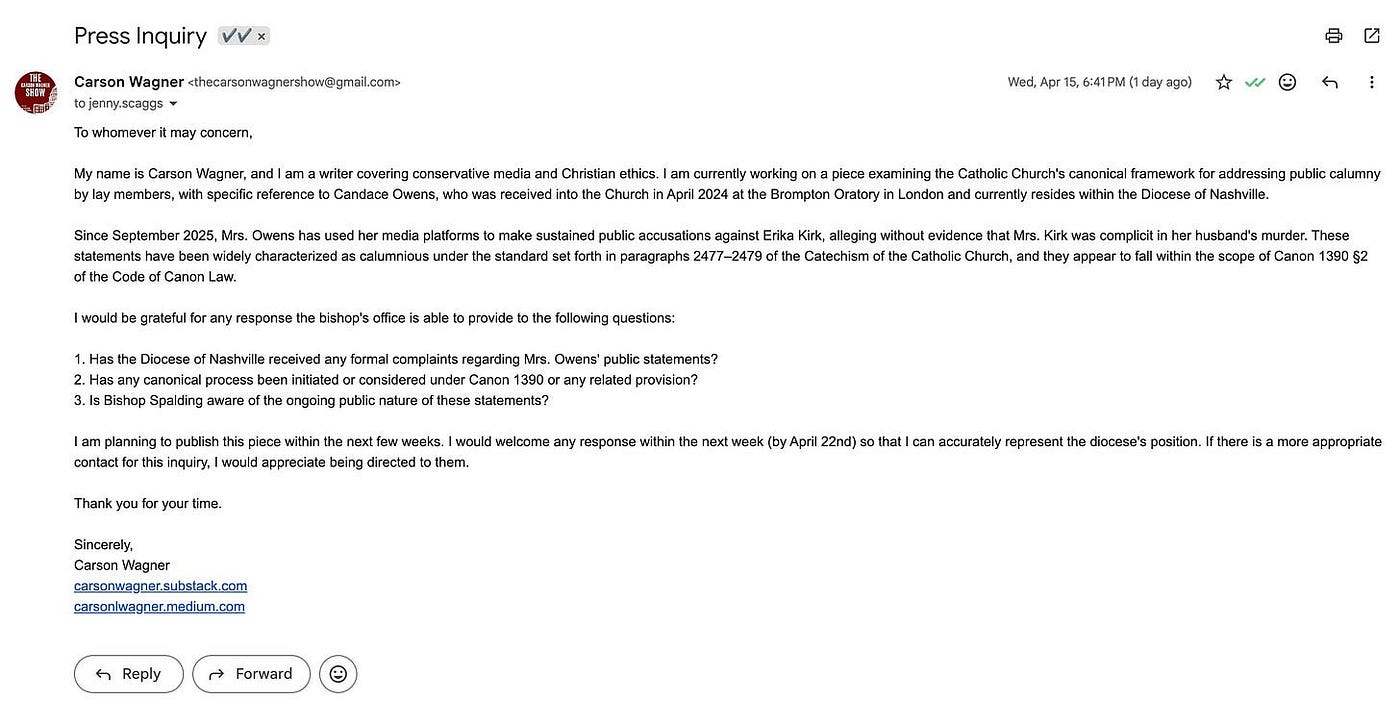
My email to the Diocese of Nashville bishop’s office on April 15th (weeks ago)
The Christian teaching on calumny is not obscure. Augustine taught it, Aquinas taught it, Trent carried it forward, and the present Catechism, last revised by John Paul II, restates it. The Westminster Larger Catechism in my own tradition teaches it with almost identical conclusions. When a moral teaching is this consistent across this many centuries and these many traditions, its complete disuse in any case is worth nothing, and especially in one this prominent. The Church doesn’t stop teaching what she ought to teach when a prominent member breaks it and is not corrected. But the teaching starts, in the public mind, to feel optional. And what is popularly treated as optional long enough tends to be forgotten entirely.
This is the cost that is easiest to overlook. A number of innocents, including a widow, are being publicly accused of a crime they did not commit, and that is grave enough by itself. But there is a second harm. Every Catholic who watches the Church’s moral vocabulary invoked weekly by a public figure whose conduct contradicts it, and then watches the Church decline to respond, learns something about how seriously that vocabulary is meant to be taken. Non-Catholics learn it too. The Westminster Catechism is not binding on a Catholic bishop, and I wouldn’t claim otherwise. But paragraphs 2477 through 2479 of the Catholic Catechism are binding on a Catholic bishop, and the question of whether those paragraphs still mean what they say is not a question only Catholics have reason to care about.
I’m in high school. I’m not a canon lawyer by any means, and it’s not my place to say which specific canonical measure should be applied. That judgment belongs to the men who hold the office. What I can say from outside is that complete inaction, over many months, in a case this public, is itself a pastoral choice. To do nothing, when the Church’s own law authorizes something, is far from neutrality. It’s a public decision about what the Church now considers calumny, and what she does not.
What would action look like? Not necessarily excommunication or public humiliation. Not any of the severe penalties the uncharitable imagination tends to reach for. It would probably look like a private warning, a formal correction, and, if those were ignored, a withholding of the sacraments until repentance and amends are made. These are ordinary tools of pastoral care. They are medicinal rather than punitive, and the Church has applied them to people far less prominent, and far less publicly destructive, than the figure now in question.
Revelation tells us that the accuser of the brethren is finally cast out by the blood of the Lamb and the word of the saints’ testimony. That testimony is not only the positive proclamation of the Gospel. It is also, sometimes, the simple naming of what is false as false. A Church that can no longer bring herself to call calumny by its proper name, even when the calumniator closes her broadcasts with the Kingship of Christ, has given up something important about what testimony means. I don’t think Rome has given that up. I think, in this case, she is being asked whether she means what she teaches. The answer she gives, or declines to give, will be heard well beyond her own communion.
This post was originally published on The Compass at carsonwagner.substack.com.
메타데이터
- post_id
- bb0ee992da6c
- slug
- an-open-letter-to-the-catholic-church-bb0ee992da6c
- url
- https://medium.com/@carsonlwagner/an-open-letter-to-the-catholic-church-bb0ee992da6c
- canonical_url
- https://medium.com/@carsonlwagner/an-open-letter-to-the-catholic-church-bb0ee992da6c
- author_url
- https://medium.com/@carsonlwagner
- status
- ok
- fetched_at
- 2026-08-11 00:09:06