Male Suitors in 19th Century Romance Narratives: EMMA, THE TENANT OF WILDFELL HALL and WIVES &…
uni literature dissertation | spring ’24 | PART 2
Male Suitors in 19th Century Romance Narratives: EMMA, THE TENANT OF WILDFELL HALL and WIVES & DAUGHTERS
uni literature dissertation | spring ’24 | PART 2
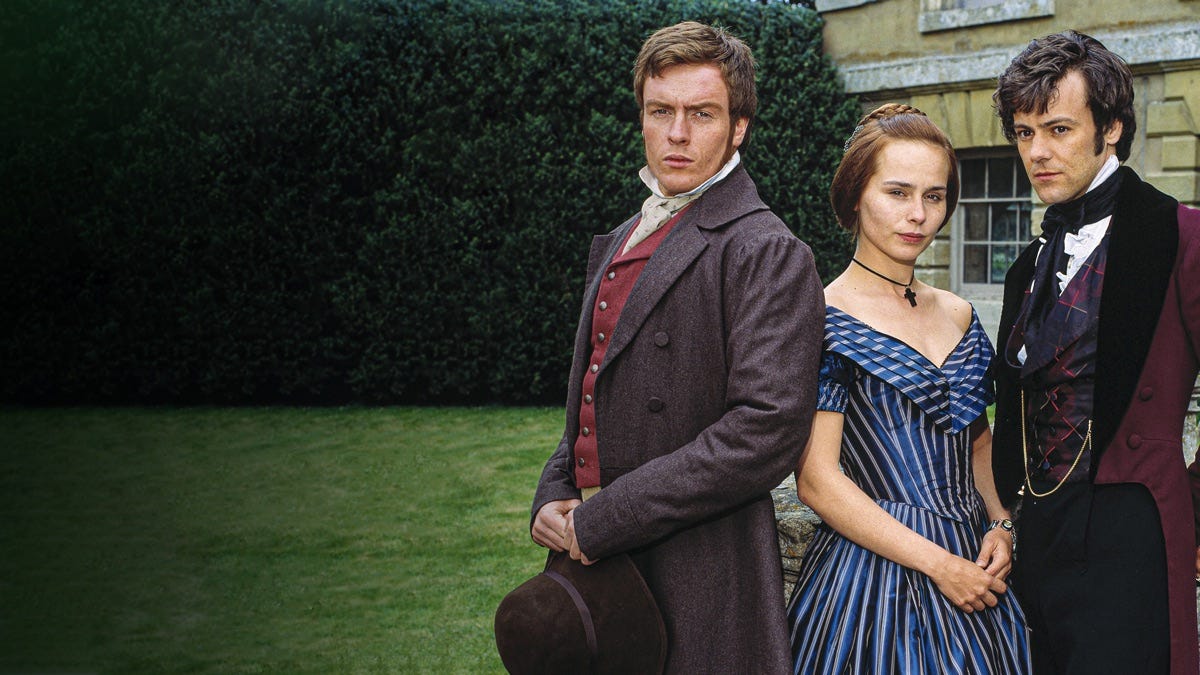
Gilbert, Helen & Huntingdon in the 1996 adaptation
‘I no longer love my husband — I HATE him!’: Arthur Huntingdon & Gilbert Markham in The Tenant of Wildfell Hall
As a ‘failed marriage plot’ (Harrison, 2014, 114) The Tenant of Wildfell Hall examines marriage in which the heroine has already chosen the “wrong man”. We see the repercussions of Helen’s choice through the perfect unhappiness of her and Arthur’s union as told through her diary and Gilbert Markham’s point of view. Gilbert’s relationship with Helen follows a more conventional courtship narrative. However, Gilbert is a controversial suitor in the eyes of critics, potentially undermining this conventionality. However, I will argue that Gilbert, who transforms over the course of the novel, does partly fulfil a Victorian ideal. Anne Bronte can explore both Regency masculinity and Victorian masculinity due its ‘double time frame narrative’ of the 1820s and 1840s (Sturridge, 2005, 7). As Surridge writes: ‘[Male] characters’ lives […] exemplify the nation’s development: Arthur Huntingdon’s violence dies with George IV, while Gilbert Markham matures with the century’(2005, 73).
The text is arguably partly didactic in intent and brims with scepticism concerning marriage. Utilising a female gothic mode, an often ‘politically subversive genre articulating women’s dissatisfactions with patriarchal structures’, it allows Tenant to subvert courtship conventions (Wallace & Smith, 2009, 2). Bronte’s dissatisfactions are partly with women’s rights in marriage. By purposefully placing events before the Custody of Infants Act in 1839, it excludes Helen the custodial right to her child. Divorce was incredibly difficult for women to obtain as it required an ‘ecclesiastical annulment or private act of Parliament’ (Matus, 2006, 108). Even after the 1857 Act, Helen would lose the right to any property, including her son (Matus, 2006, 108). In Bronte’s preface to the second edition of Tenant, she said that ‘the book has not been written in vain’ if it had ‘prevented one thoughtless girl from falling into the very natural error of my heroine’(4). The ‘cautionary tale’ (McDonagh, 2008, xvii) follows a young woman who marries a charming but disreputable rake, the central tale in Helen’s diary, enclosed by her more positive courtship with Gilbert.
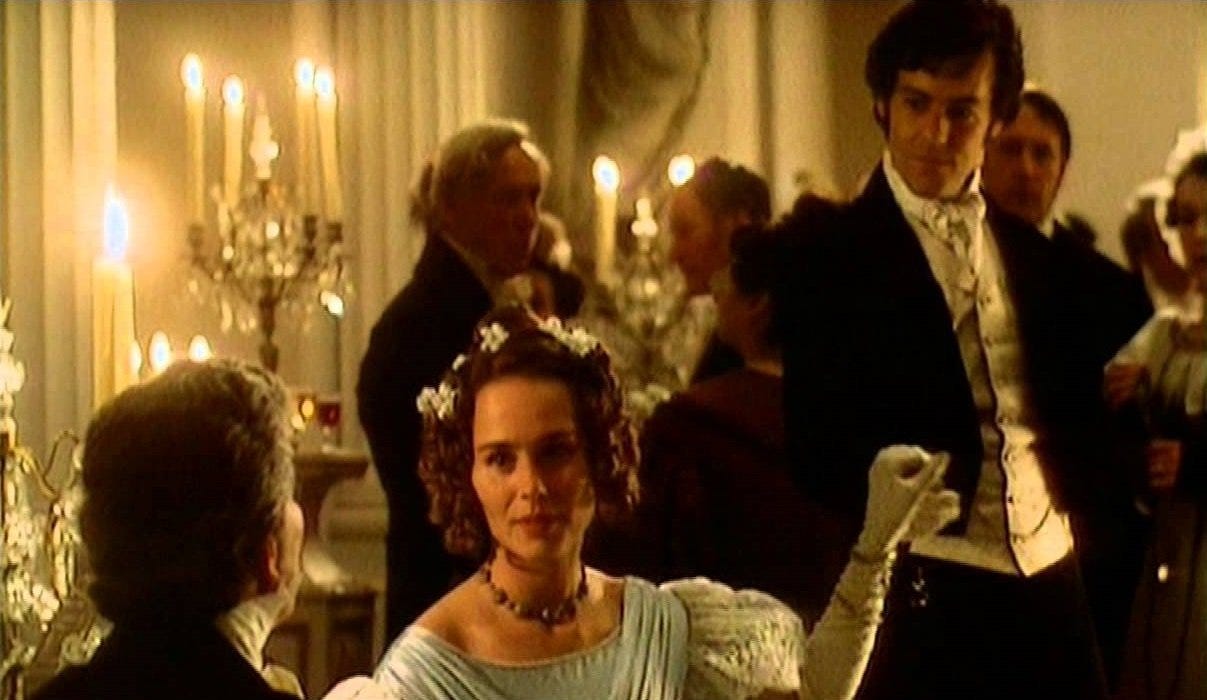
Helen and Arthur before their marriage
Arthur enters Helen’s account charming, young and virile. Helen’s aunt is able to see his lack of good character, proposing that a man who is ‘upright, honourable, sensible, sober, respectable’ (117) is a man of ‘noble qualities’(117) and one whom her niece should strive for. These descriptors perhaps resonate with Gilbert, but certainly not with Arthur. Helen prizes Arthur’s ‘sanguine temperament’(126), which ties him with other engaging ill-fated suitors like Frank, who are in appearance, affable.
At this early stage, Arthur is shown with negative characteristics that will only worsen during his marriage to Helen. He regularly attends hunting and shooting parties (130) drives a flashy sporty ‘phaeton’ (131) that displays his vanity, and disregards Helen’s feelings on a multitude of occasions, including his emotional games by withdrawing his affection when he pleases. One example of his behaviour is when he discovers a painting of himself by Helen, a scene that is to be repeated years later by Gilbert. Upon returning from a hunting party, he takes her portfolio without her consent. Helen protests: ‘I insist on having that back! It is mine and you have no right to take it’(136). He does a ‘gleeful laugh’ and only gives it back after multiple requests. He says, ‘as you value it so much.’(136) Helen tears it in two to spite him and, agitated, he determines to go and ‘shoot now’(137). He returns later, offending her aunt’s ‘strict sense of propriety’ ‘all spattered and splashed […] with the blood of his prey’ and ‘words for all but’ (137) Helen. Surridge (2005, 80) discusses the predator-prey dynamic present between men and women in the novel. Frustrated that he cannot get satisfaction from Helen, or metaphorically, conquest of his prey, he seeks bloodsport to quell his desire for triumph. Even his name, Huntingdon, conveys his predatory nature (Surridge, 2005, 80). Whilst he has some effeminate traits, such as vanity, he more readily inhabits a toxic ‘coarse’ masculinity (Flint, 2006, 179).
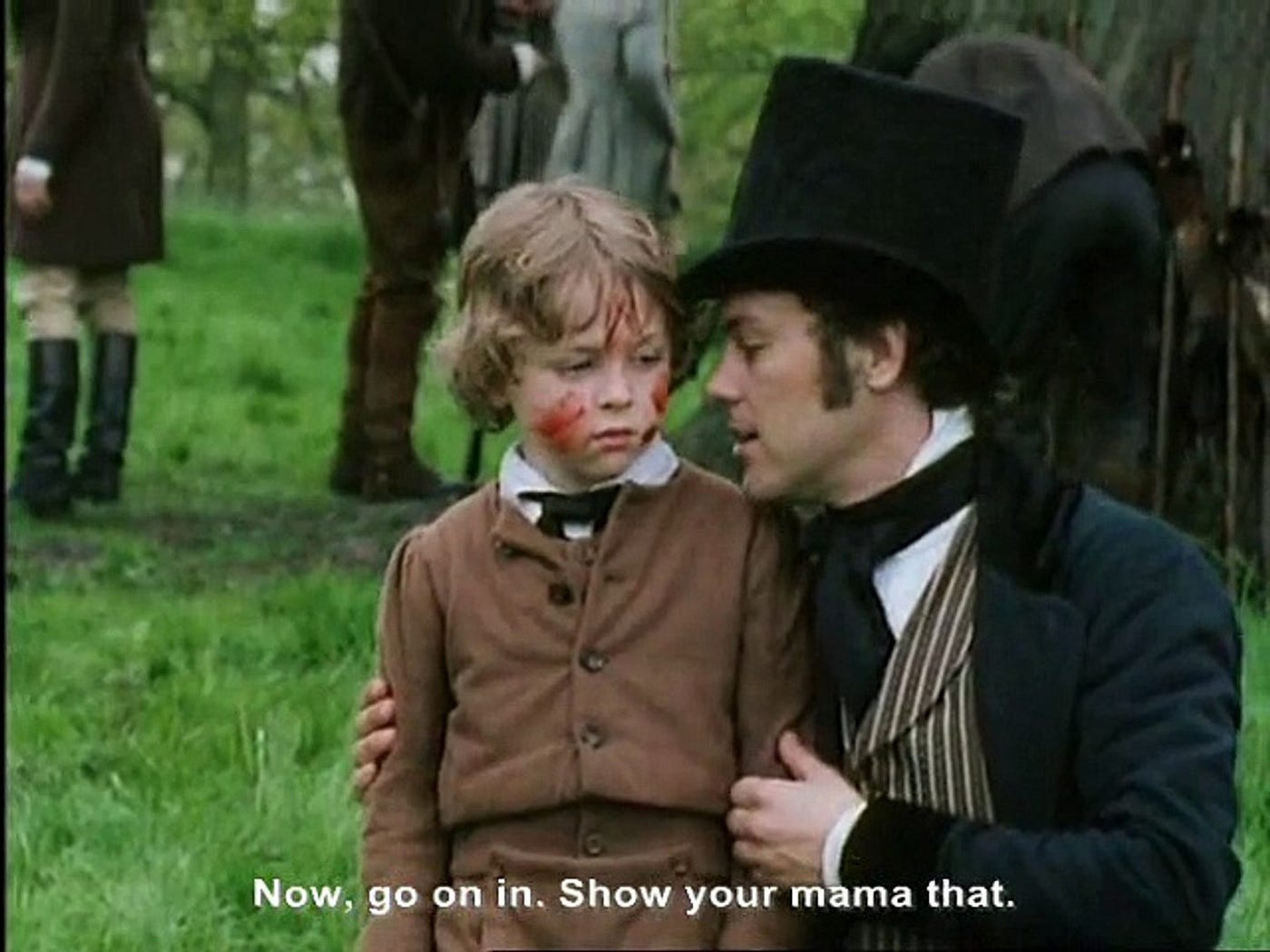
Arthur and his son, smeared in blood
His unsuitability is demonstrated not only through initial aspects of his character, but also his phrenological characteristics. When Gilbert at Wildfell finds a painting of young Arthur, before even knowing who he is, he can identify negative physical traits that denote his moral failings. Arthur’s eyes contain a ‘lurking drollery’ and ‘abundant, wavy curls, that trespassed too much upon the forehead.’ (42) Gilbert remarks on Arthur’s vanity (‘seemed to intimate that the owner thereof was prouder than his beauty than of his intellect’)(42) and a reader knowledgeable in phrenology would recognise its significance. George Combe, ‘leading exponent on phrenology in the early nineteenth century’ (Thormahlen, 1993, 834), wrote that a low forehead denoted ‘a mind in which the lower propensities are the ruling springs of action’. (Combe 1828, 147 cited Thormahlen, 1993, 835). This phrenological approach is reinforced when the new couple walk back from a morning service and Arthur complains of Helen’s extreme piety, spurning a Christian ideal. She desires him to exemplify this ideal but he protests he cannot ‘with such a head as this’(173). Helen’s hand ‘sunk in a bed of curls, alarmingly low, especially in the middle’(174). Thormahlen (1993, 824) notes how this would have been ‘ominous indeed’ for Victorian readers. George Combe wrote that ‘the brain is the seat of moral sentiments [and with a dip in the skull] moral feelings will be weakly manifested.’ (Thormahlen, 1993, 834). The rest of Helen’s diary gives further evidence to the traits attributed to Arthur through phrenology; he is doggedly selfish, alcoholic, irreligious and unrelenting: a character seemingly unable to be improved upon.
During the course of the diary ‘the irresponsible but not unlovable scamp becomes an agent of evil’(Thormahlen, 1993, 840). While Arthur had shown instances of cruelty before his marriage with Helen, they become much more acute. Helen, even within only four months of marriage, begins to regret her decision: ‘Arthur is not what I thought him at first, and if I had known him from the beginning […] I fear I should have thought it my duty to not have married him.’(171) ‘I was wilfully blind,’ (171) she admits. His crimes after this are numerous: neglect of his wife by spending long stretches of time in London, his disruptive parties during the hunting season, infidelity with Arabella Wilmot and maltreatment of his son. Helen, with her pious sensibilities, begins to detest his habits even more. Arthur and his profligate friends ‘represent the masculine ethos’ of the Regency (Pike, 2012, 113) contrasting with the newer masculine model of ‘Christian manhood’(Davidoff and Hall, 1987, 110 cited Sturridge 2005, 74). Matus writes that the Bronte’s juvenilia was influenced by various accounts of ‘Regency profligacy’ such as Moore’s Life of Byron (Matus, 2006, 102). According to Lutz, the Regency was often depicted in the early Victorian period as ‘full of moral vacuity, dissipation, degeneration’ in comparison to Victorian middle-class morality (2006, 68). Anne’s dissolute brother Branwell may have served as an inspiration (McDonagh, 2008, xviii).
Arthur is undoubtedly the worst form of the rake, as described by Mackie as ‘ruthless, sometimes violent, predatory, dangerously antisocial’(2009, 44) indulging in behaviour that is excused by his ‘elite social status’(2009, 35). The rake’s behaviour includes ‘fighting, swearing, committing adultery, cheating, incurring debt, killing and kicking’ alongside fashionable pursuits associated with the Restoration libertine rake that became a ‘nostalgic modern masculine fantasy’ for later generations in the 18th and 19th centuries (Mackie, 2009, 38; 41). Arthur commits all of the above, thus, aligning himself with this archetype to assume this form of hegemonic masculinity whilst having no care for his moral and physical health, and that of his wife and son. His kicking of the dog Dash is one of many ‘archetypal examples of ungentlemanly behaviour’ that he exhibits, combining his violence towards animals and women (Thormahlen, 1993, 837). To Helen, he becomes so unbearable that she proclaims to Arthur ‘we are husband and wife only in the name’(260) and writes ‘I no longer love my husband — I HATE him!’(263) Bronte’s descriptions of Arthur shocked Victorian critics (Surridge, 2005, 75) but it aimed to shed light on some women’s position in bad marriages. He is the antithesis of what the ideal suitor and husband should be, and interestingly, his counterpart’s suitability is controversial with critics despite being a marked improvement on Arthur.
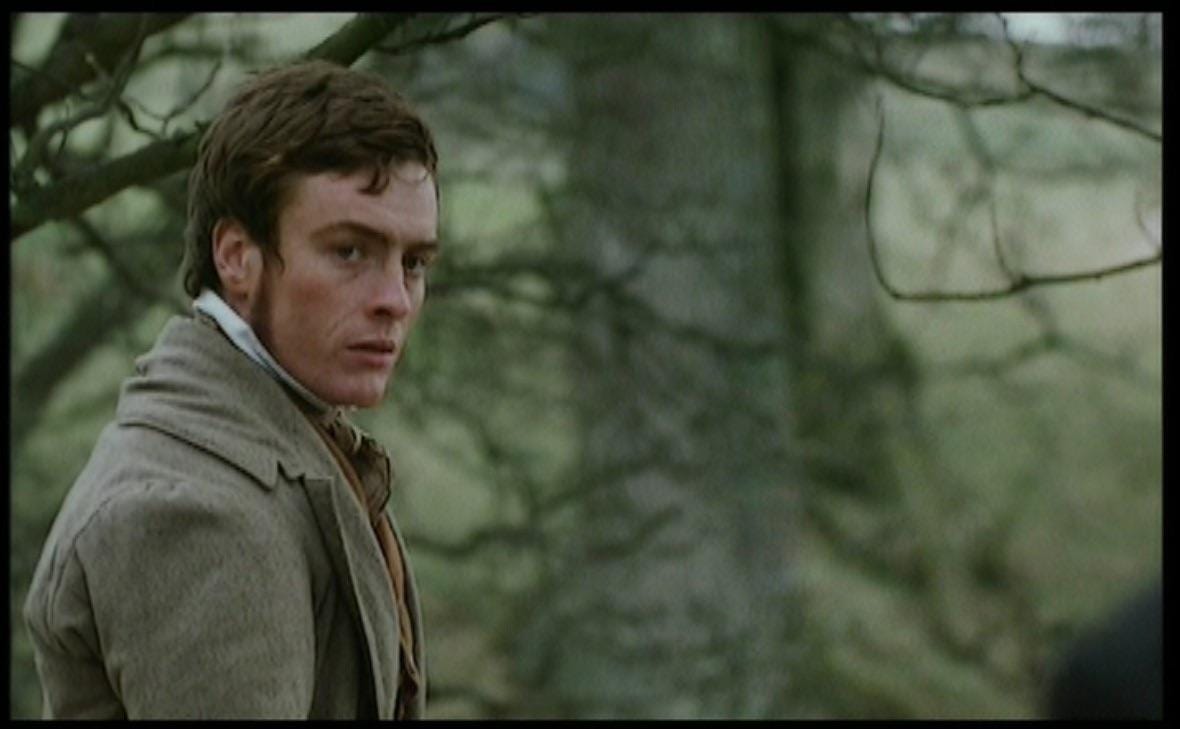
Gilbert Markham
Scholars have called Gilbert Markham ‘oddly unsuitable’ (O’Toole, 1999, 716), ‘supposedly reformable’ (Thierauf, 2020, 5), and with traits similar to Arthur, ‘a selfish, manipulative boy who hungers for conquest’ (Signorotti, 1995, 21 cited Hallenbeck, 2005, 18). He does share Arthur’s propensity for selfishness and violence, as shown in the notorious scene where he savagely attacks Helen’s brother: ‘I had seized my whip [… and] brought it upon his head. It was not without a feeling of savage satisfaction that I beheld the instant deathly pallor that overspread his face’(98). A myriad of critics — including Surridge and Diederich — have noted how this scene rivals or even betters any displays of Arthur’s violence, and how it happens while Gilbert is sober. In this interpretation, with the petulant Gilbert married to Helen, Bronte puts into question ideal masculinity, which ‘problematizes the new domestic sphere established at the end of the novel’(Diederich, 2003, 37).
However, Gilbert can be viewed as fulfilling a masculine and suitor ideal, but perhaps with some lingering hesitation: ‘far from perfect, but at least not oppressive’ (Matus, 2006, 109). Older Gilbert, narrating the events of twenty years earlier in 1847, does not approve of his younger ‘four and twenty’(11) self. He notes how he was dissatisfied with his ‘gentleman farmer’ lifestyle due to ‘self-conceit’ but by the time of his writing comes to approve of his ‘honest and industrious’(11) lifestyle, in keeping with the Victorian ideal of hard-working masculinity and self-control (Surridge, 2005, 73). His occupation contrasts him to the idle Arthur, with his ‘increasingly untenable role of the landed gentleman in Victorian culture’(Hyman, 2008, 451). Hallenbeck notes throughout the text, Gilbert mocks his younger self, who had not yet ‘acquired the rule over [his] own spirit’(11). Concerning the attack on Lawrence, Hallenbeck also defends him by saying the callousness of his description is actually ironic, mocking the anger of young Gilbert (2005, 20). By defending Helen’s honour, he could be viewed as fulfilling ‘conventional expectations for [chivalric] gentlemanly behaviour’(Hallenbeck, 2005, 21).
During the course of the novel, Gilbert’s character matures, principally after the reading of Helen’s diary. He ‘learns of the mistakes of his predecessor, and corrects them through his own behaviour’(Hallenbeck, 2005, 9). As the narrator, Gilbert knows he is setting himself up for comparison with his wife’s first husband in the text itself. Unlike Arthur, who is shown displaying little affection for his son, Gilbert has a healthy relationship with Arthur Jr, quickly becoming ‘excellent friends’. (44) Pike notes that Gilbert’s paternal affection is a ‘powerful appeal for Helen’ as a father substitute who will not infect her son with ‘corrupted models of manliness’(2012, 122; 113) as Arthur did. He gives him ‘a little waddling puppy’(63), whose father is Gilbert’s dog Sancho. Again, unlike Arthur, Gilbert takes an interest in Helen’s art, admiring her talents. In the mirrored scene of Gilbert finding a ‘portrait of a gentleman’(42) he rightly gives back the painting when Helen requests it. Gilbert does sulk, saying, ‘I was only going to ask if you had painted it yourself’(44) but he is more invested in her skills as an artist, than for his own self-satisfaction as Arthur was.
While his character as a younger man may still be debated, Gilbert’s propensity for anger and Byronic flaws may be part of his appeal. Thierauf (2020, 6) notes the congruence with other Bronte romantic heroes with a ‘surplus of violent passion’, Tenant falling victim to ‘that very fantasy’. While Gilbert adheres to many ideals of Victorian manhood — including ‘energy, will, straightforwardness and courage’ — he has access to the more violent and overt masculinity of the rake archetype (Tosh, 2007, 111). Gilbert’s inferiority to Helen could be a resistance against the socially and morally superior hero who raises the heroine, which is partially fulfilled by the mentor-lover trope. As Matus notes, this may be in an attempt to partially offset how ‘marriage diminishes a woman’s power’(2006, 110).
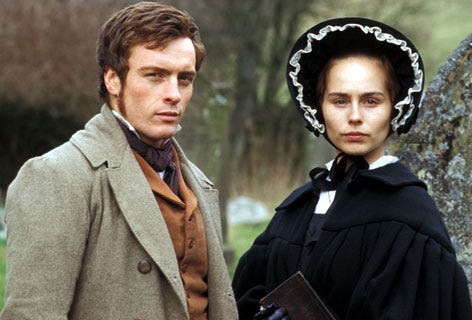
Gilbert & Helen
Similarly to Austen’s Emma, Anne Bronte uses her two central male characters to explore different styles of masculinity, one an older and much more reprehensible form, and the latter an emerging masculine style of industry and self-restraint. Of course, Gilbert is no Knightley, and must navigate a more complex type of masculinity, with flaws that some critics see as too severe to overlook. Arthur is undoubtedly a ‘profligate scoundrel’ (341) as Gilbert dubs him, who exemplifies a toxic Regency masculinity in an attempt to consolidate power over others. His extreme cruelty works to alleviate Gilbert’s need to be a perfect paragon of masculinity, as he easily serves as an improvement on Helen’s first husband. As Matus states, Gilbert
‘is never an idealised antidote to Arthur Huntingdon, but a means by which Anne Bronte puzzles over the question of masculine adequacy — what makes a worthwhile, redeemable, ‘good enough’ man’ (2006, 108)
Despite Gilbert’s deficiencies, he partially inhabits a masculine ideal, one that even Helen’s aunt partially approves of: ‘I know of no one […] to whom I would more willingly resign her than yourself, or who would be more likely to appreciate her worth and make her truly happy, as far as I can tell.’ (416, emphasis mine) This could instil some pause in the reader, but the novel’s relationship to convention is complicated, as Flint argues it rejects ‘assimilation as either a conservative or a radical text in feminist terms’ (Flint, 2006, 178). Through its almost-ideal hero Gilbert, it simultaneously is suspicious of the romance narrative whilst complicit and partly supportive of it.
Part 2/3. This essay was originally written as my 3rd year BA English dissertation, which received a 1st. Apologies for any inaccuracies or mistakes, as this essay was originally only intended for the eyes of a marker. (I’ve made some edits to make it more readable on Medium).
메타데이터
- post_id
- bb104a54885a
- slug
- male-suitors-in-19th-century-romance-narratives-emma-the-tenant-of-wildfell-hall-and-wives-bb104a54885a
- url
- https://medium.com/@literarybluestocking/male-suitors-in-19th-century-romance-narratives-emma-the-tenant-of-wildfell-hall-and-wives-bb104a54885a
- canonical_url
- https://medium.com/@literarybluestocking/male-suitors-in-19th-century-romance-narratives-emma-the-tenant-of-wildfell-hall-and-wives-bb104a54885a
- author_url
- https://medium.com/@literarybluestocking
- status
- ok
- fetched_at
- 2026-07-19 21:30:35



