Aster vs Hyperliquid: Applying a PM Lens to What Makes a Perp DEX Win
TL;DR
Aster vs Hyperliquid: Applying a PM Lens to What Makes a Perp DEX Win
TL;DR
Perp DEX competition is decided by execution quality under pressure, not feature count. Aster’s Trade & Earn mechanism changes the opportunity cost of holding a position open, and that design decision runs deeper than it first appears. Liquidation UX, meanwhile, remains the most underbuilt moment in the entire trader journey.
1. Why perp mechanics deserve a PM lens
You’ve opened a 10x long on ETH. Funding rate just turned negative. Your position is approaching the liquidation price, and you’re on mobile. What information can you see? What actions can you take? How much time do you have?
If you struggle to answer those questions, you’ve found a product problem.
The perp DEX space crossed $1 trillion in monthly volume in late 2025. Aster holds roughly 20% of global market share. Hyperliquid leads in open interest. New challengers like Lighter and EdgeX are closing fast.
What all these platforms are really competing for is the same set of traders at their worst moment. When a position is approaching liquidation, markets are moving violently, or losses have already hit — whether a trader stays on the platform or walks away is where the competition is actually decided.
2. Order book vs AMM is a decision about who you’re building for
Order book and AMM models are usually framed as a technical tradeoff. They’re better understood as a choice about your target user.
Order book platforms like Aster Pro Mode and Hyperliquid assume traders arrive with a specific price in mind. They want limit orders, precise entries, and control over fill price. AMM and pool-based platforms like GMX assume users prioritize execution certainty above all else — they’re willing to pay a spread in exchange for knowing that when they click, the trade goes through at a predictable price.
This distinction cascades into every downstream product decision: what the dashboard surfaces, how risk is communicated, what mode you default to on mobile, how onboarding copy is written.
Here’s how the four major platforms compare today:
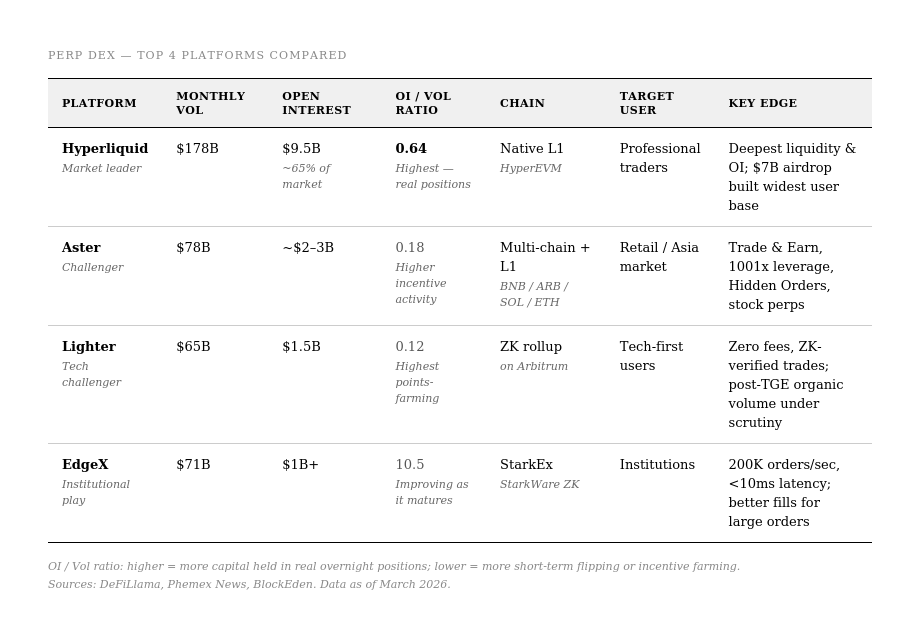
The OI/Volume ratio is the number worth paying attention to here.¹ Hyperliquid’s 0.64 reflects genuine holding behavior — traders with directional conviction staying in positions. Aster and Lighter’s ratios of 0.18 and 0.12 suggest a larger share of their volume comes from rapid position flipping, the kind of activity that tends to show up on platforms with trading incentive programs. Volume rankings fluctuate. Open interest is harder to manufacture, which is why it tells you more about where real market participation actually sits.
Aster’s answer to the persona question is to serve both groups on one platform: Simple Mode for retail traders with up to 1001x leverage, and Pro Mode with a full order book for professionals. It’s an ambitious bet. The real question at scale is whether liquidity will be deep enough across both modes to serve either group well, or whether the split ends up costing users on execution quality in both directions.
3. What Trade & Earn actually changes
Most commentary frames Trade & Earn as a yield feature: post yield-bearing assets like asBNB or USDF as collateral instead of idle USDC, and earn while you trade. That’s accurate, but it understates what the mechanic is actually doing.
What Trade & Earn changes is the opportunity cost of keeping a position open.
In a standard perp setup, margin is dead capital for the duration of the trade. $10,000 USDC sitting as collateral earns nothing. Every hour the position stays open, the trader is paying a time cost on locked capital. That cost is invisible on the interface, but it shapes behavior.
Consider a concrete example. You think ETH will rally this week, so you open a position with $10,000 USDC as margin. Three days pass and the market hasn’t moved. You start thinking that capital could be doing something elsewhere, so you close the trade — not because your view on ETH changed, but because the cost of waiting became too high to justify holding.
Aster’s model changes that calculation. Margin generating 8–12% APY while a position is live means the arithmetic of staying in the trade shifts. The threshold for keeping a position open drops, and traders hold longer, size larger, and return more frequently. This is a structural product decision, and it connects directly to execution quality under pressure. A trader who isn’t watching the clock on locked capital has more cognitive bandwidth to manage the actual position.
There’s a risk worth flagging here. Liquidation price is calculated based on the current value of your collateral. If you post $1,000 worth of asBNB as margin, the liquidation price displayed assumes that collateral is still worth $1,000. But if asBNB experiences a peg deviation during a period of market stress and drops to $900, your actual margin has shrunk while the displayed liquidation price hasn’t moved. You believe you have a safe distance from liquidation, but you’re closer than the interface shows. The timing problem is that peg deviations are most likely to happen exactly when markets are most volatile — which is precisely when you need that number to be accurate. Regardless of how platforms currently handle this, the dynamic should be reflected in real time on the interface, in a format that a trader under pressure can read at a glance.
4. Liquidation UX is the hardest moment nobody has designed for
Most platforms treat liquidation as a risk management function. It’s more useful to think of it as the highest-stress moment in a trader’s entire journey — the point where they’re losing money fast, often without understanding why, making a split-second decision about whether this platform is worth coming back to.
That framing changes what you build.
The first gap is margin health visibility. TradFi margin platforms surface margin health as a persistent, prominent element of the dashboard. On most perp DEXs, the liquidation price is technically visible somewhere, but the real-time distance to that price in a format that reads clearly on mobile is rarely treated as a design priority. This is a legibility problem, and a product prioritization problem.
The second gap is partial liquidation transparency. When margin health drops below a certain threshold, the platform closes part of your position to bring the remaining exposure back into a safe range. The platform’s formula for determining how much to close isn’t shown anywhere — users just see their position shrink. If the market keeps moving against them, that partial close is followed by another one thirty seconds later. From the trader’s perspective, the experience feels like a black box: something happened to my position, I thought it was over, and then it happened again. Trust erodes at exactly this moment, turning what could have been a recoverable situation into a reason to leave the platform.
The third gap is pre-liquidation alerts. Right now, traders who want to be notified before they get liquidated piece together their own system using external tools — Nansen alerts, Telegram bots, manually set price watches. No platform has yet integrated alerts, configurable thresholds, and one-tap partial close into a single native flow. A platform that does this means traders no longer need to keep one eye on a Telegram channel while managing a position, and that reduction in cognitive overhead is itself a retention advantage.
None of the major platforms have fully built this. It’s the clearest uncontested design opportunity in the space right now, and it connects directly to the core competition — because surviving a near-liquidation on a platform that handled the moment well is one of the strongest retention events possible.
5. The gap that will define the next growth wave
The next large wave of perp DEX users will likely come from people who have already traded options or futures on traditional platforms. Their mental model is built around CEX conventions: margin call notifications, visible utilization dashboards, defined margin tiers, human support as a backstop.
The distance between that mental model and the current DeFi onboarding experience — connect wallet, choose collateral type, interpret funding rate, understand partial liquidation mechanics — is real, and most platforms have not seriously reckoned with it in their design.
My working hypothesis is that the barrier isn’t primarily about technical literacy. Most traders with a TradFi futures background can learn how the mechanics work. The real barrier is trust legibility: does this platform behave predictably when something goes wrong? Can I tell at a glance whether my position is safe, approaching risk, or being partially closed? A platform that can answer those questions clearly, at a moment of stress, without requiring the user to already understand how DeFi works, will have an acquisition and retention advantage that’s genuinely hard to replicate.
That’s the product problem worth working on.
Note ¹ OI (open interest) is the total value of all outstanding contracts at a given point in time. Volume is the total value of trades executed over a period. A trader who holds a position contributes to OI; a trader who opens and closes rapidly accumulates Volume without moving OI much. A high OI/Volume ratio means traders tend to hold their positions, which reflects directional conviction. A low ratio means a larger share of volume is coming from rapid flipping — a pattern that tends to appear on platforms with trading incentive programs where activity is being generated to earn rewards rather than to express a market view.
메타데이터
- post_id
- bb1b7e6df557
- slug
- aster-vs-hyperliquid-a-pms-take-on-what-makes-a-perp-dex-win-bb1b7e6df557
- url
- https://medium.com/@meganfeng/aster-vs-hyperliquid-a-pms-take-on-what-makes-a-perp-dex-win-bb1b7e6df557
- canonical_url
- https://medium.com/@meganfeng/aster-vs-hyperliquid-a-pms-take-on-what-makes-a-perp-dex-win-bb1b7e6df557
- author_url
- https://medium.com/@meganfeng
- status
- ok
- fetched_at
- 2026-07-11 21:00:18