Why Every Media App Should Use HLS (HTTP Live Streaming)
Modern media apps live or die by one thing: streaming quality. Users don’t tolerate buffering, lag, or sudden drops in resolution anymore…
Why Every Media App Should Use HLS (HTTP Live Streaming)
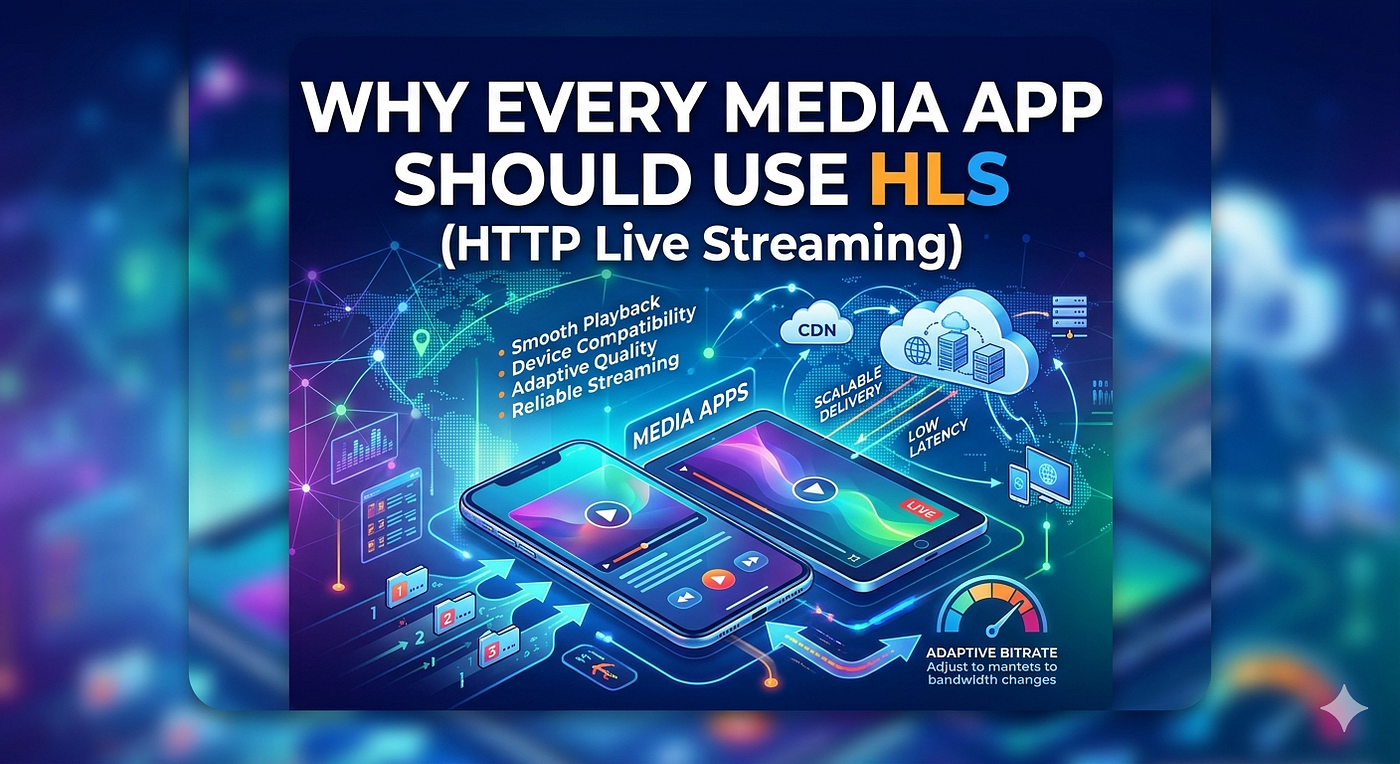
Modern media apps live or die by one thing: streaming quality. Users don’t tolerate buffering, lag, or sudden drops in resolution anymore. Whether it’s OTT platforms, sports streaming apps, live events, or short-form video apps, expectations are simple — content should play instantly and smoothly on any device, under any network condition.
This is exactly where HLS (HTTP Live Streaming) becomes a foundational technology. Originally developed by Apple, HLS has become one of the most widely adopted streaming protocols across the internet. Today, it powers everything from global OTT platforms to live sports broadcasts and scalable video-on-demand systems.
A strong understanding of HLS benefits for media apps is essential for any business building a modern streaming product. It is not just a playback format — it is a complete delivery architecture designed for scalability, reliability, and adaptive user experience.
Understanding HLS: What Is HTTP Live Streaming?
What is HLS?
HLS (HTTP Live Streaming) is a media streaming protocol developed by Apple that delivers video and audio content over standard HTTP connections.
Unlike traditional streaming methods that attempt to deliver a continuous video stream, HLS breaks content into small segments (usually 2–10 seconds each). These segments are delivered sequentially and assembled by the client device in real time.
At the core of HLS is the Apple protocol, which ensures compatibility, scalability, and adaptive playback across devices.
How HLS Streaming Works
HLS operates using a simple but powerful mechanism:
- Video is encoded into multiple quality levels (bitrates).
- Each version is split into small media segments.
- A playlist file (M3U8) is generated.
- The player reads the playlist and downloads segments one by one.
This structure enables seamless switching between different quality levels depending on network conditions.
Why HLS Became an Industry Standard
HLS gained popularity because it solves major streaming problems:
- Works over standard HTTP (no special servers required)
- Easily scalable using CDNs
- Compatible with almost all modern devices
- Supports adaptive bitrate streaming
- Firewall-friendly delivery
These features make HLS ideal for both live and on-demand media applications.
Why Media Apps Need Advanced Streaming Technologies
Media consumption has changed drastically over the last decade. Users now expect:
- Instant playback
- Zero buffering
- Multi-device support
- HD and 4K streaming
- Seamless switching between networks
However, delivering this experience is technically complex.
Key Challenges Media Apps Face
Media applications must solve several problems simultaneously:
1. Network Variability
Users switch between 5G, Wi-Fi, and low-speed mobile networks.
2. Device Fragmentation
Content must run on:
- Smartphones
- Tablets
- Smart TVs
- Web browsers
3. Bandwidth Constraints
Not every user can stream HD or 4K content smoothly.
4. Server Load During Peak Traffic
Live sports and events can cause sudden traffic spikes.
Why Streaming Infrastructure Matters
The streaming protocol directly affects:
- User retention
- Watch time
- Monetization
- Subscription conversions
Poor streaming leads to churn, even if content is high quality.
This is why platforms adopt HLS as a default delivery mechanism.
Key HLS Benefits for Media Apps
The true value of HLS lies in its ability to solve real-world streaming problems at scale.
1. Adaptive Bitrate Streaming for Seamless Playback
One of the most powerful HLS benefits for media apps is adaptive bitrate streaming.
How Adaptive Bitrate Works
Instead of delivering a single video quality, HLS provides multiple versions:
- 240p (low bandwidth)
- 360p
- 720p HD
- 1080p Full HD
- 4K (if available)
The player automatically switches between these based on real-time network speed.
Why This Matters
- No buffering during network drops
- Smooth playback transitions
- Optimized data usage for mobile users
2. Reduced Buffering and Faster Startup Times
HLS improves playback experience by breaking videos into small chunks.
This enables:
- Faster video start times
- Pre-buffering of short segments
- Reduced playback interruptions
For users, this translates into a smoother experience, especially on mobile networks.
3. Universal Device Compatibility
HLS is supported across nearly all platforms:
- iOS and Android
- Safari, Chrome, Firefox
- Smart TVs (Samsung, LG, Android TV)
- Streaming devices (Roku, Apple TV, Fire TV)
This eliminates the need for multiple streaming formats.
4. Scalability for Large Audiences
HLS works extremely well with Content Delivery Networks (CDNs).
During peak traffic events like:
- Sports finals
- Live concerts
- Breaking news streams
HLS ensures:
- Distributed load handling
- Reduced server stress
- Smooth global streaming
This makes it ideal for enterprise-level media platforms.
5. Enhanced Security and Content Protection
HLS supports multiple security layers:
- AES-128 encryption
- Token-based authentication
- DRM integration (FairPlay, Widevine)
This is crucial for:
- Premium OTT platforms
- Subscription-based content
- Pay-per-view events
6. Seamless CDN Integration
HLS is HTTP-based, meaning it works naturally with CDNs.
Benefits include:
- Faster content delivery
- Reduced latency
- Global caching efficiency
CDNs can store video segments closer to users, improving speed and reliability.
7. Firewall and Network Friendly Delivery
Because HLS uses HTTP/HTTPS:
- It bypasses most firewall restrictions
- Works in corporate networks
- Functions smoothly on mobile carriers
This improves accessibility across regions.
8. Support for Live and On-Demand Streaming
HLS is versatile and supports:
- Live streaming (sports, events)
- Video on demand (movies, shows)
- Continuous playlists
This flexibility makes it ideal for modern media ecosystems.
How Adaptive Bitrate Improves Media App Performance
Adaptive bitrate streaming is central to HLS performance.
What is Adaptive Bitrate Streaming?
Adaptive Bitrate Streaming dynamically selects video quality based on network conditions\text{Adaptive Bitrate Streaming dynamically selects video quality based on network conditions}Adaptive Bitrate Streaming dynamically selects video quality based on network conditions
It ensures users always receive the best possible quality their network can support.
Why Adaptive Bitrate Is Critical
Without adaptive bitrate:
- Users on slow networks experience buffering
- High-quality streams fail on low bandwidth
- User churn increases
With HLS adaptive streaming:
- Quality adjusts automatically
- Playback remains uninterrupted
Impact on User Retention
Streaming stability directly impacts:
- Watch duration
- Subscription renewal rates
- App store ratings
Even a few seconds of buffering can lead users to abandon content.
HLS vs Other Streaming Protocols
Choosing the right protocol is critical for media architecture.
HLS vs MPEG-DASH
- HLS: Widely supported, especially on Apple devices
- DASH: More flexible but less universally supported on iOS
HLS remains more reliable for consumer apps.
HLS vs RTMP
- RTMP: Legacy protocol, low latency but not scalable
- HLS: Better scalability, CDN-friendly
RTMP is mostly used for ingestion, not delivery.
HLS vs WebRTC
- WebRTC: Ultra-low latency communication (video calls)
- HLS: Optimized for scalable media streaming
They serve different purposes.
Why HLS Wins for Media Apps
HLS is preferred because it balances:
- Quality
- Scalability
- Compatibility
- Stability
Technical Considerations for Implementing HLS
Building HLS into a media app requires careful engineering.
Video Encoding Strategy
Developers must generate multiple bitrate versions using codecs like:
- H.264
- H.265 (HEVC)
This ensures compatibility and quality optimization.
Segment Duration Optimization
Segment size affects performance:
- Short segments = lower latency
- Longer segments = better compression
Most systems use 2–6 second segments.
CDN Architecture Design
A strong CDN setup ensures:
- Global availability
- Reduced latency
- Efficient caching
DRM and Content Protection
Media apps often integrate:
- Apple FairPlay
- Google Widevine
- Microsoft PlayReady
This protects premium content from piracy.
Monitoring Streaming Performance
Key metrics include:
- Startup time
- Rebuffer ratio
- Bitrate switching frequency
- Playback failures
These help optimize user experience.
Common Challenges in HLS Streaming
Despite its benefits, HLS has some limitations.
Latency Issues
Live streaming may have slight delays compared to real-time protocols.
Storage and Encoding Costs
Multiple bitrate versions increase storage requirements.
Complex Multi-Stream Management
Managing many video renditions can increase backend complexity.
Device Testing Requirements
Ensuring consistency across devices requires extensive QA.
Why Businesses Need Expert Help for HLS Implementation
Implementing HLS at scale is not just a backend task — it requires full-stack expertise.
A professional **media app development company for HLS streaming** helps businesses:
- Design scalable streaming architecture
- Optimize adaptive bitrate workflows
- Integrate DRM systems
- Improve CDN performance
- Reduce playback latency
This ensures a production-ready streaming platform.
Why Businesses Choose JPLoft for Media App Development
JPLoft specializes in building scalable digital media solutions designed for high-performance streaming environments.
They focus on:
- HLS-based streaming architectures
- Real-time media delivery systems
- Cross-platform media applications
- Scalable backend infrastructure
- Optimized user experience design
They develop media applications that prioritize smooth playback, adaptive streaming, and global scalability. Their engineering approach ensures businesses can deliver high-quality video experiences even under high traffic conditions.
By combining modern streaming protocols like HLS with robust backend systems, they help businesses build future-ready media platforms that perform reliably across devices and regions.
Conclusion: Why HLS Is the Future of Media Streaming
The demand for high-quality, buffer-free streaming experiences continues to grow rapidly. Users expect instant playback, adaptive quality, and seamless switching between devices and networks.
HLS (HTTP Live Streaming) solves these challenges by offering a scalable, adaptive, and universally compatible streaming solution.
The key HLS benefits for media apps include:
- Adaptive bitrate streaming
- Reduced buffering
- Cross-device compatibility
- CDN scalability
- Secure content delivery
- Support for live and on-demand video
When combined with adaptive bitrate technology and a robust Apple protocol foundation, HLS becomes the backbone of modern media applications.
For businesses aiming to build competitive streaming platforms, adopting HLS is not just an option — it is a necessity for long-term success in the digital media landscape.
메타데이터
- post_id
- bb270293188d
- slug
- why-every-media-app-should-use-hls-http-live-streaming-bb270293188d
- url
- https://medium.com/@strackajmesh786/why-every-media-app-should-use-hls-http-live-streaming-bb270293188d
- canonical_url
- https://medium.com/@strackajmesh786/why-every-media-app-should-use-hls-http-live-streaming-bb270293188d
- author_url
- https://medium.com/@strackajmesh786
- status
- ok
- fetched_at
- 2026-06-11 11:25:07