How to raise seed funding for early stage startup in 2026
In Q1 2026, $41.3 Billion was raised by 1,800 startups globally.
How to raise seed funding for early stage startup in 2026
In Q1 2026, $41.3 Billion was raised by 1,800 startups globally.
The ones who closed didn’t have prettier decks — they had a sharper story, a financial model investors trusted, and a fundraising strategy built around how VCs actually think.
Every year, millions of startups are born across the world — from a fintech app in Bangalore to a climate tech company in Berlin, a healthtech idea in Nairobi to an AI tool in San Francisco. Some are pre-seed, just an idea and a founder’s conviction. Others are seed stage, with early traction but no real proof yet. Across every vertical, the challenge is strikingly similar — founders know their product, but struggle to translate that belief into a story investors trust.
It’s that the founder hasn’t yet learned how investors think, what timing means to them, or how a financial model needs to speak their language. That gap — between a great founder and a fundable founder — is where most startups quietly fail before they even get a “no.”
This is exactly why founders search for the best services to create investor-ready pitch decks for startups, or wonder what mistakes to avoid when preparing pitch decks and financial models for fundraising rounds. Many compare pitch deck design companies vs financial modeling firms, unsure which should I hire first — when in reality, the two were never meant to be separate.
A startup raising a pre-seed round needs an investor-ready pitch deck built for pre-seed, not a generic template. A founder preparing for Series A needs a financial model that shows exactly how 5X returns happen, not just a spreadsheet of guesses. And first-time founders joining an accelerator often discover too late that a fundraising strategy for first-time founders requires more than a deck — it requires a complete, done-for-you pitch deck and financial model service that understands both the story and the math behind it.
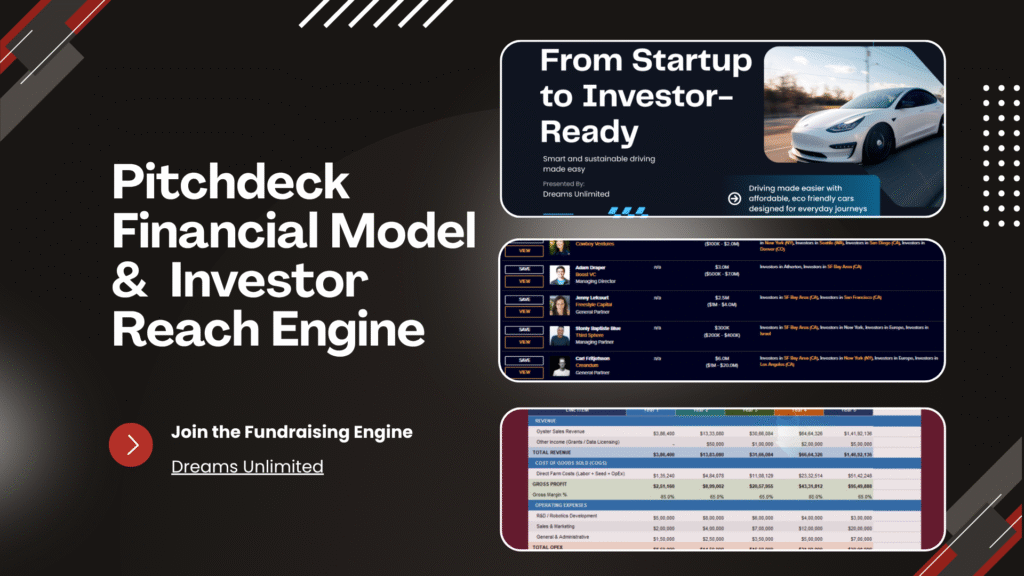
But here’s the uncomfortable truth most founders don’t want to hear — you didn’t build your startup on a shortcut, so why are you trying to raise funding on one? Every week, founders type prompts into ChatGPT or Gemini asking for the best platforms that combine pitch deck creation and financial modeling, hoping an AI tool can hand them what investors took years to build instinct for.
A prompt can format a slide. It cannot understand why an investor said no in a previous meeting, or what your specific vertical’s metrics actually need to prove traction. You spent months — maybe years — solving a real problem, hiring the right people, surviving the version of your product that didn’t work before you found the one that did. That journey had no shortcut.
So why would the moment that decides your company’s future — the fundraising round itself — be any different? A pitch deck without strategy is just a presentation. And presentations don’t raise capital. Conviction, timing, and a founder who understands how investors actually think — that does. Here are
**top-[10-pitch-deck-mistakes](http://top-10-pitch-deck-mistakes-startups-must-avoid-to-raise-funding)-startups-must-avoid-to-raise-funding**.
This is the real question founders should be asking — not “what is the difference between a pitch deck and a fundraising strategy,” but “how do I raise seed funding for early stage startup in 2026” the right way. Not “what are the essential components of an investor-ready pitch deck that convinces VCs,” but “what do investors look for in a startup pitch deck financial model” before they even take the second meeting.
The answers aren’t in a prompt. They’re in a process. Not sure where to start? Grab the Free Fundraising 👉 Toolkit. You Get:
Pitch Deck Checklist 📄
Financial Model Template and 📈
Investor Outreach Guide 📁
Why this matters:
Whether you’re a founder in the US closing a seed round, a startup in Europe preparing for Series A, or building in the Middle East or Africa chasing your first cheque — every investor conversation starts the same way: a pitch deck, a financial model, and a fundraising strategy that actually works. This free toolkit gives you the foundation before you spend a single dollar on a “done for you pitch deck and financial model service.”
The 3 Basics of a Pitch Deck That Actually Gets Funded

Every investor-ready pitch deck — regardless of vertical, stage, or geography — is built on three non-negotiable pillars. Get these wrong, and no design, animation, or AI tool can save the deck.
01. Urgency, Not Just Problem Founders explain the problem. Funded founders explain why it can’t wait. This is the single biggest mistake we see when reviewing what common mistakes founders should avoid when preparing pitch decks for VCs.
02. A Named Buyer, Not a Market Size “$50 billion market” means nothing to an investor if you can’t name who’s paying you on day one. The best services to create investor-ready pitch decks for startups always start here — with specificity, not scale.
03. A Path to Returns, Not Just Revenue Investors aren’t funding your product. They’re funding their own 5X. If your deck doesn’t show how do investors get returns post GTM, it’s not an investor pitch deck — it’s a presentation.
If you are thinking where can I download a free pitch deck checklist for startups? 👉 **Download Blueprint**
The 3 Basics of a Financial Model That Builds Investor Trust
01. Realistic Unit Economics, Not Hockey Sticks Investors in 2026 are prioritizing unit economics and path to profitability over pure growth projections. A model with believable numbers beats one with impressive but unprovable ones.
02. Clarity on Where the 5X Comes From If an investor can’t trace your model to their return, the spreadsheet is decoration, not a financial model for startups that actually raises capital.
03. Built for Your Specific Funding Stage A pre-seed model and a Series A model are not the same document. Best fundraising strategy advisors for tech startups know the difference — and build accordingly.
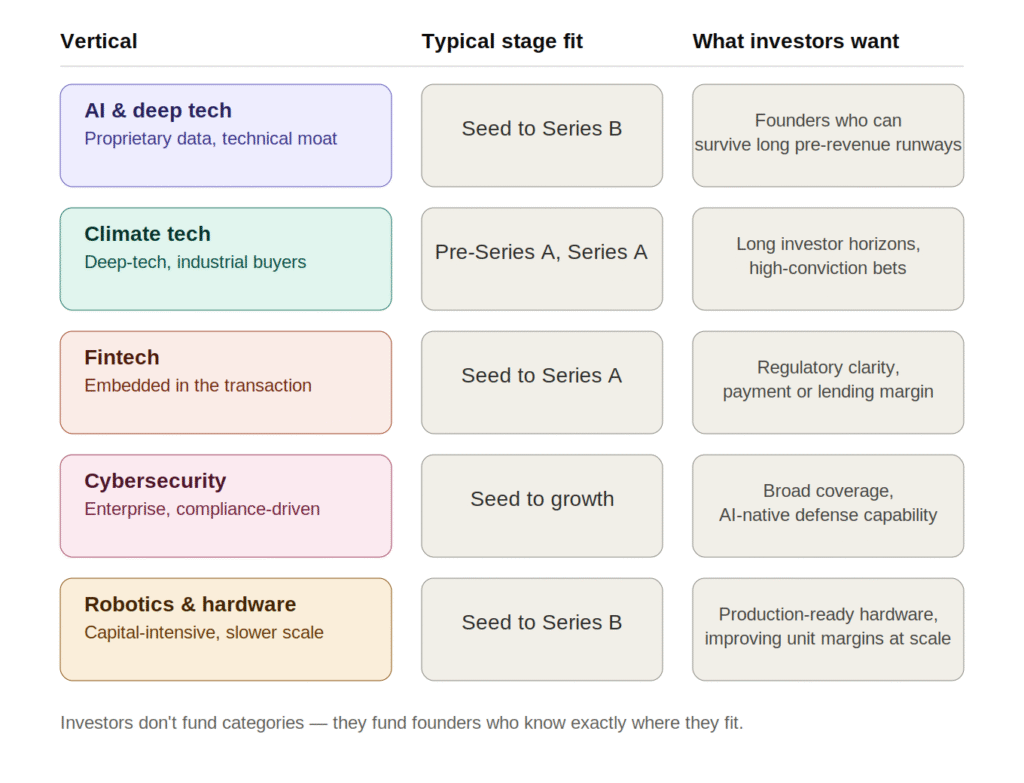
Who’s Funding What — A Founder’s Guide to Investor Behavior by Vertical
A pitch deck or a Financial Model means nothing if it’s reaching the wrong investor. Different verticals attract different capital and Investors, at different stages, for different reasons — and knowing this before you build your fundraising strategy changes everything.
AI & Deep Tech AI startups are pulling in a disproportionate share of global venture funding right now. Investors here want proprietary data, technical moats, and founders who can survive long pre-revenue runways. Best fit: seed to Series B, with patience for iteration.
Climate Tech Climate tech continues to see resilient global investment despite tighter overall markets — but investors are concentrating into fewer, higher-conviction bets. Best fit: pre-Series A and Series A founders with deep-tech solutions and access to industrial buyers, not consumer apps chasing quick exits.
Fintech Fintech investors look for startups that embed directly into the transaction — earning on payment volume, lending spread, or interest margin — not just another app sitting on top of existing banking rails. Best fit: founders who understand regulatory timelines as much as growth metrics.
Cybersecurity Global spending on information security keeps climbing, and investors are backing platforms with broad coverage and AI-native defense capabilities. Best fit: enterprise-focused founders solving compliance and data-sensitivity problems — not low-stakes consumer tools.
Robotics & Hardware This is a heavier funding profile — capital-intensive, slower to scale — but investors here are betting on production-ready hardware solving real-world physical problems. Best fit: founders who can prove unit margins improve at scale, not just a working prototype.
The lesson across every vertical is the same — investors don’t fund categories, they fund founders who understand exactly where they fit inside one.
Founders often ask how startups backed by firms like Sequoia Capital or Y Combinator actually get funded — and the answer is rarely the deck alone. Guy Kawasaki, who spent years on the venture side advising founders, has long said the same thing in different words: investors fund clarity, not complexity.
Whether you’re raising your first $50K from angels or chasing a $5M seed round from a recognized VC, the principle holds — the firms writing checks at this scale aren’t impressed by polish, they’re convinced by founders who understand their own numbers, their own market, and their own timing better than anyone in the room. That’s the gap between a startup that gets a meeting and one that gets a wire transfer.
If you’re raising anywhere between $50K and $5M — this is where strategy starts. See How the 👉 Fundraising Engine Works
Why Founders Choose Dreams Unlimited
When founders search for the best fundraising strategy advisors for tech startups looking to scale, or compare pitch deck design companies vs financial modeling firms wondering which should I hire — the honest answer is that they were never meant to be separate services. At Dreams Unlimited, we’ve helped founders across the US, Europe, the Middle East, and Africa raise over $2.5M combined, building investor-ready pitch decks, financial models, and fundraising strategies for startups across AI, fintech, climate tech, and healthtech — at every stage from pre-seed to Series A. We’re not a template, a prompt, or a generic deck designer. We’re the affordable investor pitch deck creators with proven fundraising success that founders come back to, not because we build presentations — but because we build the fundraising engine behind the raise.


You didn’t build your startup on a shortcut. Don’t raise it on one either.
Book a Free Strategy 👉 Call
Grab the Free 👉 Toolkit First
See How the 👉 Fundraising Engine Works
메타데이터
- post_id
- bb2b7d2ffe3c
- slug
- how-to-raise-seed-funding-for-early-stage-startup-in-2026-bb2b7d2ffe3c
- url
- https://medium.com/@rsashidharan07/how-to-raise-seed-funding-for-early-stage-startup-in-2026-bb2b7d2ffe3c
- canonical_url
- https://medium.com/@rsashidharan07/how-to-raise-seed-funding-for-early-stage-startup-in-2026-bb2b7d2ffe3c
- author_url
- https://medium.com/@rsashidharan07
- status
- ok
- fetched_at
- 2026-07-07 02:51:59




