The Altitude of the Ego
From brittleness of independence to strength of community
The Altitude of the Ego
From brittleness of independence to strength of community
Photo by Floris Bronkhorst on Unsplash
There was once a man who found the world below too common and crowded for a spirit as “great” as his own. Seeing only the limitations of his neighbors, he decided he must be raised above them.
He found the largest tree in the valley and, using a complex system of ropes and pulleys, hoisted his home to the highest canopy. From his balcony in the cold, thin air, the villagers looked like ants. Their lives appeared as mere shadows in the dirt, and he felt a surge of pride; he had finally achieved the “high gaze.”
The villagers looked up not with envy, but with quiet concern. Fearing he would lack necessities, they gathered at the base of the tree to leave baskets of fresh fruit, bread, and water. Looking down, the man felt no gratitude — only entitlement. He assumed they were simply paying tribute to his greatness, so he took the gifts without a single word of thanks.
But the heights offered exposure, not protection.
When summer peaked, he was baked by the scorching sun, closer to the fire than anyone else. Instead of recognizing his own choice to rise as the cause, he grew bitter and cursed the sun. When winter arrived, he shivered alone in the biting wind while the village huddled around shared hearths. Again, he blamed nature, turning his ego into a rigid wall that blocked out the shade in the summer and warmth in the winter.
Then came the storm — a great wind that thrashed the forest like a sea. The ropes groaned under the weight of his pride. Trying desperately to steady the walls alone, he realized with terrifying clarity that he had raised himself so high that no hand could reach him.
With a sickening crack, the ropes gave way.
The house plummeted through the layers of the forest until it smashed into the damp earth. Lying broken in the very dust he had once despised, the man braced for the villagers’ mockery.
But when he opened his eyes, he saw a circle of concerned faces. They weren’t ants; they were people holding medical supplies and warm blankets, extending their hands to pull him from the wreckage. At the level of the soil, the man finally saw the truth. With a voice softened by the fall, he spoke the words his pride had locked away for years: “I am so sorry. And thank you… thank you for being here for me.”
The house was gone, but true sanctuary had finally begun.
The myth of hierarchy
For a time, the man in that story was me. During my years leading various groups and organizations, I lived in the canopy and carried a heavy sense of pride and a fierce, almost desperate independence. I believed that to lead was to be “above,” and that to ask for help was to admit a flaw in my own character.
Whenever I felt I had to lower myself to ask for support, it felt like a defeat. Even worse, I looked down at the “soil” of other people’s wisdom with a quiet arrogance. I dismissed the traditional or spiritual insights of others as “delusional” or “out of touch.” I thought I was higher, so I thought I saw more. But the heights are lonely, and they are fragile. When the most turbulent spiritual storm of my life finally hit, the ropes of my independence snapped. I crashed.
But it was in that wreckage that my “high gaze” was corrected. I looked up from the dirt and found my family, alongside mentors and friends already standing there. They didn’t come with an “I told you so.” They came with the very kindness and wisdom I had once taken lightly, offering a “Good Way” of living that I had previously dismissed. They taught me the first and most vital lesson of the relational part of the Stewarding Path: *humility — the leveled gaze*.
In the corporate world, we are obsessed with the ladder — titles, degrees, and seniority. But the Indigenous elders and the life of Jesus taught me something different: we are all equal in creation. No title, no MSc, and no position of power elevates one soul above another. When we finally accept that nobody is truly above or below, the “lowering” of ourselves no longer feels like a humiliation. Instead, it feels like a homecoming.
True interdependence is only possible when the ego is dead. When I stopped trying to be better than another, I was finally free to be helped by those around me. Seeking aid isn’t a sign of weakness; it is a recognition of reality: we were never meant to survive the storms in a suspended house alone but to weather them together on the ground.
Blame-shift and the environment
When things go wrong, the canopy perspective makes us feel like the victim of the universe. If we are stressed, it’s the “scorching sun” of our workload. If we are lonely, it’s the “biting wind” of other people’s coldness. If we fail, it’s the “storm” of bad luck. We blame the sun for being hot, forgetting that we climbed out from under the protective shade of the community.
Psychologically, a big ego creates a rigid external locus of control to avoid the injury of being wrong. But stewardship requires an deep self reflection. It asks: “Is the problem the heat of the sun, or that I climbed too high?”
My Indigenous mentors taught me that you cannot be in “Right Relation” with the world if you are constantly at war with your environment. The environment isn’t just happening to us; we are part of it. When we return to the soil, we find that the forest floor has the shade and the village has the hearth. Many of the “storms” we struggle with are simply the natural consequences of the height we’ve chosen. When we admit that we are in charge of our own problems, we stop trying to “fix the sun” and start the long, humble walk back down to the shade.
Poison of entitlement
In the story, the gifts at the base of the tree weren’t appreciated; they were viewed as tributes. When our ego is high, we stop seeing the kindness of others as a grace and start seeing it as a debt the world owes us.
Entitlement creates a dangerous one-way valve in our relationships. We inhale the efforts of others, but we never exhale the appreciation they need to keep going. While the worldly narrative tells us to measure our value by how much others serve us, true stewardship teaches us that everything we have — our talents, our health, our community — is a gift. We are beneficiaries of a thousand quiet kindnesses from those at the base of our tree.
Entitlement ultimately kills joy because you cannot be pleasantly surprised by something you feel you already earned. You can’t be “blessed” if you’re just being “paid.” It is only when we descend to the level of the soil that the bread starts to taste like a miracle again.
The descent of the King
There is a striking irony in the life of Jesus: the King of the Universe was born in a stable, among the dust, at the very level of the soil. He didn’t start in the canopy; He started in the lowest place.
The story of Christ is one of voluntary descent. Throughout His ministry, Jesus didn’t just walk among the lowly; He identified with them. He taught us that the only way to truly “ascend” in the Kingdom is to first “descend” in the heart. He modeled a life where the ego didn’t exist to be defended, but to be laid down. He traded the heavenly throne for the carpenter’s bench, and showed us that true power is found in how low you are willing to kneel to wash the feet of another.
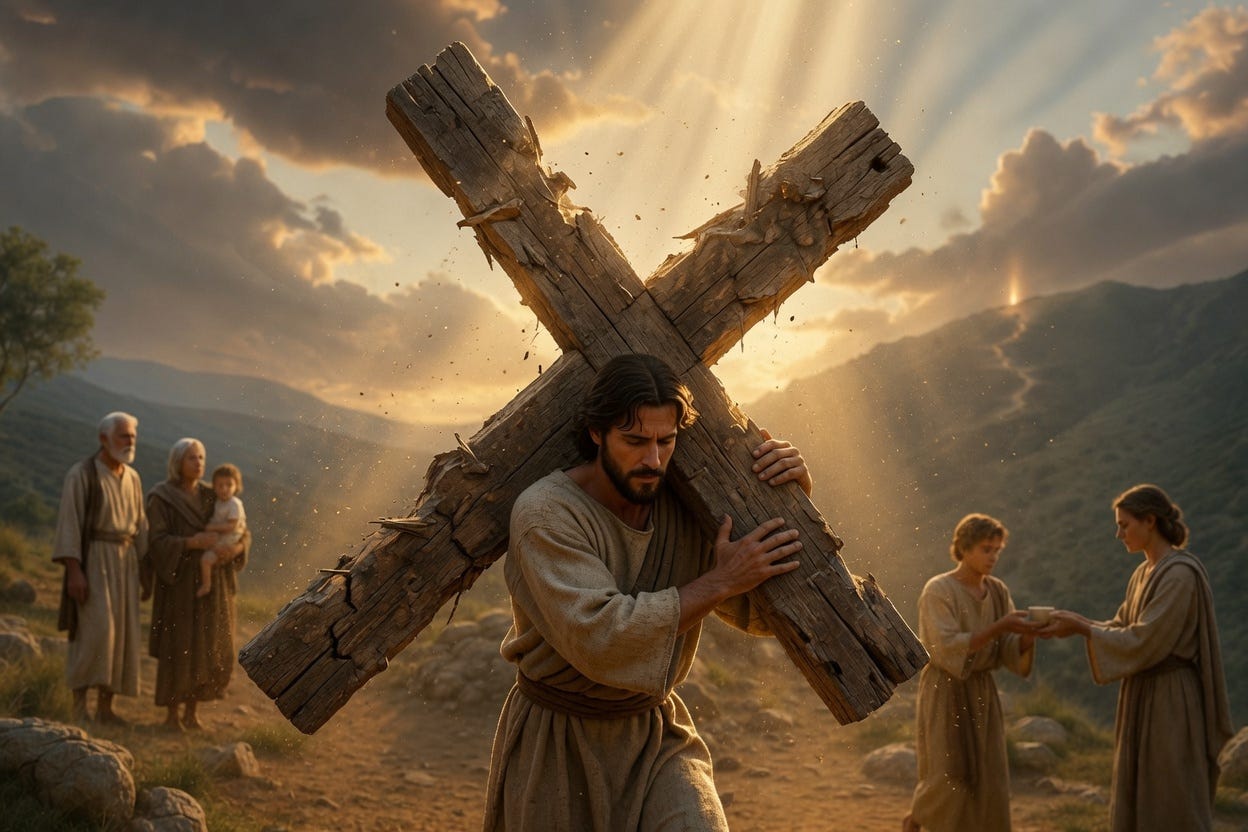
Despite being born of God the Father and the Spirit, He chose to lay down his crown and take up the cross for those He loved.
When we find ourselves plummeting from our own “High Houses,” we often feel like we are losing out. But the Gospel tells us the opposite. God isn’t waiting for us at the top of our pulleys and ropes; He is waiting for us at the bottom. He is the one in the circle of villagers, holding the medical supplies and the bread.
God opposes the proud but shows favor to the humble. (James 4:6b, NIV)
God opposes the high house because He knows it is a prison of our own making. He wants us in the Circle, where the air is breathable and the community is real. The moment we stop trying to out-climb our humanity, we finally stop being too big for the help we desperately need.
메타데이터
- post_id
- bb2b80085e09
- slug
- the-altitude-of-the-ego-bb2b80085e09
- url
- https://medium.com/koinonia/the-altitude-of-the-ego-bb2b80085e09
- canonical_url
- https://medium.com/koinonia/the-altitude-of-the-ego-bb2b80085e09
- author_url
- https://medium.com/@desmond.y01
- status
- ok
- fetched_at
- 2026-06-22 12:55:45