The Future of Coding Changed at Google IO 2026
Google’s AI agents can now build Android apps, debug code, deploy software, and automate developer workflows.
The Future of Coding Changed at Google IO 2026
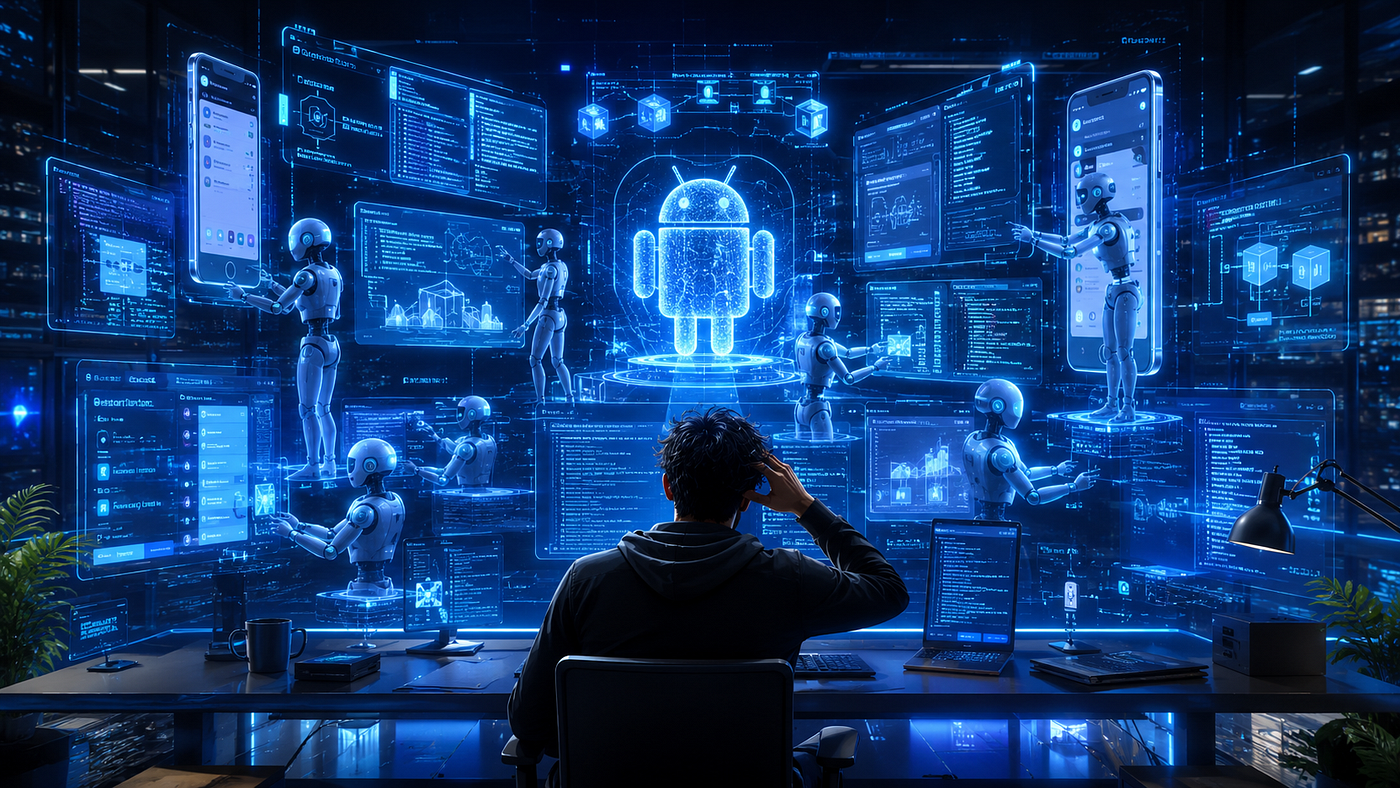
Google’s AI agents can now build Android apps, debug code, deploy software, and automate developer workflows.
For years, tech companies kept promising the same thing:
“AI will help developers code faster.”
Autocomplete got smarter. Code suggestions improved. Boilerplate became easier.
Useful? Definitely.
But after watching Google IO 2026, one thing became painfully obvious:
Google is no longer building AI coding assistants.
They’re building autonomous software workers.
And that changes everything.
This Wasn’t a Typical Developer Conference
At first, the keynote looked normal.
New Gemini models. Better reasoning. Faster APIs. Improved tooling.
Standard AI conference material.
But then Google started demonstrating something much bigger:
AI agents capable of:
- building Android apps,
- deploying websites,
- debugging production issues,
- generating UI,
- optimizing performance,
- testing interfaces,
- orchestrating workflows,
- managing cloud infrastructure,
- migrating iOS apps to Android,
- and even fine-tuning AI models automatically.
Not prototypes.
Real workflows.
And honestly, it felt less like a product launch and more like a preview of what software engineering becomes next.
The Android App Demo Was the Moment Everything Changed
This was easily one of the biggest moments of the keynote.
Google demonstrated developers building full Android apps directly inside AI Studio.
No SDK setup. No environment configuration. No Android Studio installation.
Just prompts.
The AI generated:
- native Kotlin code,
- app interfaces,
- emulator previews,
- deployment configurations,
- testing flows,
- and even Google Play publishing support.
One presenter casually said:
“No software to install, no SDKs to manage, and no local environment needed.”
That single sentence quietly eliminates years of developer frustration.
And probably half the “Android setup tutorials” on YouTube.
Traditional Coding Is Quietly Being Replaced by Orchestration
For decades, software engineering meant:
- writing syntax manually,
- connecting APIs,
- debugging line by line,
- fixing environments,
- managing deployments,
- configuring infrastructure,
- optimizing performance,
- repeating the process endlessly.
Google’s new agentic platform changes that workflow completely.
Developers increasingly describe:
- the goal,
- the constraints,
- the desired outcome.
The agents handle implementation.
That’s not just productivity improvement.
That’s a completely different relationship between humans and software creation.
The Most Important Line From the Entire Event
At one point during the keynote, a presenter joked:
“Honestly, it feels like the hottest new programming language is Markdown.”
Everyone laughed.
But nobody disagreed.
Because modern development is rapidly shifting away from manually writing every line of code toward:
- prompting,
- orchestrating,
- supervising,
- reviewing,
- and guiding AI systems.
Developers are increasingly becoming directors of intelligent systems instead of pure implementers.
That’s a massive shift.
Google’s AI Fine-Tuning Demo Felt Unreal
One developer gave the system a simple voice instruction:
“I want to fine tune Gemma 4 to directly give me a Bash command response with no additional fluff…”
That’s it.
The AI then:
- researched the approach,
- generated training code,
- built evaluation scripts,
- configured deployment,
- spun up infrastructure,
- monitored logs,
- validated outputs,
- and deployed the model locally.
In minutes.
Historically, workflows like this required experienced ML engineers and complicated infrastructure management.
Now it looked conversational.
That should make every developer pay attention.
AI Agents Are Becoming Entire Digital Teams
Google repeatedly used terms like:
- subagents,
- orchestration,
- mission control,
- autonomous workflows,
- scheduled agents,
- parallel task execution.
At one point, multiple agents were working simultaneously:
- one building a website,
- another generating assets,
- another planning architecture,
- another handling QA,
- another debugging issues.
Not humans.
Agents.
The developer becomes:
- the reviewer,
- the strategist,
- the architect,
- the operator.
Less typing. More decision-making.
Junior Developer Work Is Disappearing First
This is the uncomfortable reality most people avoid discussing.
A huge amount of entry-level engineering work revolves around:
- repetitive UI building,
- setup tasks,
- integrations,
- configuration,
- testing,
- debugging,
- migrations,
- deployment support,
- optimization work.
Google’s demos automated enormous portions of those workflows.
And the scary part?
The AI looked genuinely good at it.
Fast. Practical. Production-oriented.
That changes the economics of software hiring immediately.
The Web Development Demos Were Just as Important
Google also showed how AI agents are transforming the web itself.
The new tools could:
- implement browser APIs,
- debug accessibility issues,
- run Lighthouse audits,
- automatically fix performance problems,
- test interfaces like real users,
- optimize websites for AI agents,
- and create agent-compatible web experiences.
The browser itself is becoming AI-native.
Not just websites.
The browser.
That’s a much bigger shift than most developers realize.
AI Is Removing the Worst Parts of Software Development
And this is why the industry feels conflicted.
Because honestly?
The demos looked incredibly useful.
Deploying apps instantly. Fixing crashes automatically. Generating production-ready UI. Testing performance with one prompt. Managing infrastructure automatically.
These are tasks developers have hated for years.
AI isn’t just replacing work.
It’s removing friction.
And once developers experience that speed, going back to manual workflows will feel painful.
But There’s a Serious Problem Nobody Solved
If AI increasingly handles implementation…
How do future engineers learn fundamentals?
Because real expertise usually comes from:
- debugging painful failures,
- breaking systems,
- fixing performance bottlenecks,
- understanding infrastructure deeply,
- solving architecture problems manually.
If AI removes all friction too early, we may accidentally create developers who can prompt effectively…
…but don’t actually understand systems when things break.
And eventually, things will break.
That may become one of the biggest technical challenges of the next decade.
The Real Skill of the Future Isn’t Coding
It’s judgment.
The developers who thrive in this new era won’t necessarily be:
- the fastest coders,
- the best syntax memorizers,
- or the people grinding framework tutorials endlessly.
The winners will be the people who can:
- think clearly,
- communicate precisely,
- understand systems deeply,
- guide AI effectively,
- make strong technical decisions,
- and adapt faster than everyone else.
Because software engineering is no longer just about writing code.
It’s about directing intelligence.
Google IO 2026 Felt Like a Turning Point
This wasn’t simply another AI keynote.
It felt like a line in the sand.
A future where:
- AI builds apps,
- AI deploys software,
- AI optimizes performance,
- AI handles debugging,
- AI manages workflows,
- and humans increasingly supervise instead of manually implement.
And whether developers are emotionally ready or not…
The era of agent-first software development has officially started.
메타데이터
- post_id
- bb2ced7a7c8d
- slug
- the-future-of-coding-changed-at-google-io-2026-bb2ced7a7c8d
- url
- https://medium.com/@dverma9699/the-future-of-coding-changed-at-google-io-2026-bb2ced7a7c8d
- canonical_url
- https://medium.com/@dverma9699/the-future-of-coding-changed-at-google-io-2026-bb2ced7a7c8d
- author_url
- https://medium.com/@dverma9699
- status
- ok
- fetched_at
- 2026-06-09 15:37:30



