Chapter 4 — Space as Language (Part III)
5.Sensory Branding and Multisensory Experience
Chapter 4 — Space as Language (Part III)
5.Sensory Branding and Multisensory Experience
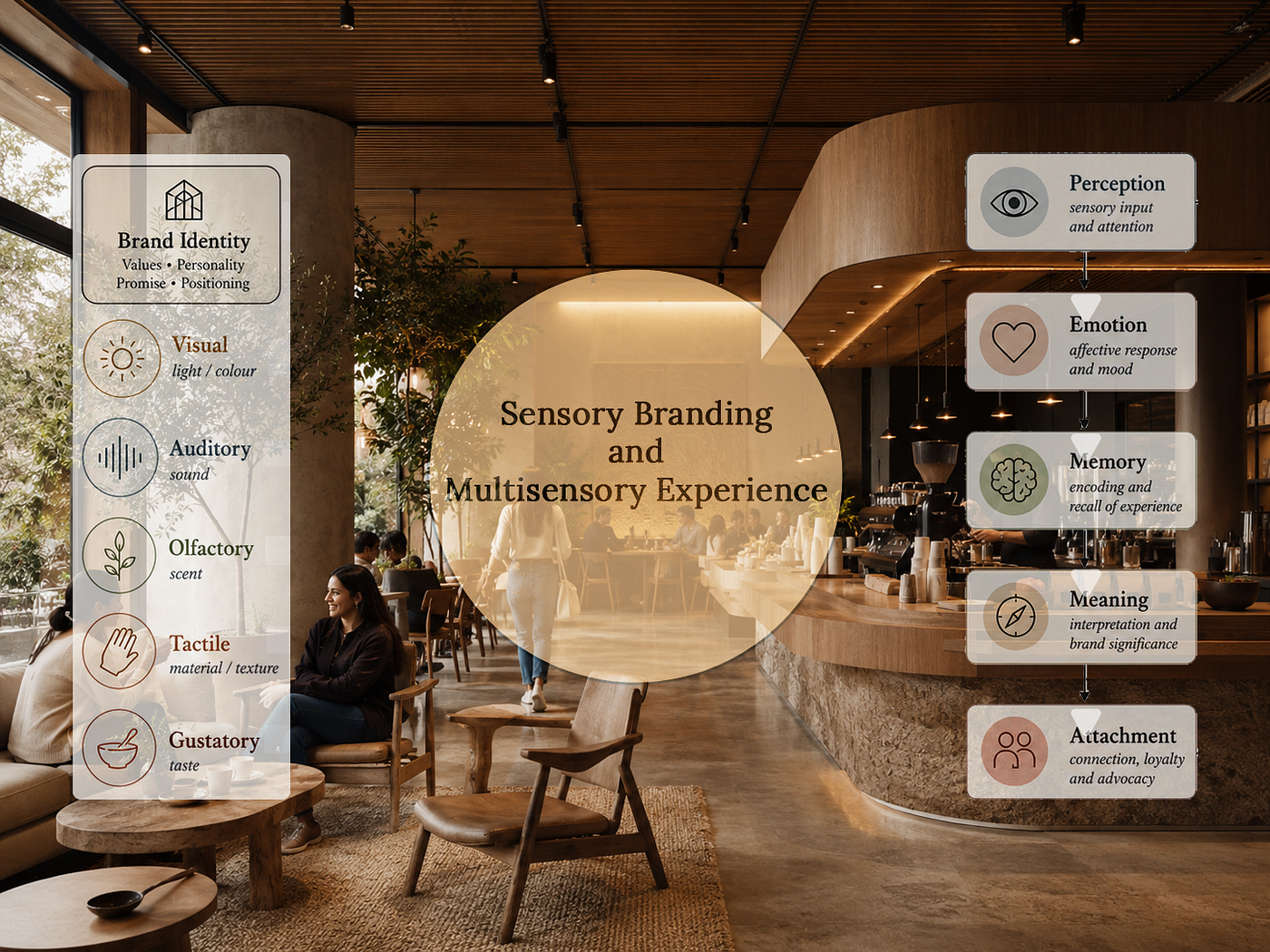
The intersection of branding strategy and sensory perception has generated significant research demonstrating that comprehensive brand experiences extend beyond visual communication to encompass auditory, olfactory, gustatory, and tactile dimensions. Sensory experience plays a significant role in how people perceive, interpret and relate to brands, because it influences emotional response, memory, recognition and behavioural engagement. Within this broader perspective, the branded environment becomes a three-dimensional expression of brand identity, extending the experience of a brand beyond graphic or verbal communication and into lived, embodied space. (Alawadhi, 2009) This framework reconceptualises physical environments as immersive brand settings rather than neutral containers for activity, service or interaction.
This perspective resonates with Juhani Pallasmaa’s reflections in The Eyes of the Skin, where he challenges the dominance of vision and argues for a more embodied understanding of spatial experience. For Pallasmaa, architecture is not apprehended through the eye alone; it is encountered through the entire sensory body, through touch, sound, smell, movement, materiality and atmosphere. By analogy, sensory branding may be understood as the extension of brand identity into a similarly embodied field of perception. A branded environment does not merely display a brand visually; it allows the brand to be physically and sensorially encountered, transforming identity into an atmosphere that can be perceived, remembered and emotionally internalised.
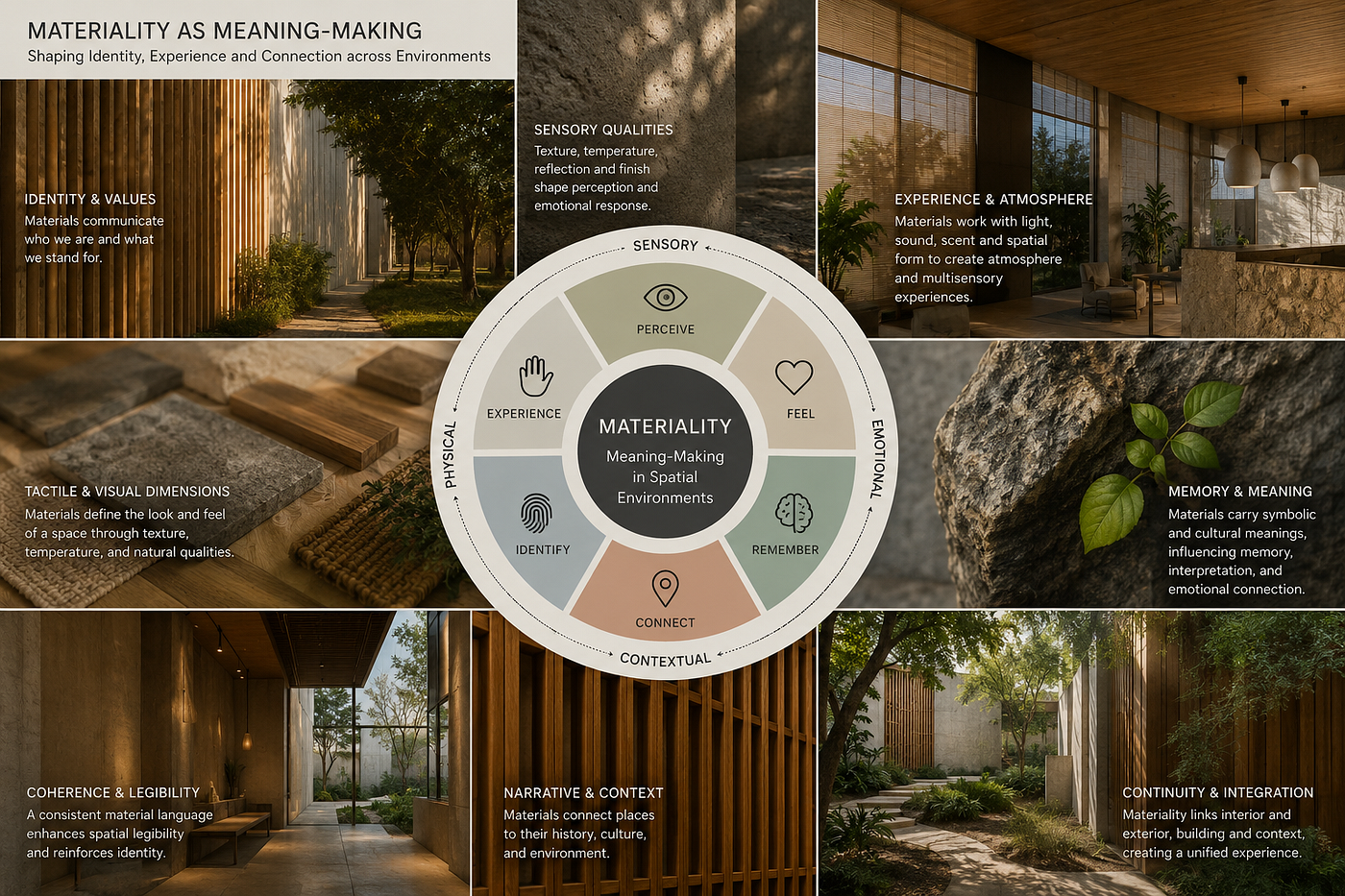
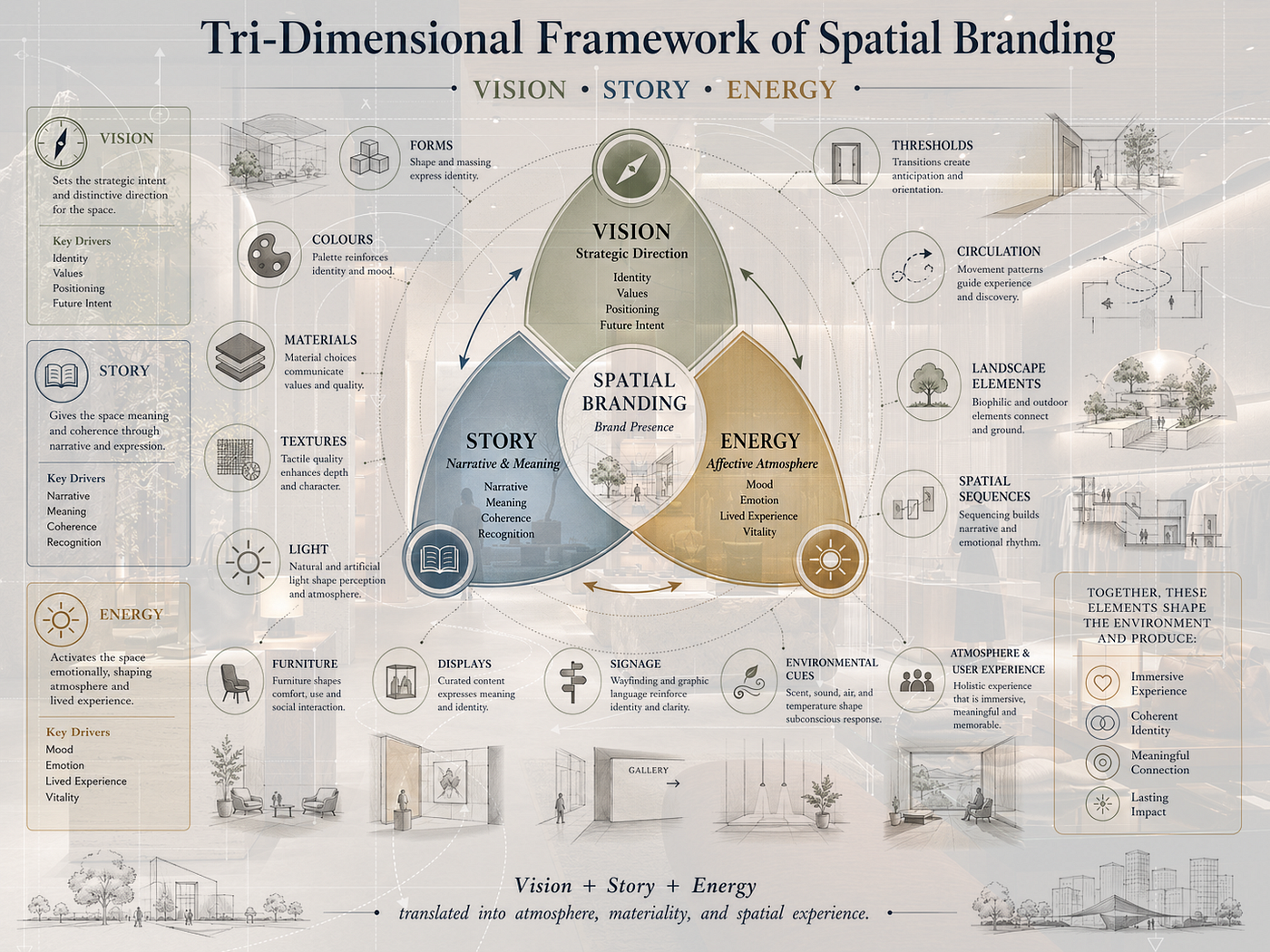
Following this line of thought, the sensory dimension of branding can be understood less as a set of persuasive marketing cues and more as the orchestration of an atmosphere through which identity becomes perceptible. Sound, light, texture, smell, scale, temperature and material presence do not merely decorate an environment; they shape the conditions through which people orient themselves, interpret meaning and form emotional associations with an organisation, place, service or community. The servicescape tradition has shown that physical surroundings influence the responses and behaviours of both users and staff, while theories of atmosphere emphasise the relational condition that emerges between spatial qualities and the perceiving subject. In this sense, sensory branding operates through the convergence of environmental, symbolic and embodied dimensions, transforming space into a medium through which brand meaning is not only seen, but felt, inhabited and remembered. (Bitner, 1992; Böhme, 1993; Zumthor, 2006)
Extending this argument, sensory brand experience may be understood as the internal processing of brand-related stimuli that emerge from a given brand setting. Zha et al. identify visual, auditory, olfactory, tactile and gustatory cues not as isolated instruments, but as a combined sensory system through which brand experience is formed. For the purposes of spatial branding, the relevance of this argument lies less in its consequences for loyalty and more in its recognition that brand meaning is shaped through the interaction between external environmental cues and internal bodily, affective and cognitive processes. In this sense, the branded environment becomes an ecological and embodied field of perception, where identity is translated into sensations, affects and subjective feeling states. (Zha et al., 2024)
In retail design, for example, brand-related information conveyed through multisensory cues in a brand setting is processed internally as sensory brand experience, involving impressions that may be perceived as fun, interesting, extraordinary, comforting, caring, innovative, pleasant, appealing or convenient. These impressions can influence key variables in customer–brand relationships, including satisfaction, attachment and emotional preference. (Zha et al., 2022) Although this research is developed within a commercial context, its broader relevance lies in showing how multisensory engagement can support stronger relationships with brands across commercial, institutional, cultural, hospitality, territorial, workplace and service environments.
The role of specific sensory modalities has been studied in particular detail. Lighting is a powerful tool for creating atmosphere and enhancing the sense of space, with lighting design significantly impacting interaction and mental well-being, involving the balance between artificial and natural illumination, the incorporation of biophilic elements, and the consideration of psychological aspects. (Ahmed & Sheyadi, 2025) Lighting operates across multiple registers — functional visibility, atmospheric mood creation, spatial orientation, symbolic emphasis and psychological wellbeing — making it a particularly versatile branding instrument in any environment where identity, behaviour and experience are intentionally shaped.
Colour, material and transparency interact significantly with one another. The coordination of colour systems and material palettes emerges as a crucial mechanism through which interiors achieve a unified brand presence. Colour is an important design element in architectural interior design, capable of improving the interior environment and creating atmospheres that respond to user preferences and needs. The understanding of colour, its relationship with the scale of architectural space, and its flexible application directly affect the quality of spatial design. (Liang et al., 2024) This technical design perspective emphasises colour’s dual role — aesthetic and functional — in structuring spatial experience and brand communication.
The interaction of colours and materials can produce either positive or negative emotional responses. Positive emotional experiences may be enhanced by specific combinations, such as “orange colour + metal material”, whereas negative emotions and psychological tension may be evoked by combinations such as “blue colour + metal material”. (Chen et al., 2026) This finding emphasises that sensory and material elements do not operate independently but generate emergent emotional effects through combinatorial interaction. In branding terms, this suggests that identity is not translated into space through isolated design decisions, but through the orchestration of material, chromatic, tactile and atmospheric relations.
Consistency between scent, atmosphere, spatial design, material qualities and perceived value can strengthen attachment and recognition within a brand experience. (Singh, 2021) Although this evidence is frequently drawn from retail environments, the underlying principle can be extended to broader brand contexts: multisensory coherence often supports meaning more effectively than isolated sensory effects. More broadly, sensory branding depends on consistency between identity, environment, behaviour and perception, transforming physical space into an active medium of brand meaning.
In this sense, sensory branding does not operate as an isolated layer of experience, but as part of a broader spatial system in which perception, emotion, memory and meaning are continuously constructed. Light, colour, material, sound, scent and tactility contribute to the atmosphere of a place, but they also prepare the ground for narrative interpretation: they guide attention, suggest values, organise expectations and give symbolic coherence to the encounter with a brand. This leads to the next question: how can space not only be sensed, but also read? The following section therefore turns to experiential branding and spatial narrative, examining how visual communication, spatial organisation and symbolic meaning work together to transform environments into legible brand experiences.
— // —
References
Ahmed, O. M. M., & Talib Al Sheyadi, A. A. (2025). The role of lighting design on human psychology in interior spaces (Fashion retail store case study). International Journal of Engineering Technologies and Management Research, 12(4), 47–75. https://doi.org/10.29121/ijetmr.v12.i4.2025.1560
Alawadhi, A. M. (2009). Retail branding through sensory experience: Local case-study at Chocolaterie Stam [Master’s thesis, Iowa State University]. Iowa State University Digital Repository. https://doi.org/10.31274/etd-180810-526
Bitner, M. J. (1992). Servicescapes: The impact of physical surroundings on customers and employees. Journal of Marketing, 56(2), 57–71. https://doi.org/10.1177/002224299205600205
Böhme, G. (1993). Atmosphere as the fundamental concept of a new aesthetics. Thesis Eleven, 36(1), 113–126. https://doi.org/10.1177/072551369303600107
Chen, F., Zhao, F., & Wang, Y. (2026). Interactive effects of emotional perception in university interior spaces: An empirical exploration based on the PAD model and multi-sensory simulation. Indoor and Built Environment. Advance online publication. https://doi.org/10.1177/1420326X261452152
Cho, J. Y., & Suh, J. (2020). Spatial color efficacy in perceived luxury and preference to stay: An eye-tracking study of retail interior environment. Frontiers in Psychology, 11, Article 296. https://doi.org/10.3389/fpsyg.2020.00296
Liang, T., Xiao, Z., & Guo, L. (2024). A deep learning model-based feature extraction method for architectural space and color connection in interior design. Scalable Computing: Practice and Experience, 25(4). https://doi.org/10.12694/scpe.v25i4.2896
Pallasmaa, J. (2012). The eyes of the skin: Architecture and the senses (3rd ed.). John Wiley & Sons.
Shahid, S., Paul, J., Gilal, F. G., & Ansari, S. (2022). The role of sensory marketing and brand experience in building emotional attachment and brand loyalty in luxury retail stores. Psychology & Marketing, 39(7), 1398–1412. https://doi.org/10.1002/mar.21661
Singh, R. (2021). The role of sensory branding in shaping customer loyalty: A case study of Starbucks. International Journal for Multidisciplinary Research, 3(1). https://doi.org/10.36948/ijfmr.2021.v03i01.45386
Zha, D., Foroudi, P., Melewar, T. C., & Jin, Z. (2022). Experiencing the sense of the brand: The mining, processing and application of brand data through sensory brand experiences. Qualitative Market Research: An International Journal, 25(2), 205–232. https://doi.org/10.1108/QMR-09-2021-0118
Zha, D., Foroudi, P., Melewar, T. C., & Jin, Z. (2025). Examining the impact of sensory brand experience on brand loyalty. Corporate Reputation Review, 28, 14–42. https://doi.org/10.1057/s41299-023-00175-x
Zumthor, P. (2006). Atmospheres: Architectural environments, surrounding objects. Birkhäuser.
메타데이터
- post_id
- bb2ecab86885
- slug
- space-as-language-part-iii-bb2ecab86885
- url
- https://medium.com/@francdccnha/space-as-language-part-iii-bb2ecab86885
- canonical_url
- https://medium.com/@francdccnha/space-as-language-part-iii-bb2ecab86885
- author_url
- https://medium.com/@francdccnha
- status
- ok
- fetched_at
- 2026-07-18 21:36:33