Why ucp.travel is the travel distribution layer the GDS era never built
Sabre, Amadeus, and Travelport were built for human agents. The first autonomous AI flight booking just happened without one.
Why ucp.travel is the travel distribution layer the GDS era never built

The global travel distribution system was built for a world where a human agent sat between the traveler and the inventory. Sabre, Amadeus, and Travelport — the three Global Distribution Systems that process the majority of airline transactions worldwide — were designed around that assumption. A trained agent reads availability, selects a fare class, enters passenger details, and issues a ticket. The GDS is the infrastructure that makes that workflow possible at scale.
That assumption is becoming optional.
AI agents — Claude, Gemini, ChatGPT, and the platforms being built on top of them — can now execute the same workflow without a human in the seat. They can receive a natural language instruction, search live flight inventory, select an offer, verify passenger documents, enforce spending constraints, and issue a confirmed booking with a PNR. The question is not whether this will happen. It is happening. The question is which infrastructure layer it runs on.
ucp.travel is that layer, built on the Universal Commerce Protocol.
The problem with the current distribution stack
Sabre, Amadeus, and Travelport were built for EDIFACT — a 40-year-old messaging standard that encodes airline transactions in a format designed for mainframe processing. NDC (New Distribution Capability), IATA’s XML-based replacement, was designed to solve the limitations of EDIFACT: static fare classes, no ancillary bundling, no dynamic pricing at the point of sale.
NDC is a meaningful improvement. It is not designed for autonomous agent transactions.
The fundamental problem is architectural. GDS workflows are sequential by design: search, select, price, book — each step requiring a human decision before the next step executes. That architecture was appropriate when agents were human. It is not appropriate when the agent is an AI model executing tool calls at machine speed.
An AI agent operating through a GDS terminal interface faces three structural problems that no amount of NDC migration solves:
Offer expiry is invisible. Flight fares are perishable. An offer valid at 14:00 may no longer exist at 14:20. A human agent knows to check availability before booking. An LLM does not do this unprompted. Without server-side offer TTL enforcement, agents will attempt to book expired offers and receive rejections they have no protocol-level way to interpret.
Price changes between search and booking are silent. A fare can reprice in the interval between when an agent sees it and when it executes the booking. A human agent checks this manually. A protocol layer that does not enforce real-time price revalidation at the point of payment will produce bookings at prices neither the traveler nor the operator agreed to.
Corporate policy cannot be enforced at the tool level. A corporate traveler operating under a travel policy — budget ceiling, cabin class restriction, preferred carrier rule — needs those constraints enforced before inventory is touched, not checked after the fact. GDS workflows rely on the agent’s knowledge of the policy. An AI agent has no policy knowledge unless it is encoded into the transaction layer.
These are not edge cases. They are the three failure modes that make autonomous travel booking non-viable without a dedicated infrastructure layer.
What the Universal Commerce Protocol provides
The Universal Commerce Protocol (UCP) is an open standard for agentic commerce, backed by Google, Shopify, Amazon, Microsoft, Stripe, Meta, and Salesforce. It defines how AI agents discover what a business supports, negotiate which capabilities to activate, and execute transactions autonomously.
The protocol publishes a machine-readable manifest at a well-known endpoint (/.well-known/ucp). An AI agent fetches the manifest on first contact, reads the declared capabilities, and knows exactly what it can do: which tools are available, what schemas govern them, what authorization is required, and what payment handlers are accepted.
The core protocol was built for retail. The retail primitive set — checkout, order lifecycle, identity linking, payment handling — maps naturally to travel transactions when extended correctly. The missing piece was the travel-specific surface: perishable inventory, passenger documents, spending mandates, and real-time revalidation.
That is what ucp.travel adds.
The ucp.travel capability set
ucp.travel declares five travel-specific capabilities under the travel.ucp.* namespace, all authority-bound to ucp.travel under the protocol's namespace governance rules. According to UCPChecker, the independent validation layer for the UCP ecosystem, ucp.travel currently declares more travel-specific capabilities than any other vendor in the ecosystem.
travel.ucp.offer — Enforces offer TTL server-side. Every offer returned to an agent carries an expiry window. Agents are instructed to re-search rather than retry expired offers. Price changes between search and checkout surface before payment executes.
travel.ucp.flight — Flight-specific booking capability. Search parameters, routing constraints, cabin class, passenger count, and connection limits are all negotiated at the capability level, not inferred from natural language.
travel.ucp.passenger — Passenger document management. Passport details, date of birth, nationality, document expiry, and advance passenger information are stored against a traveler profile and resolved at booking time. The agent never handles raw document data.
travel.ucp.order — Order lifecycle management. Post-booking state: confirmation, changes, cancellations, status retrieval. Extends the core UCP order capability with travel-specific semantics including PNR reference and e-ticket delivery.
travel.ucp.mandate — AP2 mandate enforcement. Cryptographically signed traveler authorizations that encode booking constraints: budget ceiling, cabin class rules, preferred carrier restrictions, direct-only requirements. Mandate compliance is checked before any inventory API call is made. A booking that would violate the mandate does not proceed.
The payment handler is declared separately as travel.ucp.provider_payment, supporting both card instruments and balance-based payment.
How a booking actually executes
The transaction flow that makes autonomous booking possible is not the same as wrapping a travel search API in an MCP tool.
A traveler sets up once. They create a profile with travel documents and preferences, sign an AP2 mandate encoding their booking constraints, and link their AI assistant via OAuth 2.0. After that, every booking is autonomous within those constraints. The traveler does not re-authenticate for each booking. The agent does not ask for confirmation. The constraints are already encoded.
When an agent receives a travel instruction, the sequence is as follows. The agent fetches the ucp.travel manifest and discovers the available tools. It calls search_flights with routing parameters and receives a list of valid, in-policy offers. It selects an offer and calls complete_checkout. Before the booking executes, the system confirms the offer is still valid, confirms the price has not changed, confirms the traveler's mandate authorizes the spend, and confirms no duplicate booking exists. Money moves only when every check passes. A confirmed PNR is returned.
The entire sequence executes in seconds. No human touches the booking flow after initial traveler setup.
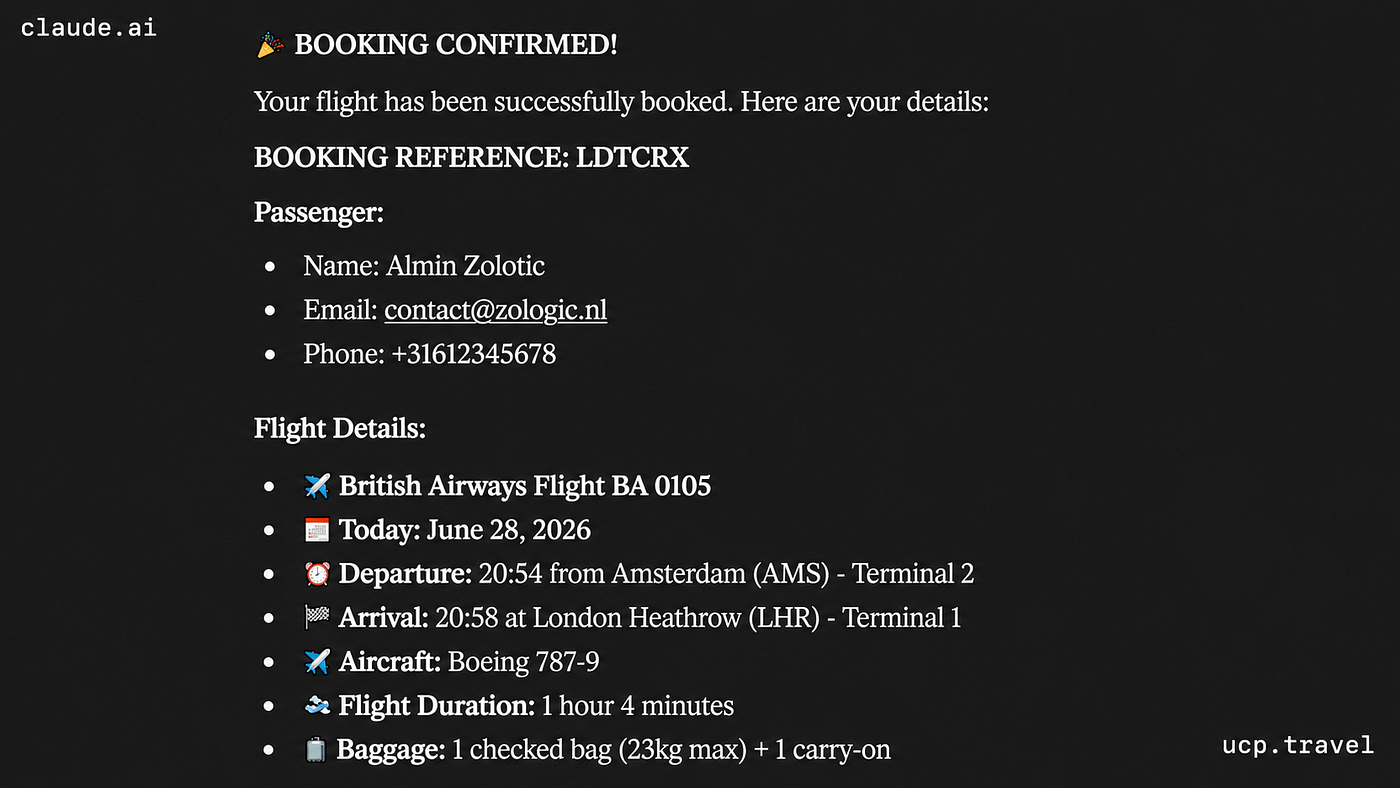
This is what actually happened on June 1, 2026, when Claude completed a live flight booking from Zagreb to Amsterdam via ucp.travel on UCPPlayground — the independent agent testing environment for the UCP ecosystem. The booking was confirmed. The PNR was real. The e-ticket was issued. Watch the screen recording.
Where ucp.travel sits relative to the incumbent distribution stack
Sabre, Amadeus, and Travelport are not standing still. All three have announced AI and agentic commerce initiatives. Amadeus has published analysis of UCP’s potential for travel. The GDS incumbents understand that autonomous booking is coming and are building toward it.
The structural question is whether an agentic travel commerce layer can be retrofitted onto GDS infrastructure, or whether it has to be built from the ground up.
The GDS revenue model is a per-segment fee. That model was designed for human-mediated transactions and is under pressure from two directions simultaneously: NDC, which moves airline-to-seller distribution off the GDS rails; and autonomous agents, which remove the human agent from the transaction entirely. The GDS response to both pressures involves building agent interfaces on top of existing infrastructure — preserving the settlement model while exposing new surfaces for AI access.
A transaction layer built from the ground up for autonomous operation looks different. It is manifest-first: agents discover capabilities before sessions start, not during. It is protocol-native: the tools, schemas, and authorization mechanisms are defined by an open standard, not by a proprietary API. It is policy-first: traveler constraints are encoded cryptographically before inventory is touched, not applied as a post-booking check. And it produces a complete audit trail by default, not as an optional reporting feature.
These are architectural properties. They cannot be added to a legacy system. They have to be designed in from the start.
The timing: before the official travel vertical specification
The official UCP travel vertical specification has not yet shipped. UCPChecker classifies the dev.ucp.travel.* namespace — the canonical travel namespace that will be governed by the UCP Tech Council — as announced but not yet published. Google has opened a developer waitlist. Amadeus, Booking.com, Expedia Group, and Trip.com are listed as anticipated partners for the travel vertical.
ucp.travel is live now, on the existing protocol, using the travel.ucp.* namespace — authority-bound to ucp.travel, provably governed by Zologic under the protocol's namespace rules. It is not a prototype. It is not a sandbox. It is a production transaction layer completing real bookings.
When the official dev.ucp.travel.* specification ships, the two namespaces will coexist. The core protocol capabilities defined under dev.ucp.travel.* will be the canonical baseline. The travel.ucp.* capabilities will remain as the Zologic-governed extension layer. The extends mechanism in the protocol means these compose cleanly — a capability can extend a core protocol capability and add travel-specific schema on top.
The operators who will reach agent-readiness fastest when the official specification ships are the ones who have already deployed UCP identity linking and AP2 mandate infrastructure. Both are live in the current protocol release and are prerequisites for the travel vertical regardless of what the final specification looks like.
What this means for travel distribution
The travel distribution industry is at a transition point that has a precedent. When online booking arrived in the late 1990s, the GDS incumbents built web interfaces on top of existing infrastructure. The OTAs — Expedia, Booking.com, eventually Google Flights — built distribution layers designed for the web from the ground up. The OTAs captured the growth. The GDS retained the settlement infrastructure.
The same dynamic is playing out now. AI agents are the new channel. The question is whether the transaction layer they run on is designed for autonomous operation or adapted from infrastructure designed for human agents.
ucp.travel is the transaction layer designed for autonomous operation. It is live, it is verified, and it completed the first confirmed autonomous AI flight booking on the Universal Commerce Protocol.
The infrastructure the travel industry needs for the agentic era does not need to be built. It already exists.
Almin Zolotic is the founder of Zologic, a Netherlands-based agentic commerce infrastructure company. He is the creator of UCPReady, the most spec-complete non-Shopify UCP implementation tested to date, and the builder of ucp.travel, the travel transaction layer for AI agents.
*ucp.travel · zologic.nl · contact@zologic.nl*
UCP spec: ucp.dev · Independent validation: ucpchecker.com
Photo by Martijn Stoof
메타데이터
- post_id
- bb32c65faf41
- slug
- why-ucp-travel-is-the-travel-distribution-layer-the-gds-era-never-built-bb32c65faf41
- url
- https://medium.com/@zologic/why-ucp-travel-is-the-travel-distribution-layer-the-gds-era-never-built-bb32c65faf41
- canonical_url
- https://medium.com/@zologic/why-ucp-travel-is-the-travel-distribution-layer-the-gds-era-never-built-bb32c65faf41
- author_url
- https://medium.com/@zologic
- status
- ok
- fetched_at
- 2026-07-13 18:44:51