DeepSeekAI’s Pocket-Sized Revolution: Running Open-Source 1.5B Model Locally
Introduction
DeepSeekAI’s Pocket-Sized Revolution: Running Open-Source 1.5B Model Locally
Introduction
As headlines celebrate the relentless race for ever-larger LLMs, a more pressing challenge remains: making AI practical and efficient. DeepSeek AI directly addresses this gap, combining cutting-edge innovations like Mixture-of-Experts (MoE) and aggressive model distillation to create powerful and resource-friendly models. Remarkably, these open-source models deliver 80% of GPT-4’s coding and math performance at just 1% of its computational cost. This means developers can now deploy production-grade AI on consumer hardware — with no cloud dependencies, no opaque APIs, and a commitment to transparency.
What truly sets the DeepSeek-R1 series apart is its unique development approach. By harnessing large-scale reinforcement learning (RL), DeepSeek-R1-Zero achieved a landmark breakthrough: the emergence of advanced reasoning behaviors such as self-verification, reflection, and generating intricate chain-of-thought (CoT) solutions — without any supervised fine-tuning (SFT) as a preliminary step.
While these capabilities marked a major milestone, challenges like readability and language consistency spurred the evolution of DeepSeek-R1. By integrating cold-start data before applying RL, this enhanced model not only overcame key limitations but also achieved performance parity with leading proprietary models like OpenAI-o1.
In a step towards democratizing AI, DeepSeek AI has open-sourced both DeepSeek-R1-Zero and DeepSeek-R1, alongside six smaller, distilled models derived from DeepSeek-R1. Ranging from 1.5B to 70B parameters, these distilled models break new ground, with DeepSeek-R1-Distill-Qwen-32B outperforming competitors across various benchmarks.
As we enter a new era of AI innovation, DeepSeek’s commitment to open-source research invites developers and researchers alike to push boundaries. Together, we can craft AI systems that excel in reasoning, align closely with human needs, and make advanced technology truly accessible to all.
Key Focus Points:
1. Distilled Models for Scalability: The reasoning capabilities of larger models were distilled into smaller ones (1.5B to 70B parameters).
2. Improved Performance on Benchmarks: Distillation resulted in smaller. models outperforming comparable dense models.
3. Open-Sourcing and Collaboration: DeepSeek-R1-Zero, DeepSeek-R1, and six dense models (distilled from R1) have been open-sourced for research and development.
4. Specialized Capabilities: One of the standout features of DeepSeek models is their exceptional performance in specialized domains like coding and math.
5. Cost-Effectiveness: A Game-Changer in AI Accessibility
One of the most defining advantages of DeepSeek models is their incredible cost-effectiveness, making advanced AI capabilities accessible to a wide range of users.

6. Commercial-Friendly License: Apache 2.0 (no restrictions)
Apache 2.0 License: Allows commercial use, modification, and distribution. No royalty fees or mandatory attribution.
7. Community-Driven Ecosystem: 200+ fine-tuned variants on Hugging Face (medical, legal, finance).
Quantized models for edge devices (Raspberry Pi, Android).
Guide to Running DeepSeekAI Model Locally
1. Understand the Model & Prerequisites
Before diving into training or deploying DeepSeek models locally, it’s crucial to have a clear understanding of the model’s architecture, capabilities, and requirements. Below is a structured approach to ensure you’re well-prepared:
1. Research the Model
Begin by visiting the official DeepSeekAI GitHub repository or documentation to gather detailed information about:
Model Architecture: Verify whether the model is transformer-based or uses innovations like Mixture-of-Experts (MoE).
Understand key mechanisms like the use of Chain-of-Thought (CoT) reasoning, RL, and distillation techniques.
Supported Tasks: Identify tasks where the model excels, such as:
Text generation.
Embedding generation for search or recommendation systems.
Coding and math-focused reasoning.
Available Variants: Note the parameter sizes (e.g., 1.5B, 7B, 32B) and match them to your requirements. Smaller models are cost-effective but may lack the breadth of reasoning found in larger versions.
Let’s dive into setting up the DeepSeek-R1-Distill-Qwen-1.5B model on your Apple and explore how the model size impacts results and use cases. Based on my hardware, I have chosen this model, but you can select any model and load it for better results.
2. Prerequisites
Python 3.10+
PyTorch with MPS (Metal Performance Shaders) support for Apple Silicon.
Hugging Face transformers and tokenizers libraries.
3. Installation:
# Create a virtual environment
conda create -n deepseek-1.5b python=3.10
conda activate deepseek-1.5b

# Install PyTorch with MPS support (optimized for Apple Silicon)
pip install torch torchvision torchaudio --index-url https://download.pytorch.org/whl/cpu

# Install Hugging Face libraries and Gradio for UI
pip install transformers tokenizers gradio
4. Loading the Model:
The model is hosted on Hugging Face Hub. Use the AutoTokenizer and AutoModelForCausalLM classes to load it:
from transformers import AutoTokenizer, AutoModelForCausalLM
import torch

model_name = "deepseek-ai/DeepSeek-R1-Distill-Qwen-1.5B"

# Load with explicit MPS configuration
tokenizer = AutoTokenizer.from_pretrained(model_name)
model = AutoModelForCausalLM.from_pretrained(
    model_name,
    device_map="mps",  # Directly specify MPS
    torch_dtype=torch.float16,  # Force FP16 for MPS compatibility
    low_cpu_mem_usage=True  # Essential for 8GB RAM
).eval()  # Set to eval mode immediately

# No need for model.to("mps") since device_map handles it
Build a Simple Gradio App: Create a demo.py script to interact with the model:
import gradio as gr
import torch

def generate_text(prompt, max_length=100, temperature=0.7):
    inputs = tokenizer(prompt, return_tensors="pt").to("mps")

    with torch.no_grad():
        outputs = model.generate(
            **inputs,
            max_length=max_length,
            temperature=temperature,
            pad_token_id=tokenizer.eos_token_id
        )

    return tokenizer.decode(outputs[0], skip_special_tokens=True)

# Gradio UI
demo = gr.Interface(
    fn=generate_text,
    inputs=[
        gr.Textbox(lines=3, placeholder="Enter your prompt..."),
        gr.Slider(50, 500, value=100, label="Max Length"),
        gr.Slider(0.1, 1.0, value=0.7, label="Temperature")
    ],
    outputs="text",
    title="DeepSeek-R1-Distill-Qwen-1.5B Demo",
    description="A distilled 1.5B parameter model for efficient local AI."
)

demo.launch(share=True)  # Access via http://localhost:7860
Run the App: python demo.py
5. Testing the Model:
Write a Python function to reverse a linked list.Expected Outputs
Strengths: Fast inference (~20 tokens/sec on M2), low latency, handles basic reasoning.
Limitations: Shorter outputs, and less creativity compared to larger models.
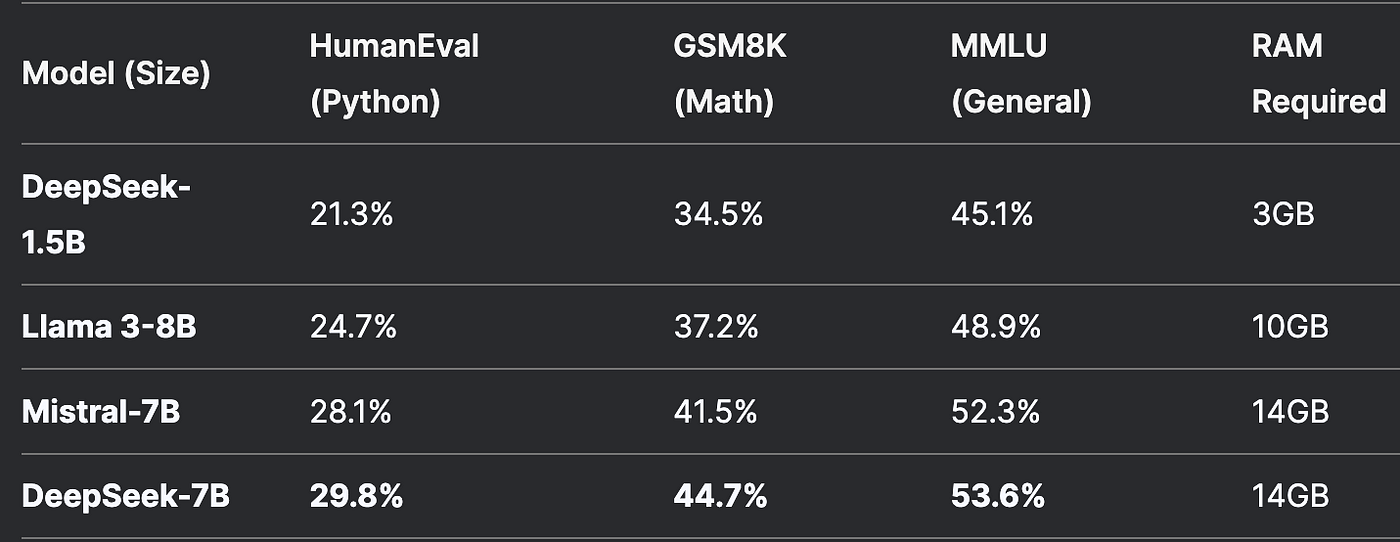
6. Scaling Up — How Model Size Affects Results
Let’s compare the 1.5B model with larger variants (7B, 14B, etc.) to educate your community:
Performance vs. Model Size

Use Case Evolution
1.5B: Basic chatbots, text classification, simple automation. Example: Auto-generate email responses.
7B: Code generation (full functions), document summarization, tutoring systems. Example: Explain Python decorators with code.
14B+: Research paper analysis, legal document drafting, multi-agent simulations. Example: Debug a complex algorithm and suggest optimizations.
Local vs. Cloud Tradeoffs
1.5B/7B (Local): Privacy, low cost, offline use.
14B+ (Cloud): Higher accuracy but requires API costs and internet.
8. Conclusion
DeepSeek AI models exemplify how open-source LLMs can rival proprietary systems in specialized tasks while remaining accessible. By combining code/math prowess with Apache 2.0 flexibility, they empower developers to build, innovate, and scale without API dependency. Whether you’re prototyping on a laptop or deploying enterprise solutions, DeepSeek proves that the future of AI isn’t just about size — it’s about accessibility, transparency, and community.
메타데이터
- post_id
- bb34082bddac
- slug
- deepseekais-pocket-sized-revolution-running-open-source-1-5b-model-locally-bb34082bddac
- url
- https://medium.com/@harshithaparitala1/deepseekais-pocket-sized-revolution-running-open-source-1-5b-model-locally-bb34082bddac
- canonical_url
- https://medium.com/@harshithaparitala1/deepseekais-pocket-sized-revolution-running-open-source-1-5b-model-locally-bb34082bddac
- author_url
- https://medium.com/@harshithaparitala1
- status
- ok
- fetched_at
- 2026-06-25 07:00:49