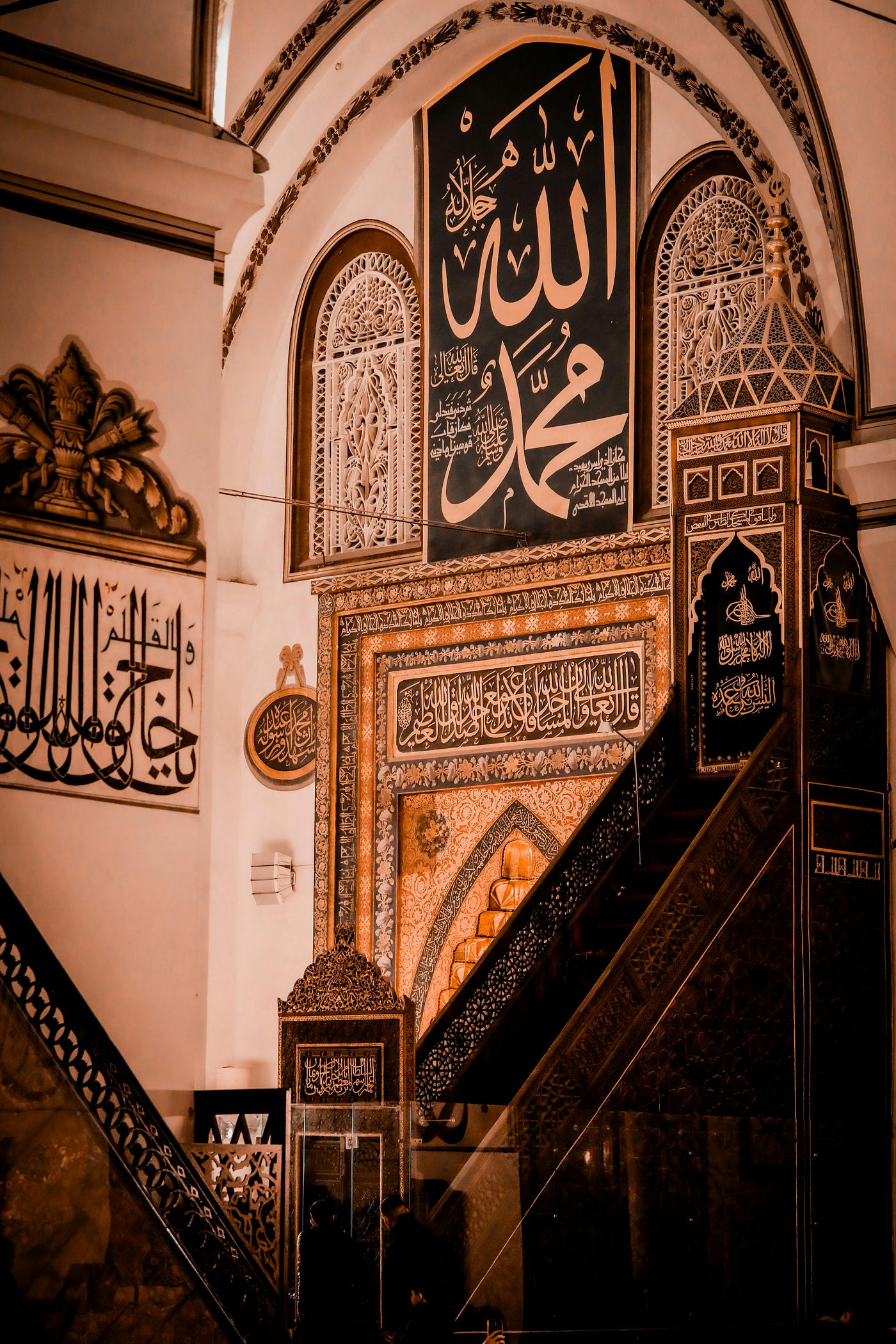
Satan Disguising Himself as an Angel of Light: Is It Proof That Prophet Muhammad Was Spreading the…
It can be quite draining to spend time on the internet or when we’re stumbling on some group of people in real life these days and witness…

Satan Disguising Himself as an Angel of Light: Is It Proof That Prophet Muhammad Was Spreading the Religion of Satan?
It can be quite draining to spend time on the internet or when we’re stumbling on some group of people in real life these days and witness the sheer volume of arguments, anger, and desperation coming from certain critics and online commentators.
When people are deeply committed to discrediting a religion like Islam, they often lose their common sense and resort into rhetorical tricks.
They will go into their own scriptures, pull out a single sentence or a random verse, twist it and try to apply it to the life of the Prophet Muhammad, all for a fast, dramatic way to win an online debate.
However, they usually miss a very basic rule of logic. The moment you take their argument out of their own forced definitions and hold it up to the actual story from both side, it turns their argument into a logical boomerang. Most of the time, if their argument were valid, then they accidentally condemned their own prophets and religious leaders because they would fail the exact same tests and standards.
One of the favorite online tricks used by these critics involves a short passage written by Paul in the New Testament.
In this letter, Paul warns his followers to be careful because even Satan can change his appearance and disguise himself as a bright "angel of light" to trick human beings into following a false path.
Theg seize this warning and point directly at Islamic history, specifically, to the day the Prophet Muhammad received his very first message from God while praying alone inside the quiet cave of Hira.
They confidently tell their audience:
"Look right here! Paul warned us about this exact situation hundreds of years before it happened. The being that Muhammad met inside that dark cave was not actually the Angel Gabriel. It was really Satan putting on a disguise, pretending to be a bright angel of light just to start a false religion."
Let us look at this claim with an open mind, a calm heart, and a clear focus on the facts. We are not here to shout or use angry words. Instead, we break down these claims piece by piece, look closely at the historical records on both sides, and put this entire narrative through a mirror test.
This argument is not just wrong about the basic facts of Islamic history, it relies entirely on a double standard. If you were to take this exact same rule and use it fairly across the board, you would completely ruin the stories, the honesty, and the validity of almost every single major prophet mentioned in the Bible.
This post was not intended to degrade or disrespect any belief. Its purpose is to encourage self-awareness and collective critical thinking, urging us to recognize and reject manipulative provocations. By examining how shallow these arguments truly are, we can better understand the tactics used by those who seek to spread hatred and sow division among us.
What Exactly Are the Critics Claiming?
To understand why this specific argument is so popular in online debate rooms, we have to look closely at the pieces used to build it. Critics generally bring forward two historical descriptions and one physical comparison to create their narrative.
1. The Cave and the Pressure
First, they open the New Testament, specifically looking at the book of 2 Corinthians chapter 11, verse 14, where Paul writes:
"And no wonder, for even Satan disguises himself as an angel of light."
Right after showing this verse, critics flip over to the books of Islamic history and look at the account of the very first day the revelation started.
The historical records tell us that the Prophet Muhammad used to go away from the busy city of Mecca to sit quietly, think, and pray inside a small cave on a mountain called Hira.
One day, while he was completely alone in the cave, a massive spiritual being, the Angel Gabriel, suddenly appeared to him. The angel looked at him and gave him a direct command:
"Read!" (which is Iqra in Arabic).
Because the Prophet Muhammad grew up in a society where most people did not know how to read or write, and because he had never gone to school, he looked back at the angel and said honestly:
"I cannot read."
The historical accounts tell us that when the Prophet said this, the angel came close, took hold of him, and embraced him so tightly that the Prophet felt an immense, overwhelming physical and spiritual weight.
It was a deep pressure that made him feel like he was losing his breath. The angel let him go, looked at him again, and gave the exact same command:
"Read!"
Again, the Prophet replied that he could not read. The angel embraced him tightly a second time, until the physical weight was almost too much to bear, and then let him go.
This happened three times in a row. Finally, after the third intense embrace, the angel delivered the very first five verses of the Qur'an, telling him about how God created human beings and taught them with the pen.
Critics look at this intense, shocking spiritual meeting and say:
"See? That looks so scary and forceful. A real angel from a loving God would never squeeze a person or make them feel like they are suffocating. This looks completely demonic, and it perfectly matches what Paul was talking about."
2. The Sadness and the Silence
Second, critics try to add a psychological argument to their case. They point to what happened right after this first meeting in the cave.
The historical records show that after that intense day, the heavy spiritual messages suddenly stopped coming for a significant period of time. This quiet time in history is known as the Fatrah al-Wahy, or the pause in revelation.
During this long silence from heaven, the Prophet Muhammad did not know what was happening. He wondered if he had done something wrong, or if God was unhappy with him.
The historical texts of the life of the Prophet Muhammad, describe him as being deeply sad. He was so overwhelmed by the sudden silence and the heavy emotional weight that he experienced a period of deep grief. Some notes even mention him walking up to the high, lonely tops of the mountains, feeling completely lost and looking for answers.
They look at this emotional grief and claim:
"Real prophets chosen by God do not get sad, depressed, or go through dark times like that. True prophets are always filled with total peace and confidence. The fact that he felt so much despair and mental torment proves that he was actually being bothered by a bad spirit that left him feeling empty."
3. The Question of Death
Finally, critics love to throw in a simple physical comparison at the very end of their argument. They look at the audience and say:
"Think about this logically. If Jesus and Muhammad are both supposed to be prophets, why is Jesus alive up in heaven right now, while Muhammad died a regular death and is buried in the dirt inside a grave in Medina? Doesn't the fact that he died and stayed in the ground prove that he was on the wrong side of the spiritual battle?"
On the outside, if you are a person who has never opened a history book, never read the Bible carefully, and never studied the context of these stories, this whole argument might sound clean and logical. It seems to connect the dots nicely.
But the moment you step away from the emotional video clips, and look at the Bible and the Torah itself, the entire argument completely collapses under the weight of its own double standards.
Testing Paul with His Own Rule
Before we walk over to look at the details of the Prophet Muhammad’s life, we have to stop and ask a basic, common-sense question, who actually wrote down this famous warning about the angel of light? It was a man named Paul.
The most ironic part about this entire debate is that the critics are building a massive argument using the words of a man whose own claim to being a religious leader relies on the exact same kind of story they are trying to attack. Let us put Paul through his own test and look at the facts of his life.
Paul was not one of the original twelve disciples of Jesus. In fact, he never actually met Jesus during Jesus' regular earthly life. During the years right after Jesus left, Paul was a fierce enemy of the early Christians.
He spent his days actively hunting them down, dragging them out of their homes, putting them in chains, throwing them into prison, and agreeing to have them hurt or killed. He was a violent man who hated the early movement.
Then, one afternoon, while he was traveling on the road toward the city of Damascus to arrest more Christians, Paul claims that something incredible happened to him.
According to his own words recorded in the Bible, he did not see a physical person walking on the road. Instead, he suddenly saw a blinding, flashing light come down from the sky, and he heard a loud voice speaking out of nowhere.
The light was so bright that it knocked him to the ground and left him completely blind for days.
Let us look at this with total honesty and common sense. Paul had absolutely no way to check or verify who that voice actually belonged to. He did not know what Jesus looked like when he was alive, and he did not know what Jesus' voice sounded like.
He was just a man lying on the ground in the dirt, completely blinded by a sudden flash of light, listening to a voice that claimed to be Jesus. He simply assumed it was Jesus because the experience was so intense, bright, and shocking.
Paul then took this private vision on the road and used it as a permanent license to tell everyone, "You just have to trust me."
He used that single vision to completely change the direction of the religion. He told people they didn't need to follow the sacred law of Moses anymore, he cancelled the ancient dietary and food laws that Jews had followed for thousands of years, and he started preaching a brand-new message.
This message caused massive arguments among the original disciples of Jesus, like Peter and James, who had actually lived with Jesus, eaten with him, and walked with him for years. Historical records in the Bible show that many of the original followers deeply distrusted Paul and were highly suspicious of his sudden claims.
But the problem for Paul becomes clearer when you look at the written records. If we apply the critics' strict standard to Paul’s own personal testimony inside the New Testament book of Acts, his story completely fractures.
He retells the story of what happened to him on that road to Damascus three different times in the exact same book, and every single time he tells it, the physical details change so much that they flatly contradict each other:
In Acts chapter 9, verse 7:
Paul states clearly that the men who were traveling with him heard the mysterious voice speaking, but they did not see anyone at all.
In Acts chapter 22, verse 9:
Paul completely turns the story around and says that the men traveling with him saw the bright light, but they did not hear the voice of the one who was speaking to him.
In Acts chapter 26, verse 14:
He changes the physical details yet again, claiming that when the light flashed, it wasn't just him who fell down, but everyone in the entire caravan fell to the ground together.
Let us think about this simply. If a person walked into a courtroom today as the primary witness in a serious case, and under cross-examination they gave three completely different, conflicting versions of what their eyes saw and what their ears heard, any decent judge would throw their testimony out immediately. They would be called an unreliable witness.
So we have to ask the critics, if Paul cannot even keep the basic physical details of his own primary vision straight, and if he had absolutely no independent witnesses who could verify what the voice actually said to him, why should we use his personal warning to judge the honesty of another prophet?
If we use their logic fairly, the argument snaps shut on Paul. If Satan truly changes his appearance to look like a blinding, heavenly light and uses a mysterious voice to lead people away from the original, sacred laws of God, then Paul's own experience on the road to Damascus fits his own warning far more perfectly than anyone else in history.
The Character of the Prophet Muhammad
Now, let us turn the mirror around, step away from Paul, and look at the actual life of the Prophet Muhammad. When you examine his history, you see a completely different picture.
Unlike Paul, who had a well-known, violent past of hunting down and hurting innocent believers, the Prophet Muhammad lived a life of completely open, transparent, and flawless character for forty long years before he ever claimed to receive a single word of revelation from God.
He did not just appear out of nowhere with a sudden, wild vision on a lonely road. He grew up, lived, worked, and got married right in the middle of his own community.
Everyone in the city of Mecca, even the wealthy leaders who eventually became his fiercest enemies, known him personally. They respected him so much because of his incredible honesty that they universally gave him two special titles, Al-Amin which means "The Trustworthy," and As-Sadiq, which means "The Truthful."
People would regularly bring their money, their gold, and their most valuable possessions to his house just to keep them safe, because they knew he would never cheat them.
Let's look at the famous story that happened years later, when the message of Islam was spreading. The Prophet Muhammad sent an official letter across the borders to the great Roman Emperor Heraclius, inviting him to look at the message of Islam. When the Emperor got the letter, he wanted to know if this man was real or a fraud. He ordered his guards to find any people from Mecca who happened to be traveling in the area on business.
The guards brought in a group led by a man named Abu Sufyan. At that exact moment in history, Abu Sufyan was the leader of the Meccan opposition army. He was actively fighting a bitter war to try and stop the Prophet Muhammad and destroy Islam completely.
The Roman Emperor Heraclius stood in front of Abu Sufyan and started asking him very direct, sharp questions about Muhammad’s life and background:
"Did this man ever tell a lie before he made this claim of being a prophet? Did he ever betray his promises or break his word? What does he actually command you people to do?"
Think about the massive opportunity Abu Sufyan was holding in his hands. He was standing in front of the most powerful Emperor in the world. He was actively trying to destroy Muhammad back home.
All he had to do was tell one giant lie to the Roman Emperor, and he could have ruined the Prophet’s reputation on the world stage forever. He could have easily said, "Yes, he is a liar and a crazy man."
But Abu Sufyan knew something important. He knew that the Prophet’s lifelong reputation for honesty was completely solid, and his own personal honor as an Arab leader would be utterly ruined if he got caught telling a cheap lie. He was forced to tell the absolute, raw truth.
He looked at the Roman Emperor and admitted that Muhammad had never told a single lie in his entire life. He admitted that the Prophet always kept his promises, and that his message simply commanded people to worship only one God, to give their money to charity, to help the poor, to stay close to their families, and to live a clean, moral life. We also have to look at how the Prophet lived his daily life to see if he acted like a fraud.
A person who makes up a fake religion usually does it because they want to gain something for themselves, like mountains of money, a massive palace, a crown, or total political power over others.
When the Prophet Muhammad started preaching in Mecca, his message threatened the money and power of the elite rulers because he told them to stop worshipping idols and stop cheating the poor.
The elites came to him directly and made him a concrete offer. They explicitly said:
"If you want money, we will pool our gold together and make you the richest man in the land. If you want political power, we will put a crown on your head and make you our absolute king. If you are sick or being bothered by a bad spirit, we will spend all our wealth to hire the best doctors in the world to cure you. Just stop preaching this message."
If the Prophet Muhammad were a liar trying to get power, he would have taken that deal on day one. It was everything a con man could ever dream of. But he looked at them and refused every single bit of it.
He chose instead to stay with his followers and endure ten long, agonizing years of public mockery, physical stones being thrown at him, severe starvation where they had to eat leaves off trees during a total community boycott, and watching his closest friends get tortured to death.
A con man simply does not stick around to suffer through decades of poverty, hunger, and danger just to teach people to pray to God, feed orphans, and avoid sins. His flawless character before the revelation, and his deep sacrifice during it, completely match the profile of a real messenger of God.
Spiritual Meetings in Biblical History
Let us turn our attention back to the critics' favorite claim about the cave. They argue that because the Prophet Muhammad experienced a massive spiritual weight, felt terrified, and went through an intense physical toll during his very first encounter with the Angel Gabriel, the experience must be demonic.
They try to claim that a real, good angel from God would always be soft, gentle, and comfortable, and would never cause a human being to feel fear, physical exhaustion, or heaviness.
This specific argument shows that these online critics have not actually sat down to read their own Bible with care. Let us look at the written records inside the Old and New Testaments to see how biblical prophets actually reacted when they met real angels of God.
Every single time a major prophet or a righteous figure in the Bible encounters a real, powerful angel of the Lord, or gets a direct taste of the spiritual world, they do not sit down for a casual, comfortable chat.
They are completely terrified, physically overwhelmed, shaken to the core, and often paralyzed by the sheer spiritual weight of the experience.
The Prophet Daniel's Experience
Let us look at the great Prophet Daniel in the Old Testament. When Daniel was blessed with a vision of a heavenly angel, he did not get a warm, comfortable feeling. He describes the physical toll it took on his body in the Book of Daniel, chapter 10, verses 8 and 9:
"So I was left alone and saw this great vision, and no strength was left in me. My radiant appearance was fearfully changed, and I retained no strength. Then I heard the sound of his words, and as I heard the sound of his words, I fell on my face in deep sleep with my face to the ground."
Daniel lost all his physical strength, his face turned pale with deep fear, and he literally passed out cold, falling face-first into the dirt because his human body could not handle the presence of the angelic being.
The Prophet Ezekiel's Encounter
Let us look at the Prophet Ezekiel. In the Book of Ezekiel, chapter 1, verse 28, when this great prophet was given a glimpse of the glory of the Lord and the heavenly realm, he writes down his immediate physical reaction:
"And when I saw it, I fell on my face..."
He was so physically overwhelmed and crushed by the sheer weight of the experience that he collapsed into the ground, and God had to explicitly command him in the next chapter to stand back up on his feet because his body had given out.
The Apostle John in the Book of Revelation
If we jump over to the New Testament and look at the Apostle John, we see the exact same pattern. In the Book of Revelation, chapter 1, verse 17, when John is given a powerful vision of the spiritual world and sees a heavenly manifestation, he writes:
"When I saw him, I fell at his feet as though dead."
John did not smile or feel a casual sense of peace. He fell to the ground looking like a cold corpse, because the spiritual energy of the encounter completely drained the physical life right out of his human frame.
When you look at these clear biblical examples, the critics' argument completely evaporates. The heavy, intense embrace that the Prophet Muhammad felt inside the cave of Hira was not an act of demonic violence.
It was simply the natural, heavy reality that always happens when the intense spiritual world comes down to interact directly with a regular human body. It was the physical reality of receiving what the Qur'an itself calls a Qawlan Thaqeela, which translates directly to "a Heavy Word."
And what about the arguments that critics play on the internet? They will sometimes say,
"Oh, but the Bible says 'Angel of the Lord,' it doesn't say 'Angel of Light' like Paul warned about! Muhammad must have met something else."
This is just an argument over basic translation words. If you look at Islamic history, the Qur'an and the collections of sayings (Hadith) never call the Angel Gabriel an "Angel of Light." That is a phrase the critics are trying to force into the story. In Islam, Gabriel is called by his actual name, Jibril, or he is given the beautiful title Ruh al-Qudus, which means "The Holy Spirit."
Furthermore, if these critics want to argue that the presence of a bright light and intense human fear means an experience is automatically demonic, they are completely destroying their own Christian scriptures.
Look at what happened to the regular, innocent shepherds out in the fields on the night Jesus was born, recorded in the Gospel of Luke, chapter 2, verse 9:
"An angel of the Lord appeared to them, and the glory of the Lord shone around them, and they were filled with great fear."
A bright, shining heavenly light and an immediate feeling of deep human terror are standard, regular features of angelic encounters all through the pages of the Bible.
Trying to use those exact same features to claim that the Prophet Muhammad met a devil in the cave is a complete act of hypocrisy.
Real Human Sadness and the Mirror Test
Let us move on to look closely at the second main point the critics like to make. They point to the historical records showing that the Prophet Muhammad experienced an intense, crushing sadness during the long pause when the heavenly revelations suddenly stopped coming.
Because he felt deeply downcast, lonely, and expressed a strong desire to just leave this world behind during his moments of grief, the critics claim:
"This is not how a real, holy prophet behaves! A real man of God would never feel that kind of emotional darkness or despair."
Once again, the moment you take this online argument and hold it up to the mirror of the Bible, it shatters into pieces. The history of the biblical prophets is filled to the brim with stories of incredibly great, holy men who hit absolute rock bottom emotionally.
They fell into such deep, heavy despair due to the public persecution they faced and the massive weight of their missions that they explicitly sat down and begged God to just end their lives because they couldn't handle the emotional pain anymore.
The Prophet Elijah
Let us look at the great Prophet Elijah, who is highly honored in biblical history. In the Old Testament, inside the First Book of Kings, chapter 19, verse 4, after running away into the lonely wilderness to escape a wicked queen who was trying to kill him, Elijah sat down under a desert tree, completely broken in spirit. Look at what he prayed to God:
"It is enough; now, O Lord, take away my life, for I am no better than my fathers."
Elijah was in such a dark place mentally that he explicitly asked God to kill him right there, because he felt his life was a complete failure and the burden was too heavy to carry.
The Prophet Jonah
Let us look at the Prophet Jonah. In the Book of Jonah, chapter 4, verse 3, Jonah was so deeply upset, angry, and emotionally depressed by the difficult circumstances of his mission and the actions of the people around him that he cried out to heaven:
"Therefore now, O Lord, please take my life from me, for it is better for me to die than to live."
Jonah hit such a deep level of emotional despair that he openly told the Creator of the universe that staying alive was completely worthless to him, and that death was a better option.
The Prophet Job
The entire Book of Job in the Bible is a massive look at the reality of human grief, loss, and mental sorrow. Job was a righteous prophet who lost his wealth, his children, and his physical health.
In the Book of Job, chapter 3, verse 11, he sits in the ashes, completely consumed by emotional torment, and screams out:
"Why did I not die at birth, come out from the womb and expire?"
Job openly wished he had died as a tiny baby so he wouldn't have to experience the crushing pain of human life.
When we look at Elijah, Jonah, and Job, we see that feeling a deep, crushing sorrow, experiencing a dark night of the soul, or wanting to leave this world when you are facing public hatred and deep isolation does not prove that you are demonic.
It doesn't prove you are a false prophet. It simply proves that you are a real, living human being with actual blood, flesh, and deep feelings.
In fact, the very fact that the historical records of Islam openly and honestly preserve these moments of real human vulnerability, deep sadness, and emotional pain in the life of the Prophet Muhammad is one of the ultimate proofs that he was not the author of the Qur'an, and that he was not a fake leader making up a story.
Think about the basic psychology of a con man or a fraud. If a person is sitting down to write a fake history and invent a false persona of a superhuman leader to trick millions of people, they want to look perfect, strong, and bulletproof at all times. They would completely erase any stories of themselves crying, feeling lost, or wanting to climb a mountain in grief. They would write a script where they are always standing tall, smiling, confident, and completely unshakeable.
But Islamic history did not do that. It honestly kept the raw, human moments of the Prophet on the record for everyone to see. And how did God answer the Prophet's deep human sadness when the revelation finally came back? God did not mock him, and He did not tell him he was a failure.
Instead, God sent down one of the most comforting and gentle chapters in the entire Qur'an, Surah Ad-Duha (The Morning Brightness), specifically to soothe his aching heart and lift his spirit. Let us read the opening lines of that chapter:
"By the morning brightness. And [by] the night when it covers with darkness. Your Lord has not taken leave of you, [O Muhammad], nor has He detested you..."
This is a beautiful, divine reassurance sent to a human messenger who was hurting, completely matching how a loving God comforts His true servants during their darkest hours.
The Internal Proof of the Word "Qul"
There is another massive piece of internal structural proof built right into the text of the Qur'an itself that completely eliminates the idea that the Prophet Muhammad was making this up, or that he was acting under some kind of personal delusion.
To see this proof, you don't even need to look at complicated history books. You just have to open up the very last three chapters of the Qur'an, chapters that are so famous that every single Muslim around the world memorizes them and recites them daily for spiritual protection.
When you look at these chapters, Surah Al-Ikhlas, Surah Al-Falaq, and Surah An-Nas, you notice the very first word of the very first line of each chapter.
They do not just dive straight into the spiritual message. Instead, they all explicitly begin with the exact same Arabic word, Qul. In the Arabic language, the word Qul is a direct command that means "Say!" or "Speak!"
Let us read how they look in English:
Surah Al-Ikhlas: "Say, He is Allah [who is] One..." Surah Al-Falaq: "Say, 'I seek refuge in the Lord of daybreak...'" Surah An-Nas: "Say, 'I seek refuge in the Lord of mankind...'"
Let us apply some basic, common-sense human logic to this text. If the Prophet Muhammad were the actual author of this book, or if he were a clever fraud sitting in a room trying to pass off his own personal thoughts as the words of God, why in the world would he keep the literal command word "Say" inside the final text that he preached to the public?
Think about how human communication works in everyday life. If your boss at work looks at you and says, "Go tell the crowd that dinner is ready," you walk up to the microphone, look at the audience, and you say, "Dinner is ready."
You do not walk up to the microphone and repeat your boss's direct command by saying out loud, "Go tell the crowd that dinner is ready." If you did that, people would look at you like you didn't understand how to speak properly.
The only logical reason why the command word Qul ("Say!") remains firmly placed at the start of hundreds of verses and chapters all through the text of the Qur'an is because the Prophet Muhammad was a completely transparent, honest, and meticulous vessel for the message.
He was so deeply disciplined about preserving the exact, raw transmission of the revelation he received that he did not allow himself to alter, add, or remove a single syllable, not even a grammatical command directed at himself.
He repeated the command right along with the message, showing that he was completely subordinate to a higher Divine Will. He was delivering the letter exactly as it was dropped into his heart, without touching a single piece of the text.
This completely shatters the idea that the book was a product of his own thoughts or a demonic delusion.
The Death Argument
Finally, we have to address the very cheap physical argument that online critics love to use as a final "gotcha" to close out their presentations. They look at their audience and say:
"Think about the ending of their lives. Jesus was miraculously raised up alive into heaven, but Muhammad suffered a sickness, died a regular human death, and is buried in the dirt under a green dome in the city of Medina. Doesn't the fact that Muhammad died and stayed in the ground prove that his mission lost, and that Jesus won?"
This specific argument shows a total lack of theological understanding and basic religious consistency. If you open up both the Islamic tradition and the traditional history found in the Bible, you will see a very clear reality, experiencing a natural, physical human death is the standard, universal destiny for almost every single great prophet who ever walked the face of the earth.
Let us look at the grand lineup of biblical heroes that people respect and look up to as the greatest examples of faith:
The Prophet Adam
The very first human being created by God, experienced old age, died, and returned to the earth.
The Prophet Abraham
Who is honored as the great father of faith, lived his life, passed away, and was buried by his sons inside a dark cave in Hebron.
The Prophet Isaac and the Prophet Jacob
The great patriarchs of the chosen lineage, both lived their lives, experienced the physical aging process, died, and were buried.
The Prophet Moses
The mighty man who split the Red Sea with his staff and spoke directly to God on Mount Sinai, died a lonely death on a mountain, and the Bible explicitly says he was buried in a valley.
The Prophet David
The great king and author of the beautiful Psalms, died an old man and was buried in the City of David.
Let us ask the critics their own question, does the fact that Prophet Moses’ physical body died and was buried in the ground prove that his holy mission from God was a total failure? Does the presence of a tomb for King David prove that he was actually a false prophet on the wrong side of the spiritual war?
Of course not. Nobody would ever say something that silly.
Physical death is not a punishment from God, and it is not a sign of spiritual failure for a prophet. In fact, in the Islamic worldview, the natural death of a prophet is the final, beautiful seal that proves to the entire world that this messenger was a true, pure human being. He was not a demigod, he was not a divine being, and he was not an object to be worshipped alongside the Creator.
In Islam, we have a very strict, beautiful line of monotheism, we worship only the Creator, never the creation. If the Prophet Muhammad had never died, or if he had been flown up into the sky permanently, human beings would have quickly fallen into the trap of turning him into a god, building idols of him, and praying directly to him instead of praying to Allah. His death keeps the theology clean.
Muslims do believe that Prophet Jesus was miraculously raised up by God into the heavens, but that was done to fulfill his specific, unique prophetic role as the Messiah, a mission that has not yet been fully completed.
Islam teaches that Prophet Isa will eventually return to the earth in the future to complete his work, and when he does, he too will eventually live out his life and experience a regular, natural human death, just like every other member of the human family.
Using the natural, peaceful death of a prophet as an insult or a way to win a debate is a deeply childish tactic. It actually validates the exact baseline that Islam has taught since day one, that Prophet Muhammad was a human servant and a faithful messenger.
He did his job, he carried the heavy weight of the duty, he delivered the final message to humanity perfectly without ever losing his good character, and when his time was up, he peacefully returned to his Lord.
Conclusion
When you finally step completely out of the loud, chaotic shouting matches of internet forums and look at the actual records with a calm mind, the entire argument about the "angel of light" completely evaporates like mist in the morning sun.
The critics are trying to use a warning written by Paul, a man whose own spiritual authority relies entirely on a completely unverified, private vision of a blinding light that he couldn't keep straight in his own book, to attack the validity of a Prophet whose entire life was lived completely in the open light of flawless honesty, public consistency, and immense personal sacrifice.
They try to label the heavy spiritual intensity and physical toll of the cave of Hira as something demonic, completely ignoring the massive historical fact that their own biblical heroes, like Daniel, Ezekiel, and John, passed out cold, fell flat on their faces like dead corpses, and shook with deep terror every single time they encountered a real angel of the Lord.
They try to weaponize the Prophet’s deep human sadness and moments of emotional grief during the pause in revelation, completely forgetting that the greatest prophets of the Bible like Elijah, Jonah, and Job, hit such deep levels of despair that they sat down in the dirt and explicitly begged God to kill them because the pain of their life was too much to bear.
They try to use his natural human death as a sign of failure, completely ignoring that Abraham, Moses, and David are all buried in the earth as well.
The lesson here is simple, do not let loud internet influencers and biased commentators control your mind with these cheap, selective, and deeply hypocritical "gotchas."
The real truth does not hide behind clever word games, emotional video clips, or unfair double standards. When you use a fair, equal measure across the board, the character and truth of the Prophet Muhammad stand tall, clear, and completely vindicated.
메타데이터
- post_id
- bb35c63aaca1
- slug
- satan-disguising-himself-as-an-angel-of-light-is-it-proof-that-prophet-muhammad-was-spreading-the-bb35c63aaca1
- url
- https://medium.com/islamic-reunion-of-thoughts-irot/satan-disguising-himself-as-an-angel-of-light-is-it-proof-that-prophet-muhammad-was-spreading-the-bb35c63aaca1
- canonical_url
- https://medium.com/islamic-reunion-of-thoughts-irot/satan-disguising-himself-as-an-angel-of-light-is-it-proof-that-prophet-muhammad-was-spreading-the-bb35c63aaca1
- author_url
- https://medium.com/@minaretofreason
- status
- ok
- fetched_at
- 2026-07-10 08:43:10