Colour as Translation: Francine Savard’s Les Couleurs de Cézanne dans les Mots de Rilke
Thirty-six painted panels on a museum wall. Each one is a different colour. Each one named — not with a swatch number or a code, but with a…
Colour as Translation: Francine Savard’s Les Couleurs de Cézanne dans les Mots de Rilke
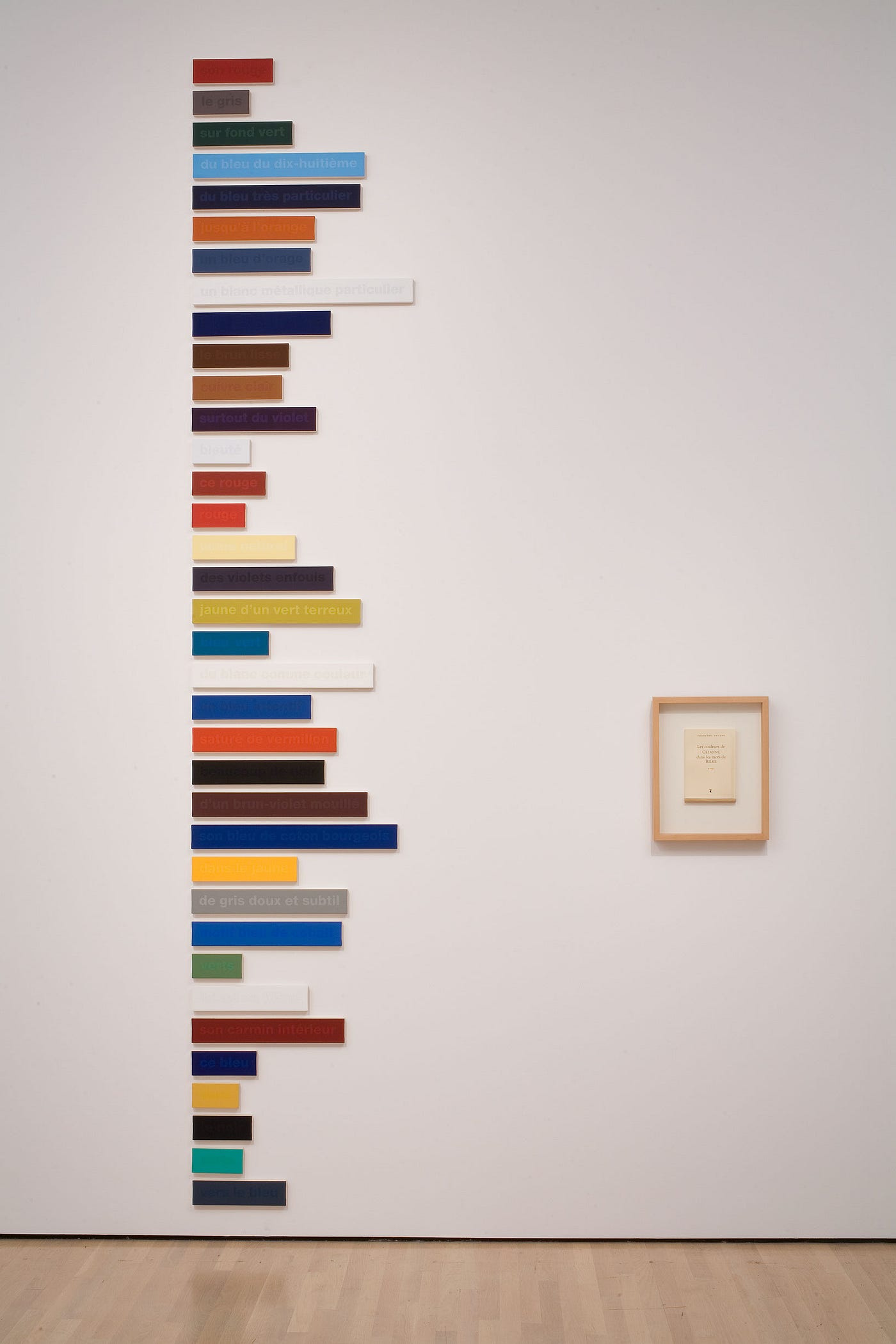
Francine Savard, The Colours of Cézanne in the Words of Rilke 36/100 — Test (detail), 1998, vinyl and acrylic on canvas mounted on fibreboard, framed book, 380 x 66 cm (painting), 42 x 33 cm (framed book). Photo by: Richard-Max Tremblay. Courtesy of MACM.
Thirty-six painted panels on a museum wall. Each one is a different colour. Each one named — not with a swatch number or a code, but with a phrase. Un gris doux et subtil. Un bleu attentif. A soft and subtle grey. An attentive blue.
To the right of the panels, framed and mounted: a copy of Rilke’s letters.
This is Les Couleurs de Cézanne dans les Mots de Rilke (1998) by Francine Savard. It is interesting on many levels — as a painting, as a conceptual object, as a study in literary references crossing over into fine art and contemporary practice. As a study in how meaning travels. How it transforms. How it arrives somewhere completely new and is still, somehow, recognizable.
The Artist
Francine Savard. Graphic design at UQAM. Royal College of Art in London. MFA back at UQAM, 1994. Two disciplines, two careers, running in parallel, bleeding into each other.
That dual practice is not incidental. It is structural to everything she makes.
She has said she doesn’t fully think of herself as a painter — even though she paints. Mixing paint is hard. Finding exactly the right shade, the right hue, the one that matches what you’re seeing in your head.
She sees her relationship with paint as an apprenticeship.
Her process is systematic, research-based, almost categorizing and organizing, creating, not playing, with colour. The forms of a work are often fabricated in advance based on her plans, freeing her up to focus on the colour problems she’s actually there to solve.
If you’ve ever spent an hour adjusting a hex code — or held Pantone swatches up trying to find the one that matches the creative vision and aesthetic concept you’re going for — you know this feeling. Savard is doing that, but with paint, and with the entire history of painting as her reference. A nod to graphic design, right there in the studio.
The graphic sensibility bleeds into the visual work in ways that are immediately legible upon viewing. The panels in Les Couleurs de Cézanne are stacked and left-justified — like lines of text, like a poem set in a very deliberate typeface, like type formatting on a wall. The colour names function as labels, as captions, as typographic elements — organizing and categorizing at the same time as they describe. The eye moves down the wall the way it moves down a page.
This is not only a painter’s instinct. It’s the instinct of someone who has spent years trained to see how information sits on a surface. How hierarchy, colour and shapes work. How spacing carries meaning before a single word is read.
The Work
No illusions of depth. No recessional space, no figure-ground games, no tricks. Flat surface. A sequence of colour decisions, laid out for inspection. Savard wants you to see the painting as a painting — to look at it, not through it. She is making you aware of its two-dimensionality, and that is precisely the point.
And yet it’s not simple.
Thirty-six panels, each distinct, each its own study — multiplicity and unity at the same time. A grouping of free parts that cohere. You can read each panel separately, like a standalone poem. You can read them in sequence, like a collection. Both are valid. Both are intended.
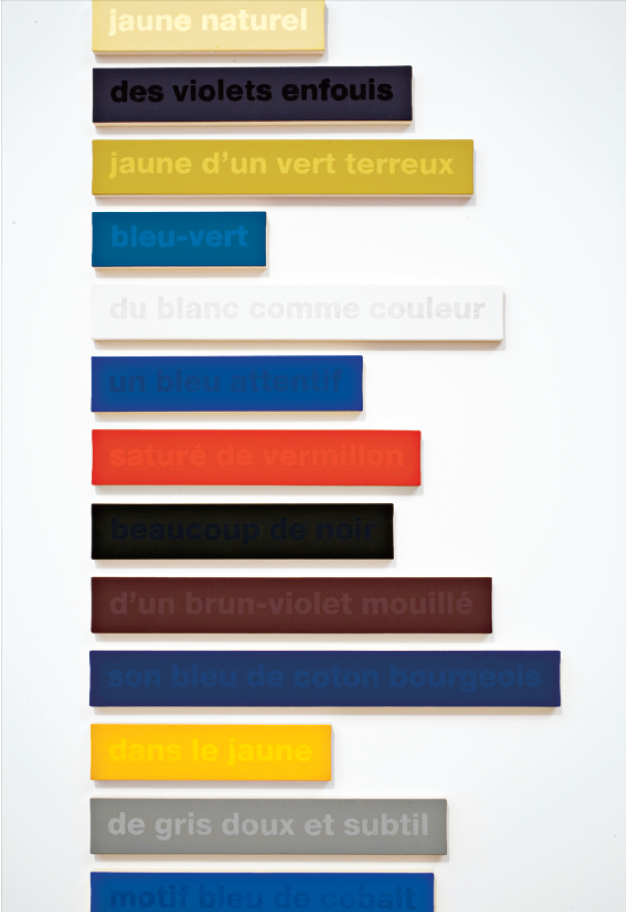
Francine Savard, The Colours of Cézanne in the Words of Rilke 36/100 — Test (detail), 1998, vinyl and acrylic on canvas mounted on fibreboard, framed book, 380 x 66 cm (painting), 42 x 33 cm (framed book). Photo by: Richard-Max Tremblay. Courtesy of MACM.
The panels sit one above the other, left-justified — as though each one is a line from a poem on the wall. Which is essentially what they are.
Then there’s the book.
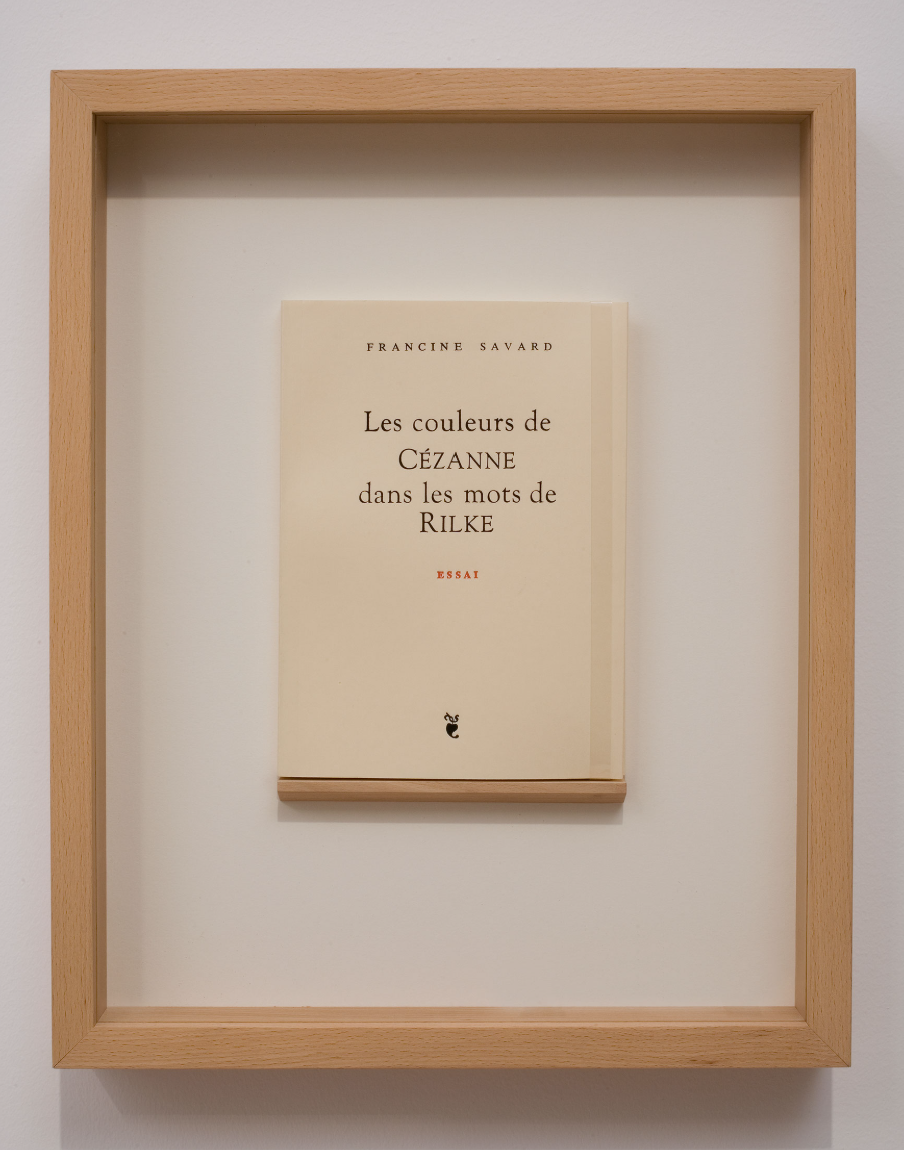
Francine Savard, The Colours of Cézanne in the Words of Rilke 36/100 — Test (detail), 1998, vinyl and acrylic on canvas mounted on fibreboard, framed book, 380 x 66 cm (painting), 42 x 33 cm (framed book). Photo by: Richard-Max Tremblay. Courtesy of MACM.
Framed and mounted beside the panels: a copy of Rilke’s letters. Not a label in any conventional sense — a companion piece. Almost could be a different piece entirely, existing in dialogue with the panels beside it. Separate enough to stand on its own, present enough to be part of the whole. It contains all one hundred of Rilke’s colour descriptions — the ones Savard read, catalogued, and used as her guide. It is at once a label for the artwork and an artifact in its own right. Evidence of the research. Evidence of the hours spent with his words, trying to understand what attentive blue actually looks like when you mix it. Clues to the origin of the colours and the names on the panels, extending the meaning of the work beyond the panels themselves, beyond the museum walls.
The letters open the work outward. They point beyond, to a poet standing in front of paintings in Paris in 1907, reaching for words. The book is the portal. Or one of them.
The Chain
Three people. Three moments in time. One colour on a wall.
Cézanne paints. Late career, largely dismissed, obsessive. Same subject, different light, different day — Mont Sainte-Victoire again and again. Not interested in representing the mountain. Interested in colour: how it holds structure, how it vibrates against other colours, how it means something before you’ve decided what it means.
Rilke stands in front of those paintings at the Salon d’Automne, Paris, 1907. He’s a poet. He does what poets do — reaches for words. Writes it all down: un bleu attentif, un gris doux et subtil. Trying to capture not just what he sees but what the colour does. How it behaves. This is not art criticism. It is a record of looking — precise, personal, untranslatable, and yet translated. Words as the bridge.
Savard reads those letters in Montreal, decades later. All of them. Catalogues every colour description — one hundred of them. Then she goes into the studio and starts mixing. She is not trying to match Cézanne’s paintings. She is trying to match Rilke’s words. What does attentive blue look like? What does it mean to her, now, here?
They are being doubly transposed — once by Rilke in his letters, then again by Savard. Two portals. Cézanne to Rilke: painting becomes language. Rilke to Savard: language becomes paint again. There is a time and space aspect here, almost a reaching through two portals to where and who we are, looking at Francine’s piece. A three-dimensionality to what is, on the surface, a flat painted panel.
It is not like broken telephone — nothing is simply lost. Transformed at each step, filtered through a different sensibility, a different medium, a different century. Rilke’s medium — words — is the bridge between Cézanne’s contemporary timeline and Savard’s. Between techniques and methods separated by almost a hundred years.
What ends up on the wall is not Cézanne’s blue. It is Savard’s reading of Rilke’s reading of Cézanne’s blue. Three layers deep. And still specific. Still a colour you can see.
Modularity and Time
One hundred descriptions. Thirty-six panels. The ceiling height at the Musée d’art contemporain de Montréal determined what was possible for the first installation. She chose thirty-six. The other sixty-four exist in the letters, as possibilities.
This again gives the work a temporality and an additional modularity. It can change form and size depending on how many panels are exhibited, in what configuration, and presumably with or without the letters. Perhaps the panels can even stand on their own. The work is never quite the same twice, never quite finished. It exists as a set of possibilities as much as a fixed object. This reconfiguration of the work as originally intended is itself meaningful — a painting that is also a system.
When Les Couleurs de Cézanne was shown as part of De L’Écriture at the MAC in 2007, it was displayed on a wall built specifically for it — positioned in the centre of the room with its back to you as you entered. You couldn’t see it right away. You had to move through the space, come around to it. Veiled, then revealed. There’s something right about that. The work is about things that aren’t directly accessible — that require an intermediary, a passage through something else before you arrive. In that exhibition, the museum made that transit physical.
Savard also separates the two elements of the work — panels on the wall, Rilke’s letters beside them — in a way that enacts the same dynamic. The panels are the paintings, the things Rilke stood in front of. The letters are the transmission. Together they make a whole. Apart, each reaches toward the other.
The gap between them is not a failure. It’s the subject.
Painting About Painting
Savard’s practice sits within a Quebec painting tradition rooted in the Plasticien painters of the 1960s — artists working in plastic and acrylic who believed non-objective painting could carry real conceptual weight. Who advocated for colour and form over narrative, for the primacy of the medium itself. She inherits that seriousness. Her practice is a study of process and materials — and of that space and time collapse between Cézanne’s era and her own contemporary timeline and techniques, transported across the gap by Rilke’s medium: words.
But she takes it somewhere else. She infuses it with literary reference, with time, with the question of how meaning moves between people and across media. The National Gallery of Canada describes her work as “rich in references to art history, its writings and its meanings” — paintings that offer “poetic approaches to formalism and conceptualism, playfully and thoughtfully turning the language of painting back onto itself.”
Accurate. But Les Couleurs de Cézanne does something more specific. It makes looking at colour into a study of transmission and inheritance. A painting becomes a letter becomes a published book becomes thirty-six panels on a wall in Montreal. Something survives that. Changed, filtered, personal — but still there. Still visible.
Un bleu attentif. Someone paid attention. Several people did, across more than a century.
That’s what you’re looking at.
Francine Savard’s work is part of the permanent collection of the Musée d’art contemporain de Montréal, among other institutions. Les Couleurs de Cézanne dans les Mots de Rilke was first exhibited in 1998 and has been shown in multiple configurations since.
(Note: Originally written as a 2-part series on art history methods in 2012.)
메타데이터
- post_id
- bb39ca4c625e
- slug
- colour-as-translation-francine-savards-les-couleurs-de-cézanne-dans-les-mots-de-rilke-bb39ca4c625e
- url
- https://medium.com/@sraudsepp/colour-as-translation-francine-savards-les-couleurs-de-c%C3%A9zanne-dans-les-mots-de-rilke-bb39ca4c625e
- canonical_url
- https://medium.com/@sraudsepp/colour-as-translation-francine-savards-les-couleurs-de-c%C3%A9zanne-dans-les-mots-de-rilke-bb39ca4c625e
- author_url
- https://medium.com/@sraudsepp
- status
- ok
- fetched_at
- 2026-07-10 22:28:30