Optimizing Retrieval for Smarter AI Response.
Boost AI output with smart Retrieval Optimization Strategies.
Optimizing Retrieval for Smarter AI Response.
Boost AI output with smart Retrieval Optimization Strategies.
Imagine asking your company AI assistant (LLM) a simple query: ‘What is WFH leave policy?’, and instead of a clear answer, LLM respond with a 30 page pdf, detailing every type of employment leave and citing an complete ‘employment leave policy.pdf’. This prompts questions about RAG’s LLM, is it hallucinating or misinterpreting as it retrieves wrong information and if that’s the case, what fixes are available.
Topic of Article
We have explored how to build RAG, chunk the data and understand how to choose the embedding model and vector store. It’s time to advance, past the fundamentals.
This article focuses on improving the RAG’s information of retrieval, explore the optimization methods that make responses more relevant while also improving the accuracy and efficiency at scale.
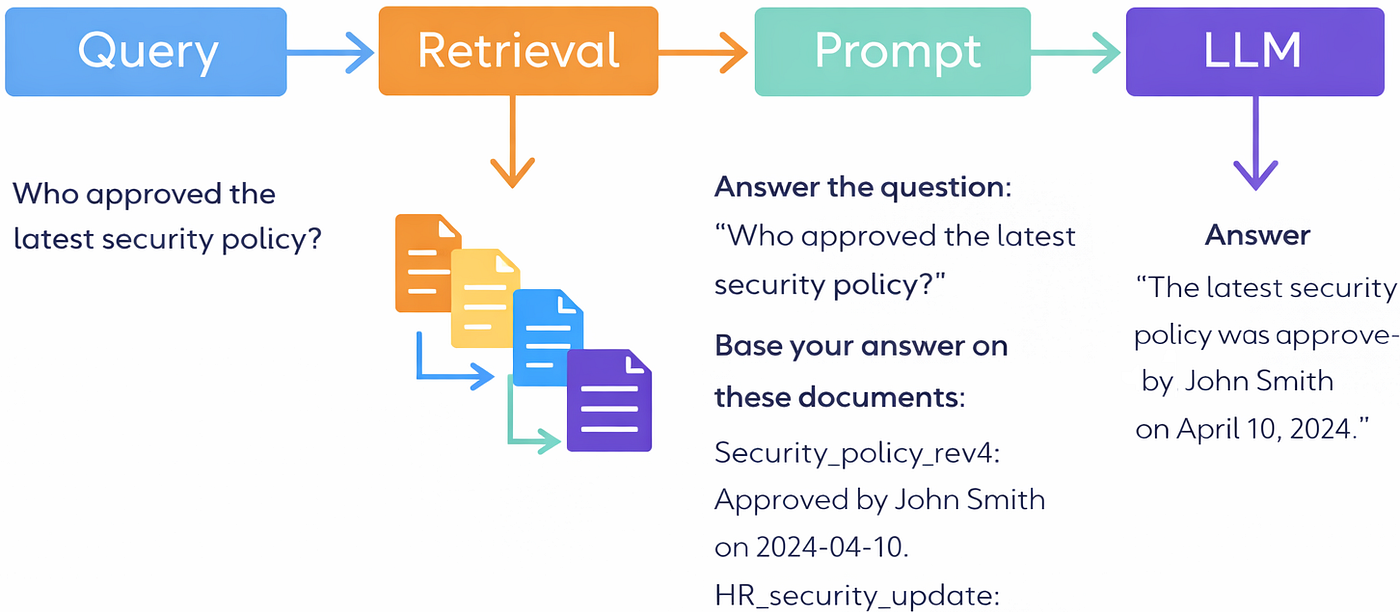
RAG Workflow.
Optimization Strategies.
RAG can become expensive if not optimized properly.
Below are practical strategies that act as stepping stones towards building a faster, more efficient and cost aware RAG pipeline.
1.Query Optimization: The quality of retrieval improves dramatically when queries are explicit, scoped and rewritten. Continuously refining query selection, retrieval pipelines can dynamically adjust to changing user intent while maintaining response quality.
1.1 Query Rewriting: RAG cannot grasp the intent unless you assist them as a user. To achieve this, don't ask vague, incomplete and ambiguous questions, like.
Query: Leave Policy?
Response: gives a long confusing answer.

Rewrite query: What is the current leave policy for full time employees?
Response: retrieves exact policy of full time employment.
The problem with the initial query was the absence of a scope or timeframe for the LLM to retrieve accurate information. Rephrasing vague input into a structured semantic query, yields for better embeddings, higher retrieval accuracy and less noisy chunks.
1.2. Multi-Intent Queries and Follow-up questions: To handle multi-intent queries, split them and retrieve separately and then merge the answers. For follow-up questions, check for conversational memory and context linking.
Query: What is the refund policy and how many days it takes?-
Context Window: Every LLM has a finite memory per request, known as context window. Once it is full, older or low priority data is dropped. If important chunks are truncated or instructions disappear then RAG is broken down due to token overflow. Various context prioritization techniques can be used for RAG accuracy.
-
Token Management: Correct retrieval but wrong answers, random behavior across similar queries or increased hallucination risk are the practical impact of poor token management.
-
Reranking: To assess which documents are the most relevant and important, advanced ranking algorithms are used. With retrieval of top-k, relevant and irrelevant documents are also returned. To emphasize valuable context needs to re-evaluates the retrieved chunks more intelligently, is known as reranking. RAG accuracy improves more from reranking than from upgrading to a bigger LLM.
-
Metadata Filtering: Filtering mechanisms can also be used to eliminate results that are irrelevant or of low quality. Metadata is extra information attached to each chunk (like date and time, location, department and authorship), before semantic search happens, the system filters the dataset. This enables the prioritization of content relevance based on the user’s context and intentions.
6. Hybrid search: A hybrid retrieval approach combines two retrieval methods, semantic search (dense) with keyword matching (sparse) to balance meaning and precision. This results in more relevant chunks, smaller context windows, lower LLM token utilization and reduce overall cost.
Query: WFH rules during probation period.
     Vector search finds --> remote working guidelines
     Keyword search finds --> probation policy
Response: retrieves exact policy.
7. Feedback loops: Active learning with feedback loops uses user inputs to continuously refine retrieval results. Over time, this improves relevance, accuracy and overall system performance.
- Prompt augmentation: Bedrock builds a prompt behind the scenes. You can give prompt instructions on how the response should be, like short answers, step-by-step answers, answer only from documents and even refuse if unknown.
9. Performances and Cost management: It is not a single configuration change but a layer strategy.
- Parallel processing: Lag can diminish user experience and precision of response, which is crucial for real time AI application, therefore optimize the retrieval speed. Executing queries in parallel removes bottlenecks, reducing latency and improving system efficiency. Sequentially fetching documents chunks even hinders response. To handle several chunks at once and to avoid delays in retrieval, enable multi-threaded query.
- Caching and pre-fetching: Reduce computation overhead by caching and pre-fetching. Delays in retrieval delays may harm response consistency, especially when queries require contextual continuity. Storing commonly accessed responses enhances retrieval time and minimizes computational load, Pre-fetching boots efficiency by predicting future queries prior to their request.
- Document with meaningless title: Check the file name before uploading them to datasource. Better metadata leads to better retrieval performance.
Cost differ based on the model and use cases, but from optimization perspective, embed documents once, avoid re-ranking of entire KB, Use metadata filtering and hybrid search, for less retrieved text which result in fewer token utilization and lower cost.
- Continuous Monitoring: Continuously monitor retrieval performances, to pinpoint inefficiencies prior they impact system reliability. To identify retrieval failures early, set automated alerts, this will assist AI teams in improving retrieval methods and ensuring system reliability, search accuracy and deliver exact up-to-date response.
RAG Evaluation
Don’t perform typical testing on RAG, rather create a test dataset of real user questions that can be vague or trick or partial queries and expect the correct answers or source documents.
RAG performance is commonly assessed along the following RAG metrics.
- Retrieval Tuning: Relevance matters more than quantity, which can be achieved with Top-k, a most important setting. Top-K defines how many chunks are retrieved from a vector store. Ideal value is 3–8 (depends upon the use cases), if it’s too small then retrieval may have missing context or partial answer or don’t know response. If too large then irrelevant context or conflicting information or even hallucinations.
- Faithfulness: To prevent hallucination and guessing, verify whether the response is backed by the documents.
- Precision and Relevance: Measure the noise in retrieval, which refers to the number of chunks retrieved and the number of that are beneficial. Ultimately, how RAG responded to user questions, was it relevant or lengthy, irrelevant explanations.
Debugging a bad RAG response.
If the response is wrong, perform a debugging sequence. Initiate by verifying if there are issues with embeddings and metadata, by inquiring ‘was the correct document retrieved?’. If so, then check whether the correct section is retrieved which will indicate any problem with the chunking strategy. Next verify for token overflow, meaning check was the chunk truncated. Verify the prompt to see if system instructions allow guessing. Only after all of the above, finally check the model behavior or limitation.
Tasks RAG cannot do well.
RAG is quite successful for finding similar content, but it doesn’t perform as well at filtering, counting, calculating and analytics. The majority of business applications require both functionalities. As vector search, being intended for retrieving and contextualizing text rather than for computing or analyzing data numerically. To address this limitation, can integrate external tools, or enhance to tool-augmented generation (TAG), Or can combine RAG for knowledge retrieval with SQL database or API for structured data.
Conclusion
Rather than searching documents and generating a response, a system that engages in deep thinking is needed. A system that searches intelligently, selects the most relevant chunk, adjusting the responses based on the question asked by the users or even go deeper to dig for precise retrieval. In short, a system that will bridge the gap between stored data and dynamic human questions. When optimized properly, a RAG system becomes not only more accurate but also scalable, responsive and cost-efficient in production environments.
메타데이터
- post_id
- bb40bba010a2
- slug
- optimizing-retrieval-for-smarter-ai-response-bb40bba010a2
- url
- https://medium.com/@nik_72739/optimizing-retrieval-for-smarter-ai-response-bb40bba010a2
- canonical_url
- https://medium.com/@nik_72739/optimizing-retrieval-for-smarter-ai-response-bb40bba010a2
- author_url
- https://medium.com/@nik_72739
- status
- ok
- fetched_at
- 2026-07-30 03:13:15