What Happens When the Democratic Values and Institutions collapses?
The quality of a nation’s democratic institutions is inseparable from the trajectory of its economic and social development. In the Indian…
What Happens When the Democratic Values and Institutions collapses? Rethinking India’s Development Path in an Age of Institutional Decline”
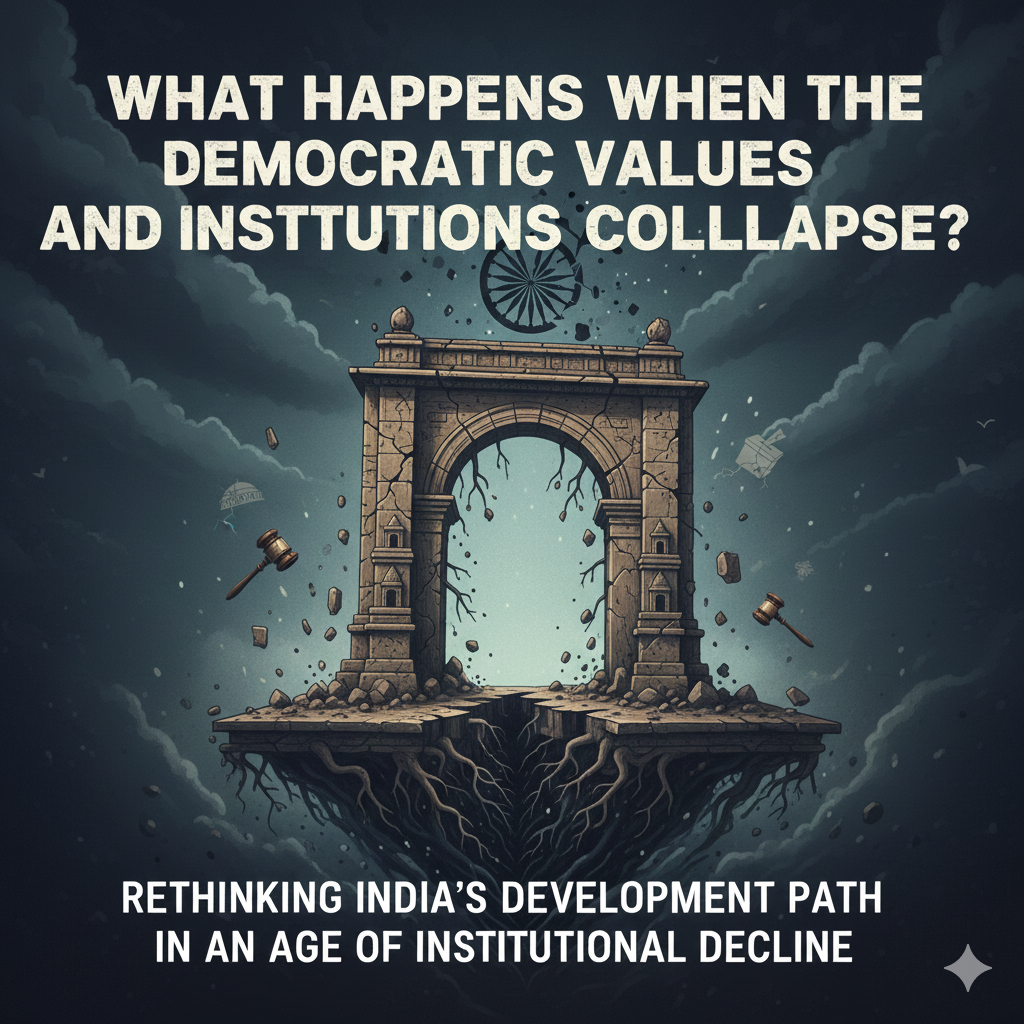
The quality of a nation’s democratic institutions is inseparable from the trajectory of its economic and social development. In the Indian context, the Constitution of 1950 envisioned a political order rooted in popular sovereignty, equality before law, deliberative governance, and accountable public institutions. Over the decades, these institutions — an independent judiciary, a professional bureaucracy, autonomous regulatory bodies, a free press, and vibrant civil society — collectively shaped India’s developmental path by providing stability, predictability, and legitimacy to economic policymaking. However, contemporary debates increasingly point towards a gradual erosion of these democratic values and institutional norms. Scholars of political economy caution that when institutions weaken, development becomes less inclusive, less stable, and more vulnerable to elite capture.
Institutional decline does not occur suddenly; it unfolds through a series of incremental shifts — concentration of executive power, politicisation of oversight bodies, restriction on civic freedoms, declining media autonomy, erosion of federal principles, and weakening of judicial independence. Each of these shifts produces a compounding effect: economic decisions become less evidence-based, policy uncertainty increases, corruption widens, and public trust in state legitimacy declines. In a developing economy like India, where long-term growth depends on institutional credibility, regulatory consistency, and social cohesion, the consequences are particularly severe. Democratic backsliding not only reshapes the political landscape but fundamentally alters the economic incentives that guide investment, innovation, labour markets, and public welfare.
The collapse or weakening of democratic norms also has profound implications for distributive justice. Historically, India’s development model sought to balance growth with equity through constitutional guarantees and welfare institutions. When democratic accountability erodes, these mechanisms become hollow, enabling policies that disproportionately benefit political elites or powerful economic groups while marginalising vulnerable communities. The result is a shift towards what development economists describe as “extractive institutions” — arrangements that prioritise control over participation, coercion over deliberation, and short-term political gains over long-term societal welfare.
This context raises a fundamental question: What happens to a nation’s development path when the institutions meant to protect democracy begin to decline? For India — a country that has long been celebrated as the world’s largest democracy — the question is not merely theoretical. It strikes at the heart of its political identity and its economic future. Understanding the link between institutional quality and development outcomes is essential for rethinking India’s trajectory in the twenty-first century. This paper therefore examines how institutional decline affects governance, economic performance, social justice, and India’s broader developmental prospects. In doing so, it invites a critical reconsideration of the role that democratic values play in sustaining inclusive, resilient, and sustainable development.
How Democratic Institutions Once Anchored India’s Economic Trajectory
India’s economic rise after 1991 was shaped not only by market reforms but by the unique credibility conferred by its democratic institutions. At a time when many emerging economies struggled with volatility, India benefitted from a framework of constitutional checks and balances. Independent courts ensured that property rights and commercial contracts were enforceable. A pluralistic media ecosystem held policymakers accountable, exposing corruption and amplifying public grievances. Regulatory bodies such as the RBI, SEBI, CAG, and Election Commission acted as autonomous guardians of specific domains, insulating economic governance from partisan control. Civil society groups mobilised citizens, monitored welfare schemes, and demanded transparency through instruments like the RTI Act.
This ecosystem of multilevel accountability offered more than political legitimacy — it functioned as a key economic stabiliser. Investors interpreted India’s institutional resilience as a signal that policy, even if slow or contentious, would remain broadly consistent, predictable, and anchored in due process. This predictability created the underlying conditions for growth. Crucially, it also signalled that India was a rules-based state, not a patronage-driven or militarised economy. Understanding this historical baseline is essential, for it reveals how deeply India’s development prospects are tied to the health of its democratic institutions.
The Slow Displacement of Democratic Norms and Institutional Balance
Democratic decline does not arrive as a sudden upheaval. Instead, it unfolds through subtle but cumulative shifts that alter the balance of power. In India, recent years have witnessed an unmistakable centralisation of authority within the executive. Parliamentary debate has weakened; key legislation is passed with limited discussion or committee review. Judicial appointments face delays, and the higher judiciary’s willingness to challenge the executive appears inconsistent, creating a perception of institutional acquiescence. Media houses experience ownership concentration, advertising pressures, and regulatory intimidation, eroding editorial independence.
Civil society, once a vibrant pillar of democratic engagement, encounters an atmosphere of surveillance and restrictive compliance. Foreign funding rules and NGO registration procedures have been recast in ways that reduce organisational autonomy. Federal structures, too, reveal strain. States report declining fiscal space, growing dependency on central transfers, and diminishing input in national policy decisions. The result is what political scientists describe as a “slow constitutional drift” — a movement towards a system where institutional checks remain formally intact but functionally weakened.
Political Overreach Reshapes the Nature of Economic Governance
When democratic institutions weaken, the economic costs are not immediately visible but gradually permeate policy design and execution. Administrators, unsure of institutional backing, shift from principled decision-making to political compliance. Regulatory bodies risk losing their independence, resulting in policy reversals, selective enforcement, or politically motivated intervention in sectors like telecommunications, energy, and financial markets.
This transformation undermines the professional ethos of the bureaucracy. Officers become more cautious, less innovative, and more inclined to avoid decisions that could attract political scrutiny. Policy formulation also becomes increasingly centralised, reducing space for expert consultation. Without institutionalised deliberation, decisions often reflect short-term political calculations rather than long-term economic strategy. The cumulative result is a governance environment marked by policy uncertainty — a key deterrent for investment, especially in long-gestation sectors such as infrastructure, renewable energy, pharmaceuticals, and technology.
Transparency Erodes, Undermining Credibility and Market Trust
Modern economies depend on credible data. Investors require transparent fiscal accounts, accurate inflation statistics, and reliable labour market surveys to assess risks. As democratic norms decline, the integrity of public data often becomes collateral damage. Questions raised about GDP revisions, unemployment surveys, consumption data, fiscal deficits, and independent economic assessments weaken confidence in the reliability of official statistics.
Markets are acutely sensitive to information asymmetry. When investors suspect that data may be politically influenced or selectively disclosed, they recalibrate their expectations and hedge against political risk. This results in higher borrowing costs, delayed investment decisions, and reduced long-term commitments. Opacity also distorts domestic policymaking: without accurate data, governments struggle to design effective welfare schemes, calibrate monetary policy, or evaluate sectoral interventions. In effect, the weakening of transparency is both a governance failure and an economic liability.
Welfare Drifts Toward Patronage, Weakening Long-Term Development
Democratic erosion often reshapes welfare architecture by shifting emphasis from universal entitlements to discretionary, politically targeted distribution. As checks and balances weaken, welfare becomes more closely tied to electoral incentives rather than evidence-based need assessments. Governments prioritise high-visibility, short-term schemes that yield immediate political returns over long-term investments in education, healthcare, and skill development.
This distortion weakens the quality of human capital, deepening structural inequality. Subsidies and transfers may proliferate, yet they fail to address underlying vulnerabilities. With civil society weakened and independent audits diluted, leakages increase, accountability declines, and the most marginalised citizens — who depend most on democratic safeguards — find themselves further excluded. In the long run, an economy cannot achieve inclusive development without institutional integrity, because welfare without accountability becomes inefficient and inequitable.
Crony Capitalism Thrives as Institutional Checks Weaken
A hallmark of institutional decline is the entrenchment of crony capitalism. When political power is unchecked, certain corporate groups gain privileged access to state resources — land grants, regulatory exemptions, favourable contracts, and policy advantages. Market competition suffers, innovation declines, and monopolistic tendencies intensify. Smaller firms struggle to compete, not because of inefficiency but due to uneven playing fields.
This dynamic mirrors patterns seen in other countries where democratic institutions weakened: Turkey’s currency crisis, Hungary’s oligarchic consolidation, Russia’s state-corporate nexus, and Brazil’s corruption scandals. India’s own economic landscape shows early signs of concentration in critical sectors, an issue that warrants scrutiny. Crony capitalism is not merely a moral concern; it is economically damaging. It depresses productivity, reduces competitiveness, distorts resource allocation, and locks the economy into inefficient growth patterns.
India’s International Standing and Investor Confidence Face New Vulnerabilities
India’s global reputation as the world’s largest democracy has long been central to its international influence. This identity has shaped diplomatic negotiations, informed trade partnerships, and reassured global investors that India’s governance system — though slow — was stable, plural, and rules-based. As institutional decline becomes visible, this narrative faces challenges.
Rating agencies increasingly evaluate governance quality and institutional independence in their assessments. International investors monitor judicial decisions, media freedom, regulatory interventions, and state-business relations as indicators of political risk. Diplomatic partners, especially in liberal democracies, express concerns about press freedom, treatment of civil society, and judicial autonomy. While India remains a major global player, its soft power is undoubtedly tied to the health of its democratic institutions. Sustained decline could complicate trade negotiations, reduce foreign investment appetite, and erode its normative leadership within the Global South.
Institutional Recovery Is the Key to India’s Long-Term Prosperity
India now stands at a defining moment. The debate over democratic decline is often framed as a moral or ideological struggle, but at its core, it is a development issue. No country in modern economic history has sustained high growth for decades without strong and independent institutions. Thus, restoring institutional credibility is not a matter of nostalgia; it is a strategic economic imperative.
Reversing the current trajectory requires strengthening judicial independence, restoring parliamentary deliberation, ensuring regulatory autonomy, protecting press freedom, and empowering civil society. It also demands a cultural shift: political actors must recognise that accountability enhances rather than weakens the state. India’s long-term aspirations — becoming a $5 trillion economy, building a resilient innovation ecosystem, and ensuring inclusive growth — depend fundamentally on reviving its democratic architecture.
The question, therefore, is no longer whether democracy matters for development. It is whether India can afford the economic consequences of allowing its institutions to deteriorate. The path forward requires not only economic reform but institutional renewal — because without strong democratic foundations, India’s development story risks becoming increasingly fragile.
Thanks
메타데이터
- post_id
- bb43573b1c5e
- slug
- what-happens-when-the-democratic-values-and-institutions-collapses-bb43573b1c5e
- url
- https://medium.com/@pratikgsalvi03/what-happens-when-the-democratic-values-and-institutions-collapses-bb43573b1c5e
- canonical_url
- https://medium.com/@pratikgsalvi03/what-happens-when-the-democratic-values-and-institutions-collapses-bb43573b1c5e
- author_url
- https://medium.com/@pratikgsalvi03
- status
- ok
- fetched_at
- 2026-08-21 12:18:34



