The Halving City
Part One — The Loaf, the Inheritance, the Marriage
Serial Fiction
The Halving City
Part One — The Loaf, the Inheritance, the Marriage
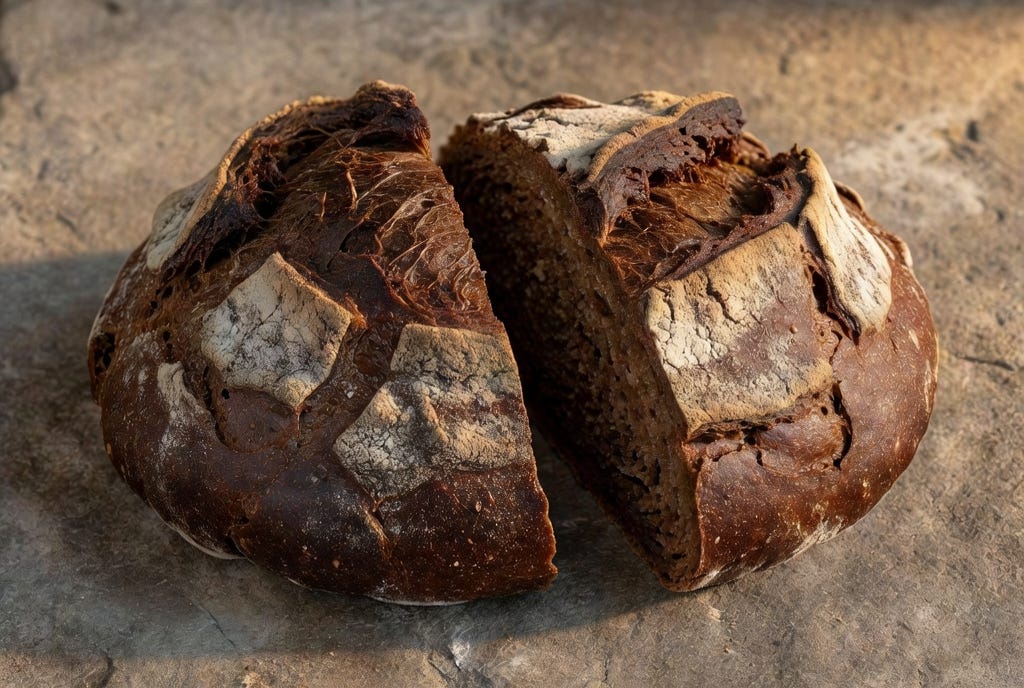
Image created by author on Magnific
There was once a city that had solved the oldest problem in the world, which is the problem of two people wanting the same thing.
It had not solved this problem the way other cities pretended to, with judges who weighed and scribes who argued and old men who remembered which family had wronged which other family three generations back. Those methods produced verdicts, and verdicts produced grudges, and grudges produced the slow accumulated weight that eventually pulls a city down into the mud it was built on.
The city in this account had watched its neighbors sink in exactly that fashion, one resentment at a time, and had resolved to do otherwise.
Its solution was the Law of the Half, and the Law was simple, which was the source of both its beauty and the thing that would eventually be made of it.
When two parties wanted the same thing, the thing was halved between them. That was all. There was no weighing of merit, no testimony, no appeal to who had held the thing first or loved it longest or needed it more. Merit was a door that opened onto endless rooms, and the founders of the city had decided, wisely, that a city could not afford to walk through it. A thing wanted by two was a thing divided into two. The bakers understood it. The children understood it. It was carved above the door of the Hall of Settlement in letters a hand high, and it required no commentary, because there was nothing in it that a commentary could clarify.
For a long time the Law worked, and because it worked, the city prospered, and because it prospered, the people came to believe that the Law was not merely useful but true, in the way that people will always mistake a thing that serves them for a thing that is so.
And it did work, in those years, in ten thousand small ways that no one thought to record because they were the texture of an ordinary good life.
- Two carters disputed the use of a lane and halved the hours of it between them and went on hauling.
- Two cousins disputed a fishing right and halved the river’s reach and each caught enough.
- A guild and a guild disputed a quarter of the market and drew the line down the middle of it and the line held for a generation.
The Law was in the air the children breathed. They halved their sweets and their games and the watches of their play without being taught to, the way children elsewhere learn to share by being scolded into it, except that these children were not sharing, which is a soft and negotiable thing, but halving, which is exact, and they grew into adults for whom the exactness was the shape of fairness itself, who could not have told you the difference between a thing fairly divided and a thing made whole, because in their city the two had always been the same, and a question with only one answer is a question no one learns to ask.
This was the city’s genius and its blindness, folded together so tightly that no one could find the seam. It had abolished the grudge, and with the grudge it had abolished the long slow conversation by which people who must go on living together learn to bear each other, the conversation that has no exact answer and produces no clean half and leaves both parties a little unsatisfied and still, somehow, bound. The city had traded that conversation for the blade, and for loaves and lanes and fishing rights it was a good trade, the best trade any city of the plain had ever made, and the city was right to be proud of it. It simply did not know, could not know, having never tested it, that the blade it was so proud of would cut anything it was given, and that the day would come when someone gave it the wrong thing, and that the city had built no other tool, kept no other custom, preserved no older way, against that day.
The man who applied the Law was called the Magistrate, and the city had been served by a line of them stretching back to the founding. The current holder of the office had come to it late, and he brought to the bench the temperament of a man who trusts a scale.
He had been, in the years before the bench, a measurer of public works, the man the city sent when a granary had to be apportioned among the wards or a flood wall raised to a height that would hold the spring melt and no higher, because a higher wall cost stone the city did not have. He had been good at it, better than good, because he had understood early the thing that separates a true measurer from a man who merely owns a rule, which is that the world does not want to be measured and will lie to you if you let it.
A river will tell you it is calm in the season you survey it and drown a ward in the season you do not. Grain will swell and settle. Timber, cut in the wrong moon, will warp past every figure you took of it green.
He had learned to measure not the thing in front of him but the thing it would become, and he had built a reputation on being the one man in the city whose figures held, and the city had rewarded him as cities reward such men, by giving him at last a thing to measure that could not be measured at all, and calling it an honor.
He believed the Law because the Law had never asked him to believe anything. It asked only that he divide, and division was the one act in the world he was certain could be done without error. A man may argue about the height of a flood wall, because the river has not yet come and no one can prove what it will do.
But no one argues about a half. A half is a thing you can show. He had spent his working life amid the doubt that hangs over every measurement of a thing not yet arrived, and the Law had lifted that doubt from him entirely, had handed him an arena in which his figures could never be wrong, because the thing was always already there on the bench in front of him, and the half of it was a matter no flood and no moon could overturn. He had taken the office the way a man who has walked all his life on shifting ground takes, gratefully, a floor of stone.
He was not a cruel man and not a kind one. He was an accurate one, and he had built his whole life on the conviction that accuracy and justice were the same thing wearing different coats. He had a wife who had died some years before the bench, and no children living, and the city had become, the way work becomes for a man who has outlived the people he worked for, the only thing he was still measuring against. He wanted to leave it sound. He believed, when he took the office, that he was being given the means to do so. This is the account of how he came to understand that he had been given instead the means to take it apart, and that the two had been, all along, the same office, the same knife, the same even and untroubled edge.
Beside him at every settlement sat the Recorder.
The Recorder’s task was to write down what was halved and how, so that the city would have a memory longer than the men who governed it. He was younger than the Magistrate and had come to the Hall as a boy, sharpening reeds and carrying tablets, and he had grown into the work the way ivy grows into a wall, so gradually that neither he nor the wall could say where one stopped and the other began. He believed in the Law as he believed in the floor beneath his stool, which is to say he did not believe in it at all, because belief is something you do to a thing you can imagine being otherwise, and he could not imagine the Law being otherwise. He simply wrote.
This is the account of the season in which both of them learned to imagine it.
The first case of that season was a loaf, and the Magistrate would remember it afterward as the last clean thing he ever cut, though he did not know it was clean at the time, because a man never knows the water was clear until something falls into it.
Two brothers came before the bench. Their father, a baker, had died in the night, and he had left one loaf cooling on the stone, the last he would ever make, and each brother said that the loaf was his.
They were not young men. The elder had gray in his beard and the younger was not far behind him, and the Magistrate understood from the first that the loaf was the smallest part of what stood between them. He had seen the shape of it many times in his measuring years, two men arrived at the far end of a life still fighting the war they had begun as boys, the war over which of them the father had loved, a war that no inheritance settles because the thing in dispute was never the property and cannot be halved or weighed or awarded, being already spent, the dead man having loved them in whatever way he loved them and taken the final accounting into the ground with him. The loaf was only the last object the father’s hands had made, and so it had become the field on which the old unwinnable war would have its last battle.
They did not argue that they were hungry. They were not hungry. They argued, each in his turn and with rising heat, that the loaf was the last thing their father’s hands had touched while those hands still held warmth, and that to eat it would be to take their father into themselves one final time, and that this was a thing a man could not share, because you cannot grieve a father by halves.
The Magistrate listened, which the Law did not require of him but which he did anyway, out of the habit of a man who had once needed to know the depth of a river before he forded it.
He listened to the elder brother say that he had worked the ovens beside the father for thirty years and knew the loaf as his own work, half his own hands in the making of it, and so it was his.
He listened to the younger say that he had left the ovens precisely because the father had favored the elder, and had come home only now, too late, and that the loaf was the one thing he could still take from the house that had never been fully his, and so it was his.
He heard, under both claims, the same claim, which was: tell me he loved me. Tell me he loved me as much. And the Law could not tell them this, because the Law did not speak of love, and that whatever he did with the loaf, both men would leave still asking it.
When the brothers had finished, he said, “Bring the loaf.”
It was brought. It was a good loaf, dense and dark, with a seam down its back where the dough had split in the heat. The Magistrate took the knife the Hall kept for such purposes, and he set its edge into the seam, and he halved the loaf, and he gave one half to each brother.
The younger brother wept. The elder did not. But they took their halves, and they left the Hall together, and a week later it was reported in the market that the two of them had eaten their halves at the same table on the same evening, and that this had been the first meal they had taken together since boyhood, and that something between them which had been broken for thirty years was, if not healed, at least set, the way a bone is set, in the hope that it knits.
The Recorder wrote it down. He wrote: A loaf. Halved. Both parties departed satisfied. He was pleased with the entry, because it was true and it was brief, and he did not yet know that he would come to envy it, the way an old man envies a thing he wrote when he still believed the world was simple enough to fit in a line.
The Magistrate cleaned the knife and returned it to its place. He was satisfied also, though he would not have used that word, because satisfaction implied that the outcome could have gone otherwise and pleased him less, and to his mind no other outcome had been possible. The loaf had wanted halving. Some things do. They come into the world already seamed, already asking for the knife, and the only error a man can make with them is to hesitate.
He did not yet know that most things are not loaves.
The inheritance came before the bench eleven days later, and it was the first case in which the Magistrate felt the floor of his certainty give, though only by the width of a hair, the way a sound floor gives when a board beneath it has begun, somewhere out of sight, to rot.
A man had died leaving a farm, and the farm had been left, by the carelessness of a man who had not expected to die, to two daughters in equal claim. The Law was clear. The farm was a thing wanted by two, and so the farm would be halved.
But a farm is not a loaf. A farm is a system that pretends to be an object. The well sat in the eastern field and the orchard in the western, and the house straddled neither, and the single road that reached the place ran in along the southern edge and stopped at the door. The Magistrate looked at the survey the daughters had brought, and he saw at once that the Law, applied here, would produce not two smaller farms but one farm cut in such a way that neither half could live.
He could give the elder daughter the well and the younger the orchard, but then the orchard would die of thirst and the elder would have water and nothing to grow with it. He could halve the land east to west and give each a strip, but then one strip held the house and the road and the other held neither, and the daughter who got the far strip would own land she could not reach and could not sleep on. There was no line he could draw through that farm that did not pass through something that needed to remain whole.
The daughters did not help him. They stood at opposite ends of the bench, as far from each other as the Hall allowed, and each watched him as though he were a weight on a scale that might still be tipped toward her by the force of being watched.
The elder was the harder of the two, a woman with her father’s jaw and her father’s way of saying nothing while everything in her said it for her. The younger spoke too much, in the manner of a person who believes that a wrong sufficiently described will correct itself, and she described the farm to him as though he had not the survey in front of him, the well her father had dug the year she was born, the orchard he had grafted with his own hands, the room she had been ill in as a child and recovered in, every part of the place freighted with a memory that was hers and not her sister’s, as if memory were a deed and the longest memory won.
It was not a thing the Law could hear. The Law did not hear memory. The Magistrate let her finish anyway, because he had not yet broken the habit of listening, and because some part of him was listening for the seam, the place where the farm wanted to come apart, and the more she talked the more clearly he understood that the farm did not want to come apart anywhere, that it had been made by one man over one life to be one thing, and that every line he might draw through it would cut through something the dead man had joined on purpose.
He sat with the survey for a long time. The Recorder watched him sit, and noted, without writing it down, that he had never before seen the Magistrate sit with a case. The man had always cut. That was the office. To watch him hesitate was like watching water hesitate at the lip of a fall, and the Recorder felt, in the watching, the first faint cold of a thing he could not yet name.
In the end the Magistrate did what the Law required. He halved the farm down a line that gave each daughter the well’s water by a shared channel and the road by a shared gate, and he wrote into the settlement the conditions of the sharing, the hours each might draw water and the days each might use the road, and he believed, as he wrote them, that he was preserving the Law by extending it.
He was not. He was beginning to amend it, which is what a man does when a tool no longer fits the work but he cannot yet admit that the tool was ever wrong. He had introduced into the Law of the Half a thing the Law had never contained, which was the idea of the shared, the thing that belonged to two and was cut by neither, and he had done it to keep the farm alive, and he was right to do it, and it was the first crack.
The daughters left less satisfied than the brothers had. Within the year they were back before a lesser officer of the Hall, disputing the hours of the water, and within two years one of them had sold her half to a stranger, and the farm that had fed one family fed none, because a thing that must be shared by people who wanted it whole is not shared. It is merely fought over on a schedule.
The Recorder wrote: A farm. Halved, with conditions of sharing appended. He looked at the word conditions for a while after he had written it. It was the first time the Law had needed a condition.
He went back through the record that night, after the Magistrate had gone, turning the old tablets, the years of halvings stretching back before his own time, the loaves and lanes and fishing rights, and he confirmed what he had felt but not known, which was that no entry before this one carried a condition. Every halving in the history of the city had been a single clean line. A thing. Halved. That was the whole grammar of the record, two words and a thing, for generations, and the grammar had been the proof of the Law’s perfection, because a thing that works perfectly needs no qualification, takes no exception, requires nothing appended.
A condition was a confession. A condition said: the halving alone was not enough. The halving alone produced a thing that could not stand, and so we have propped it up with words, and the words are not the Law, the words are the patch on the Law, the first patch in the history of the Law, and a thing that has taken its first patch has admitted that it can be torn.
He did not know what the word was the beginning of, but he knew it was the beginning of something, because the Law had been, until that line, a thing that needed nothing added to it, and a thing that begins to need additions is a thing that has begun, quietly, to fail. He thought about striking the condition from the entry, restoring the clean grammar, making the record show what the record had always shown, a thing and its half and nothing else. But the condition was true. The Magistrate had appended it. To strike it would be to make the record lie, and the Recorder, who had never in his life faced the choice between an accurate record and a reassuring one, faced it now over a single word about the hours of a well, and chose, without yet understanding that he was choosing, the accurate one. He left the condition in. It was the smallest possible act of witness, and it was the first, and the rest would follow from it the way the failure of the Law would follow from the farm, one appended truth at a time.
The marriage was the third case, and it was the one in which the Magistrate first understood, in his body before his mind would allow it, that the Law could destroy the thing it was meant to settle.
A husband and a wife came before the bench, each wanting the marriage ended and each wanting the marriage’s substance, which they could not name and so named instead by its parts. The house. The child. The years. Each said the marriage was theirs, that they had built it and the other had merely lived in it, and each demanded that what they had built be returned to them entire.
The Law was clear. The marriage was a thing wanted by two. The marriage would be halved.
But the Magistrate looked at the two of them standing apart in his Hall, and he understood that the marriage was not a thing that could be returned to anyone, because the marriage was not a thing at all. It was a relation, and a relation does not survive division. You cannot give each party half a marriage. You can give each party half a house, and he did. You can give each party half the years, in memory, and memory does this on its own without a magistrate’s help.
But the marriage itself, the thing they had actually come about, the live thing that had been between them and had died and that each now wanted to carry away whole as proof that they had been the one who truly loved it, that thing could not be halved, because it had already stopped existing the moment they agreed to want it apart.
He halved what he could. He gave the house in two, and the goods, and he set the terms of the child, which he would later think of as the cruelest arithmetic he had ever performed, the child to one parent on these days and the other on those, a living thing scheduled like the water of the farm. The child was a girl of perhaps four, and she had been brought to the Hall and sat on a bench against the wall through all of it, swinging her feet, watching the grown people make the sounds that grown people made, and when the Magistrate read out the days, this parent in the dark of the year and that one in the light, the girl did not understand the words but understood the shape of them, the way a small animal understands the shape of a coming storm, and she began to cry, not loudly, but in the steady hopeless way of a child who has grasped that something is being decided about her by people who are not asking her, and the crying went on under the reading of the terms like water under ice, and neither parent went to her, because each had been taught by the proceeding to think of her now as a thing apportioned, a quantity in the settlement, and to comfort her would have been, somehow, in the logic of the Hall, to make a claim. So she cried alone against the wall while her parents received their halves, and the Magistrate read on, and his voice did not change, because the Law did not provide for the changing of a magistrate’s voice. The feet of a four-year-old swung above a floor she could not reach, while the people who made her divided the year between them and called it her, and that was the moment, though he did not know it yet, that he would return to most often in the nights when he could not sleep.
And the husband and the wife took their halves of the house and their halves of the days, and they left, and neither of them had what they came for, because what they came for had not been among the things that could be cut.
The Magistrate cleaned no knife that day. There had been no knife. That was the thing that stayed with him. For the loaf and even for the farm there had been an edge, a physical seam he could set steel into, and the cutting had at least been honest about being a cutting. But the marriage he had halved with words alone, with the schedule and the terms, and the absence of the knife made the violence worse, not better, because it pretended not to be violence at all. It wore the coat of procedure. It called itself a settlement.
The Recorder wrote: A marriage. Halved. And then he did a thing he had never done in all his years at the bench. He crossed it out. He sat with the crossed-out line, and after a while he wrote beneath it: A marriage. The house halved, the child apportioned. The marriage could not be found among the goods. And he looked at what he had written, and he was afraid of it, because it was the first time he had written down the truth instead of the record, and he did not know whether the truth was his to write.
He carried the fear home with him, which was a thing he had never done either, because for all his years the Hall had stopped at the threshold of the small house at the edge of the artisans’ quarter, where his wife was, and the life that had nothing to do with halving. They had no children of their own any longer, the one daughter grown and gone to another quarter, and his wife had begun, that season, to speak of the cradle in the loft, of giving it to the potter’s wife next door, who was near her time. A cradle is made to be handed on, she said. It is the one thing in a house that is only ever borrowed. He had agreed, and thought no more of it, and only that night, lying awake beside her with the crossed-out line still burning in him, did he understand that a cradle handed from house to house was a thing two families would have shared, and that he had begun, without meaning to, to be afraid of what the city might one day do to a thing two families had shared. He told himself the fear was the apportioned child, the swinging feet, nothing more. He was wrong, but the wrongness would take a season to arrive, and that night he only held his wife in the dark and did not tell her why.
That night the Magistrate did not sleep. He lay in the dark and he thought about the loaf, which had come into the world already seamed, and the marriage, which had come into the world seamless, and he understood for the first time that the Law did not distinguish between them. The Law saw a loaf and a marriage as the same kind of thing, a thing wanted by two, and it brought the same answer to both, and the answer was right for the one and ruinous for the other, and the Law could not tell the difference because the Law had no eyes. It had only an edge.
He tried, lying there, to find the principle that separated them, because he was a man who trusted principles, who had spent his life reducing the world to figures that held, and he believed that if he could only name the difference between the loaf and the marriage he could carry the name back to the bench and the Law would be saved, made whole, taught to see. He thought it was the seam. The loaf had a seam and the marriage did not. But the farm had no seam and could be halved, badly, with conditions, and survive. So it was not the seam. He thought it was the body. The loaf had a body and the marriage did not. But the name had no body, he would learn, and neither did the friendship, and they could be destroyed exactly as the marriage was, so the bodilessness was a symptom and not the cause. He turned it over all night and could not find the principle, and toward morning he understood why he could not find it, which was the thing that frightened him more than any single case had.
There was no principle. There was no clean line between the things that survived halving and the things that did not, no rule he could write down and hand to the next magistrate, no figure that held. There was only judgment, case by case, the looking at this loaf and this marriage and this child and deciding, each time, freshly, whether the thing before him was the kind of thing that could be cut.
And judgment was the one thing the city had been built to do without. The founders had not struck the clause out of carelessness. They had struck it because they had seen, as he was seeing now in the dark, that to honor it you would need a man willing to judge which things were sacred, and that there was no rule that could do the judging for him, no figure, no principle, no edge. Only a man, deciding, with nothing under him but his own conviction. The one thing the city existed to abolish. The Magistrate lay in the dark and understood that the Law’s blindness was not a flaw in the Law. It was the Law’s whole purpose. The Law had been made blind on purpose, so that no man would ever have to see, because the founders had decided that a city of blind men dividing everything was safer than a city of seeing men deciding what to spare, and lying there, he could not say, even now, that they had been wrong.
메타데이터
- post_id
- bb4e2f503782
- slug
- the-halving-city-bb4e2f503782
- url
- https://medium.com/@nrw.scribe/the-halving-city-bb4e2f503782
- canonical_url
- https://medium.com/@nrw.scribe/the-halving-city-bb4e2f503782
- author_url
- https://medium.com/@nrw.scribe
- status
- ok
- fetched_at
- 2026-07-18 15:52:18