Boundaries as Architecture: How Isolation Protects Modular Frontends
Designing clear service boundaries for safe composition, resilience, and team autonomy
Boundaries as Architecture: How Isolation Protects Modular Frontends
Designing clear service boundaries for safe composition, resilience, and team autonomy
“Rethinking the Client: A New *Era of Modular, Performant Frontends” | **Part 10***

A walled fortress atop a hill with clearly defined gates and roads, symbolizing strong service boundaries, controlled integration points, and isolation at the heart of a modular frontend runtime.
Based on my experience, the toughest lesson when creating large, modular frontends is that boundaries are more important than almost anything else.
Initially, when a system is small and a single team handles most of the logic, it can avoid worrying about isolation. Shared state seems convenient. Accessing another module’s internals seems preferable to creating a formal contract.
However, as complexity increases with multiple teams contributing features, services running concurrently, and execution contexts multiplying, the absence of boundaries becomes your most significant liability.
It is no longer just about architecture. It now focuses on safety. Isolation shields you from cascading failures, permission leaks, unpredictable state sharing, and security risks. It enables your architecture to scale, both technically and organizationally.
This post discusses the importance of boundaries in client-side microservice architecture. It explains how isolation fosters safe composition and why a clear separation of state, execution context, and failure domains makes modular frontends both resilient and scalable.
Why Boundaries Matter (Even on the Frontend)
When most developers think about isolation and boundaries, they typically envision backend systems, such as network segments, containers, service meshes, and firewalls. However, boundaries are equally important on the frontend, especially in a modular architecture composed of independent services.
Without clear boundaries, modular frontends quickly suffer from hidden coupling:
- Services sharing state implicitly
- Logic relying on shared globals
- UI components reaching into service internals
- Async errors cascading across unrelated features
This results in a fragile system where a slight change in one service can cause subtle breakages in parts of the app that were never meant to be connected. It also creates unnecessary friction for teams. When boundaries are unclear, ownership becomes ambiguous, debugging becomes more challenging, and development slows down.
Boundaries give teams flexibility. By establishing clear agreements, isolating state, and containing failures, you can allow services to evolve independently while keeping them safe to combine.
In Client-side Microservices Architecture (CSMA), this principle is essential. Modularity isn’t just about dividing code into parts; it’s about making those parts run safely in parallel without interfering with each other’s state, leaking sensitive information, or causing unexpected side effects.
Standard Failure Modes in Poorly Isolated Architectures
When a modular frontend lacks explicit dependencies, specific failure patterns tend to appear, even in teams with the best intentions.
🔥 Shared mutable state
One common problem is the leakage of shared state across services. For example, two unrelated services might write to the same key in a global store, leading to unexpected overrides or stale reads.
🔁 Implicit coupling
Services often rely on the timing or side effects of other services without an explicit contract. A common sign is when a service “just works” in one environment but breaks when loaded in a different context or order.
🕳️ Leaky abstractions
Without clear boundaries, abstractions break down. UI components may delve into services to access internals. Services might work around missing contracts by importing helpers from unrelated modules.
🌪️ Cascading failures
When failures are not contained, a problem in one service can ripple through the system. A slow network request or unhandled error in a peripheral service can block or degrade core features, harming overall stability.
In small projects, these risks are often easily overlooked. In a large, modular app, they quickly add up, undermining developer trust and hindering team progress.
Boundaries prevent these issues from spreading. They safeguard the state, isolate execution, and ensure services stay well-behaved, even when problems occur.
Service Boundaries and Security Concerns
Boundaries are not just about protecting your architecture from bugs; they are also crucial for safeguarding your system against unintended security risks.
In a modular frontend, services often handle sensitive data, including user tokens, permissions, personalized content, and business-critical logic. Without apparent isolation, it becomes too easy for one service to accidentally or intentionally access data intended for another.
Here are some key security risks that appear when boundaries are weak:
- Data leakage occurs when a shared state or poorly scoped context allows one service to read or manipulate another service’s sensitive information.
- Over-permissioned interfaces: When boundaries blur, services tend to expose more than they should, creating a larger attack surface or making it harder to reason about who can do what.
- Implicit trust: Services may assume that data passed to them has already been validated or sanitized elsewhere, leading to vulnerabilities when the call chain is unclear.
By designing clear service boundaries, you reduce these risks:
- Each service controls its state, with no implicit access to shared globals.
- Contracts define exactly what data a service requires and what it provides, limiting accidental exposure.
- Context is explicitly scoped and passed; it is never assumed.
In CSMA, boundaries are a first-class concern. The runtime itself enforces isolation by treating each
Techniques for Isolating State and Execution Context
Isolation is not just a principle; it requires specific techniques that ensure services stay well-behaved and predictable as your frontend scales.

A comparison of poor versus proper service isolation. On the left, services are entangled through shared global state and implicit dependencies. On the right, services communicate through explicit contracts with clear boundaries.
Here are some patterns that help maintain isolation in a modular, client-side architecture:
🧱 Encapsulated state
Each service should own and manage its internal state. No other service or UI component should directly access that state. The only way to interact with a service should be through its public contract, such as methods, observables, or events.
This makes the state private by default, preventing accidental coupling.
🧩 Context scoping
Execution context, such as user identity, permissions, or environment variables, should be explicitly passed to services instead of assuming they are globally available.
This enables services to operate securely in isolation across different users, environments, or threads, without the risk of accidental context sharing.
🔀 Thread isolation
In a CSMA-based app, services can run in different execution contexts, such as web workers. This provides not only performance benefits but also natural isolation. A service running in a worker cannot accidentally block or interfere with other services on the main thread.
🔒 Immutable contracts
Service interfaces should be stable and versioned so that consumers know exactly what to expect. This prevents tight coupling caused by undocumented behaviors or shared assumptions.
Together, these techniques ensure that even as your frontend becomes highly modular and distributed, it remains safe to compose and resilient to change.
Example: Avoiding Cascading Failures in a Modular Checkout App
Let’s ground these ideas with a practical example.
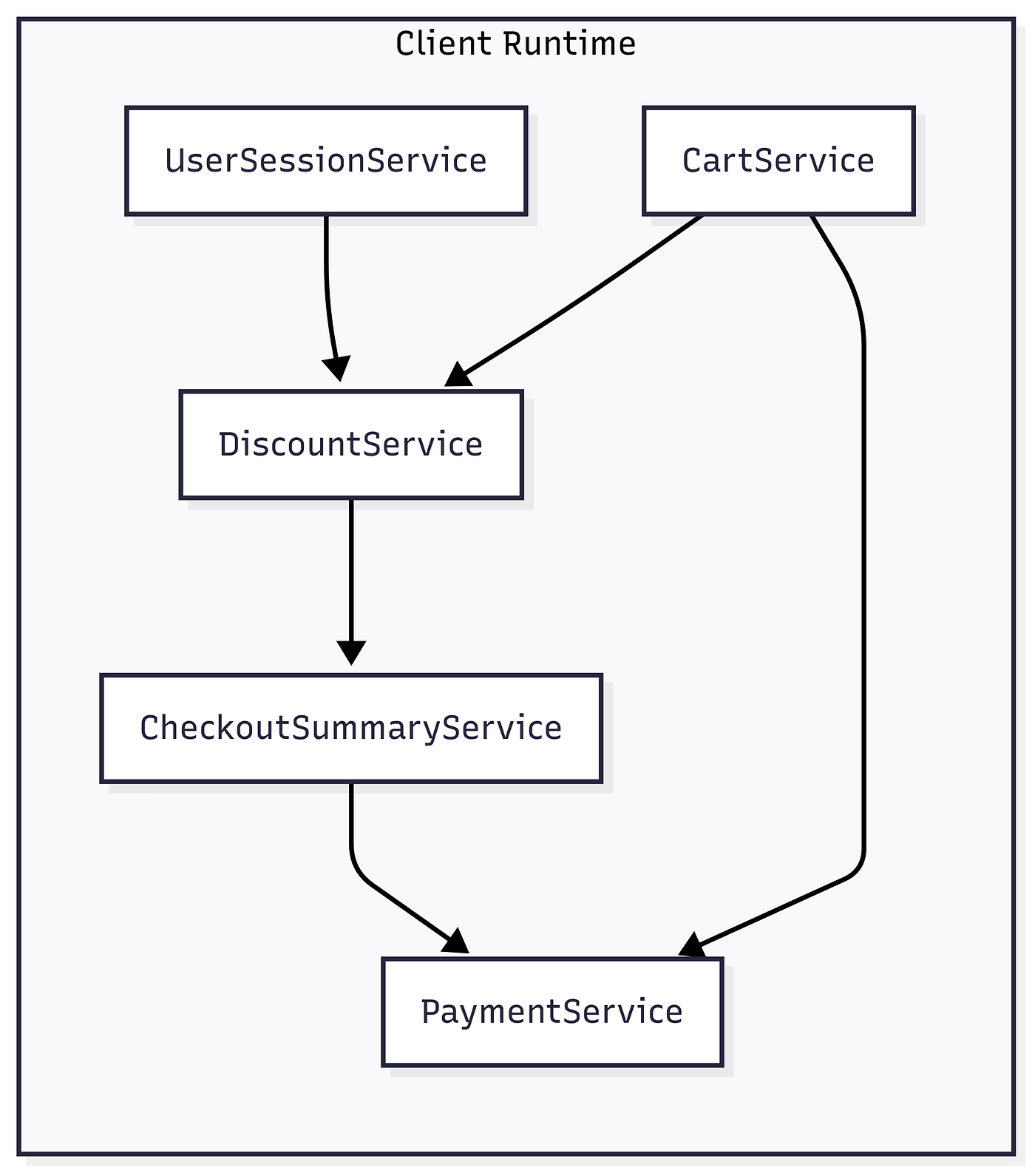
A modular frontend architecture with isolated services, explicit contracts, and clear data flow, all coordinated within the client runtime.
Imagine a modular checkout page built with several independent client-side services:
UserSessionServiceHandles authentication state.CartServiceTracks cart contents.DiscountServiceApplies promotions based on cart and user status.PaymentServicemanages payment readiness.CheckoutSummaryServiceassembles everything for display.
Without proper isolation, a failure in DiscountService could cause CheckoutSummaryService to stall or crash. Or worse, PaymentService might proceed based on stale or partial data because the contract between services was unclear.
With clear service boundaries and isolation techniques:
DiscountServicecan fail safely, publishing a fallback result (e.g., no discount) without affecting other services.CheckoutSummaryServiceconsumes contracts, not internals, so it remains decoupled.PaymentServiceonly relies on the final contract fromCheckoutSummaryService, not assumptions about upstream logic.
This structure prevents cascading failures. Each service performs its function, understands what it depends on, and manages issues gracefully in isolation. The result is a resilient checkout process where failures stay contained and the user experience remains smooth.
This is what boundaries unlock. Not just safety at scale, but confidence that your architecture is composed of well-behaved, predictable parts.
How This Fits into Client-side Microservices Architecture (CSMA)
Boundaries and isolation are not optional extras in a client-side microservice architecture; they are foundational.
In CSMA, each service is regarded as an independent logic unit, with its own scope, state, and contract. This independence facilitates testing, reuse, and evolution of services; however, it also means that without strong boundaries, services can easily develop tight coupling, implicit dependencies, and shared state contamination.
Isolation protects the modularity that CSMA promotes. It ensures that:
- State remains private and encapsulated.
- Execution context is scoped and explicit.
- Services communicate only through stable, versioned contracts.
- Errors and failures are contained within clear boundaries.
This is what allows CSMA to scale safely, not only in terms of codebase size but also in organizational complexity. Different teams can manage different services, deploy at their own speed, and still integrate their work into a unified system, knowing that clear boundaries keep the architecture predictable and resilient.
Boundaries are what make CSMA not only modular but also operable.
Key Takeaways
- Boundaries are what protect modular frontends from complexity and fragility.
- Isolation ensures that services remain safe to compose, even as they grow in number and complexity.
- Without isolation, shared state, implicit dependencies, and cascading failures quickly undermine scalability.
- In CSMA, isolation is not an afterthought; it is a core architectural principle that enables modularity to work effectively.
- Techniques like encapsulated state, scoped context, thread isolation, and immutable contracts help enforce these boundaries in practice.
A well-designed modular frontend is not just a collection of services; it is a system where each part knows its boundaries and functions within its designated scope. Boundaries make that possible
Coming Up Next
In Part 11, we’ll shift focus from isolation to integration.
We’ll explore how to create shared interfaces and contracts that enable teams to build independently while still integrating seamlessly at runtime. We’ll look at contract-driven design patterns, versioning strategies, and what it means to design a frontend for safe collaboration at scale.
If you’ve ever wondered how large teams avoid breaking each other’s work while still delivering fast, Part 11 will offer some practical guidance.
🤔 Wait, Isn’t This Just Micro Frontends?
Not quite.

Micro frontends focus on splitting up the UI, allowing different teams to own and manage different parts of the visual interface, which are often deployed separately.
**Client-side Microservices Architecture (CSMA) is different: it’s not about the UI at all. It’s about breaking up business logic components, such as state management, calculations, workflows, and side effects, into independent, testable services** that run inside the client app.
Think of it as giving your frontend the same internal structure and discipline as a backend system, without turning your components into dumping grounds for logic.
You can use CSMA with or without micro frontends. They solve different problems, and they complement each other well.
🧱 Found this helpful?
If this post helped clarify how to think about modular frontend logic, give it a 👏 or share it with someone buried under spaghetti code.
📚 Following the series? This article is part of the ongoing series: Client-side Microservices: Rethinking Frontend Architecture
Each post breaks down how to bring structure, scalability, and sanity to modern frontend development, one small service at a time.
메타데이터
- post_id
- bb52fe7a02bc
- slug
- boundaries-as-architecture-how-isolation-protects-modular-frontends-bb52fe7a02bc
- url
- https://medium.com/rethinking-the-client-a-new-era-of-modular/boundaries-as-architecture-how-isolation-protects-modular-frontends-bb52fe7a02bc
- canonical_url
- https://medium.com/rethinking-the-client-a-new-era-of-modular/boundaries-as-architecture-how-isolation-protects-modular-frontends-bb52fe7a02bc
- author_url
- https://medium.com/@enricopiovesan
- status
- ok
- fetched_at
- 2026-07-18 19:06:02