Top 10 Features Every On-Demand App Must Have in 2026
The on-demand economy isn’t slowing down. Mobile app downloads are projected to hit 181 billion globally in 2026 up 12% from the previous…
Top 10 Features Every On-Demand App Must Have in 2026
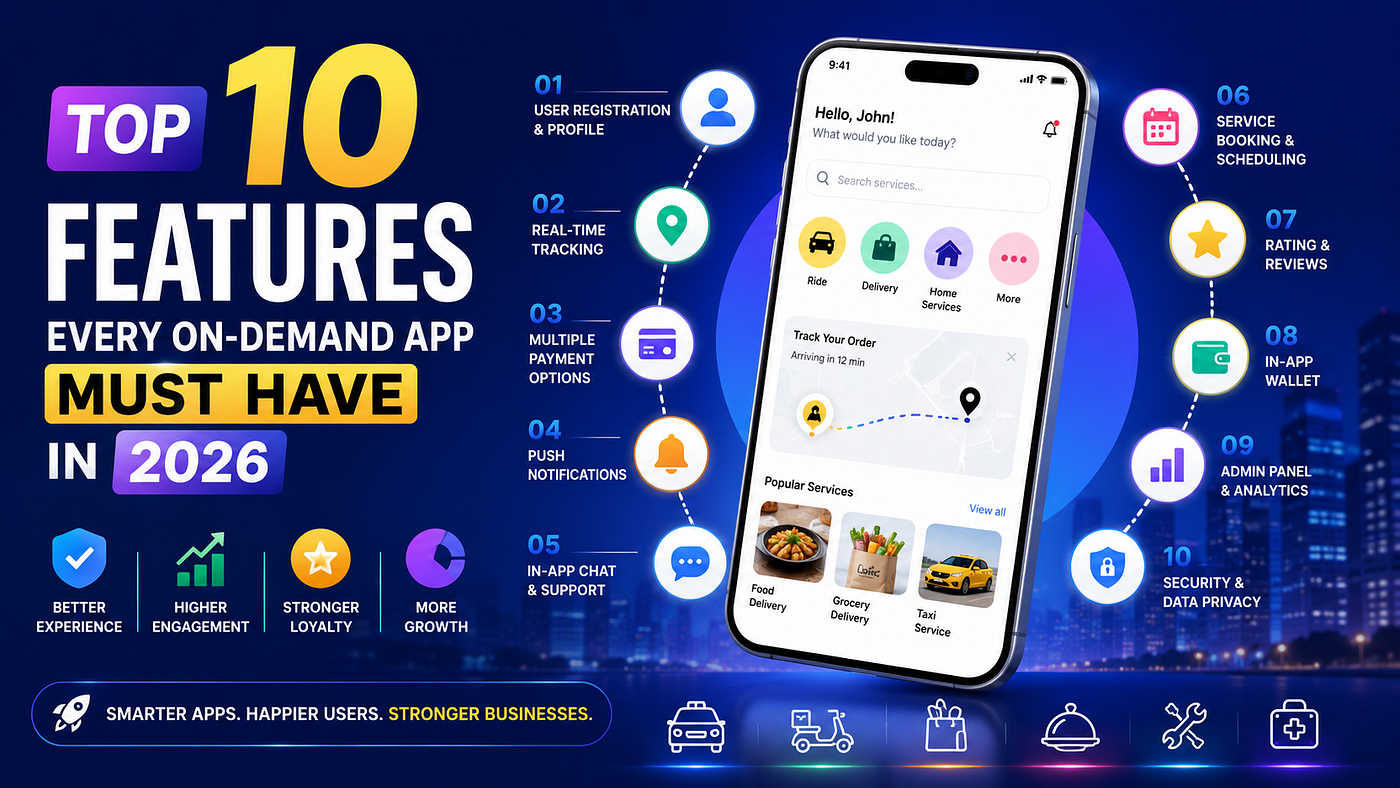
Top 10 Features Every On-Demand App Must Have (Image created by Author)
The on-demand economy isn’t slowing down. Mobile app downloads are projected to hit 181 billion globally in 2026 up 12% from the previous year driven almost entirely by AI integration and on-demand services. On-demand apps like Uber and DoorDash are posting 20% year-over-year growth. Quick commerce (delivery under 15 minutes) has become a competitive battleground. And users particularly in food, healthcare, home services, and logistics have raised the bar on what “good” looks like so high that average is now effectively invisible.
Here’s the problem most teams building on-demand apps don’t address early enough: users don’t compare your app to your direct competitors. They compare it to the best on-demand experience they’ve ever had full stop. If your food delivery app feels slower or less intuitive than Uber Eats, they’re gone. If your home services platform doesn’t have real-time tracking, they don’t trust it.
This is the feature checklist that separates on-demand apps that retain users from those that don’t. No fluff, no padding just what actually matters in 2026.
1. AI-Powered Personalisation Engine
AI has moved from being a “feature” to being the foundation of every competitive on-demand app in 2026. Apps that don’t personalise feel broken to users who’ve been conditioned by apps that do.
What it means in practice:
- On-device machine learning analyses individual user behaviour — past orders, browsing patterns, location, time of day — and adapts what’s surfaced
- Dynamic UI personalisation: the app literally reorganises its interface based on which features a specific user uses most, at specific times
- AI-powered recommendations that improve the more the app is used — not generic “you might also like” but genuinely predictive suggestions
- Intelligent push notification timing — sends alerts when a specific user is statistically most likely to engage, not at an arbitrary scheduled time
Why it matters:
- AI boosts retention by 35% in top-performing apps of 2026
- Users who experience personalised on-demand apps report significantly higher satisfaction and return rates than users of generic alternatives
- Apps using intelligent push timing are seeing open rate improvements that make the development cost look trivial
2. Real-Time GPS Tracking with Live Status Updates
This isn’t a differentiator anymore — it’s table stakes. If your on-demand app doesn’t have real-time tracking, users assume it’s not trustworthy.
What it means in practice:
- Live map view showing provider/driver/order status at all times — no estimated windows, actual live position
- Automated status push notifications at each stage of the journey (confirmed, picked up, en route, nearby, arrived)
- ETA updates that recalculate dynamically based on real traffic and route conditions — not a fixed promise made at order time
- Two-way communication: in-app messaging or call between user and service provider without exposing personal numbers
Why it matters:
- Real-time tracking directly reduces support tickets — the most common customer service query in on-demand apps (“where is my order?”) disappears when users can see for themselves
- Trust is built through transparency, and live tracking is the most visible form of operational transparency available in a mobile app
- Apps without real-time tracking churn users to competitors who have it often after a single poor experience
3. Seamless Multi-Payment Gateway Integration
The payment experience is where on-demand apps most commonly lose users at the worst possible moment — right at checkout.
What it means in practice:
- Support for cards, digital wallets (Apple Pay, Google Pay, PayPal), UPI, BNPL (Buy Now Pay Later), and in-app wallet credits — covering every preference
- One-tap checkout with saved payment methods — zero friction for repeat users
- Dynamic pricing transparency: surge pricing, service fees, and final totals displayed clearly before confirmation, not after
- Offline payment fallback options for markets where connectivity is variable
- PCI DSS compliance and tokenisation built into the payment architecture — not added later
Why it matters:
- A single failed or confusing payment flow costs a conversion and often the user
- BNPL integration is a proven conversion booster, particularly for higher-value service bookings where users want payment flexibility
- Multi-wallet support is not optional in markets across Southeast Asia, the Middle East, and South Asia where digital wallet adoption often exceeds card usage
4. Smart Search with Voice and Visual Input
Voice support is becoming more useful in mobile apps. Users can search, ask questions, and control app features with voice — improving convenience and helping users complete tasks faster. On-demand apps that still rely on keyboard-only search are leaving a meaningful portion of their users underserved.
What it means in practice:
- NLP-powered search that understands intent, not just keywords — “that Thai place I ordered from last month” should work, not just “Thai restaurant”
- Voice search integrated directly into the primary search bar — one tap to speak
- Visual search for relevant categories (food, fashion, home products): photograph an item to find it
- Predictive search that surfaces likely queries before the user finishes typing, based on their history and location
- Filter and sort options that are genuinely useful rather than decorative
Why it matters:
- In 2026, apps use voice, visual, and gesture together — voice alone is no longer the full picture
- Search that understands intent rather than matching keywords exactly is now a baseline expectation among users who interact with AI assistants daily
- Intelligent search reduces time-to-action, which is the core metric in on-demand apps where speed is the entire value proposition
5. Biometric Authentication and Zero-Trust Security
The global average cost of a data breach reached $4.44 million in 2025, while US breaches averaged $10.22 million. Apps that treat privacy as an afterthought face regulatory fines, app store rejection, and user churn. Security is no longer backend infrastructure — it’s a front-facing product feature.
What it means in practice:
- Face ID and fingerprint login as the primary authentication method — not as an optional extra
- Biometric transparency: users can see exactly how their biometric data is stored and whether it ever leaves their device (it shouldn’t)
- End-to-end encryption across all data transmitted within the app
- Zero-knowledge architecture for sensitive data — the platform itself cannot access what users store
- Session management: automatic logout after inactivity, with instant re-authentication via biometric
Why it matters:
- Users in 2026 demand biometric transparency and actively distrust apps that are vague about data handling
- App stores in both iOS and Android are applying stricter privacy requirements non-compliant apps face rejection or removal
- In financial services, healthcare, and logistics on-demand verticals, security is the primary purchase consideration, not just a hygiene factor
6. In-App AI Chatbot and 24/7 Support
Support friction is one of the top three reasons users abandon on-demand apps after a bad experience. An AI-powered chatbot that resolves the most common issues instantly — without a wait queue — is the most cost-effective support investment available in 2026.
What it means in practice:
- Conversational AI chatbot embedded in the app that handles order status, cancellations, refunds, rescheduling, and FAQs automatically
- Natural language understanding — the bot responds to how users actually type, not structured command inputs
- Smart escalation: detects frustration signals and hands off to a human agent seamlessly, with full context transferred so the user doesn’t repeat themselves
- AI virtual assistant for proactive support — notifying users of delays, issues, or updates before they need to ask
- Multilingual support for apps operating across multiple markets
Why it matters:
- AI chatbot systems automatically handle basic inquiries while forwarding more complicated matters to support agents, enabling companies to decrease their customer service expenses significantly
- On-demand apps with 24/7 intelligent virtual support retain users through bad experiences rather than losing them to competitors
- The most common support queries in on-demand apps (tracking, refunds, cancellations) are fully automatable — there is no reason for a human to handle these at scale
7. Ratings, Reviews, and Trust Signals
On-demand apps live or die on trust. Every interaction involves a stranger providing a service, and the primary mechanism through which users decide whether to trust that stranger is the review system.
What it means in practice:
- Verified review system: only users who completed a transaction can leave a review no anonymous noise
- Two-way ratings: both the service provider and the customer rate each other, creating accountability on both sides
- AI-moderated reviews: machine learning flags fake, abusive, or off-topic reviews before they’re published
- Provider profile pages with response history, repeat user rate, and transparent performance data
- Trust badges for verified identity, background checks, certifications, and insurance where relevant
Why it matters:
- A single trust failure a fraudulent provider, a fake review, an unresolved complaint can damage app reputation faster than any marketing budget can repair
- Users read reviews before booking in virtually every on-demand service category — the quality of your review system directly impacts your conversion rate
- Two-way rating systems demonstrably improve provider behaviour and reduce cancellations and no-shows
8. Hyperlocal Discovery and Location Intelligence
Hyperlocal on-demand service solutions match users with motivated providers nearby, reducing both waiting times and operating expenses for both customers and providers. Location intelligence is what makes on-demand apps feel genuinely useful rather than geographically generic.
What it means in practice:
- Precise GPS-based discovery: surface the closest, fastest, highest-rated options within a radius relevant to the specific service
- Geofencing for automated notifications: alert users when a relevant service or offer enters their area
- Location-based pricing that reflects actual local conditions — delivery costs, surge zones, service area boundaries
- Map-integrated service browsing for categories where proximity is the primary consideration
- Saved addresses with intelligent labelling (Home, Work, Frequent) that speed up repeat bookings
Why it matters:
- Quick commerce (under 15 minutes) is only possible with precision hyperlocal matching imprecise location logic breaks the core value proposition
- Geofencing-driven re-engagement campaigns are among the highest-converting marketing tools available for on-demand apps
- Location intelligence data is the primary input for demand forecasting, which drives staffing, inventory, and service area expansion decisions
9. Subscription and Loyalty Mechanics
One-time transactional apps are a commodity. Apps with subscription and loyalty mechanics build the habit loop that makes users choose them first, every time.
What it means in practice:
- Tiered membership programmes: free, standard, and premium tiers with meaningful benefits at each level (free delivery, priority booking, exclusive discounts)
- Points-based loyalty systems where every transaction earns currency redeemable for discounts, upgrades, or priority access
- Subscription passes for high-frequency users: flat monthly fee for unlimited deliveries or bookings the model that turned DoorDash DashPass into a retention engine
- Referral mechanics tied to loyalty points: users earn rewards for bringing new users who complete transactions
- Personalised loyalty offers: AI-generated incentives based on individual usage patterns, not blanket promotions
Why it matters:
- Subscription model users churn at a fraction of the rate of transactional users the economics of app unit economics shift dramatically once a user subscribes
- Loyalty programmes create switching costs that competitors can’t easily overcome with pricing alone
- The on-demand economy is projected to surge, reaching $335 billion loyalty mechanics are a primary driver of the retention that sustains that growth
10. Scalable, Cross-Platform Architecture Built for Growth
The technical foundation isn’t visible to users until it fails. And when it fails when the app crashes during a surge, when checkout breaks on a specific Android version, when load times spike under traffic users don’t give second chances.
What it means in practice:
- Cross-platform development (Flutter or React Native) that delivers a consistent experience across iOS and Android without maintaining two entirely separate codebases
- Cloud-native backend that scales automatically with demand no manual capacity planning before peak periods
- Offline functionality for core features: browsing, saved preferences, and order history should work without a live connection
- Sub-2-second load times across average devices and unstable networks performance on mid-range hardware, not just flagships
- Modular architecture: new features and integrations can be added without rebuilding core infrastructure
Why it matters:
- When an app feels slow, whether during startup, screen transitions, or API responses, people tend to lose patience quickly and stop returning
- Cross-platform development reduces build time and cost while maintaining quality critical for startups that need to iterate fast
- Scalable architecture is the difference between an app that handles 10,000 concurrent users smoothly and one that goes down when you’re featured in a press article
The Baseline Has Moved
Five years ago, real-time tracking was a premium feature. Three years ago, AI personalisation was an enterprise-only capability. In 2026, both are minimum viable requirements for any on-demand app that wants to compete.
The apps that win in this market aren’t the ones with the most features. They’re the ones where every feature on this list works flawlessly, consistently, across every device and network condition their users encounter.
Build for that standard, and the retention follows.
The hardest part of building an on-demand app in 2026 isn’t the idea. It’s the execution depth required to make every one of these features feel effortless to the user who’s never going to think about them until they’re missing.
Before you go
- Please take a moment to like the post and follow the writer!
- Did you know that over 400,000 developers share what they’re building, learning, and discovering across our platforms every month? Learn how you can contribute here
메타데이터
- post_id
- bb5ef9aa4098
- slug
- top-10-features-every-on-demand-app-must-have-in-2026-bb5ef9aa4098
- url
- https://ai.plainenglish.io/top-10-features-every-on-demand-app-must-have-in-2026-bb5ef9aa4098
- canonical_url
- https://ai.plainenglish.io/top-10-features-every-on-demand-app-must-have-in-2026-bb5ef9aa4098
- author_url
- https://medium.com/@rahul-soin
- status
- ok
- fetched_at
- 2026-07-09 20:10:33