Sukhoi Su-57
The Sukhoi Su-57 is Russia’s first stealth-capable fifth-generation fighter aircraft, developed to compete with Western counterparts such…
Sukhoi Su-57
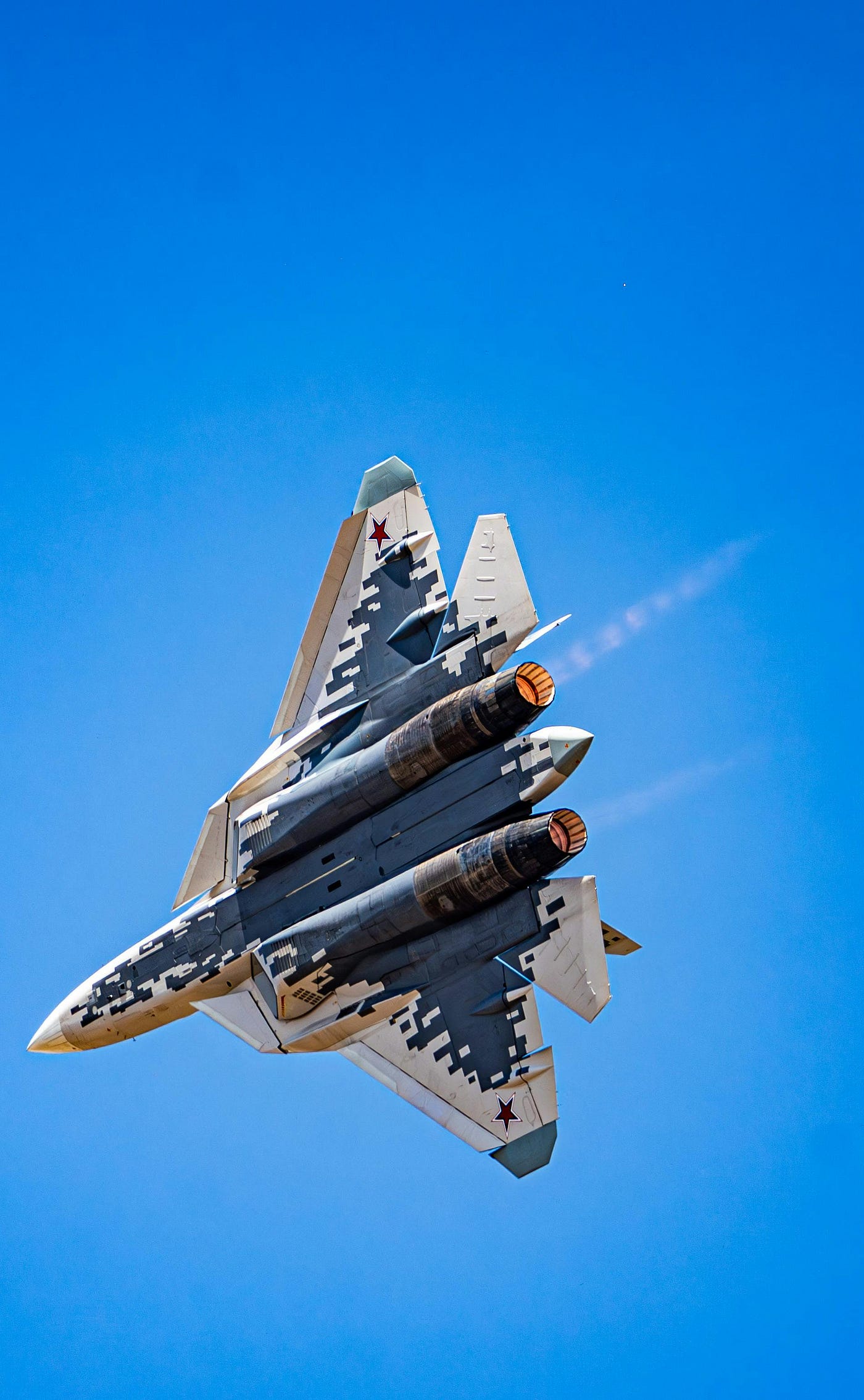
The Sukhoi Su-57 is Russia’s first stealth-capable fifth-generation fighter aircraft, developed to compete with Western counterparts such as the American F-22 Raptor and F-35 Lightning II. Designed for air superiority and strike missions, the Su-57 combines advanced avionics, stealth technology, supermaneuverability, and supersonic cruising capabilities. Developed by Sukhoi, part of Russia’s United Aircraft Corporation (UAC), the Su-57 is intended to form the backbone of Russia’s tactical airpower well into the mid-21st century.
Background and Development History
The development of the Su-57 began in the early 2000s under Russia’s PAK FA (Prospective Aviation Complex of Frontline Aviation) program. After the dissolution of the Soviet Union, Russia faced decades of stagnation in military aviation. The PAK FA program was initiated to modernize the Russian Air Force and develop an indigenous fifth-generation fighter that could rival the U.S. F-22 and F-35 programs.
Sukhoi won the development contract, and its prototype, the T-50, made its maiden flight on January 29, 2010. After years of testing, redesigns, and delays due to budget constraints and technological challenges, the aircraft was officially named the Su-57 in December 2017. The first serial production aircraft entered service with the Russian Aerospace Forces in late 2020, though full-scale deployment remains limited as of the mid-2020s.
Design and Stealth Features
The Su-57 features a sleek, angular design optimized for reduced radar signature and high aerodynamic performance. It uses composite materials, internal weapons bays, and radar-absorbing coatings to lower its radar cross-section. However, experts generally agree that while the Su-57 incorporates stealth characteristics, its design prioritizes maneuverability and speed over extreme low observability.
Its stealth profile is achieved through careful shaping of the airframe, engine inlet design, and radar-blocking materials. That said, the Su-57 does not have the same degree of stealth as the F-22 or F-35, particularly from the side and rear aspects, and its engine nozzles remain exposed — a compromise that has been criticized by Western analysts.
Still, the Su-57’s designers argue that its stealth is “good enough” for real combat scenarios, especially when paired with its long-range missiles, powerful sensors, and extreme agility.
Supermaneuverability and Performance
One of the defining characteristics of the Su-57 is its supermaneuverability — the ability to perform advanced flight maneuvers beyond the capabilities of conventional fighters. This is made possible by a combination of 3D thrust vectoring, advanced aerodynamics, and a fly-by-wire control system.
The aircraft is powered by twin engines. Early versions used Saturn AL-41F1 engines, but a more advanced engine known as Izdeliye 30 is being developed for future iterations. The new engine is expected to deliver greater thrust, lower fuel consumption, and better supercruise capabilities (sustained supersonic flight without afterburners).
The Su-57 is capable of reaching speeds of Mach 2, with a combat range of around 1,500 kilometers and a ferry range exceeding 3,500 kilometers with external fuel tanks. Its agility at both subsonic and supersonic speeds allows it to outperform most fourth-generation fighters in close combat, one of Russia’s key doctrinal requirements.
Avionics and Sensor Suite
The Su-57 is equipped with a modern avionics suite, though it is generally considered less integrated than its Western fifth-generation counterparts. The aircraft’s N036 Byelka radar system includes an active electronically scanned array (AESA) radar in the nose, as well as side-mounted radar arrays for enhanced detection in all directions.
The aircraft also features infrared search and track (IRST) systems and electronic warfare capabilities, enabling passive detection of enemy aircraft at long range. In addition, the Su-57 is designed for network-centric warfare, with the ability to share data with other platforms, including drones and ground-based units.
A defining feature is the integration of artificial intelligence (AI)-assisted systems to aid in target identification, threat prioritization, and decision-making — though the maturity of these systems remains somewhat unclear compared to Western benchmarks.
Weapons and Armament
The Su-57 features internal weapons bays to maintain stealth during combat, though it also has six external hardpoints for non-stealth missions. It is armed with a 30mm GSh-30–1 cannon, similar to that used on the Su-27 and Su-30.
Its weapons suite includes a mix of:
- Air-to-air missiles: such as the R-77M (active radar-guided) and R-74M2 (infrared-guided) missiles.
- Air-to-ground weapons: including guided bombs and Kh-59MK2 cruise missiles for precision strikes.
- Hypersonic missiles: in the future, the Su-57 may be equipped with Kinzhal-type hypersonic weapons or other high-speed munitions currently under development.
The aircraft is also expected to carry long-range missiles capable of targeting support aircraft like AWACS and aerial refueling tankers — a key aspect of Russian air combat doctrine.
Operational Status and Deployment
Despite its promising capabilities, the Su-57 has faced production delays and limited deployment. As of 2024, only a handful of aircraft have been delivered to operational squadrons. Russian officials have stated that they plan to acquire at least 76 aircraft by the early 2030s, though budgetary constraints and technological bottlenecks have slowed progress.
The Su-57 saw limited combat testing in Syria, where prototypes were deployed to evaluate performance under operational conditions. According to Russian sources, the aircraft conducted air-to-ground strikes and intelligence-gathering missions without incident, though the actual extent and nature of these missions remain classified.
Additionally, Russia is developing a loyal wingman drone, the S-70 Okhotnik-B, designed to operate alongside the Su-57 in a manned-unmanned teaming arrangement. The Su-57 will act as the command aircraft, directing the drone to carry out reconnaissance, electronic warfare, or strike missions — a concept that aligns with future air combat strategies worldwide.
Export Potential and International Interest
Unlike the U.S. F-22, which was banned from export, the Su-57 is intended for international markets. However, no confirmed export contracts have materialized yet. India was originally a joint development partner under the FGFA (Fifth Generation Fighter Aircraft) project, but withdrew from the program in 2018 due to concerns over cost, delays, and performance.
Nonetheless, countries such as Algeria, Vietnam, and the United Arab Emirates have expressed interest in the Su-57. Russia continues to market the aircraft at international defense expos and has offered a scaled-down export version, possibly branded as the Su-57E.
Given ongoing geopolitical tensions and Western sanctions, the ability to mass-produce and export the Su-57 at scale remains uncertain.
Challenges and Criticism
The Su-57 has not been without controversy. Critics have pointed to:
- Delays in development and serial production.
- Stealth shortcomings compared to U.S. fifth-gen fighters.
- Engine performance issues, with the new Izdeliye 30 still in testing.
- Cost concerns, as the Su-57 is more expensive than Russia’s fourth-generation aircraft, limiting its affordability.
Despite these issues, the Su-57 remains a symbol of Russia’s determination to modernize its air force and maintain technological parity with the West.
The Sukhoi Su-57 represents a significant step forward for Russian military aviation. While not as stealthy or digitally integrated as its American counterparts, it offers a unique blend of maneuverability, versatility, and long-range engagement capabilities tailored to Russian military doctrine.
Though its development has been slow and its fleet size limited, the Su-57 signals Russia’s ambition to remain a major player in aerial warfare. With continued upgrades and potential integration with unmanned systems, the Su-57 may yet fulfill its promise as a capable fifth-generation fighter built for the modern battlespace.
메타데이터
- post_id
- bb62a01fb46e
- slug
- sukhoi-su-57-bb62a01fb46e
- url
- https://medium.com/@imali8810/sukhoi-su-57-bb62a01fb46e
- canonical_url
- https://medium.com/@imali8810/sukhoi-su-57-bb62a01fb46e
- author_url
- https://medium.com/@imali8810
- status
- ok
- fetched_at
- 2026-07-19 21:04:01