Rethinking RAG: Why Authorization Matters More Than We Think!
When I was preparing for an interview at Okta, I ended up going through a bunch of their blogs and docs.
Rethinking RAG: Why Authorization Matters More Than We Think!
When I was preparing for an interview at Okta, I ended up going through a bunch of their blogs and docs.
Somewhere along the way I landed on something from Auth0 around AI + authorization.
And one idea really stuck with me:
Fine-grained authorization for LLMs.
So first ,what does Auth0 actually do?
At a high level, Auth0 handles identity and access:
- authentication → who you are
- authorization → what you’re allowed to access
Pretty standard.
But what’s interesting is how this extends into AI systems — especially RAG.
The part I hadn’t really thought about before
Whenever I built RAG systems, the flow was always:
- store data
- embed it
- retrieve relevant chunks
- send to LLM
That’s it.
But I never really stopped to ask:
what if the user isn’t supposed to see some of that data?
Because:
- the vector DB doesn’t know permissions
- the LLM definitely doesn’t know permissions
It just returns whatever is “relevant.”
And that’s a bit risky.
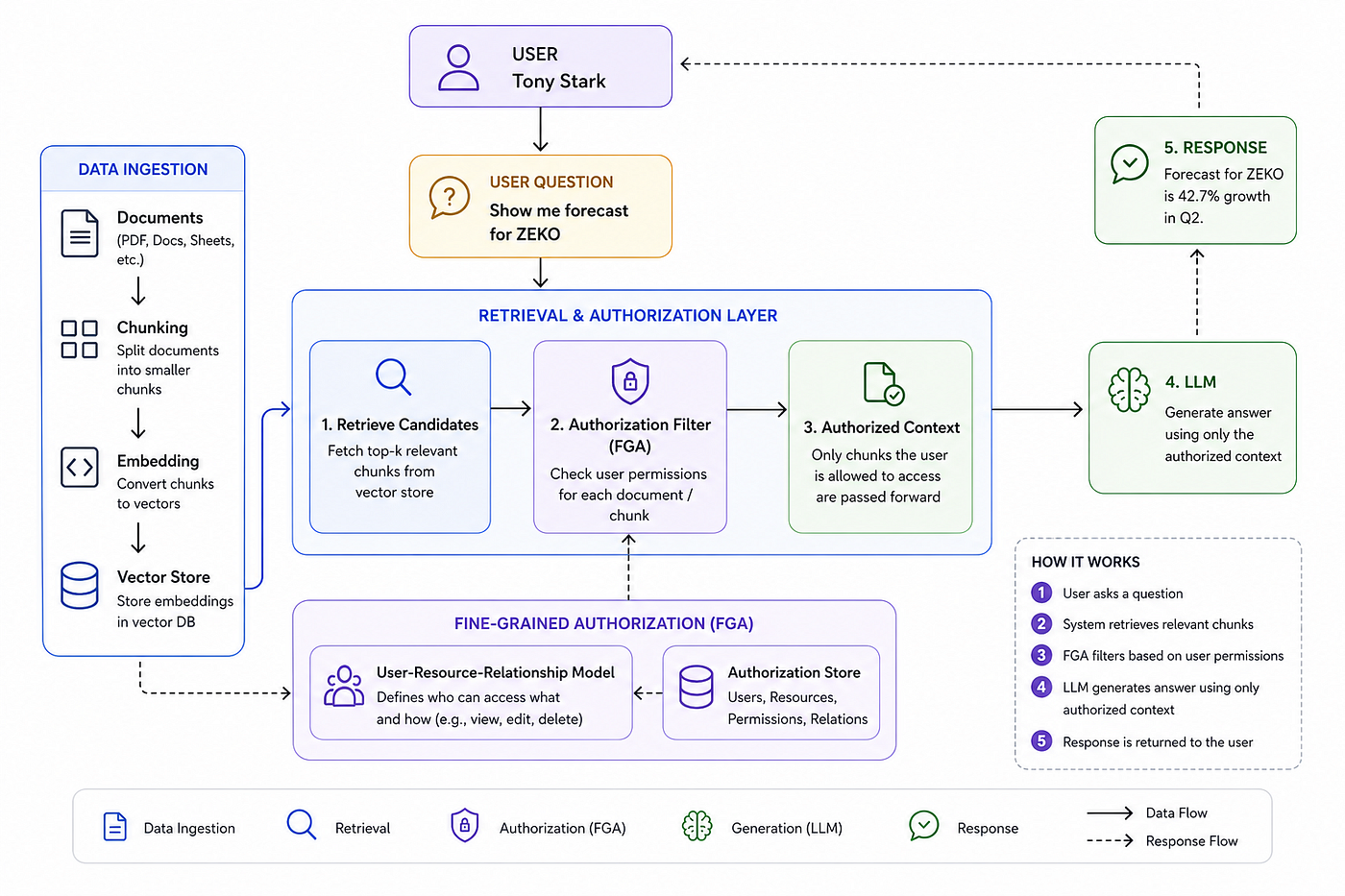
This is where fine-grained authorization (FGA) comes in
Instead of broad access like:
“user has access to system”
FGA goes deeper:
“user X can read document A, but not document B”
Even if both exist in the same dataset.
So now, access is defined at the resource level, not just the system level.
The part I found really cool
You don’t fix this after retrieval.
You fix it before.
So the pipeline becomes:
- user sends a query
- system checks permissions
- only authorized documents are retrieved
- LLM generates the answer
Which means:
the LLM never even sees restricted data.
No masking, no patching later — just clean control upfront.
This slightly changed how I think about RAG
Before:
retrieval → generation
Now:
retrieval → authorization → generation
That middle layer feels small, but it’s doing a lot.
Why this actually matters
Most demos don’t show this.
But in real systems:
- not all data is accessible to everyone
- permissions matter
- compliance matters
Without this, it’s hard to safely deploy AI in:
- enterprises
- healthcare
- finance
Final thought
This was one of those ideas that felt obvious after reading it.
But I hadn’t really considered it before.
And now it feels like something every RAG system should have by default.
Reference
메타데이터
- post_id
- bb711a091d74
- slug
- rethinking-rag-why-authorization-matters-more-than-we-think-bb711a091d74
- url
- https://medium.com/@rshree2001/rethinking-rag-why-authorization-matters-more-than-we-think-bb711a091d74
- canonical_url
- https://medium.com/@rshree2001/rethinking-rag-why-authorization-matters-more-than-we-think-bb711a091d74
- author_url
- https://medium.com/@rshree2001
- status
- ok
- fetched_at
- 2026-06-22 12:55:45