He doubted that we might not doubt: A celebration of St. Thomas in John 20:24–29
John 20:24–29
*He doubted that we might not doubt: A celebration of St. Thomas in *John 20:24–29

By Peter Paul Rubens — Museo del Prado, Public Domain, https://commons.wikimedia.org/w/index.php?curid=15158936
John 20:24–29
Thomas, called Didymus, one of the Twelve, was not with them when Jesus came. So the other disciples said to him, “We have seen the Lord.” But Thomas said to them, “Unless I see the mark of the nails in his hands and put my finger into the nailmarks and put my hand into his side, I will not believe.” Now a week later his disciples were again inside and Thomas was with them. Jesus came, although the doors were locked, and stood in their midst and said, “Peace be with you.” Then he said to Thomas, “Put your finger here and see my hands, and bring your hand and put it into my side, and do not be unbelieving, but believe.” Thomas answered and said to him, “My Lord and my God!” Jesus said to him, “Have you come to believe because you have seen me? Blessed are those who have not seen and have believed.”
Daily Prayer:
Most merciful Lord, the limitations of the human mind and heart are often confined by the constructs of our cognitive realities, leading us to place our belief predominantly in what is visible and tangible. The teachings of Holy Mother Church illuminate our understanding, guiding us towards a faith enriched by reason, which we often accept with intellectual assent. However, when confronted with the unheralded trials of life, our spiritual vision can become obscured, favoring what we can empirically verify.
In reflecting upon the Apostle Thomas, Christ’s admonition resonates: “Blessed are those who have not seen and yet have believed” (John 20:29). This exhortation calls us to elevate our spiritual perception above our physical sight, so that in our daily existence, we are propelled by the divine power and authority of God. In facing the profound challenges of life, akin to the crucifixion of Jesus, may we demonstrate the fortitude to embody a life of resurrection, while also submitting to the will of the Father through the Son.
We beseech this through Christ our Lord. Amen.
Encountering Christ:
John 20:24–29, commonly known as the account of “Doubting Thomas,” serves as a profound theological exploration of faith, doubt, and the nature of belief. The Apostle Thomas, also referred to as Didymus, embodies the skepticism and empirical demands often inherent in human nature. His declaration, “Unless I see the mark of the nails in his hands and put my finger into the nail marks and put my hand into his side, I will not believe” (John 20:25, New Revised Standard Version), encapsulates the struggle between sensory evidence and spiritual conviction.
St. Augustine interprets Thomas’s doubt as a necessary element of the faith journey. Augustine remarks, “He doubted that we might not doubt” (Augustine, Tractates on the Gospel of John, Tractate CXXI). Thomas’s initial unbelief and subsequent confession of faith, “My Lord and my God!” (John 20:28), serve as a testament to the transformative power of Christ’s resurrection and a paradigmatic shift from doubt to belief.
Furthermore, St. Gregory the Great elucidates the significance of Jesus’ response to Thomas. He notes, “It was not an accident, but providence which brought the disciple, who was to examine the wounds of his Teacher, absent, then present” (Homilies on the Gospels, Homily XXVI). Gregory highlights that Thomas’s doubt and subsequent affirmation of faith underscore the blessedness of those who believe without seeing, as emphasized by Christ: “Blessed are those who have not seen and yet have come to believe” (John 20:29). This beatitude extends beyond the immediate context to all future believers, establishing a foundation for the Church’s understanding of faith.
The theological implications of this passage are further deepened through the writings of St. Thomas Aquinas. Aquinas argues that faith involves assent to divine truths beyond human comprehension, facilitated by the grace of God (Summa Theologica, II-II, Q. 1, Art. 4). Thomas’s encounter with the risen Christ demonstrates the transition from a faith based on physical evidence to a more profound, grace-filled belief. This encounter exemplifies the harmony between faith and reason, where reason serves as a prelude to the deeper mysteries of faith.
In contemporary theological discourse, the narrative of Thomas challenges believers to embrace a faith that transcends empirical verification. As Karl Rahner suggests, “Faith is not a light that dispels all our darkness, but a lamp that guides our steps in the night and suffices for the journey” (Rahner, Theological Investigations, Vol. 20). The story of Thomas invites Christians to trust in the presence and promises of Christ, even amidst doubt and uncertainty.
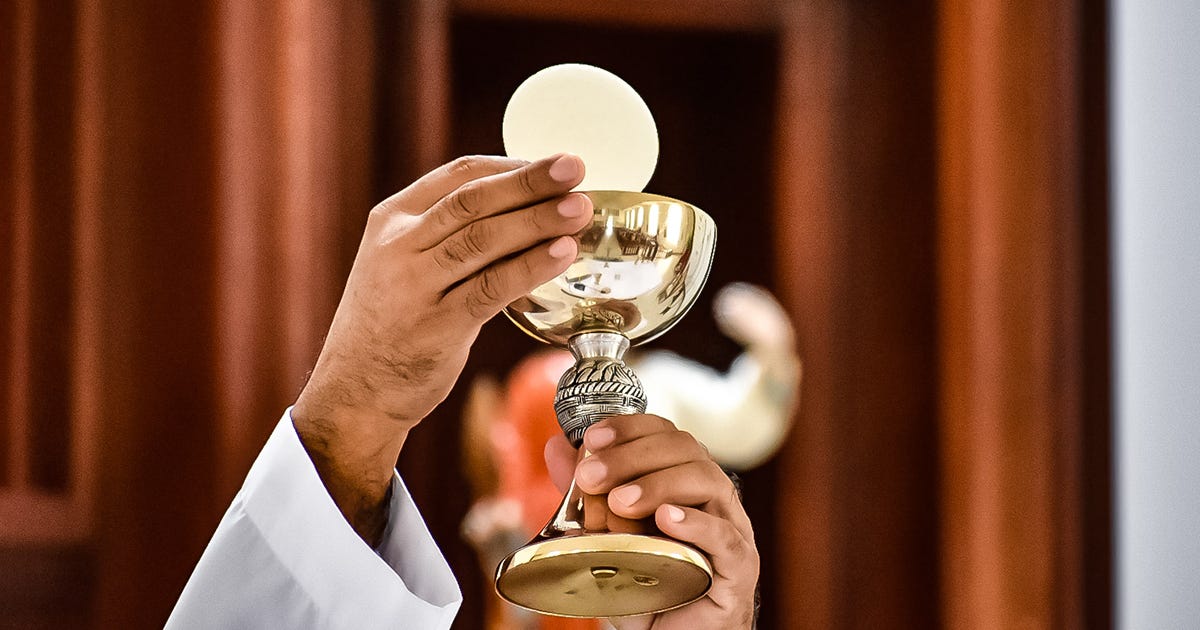
As I pen this reflection, I am compelled to contemplate the myriad thoughts that pass through our minds as we partake in the Holy Eucharist and adore the Blessed Sacrament. In this sacred act, heaven is united with earth, and we engage in a communal sacrifice where Christ, both the offerer and the offered, nourishes us with His body, blood, soul, and divinity. However, some may overlook or fail to honour the profound reality that the species of bread and wine are fully transformed into the body, blood, soul, and divinity of Christ. Through the encounter of St. Thomas, Christ invites us to open our eyes of faith, believing in what we do not see.
Thomas’s proclamation, “My Lord and my God,” educates us on the power of recognizing the divinity in the humanity of our Lord. His acknowledgment invites us to draw our understanding from the saints, church fathers, and ecclesiastical teachings that explain in detail the mysteries of our faith. Similarly, may the Eucharistic miracles that have transcended the ages instill an affirmation in us that opens our hearts and minds to the love of God given to us in the Eucharist.
May this reflection inspire you to desire, prepare, and always acknowledge God’s presence in the Sacraments, fostering a renewed commitment to Communion, adoration, and love for the source and summit of our faith.
References
Augustine. (2008). Tractates on the Gospel of John. In The Nicene and Post-Nicene Fathers (Vol. 7, P. Schaff, Ed.). Hendrickson Publishers.
Gregory the Great. (2010). Homilies on the Gospels. In Fathers of the Church (Vol. 123, D. Hurst, Trans.). Catholic University of America Press.
Rahner, K. (1981). Theological Investigations (Vol. 20). Crossroad.
Thomas Aquinas. (1947). Summa Theologica (Fathers of the English Dominican Province, Trans.). Benziger Brothers.
메타데이터
- post_id
- bb7f75fd6c71
- slug
- he-doubted-that-we-might-not-doubt-a-celebration-of-st-thomas-in-john-20-24-29-bb7f75fd6c71
- url
- https://medium.com/@mydailyreflection/he-doubted-that-we-might-not-doubt-a-celebration-of-st-thomas-in-john-20-24-29-bb7f75fd6c71
- canonical_url
- https://medium.com/@mydailyreflection/he-doubted-that-we-might-not-doubt-a-celebration-of-st-thomas-in-john-20-24-29-bb7f75fd6c71
- author_url
- https://medium.com/@mydailyreflection
- status
- ok
- fetched_at
- 2026-06-22 05:41:33