Modern PHP Type System: A Practical Guide with Real-World Examples
The Type System in Modern PHP
Modern PHP Type System: A Practical Guide with Real-World Examples
The Type System in Modern PHP
In today’s web development landscape, type safety has become increasingly crucial for building robust and maintainable applications. PHP’s type system has evolved significantly since PHP 7, and with PHP 8.4 on the horizon, it’s more powerful than ever. Let’s dive into how these features can improve your real-world applications.
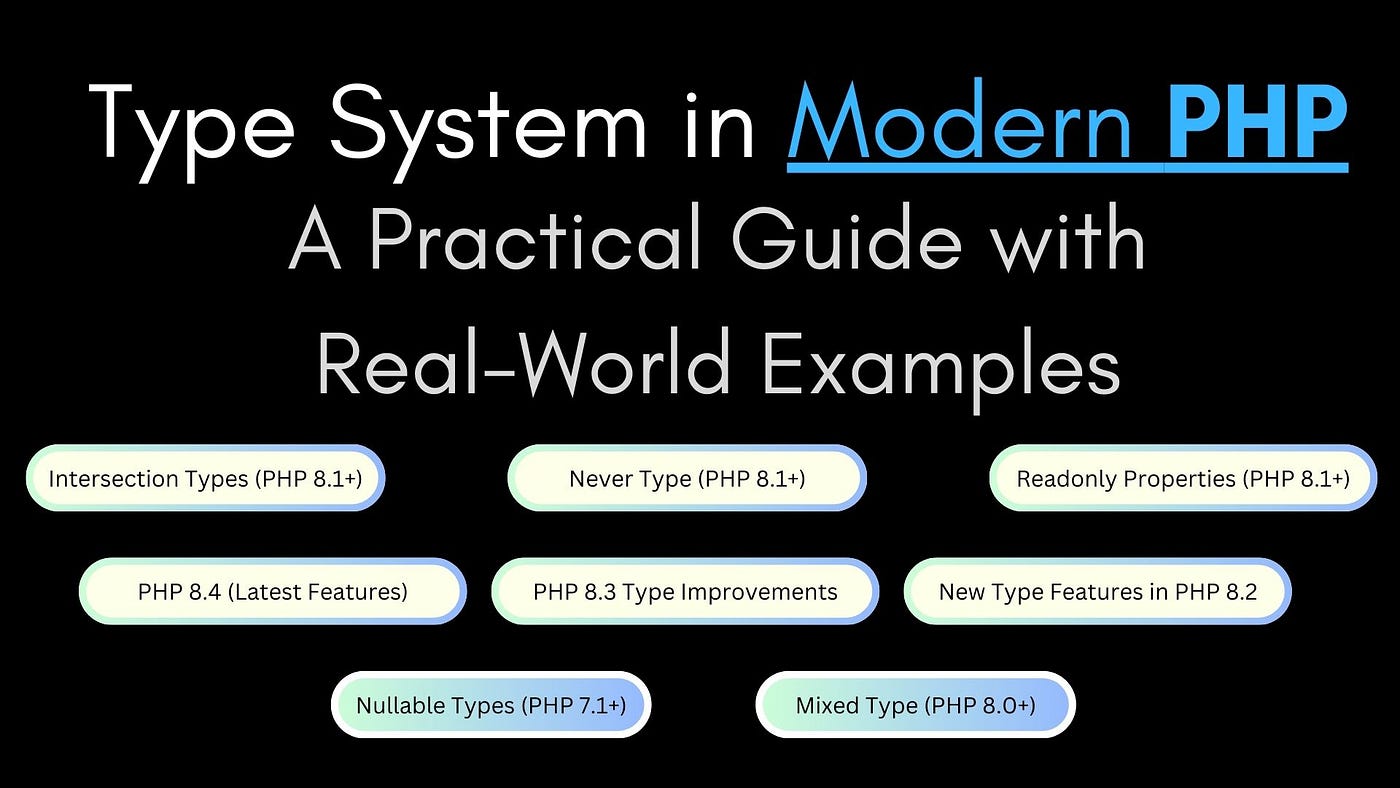
Understanding Type Safety in Modern PHP
Why Type Safety Matters: A Real Case Study
Recently, our team was debugging a payment processing system where a simple type mismatch caused significant issues. The system was occasionally treating string-formatted numbers as integers, leading to precision loss in financial calculations. Here’s how we fixed it using PHP’s strict type system:
<?php
declare(strict_types=1);

class PaymentProcessor {
    public function processPayment(float $amount, string $currency): bool {
        if ($amount <= 0) {
            throw new InvalidArgumentException('Amount must be positive');
        }

        // Process payment logic
        return $this->submitToPaymentGateway($amount, $currency);
    }

    private function submitToPaymentGateway(float $amount, string $currency): bool {
        // Gateway submission logic
        return true;
    }
}

// Usage
$processor = new PaymentProcessor();
try {
    // This will now throw an error if amount is passed as string
    $result = $processor->processPayment(99.99, 'USD');
} catch (TypeError $e) {
    // Handle type error
}
Real-World Applications of Modern Type Features
1. E-Commerce Order System
Here’s how we can use PHP 8’s union types and nullable types in an order processing system:
class Order {
    public function __construct(
        private readonly string $orderId,
        private readonly float $total,
        private readonly array $items,
        private ?string $couponCode,
        private null|string|int $customerId
    ) {}

    public function applyCoupon(?string $code): float|false {
        if ($code === null) {
            return $this->total;
        }

        // Coupon logic here
        return $this->calculateDiscountedTotal($code);
    }
}
2. Content Management System (CMS)
Using intersection types for a plugin system:
interface Renderable {
    public function render(): string;
}

interface Cacheable {
    public function getCacheKey(): string;
    public function getCacheDuration(): int;
}

class BlogPost implements Renderable, Cacheable {
    public function __construct(
        private readonly string $title,
        private readonly string $content,
        private readonly ?string $featuredImage
    ) {}

    public function render(): string {
        // Render blog post HTML
        return "<article>...</article>";
    }

    public function getCacheKey(): string {
        return "blog_post_{$this->title}";
    }

    public function getCacheDuration(): int {
        return 3600; // 1 hour
    }
}

function renderCacheableContent(Renderable&Cacheable $content): string {
    $cache = new Cache();
    $key = $content->getCacheKey();

    if ($cached = $cache->get($key)) {
        return $cached;
    }

    $rendered = $content->render();
    $cache->set($key, $rendered, $content->getCacheDuration());
    return $rendered;
}
3. API Response Handler
Using the never type and union types for robust API responses:
class ApiResponse {
    public function send(mixed $data, int $status = 200): never {
        header('Content-Type: application/json');
        http_response_code($status);
        echo json_encode($this->formatResponse($data));
        exit;
    }

    private function formatResponse(mixed $data): array {
        return [
            'status' => 'success',
            'data' => $data,
            'timestamp' => time()
        ];
    }
}

class UserController {
    public function getUser(int|string $userId): void {
        $api = new ApiResponse();

        try {
            $user = $this->userRepository->find($userId);
            if (!$user) {
                $api->send(['error' => 'User not found'], 404);
            }
            $api->send($user->toArray());
        } catch (Exception $e) {
            $api->send(['error' => $e->getMessage()], 500);
        }
    }
}
4. Form Validation System
Implementing a robust form validation system using readonly properties and union types:
readonly class FormField {
    public function __construct(
        public string $name,
        public mixed $value,
        public array $validationRules
    ) {}
}

class FormValidator {
    /** @var FormField[] */
    private array $fields = [];

    public function addField(
        string $name,
        mixed $value,
        array $rules
    ): self {
        $this->fields[] = new FormField($name, $value, $rules);
        return $this;
    }

    public function validate(): array|bool {
        $errors = [];

        foreach ($this->fields as $field) {
            $fieldErrors = $this->validateField($field);
            if (!empty($fieldErrors)) {
                $errors[$field->name] = $fieldErrors;
            }
        }

        return empty($errors) ? true : $errors;
    }
}

// Usage in a registration form
$validator = new FormValidator();
$validator
    ->addField('email', $_POST['email'] ?? null, ['required', 'email'])
    ->addField('age', $_POST['age'] ?? null, ['required', 'integer', 'min:18']);

if (($errors = $validator->validate()) !== true) {
    // Handle validation errors
}
Best Practices and Tips
- Always Use Strict Types
— Enable
declare(strict_types=1)in all new PHP files — This catches type-related bugs early in development - Leverage Constructor Property Promotion — Reduces boilerplate code — Makes classes more readable and maintainable
- Use Union Types Judiciously — Don’t overuse them — they can make code harder to understand — Perfect for handling nullable values or multiple valid types
- Readonly Properties for Immutability — Use for value objects and DTOs — Helps prevent bugs caused by unexpected state changes
Conclusion
PHP’s modern type system provides powerful tools for building more reliable applications. By leveraging these features, you can catch errors earlier, write more maintainable code, and provide better documentation through type hints. As PHP evolves, embracing these typing features becomes increasingly important for professional PHP development.
Whether you’re building a new project or maintaining an existing one, incorporating these typing features can significantly improve your code quality and reduce bugs in production. Start with strict types and gradually adopt more advanced features as you become comfortable with them.
Remember, the goal isn’t to use every type feature available, but to use them strategically to make your code more reliable and easier to maintain.
Have you implemented strict typing in your PHP projects? What challenges did you face? Share your experiences in the comments below!
메타데이터
- post_id
- bb7faacc1d87
- slug
- modern-php-type-system-a-practical-guide-with-real-world-examples-bb7faacc1d87
- url
- https://medium.com/@arifhossen.dev/modern-php-type-system-a-practical-guide-with-real-world-examples-bb7faacc1d87
- canonical_url
- https://medium.com/@arifhossen.dev/modern-php-type-system-a-practical-guide-with-real-world-examples-bb7faacc1d87
- author_url
- https://medium.com/@arifhossen.dev
- status
- ok
- fetched_at
- 2026-06-27 23:56:40