Red Riding Hood never had a name in the original story.
‘Mary Red Riding Hood,’ a contemporary retelling published on Wattpad five years ago, teaches a similar moral yet casually defies the…

A Modern Fairytale to read on Wattpad if you’re so inclined; just eight chapters, titled Mary Red Riding Hood
Red Riding Hood never had a name in the original story. That’s because it wasn’t important. Little Red Riding Hood is every medieval little girl who talks to strangers. Girls being so naive and stupid… get eaten.
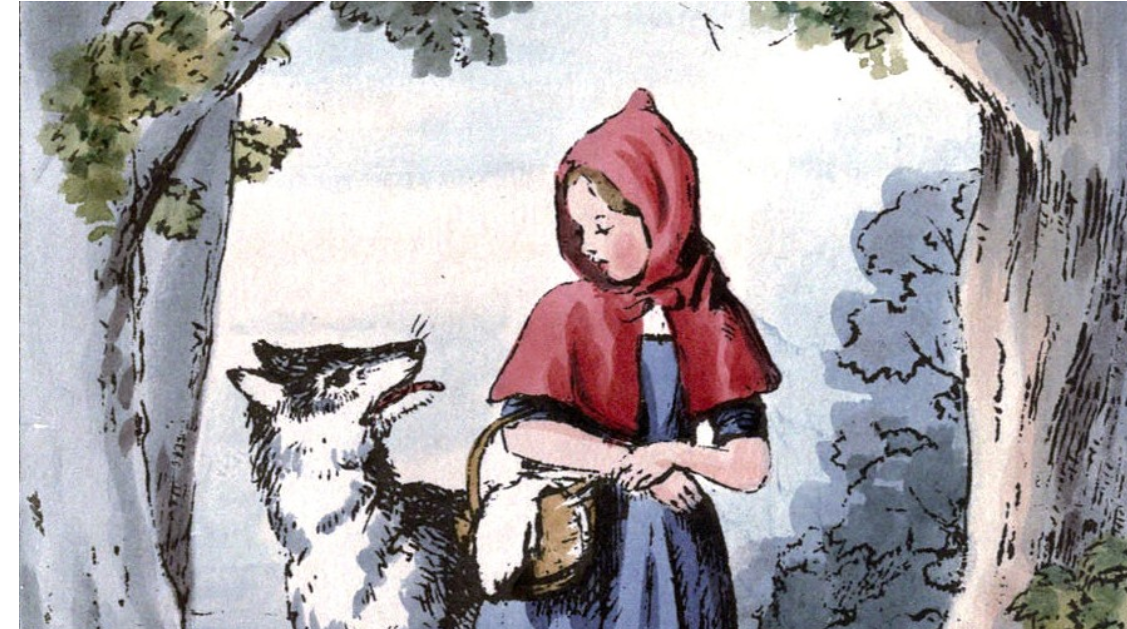
‘Mary Red Riding Hood,’ a contemporary retelling published on Wattpad five years ago, teaches a similar moral yet casually defies the implicit messaging in the original that femininity equaled passive victimization.
The story establishes agency as one of its major themes from its introductions to our female cast: Mary (Red) Thompson, Granny Esther Thompson, and the Thompson mother.
They each have distinct characteristics, so a reader must consider them as individuals rather than simplistic constructs or vessels.
We also find out how they address their agency being challenged;
Mary, as a child, directly voices discontent with an optimistic– almost obstinate– belief that she can out-muscle her way out of danger and therefore can be allowed greater independence to explore the world she finds wondrous.
Esther considers Mary her favorite grandchild; both share stubborn personalities and value personal independence. The old woman asserts her authority through grit and her status as an older adult. Ceding to compromises where she nevertheless gets what she wants, which is living alone without her family, while caring– fussing needlessly over her.
The mother also distinguishes herself as an active participant in life, despite using a gentler and softer, more traditionally feminine approach. She can’t impose singular authority upon her daughter, nor does she want to smother her child’s spirit; she is firm that her daughter must have a means to defend herself.
The mother’s method is pepper spray.
A woman can blind her attacker from a safe distance and run away from danger, unharmed and whole if not shaken. These methods are never devalued or deemed lesser. Mary graciously takes the pepper spray on the way to her grandmother’s house.
Red Riding Hood isn’t at a disadvantage for being female; in fact, she utilizes and manipulates the expectations of a girl to catch the wolf unaware. The disadvantage comes from simply being a child, more accurate than the tale that oversimplified both genders into stock roles where men are overt beasts, aggressive, and using violence at all times, which leaves disturbing implications that:
One) boys can’t be victimized
Two) boys are labeled as solely victimizers, and the girl is utterly powerless and even at fault for her misfortune due to naivety and purity– essentially her feminine traits.
Interpretations made about the Red Riding Hood fairytale find that its moral is really about the greatest harm a girl maturing into a woman can face, which is the overt beastliness of men’s gaze. From the girl’s red hood being the color of menstrual blood and other implications of the color;
“…running around in the forest in red was like carrying a flashing billboard…”
denoting a certain reputation. And Perrault’s original tale ends:
“[T]his wicked wolf fell upon Little Red Riding Hood and ate her all up,” (Lang. 1889).
Mary’s situation: The burgling wolf of the story tricks her to rob Granny’s house uninterrupted, with Mary walking directly to the bedroom where she knows the burglar is out of the emotional, irrational desire to save her grandmother reads as a maturing young woman– allowed out on the city streets alone for the first time– experiencing the danger of men who seek an easy mark from vulnerable women and girls.
The key difference is where the blame is placed. Perrault directly warned readers of “soft wolves,” those who are charming, quiet, and even sweet.
Mary’s wolf– named Walter– is a soft wolf.
First, he is established as a locksmith. A position where he can access even guarded affluent folks’ homes, knowing the security inside and out…
After all, he installed it.
Furthermore, his technique requires the patience not to rob the place immediately. Doing the deed weeks later, Mary couldn’t have stopped him from finding her grandmother; it was information he already had.
He is described in Mary’s distinctly feminine and bubbly voice as an attractive man in a uniform, with brown hair and dark eyes. It was his act of helping her off the ground and fulfilling her fantasies that marked him as good and trustworthy due to how he conducted himself. Exactly how he can fool Mary in the first place, he delivers a lie patiently and confidently. As readers, we have privileged information and genre savvy to realize we’ve met the wolf, but to Mary, he is “a Prince,” acting the role built from typical childish fancy.
Perrault’s portrayal of ‘stranger danger’ is in itself deeply dangerous, making it an overture that comes in a simple, snarling, exclusively masculine package.
‘Mary Red Riding Hood’ cautions children that strange adults can use softer approaches similar to familiar adults who care about them, gaining a child’s innate trust that the world is good. Even so, that doesn’t mean the child is stupid or at fault. Mary detected “a flicker of anger” when she initially questioned the lie, not to mention knowing that, as a person, her grandmother would hate a “bottom five floor” rule for seniors.
The story teaches children that trusting their own intuition and even their feelings is as valid as an adult’s “logic.” Or their lies. An essential idea that girls receive when their suffering is treated as the result of stupidity or naivety inherent to femininity. Also inherent is that a girl’s emotions are what allow them to be subjected to harm and humiliation.
Mary freezes, and while for her age she impressively collects her thoughts and comes up with a plan, the story’s unsettling detail to the setting, the thrill of terror conveyed by Walter in grandma’s bed, convey a tense and frightening experience that no child should be expected to handle with grace, much less success. Mary’s act may be admirable, but as she herself says,
“my knees nearly gave out until a pair of hands caught me and guided me to the sofa–”
She certainly doesn’t feel like a heroine, though she isn’t old enough to put it into words. What just happened is that the adrenaline rush had ended once she was finally allowed to be scared.
Despite having met a horrible man, the officers play a role similar to huntsmen, portraying a positive and much softer side to men as protectors to the weak and defenseless, much healthier and hopeful representation where men not only persecute the offender rather than the girl they are also part of the after-care, tending and mollifying the child from a terrifying experience.
From Perrault to the modern day, stories and media have the unfortunate trait of degrading and minimizing femininity as the weaker, more hysterical, and illogical gender.
This modern version impressively weaves femininity as a fact of life rather than a grand form of power and defiance, which places its own set of crushing irons on young girls. Mary is not weak for liking pink and desiring a pair of heels; her agency is not devalued for being scared. In fact, she is stronger and compelling as a character who gathers her courage and tries her best. Because this wasn’t a story about telling girls that femininity means to be a victim, instead it’s a story about how a good head on a kid’s shoulders is the best weapon they have if they ever face up to harmful adults. The story wants kids to keep themselves safe, conveying that taking agency isn’t about taking unnecessary risks and isn’t necessarily about being a warrior. It’s about awareness and sensibility, understanding that such traits aren’t gender exclusive.
___
Story can be read here: https://www.wattpad.com/story/246491902-mary-red-riding-hood
Citations
Perrault, C. (2003, September 21). Little red riding hood. Perrault: Little Red Riding Hood. https://sites.pitt.edu/~dash/perrault02.html
White, S. (2021, July 31). Little red riding hood: A sexy cautionary tale — SWW. SWW — Fairy Tales & Writing Inspiration. https://snowwhitewrites.com/little-red-riding-hood-sexy-cautionary-tale/
메타데이터
- post_id
- bb8012d07178
- slug
- red-riding-hood-never-had-a-name-in-the-original-story-bb8012d07178
- url
- https://medium.com/@alyin1031/red-riding-hood-never-had-a-name-in-the-original-story-bb8012d07178
- canonical_url
- https://medium.com/@alyin1031/red-riding-hood-never-had-a-name-in-the-original-story-bb8012d07178
- author_url
- https://medium.com/@alyin1031
- status
- ok
- fetched_at
- 2026-06-26 03:39:16



