A TMF-Native Odoo Platform: When Co-location Is the Right Trade-off
An exploration of what changes when the TM Forum contract and the operating platform share the same core — and when that trade-off is worth…
A TMF-Native Odoo Platform: When Co-location Is the Right Trade-off
An exploration of what changes when the TM Forum contract and the operating platform share the same core — and when that trade-off is worth making.
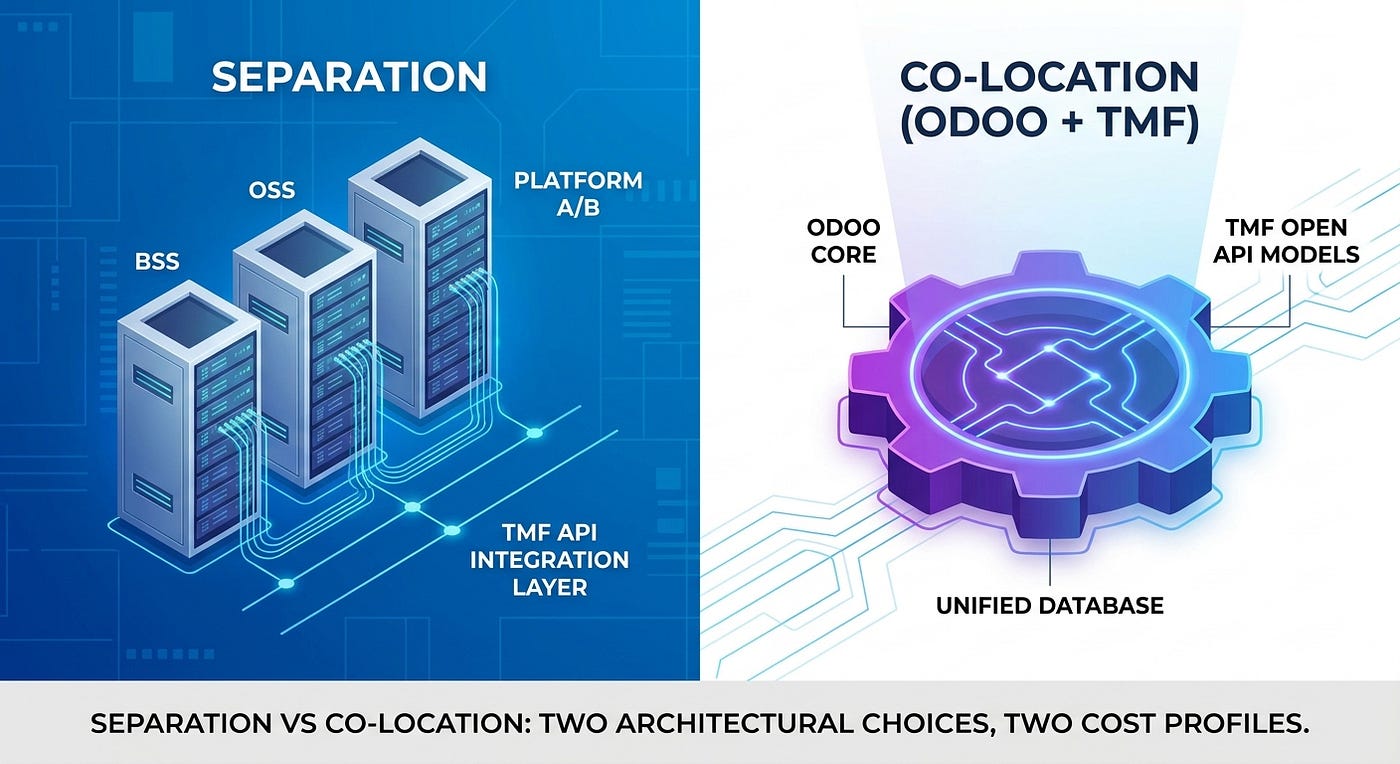
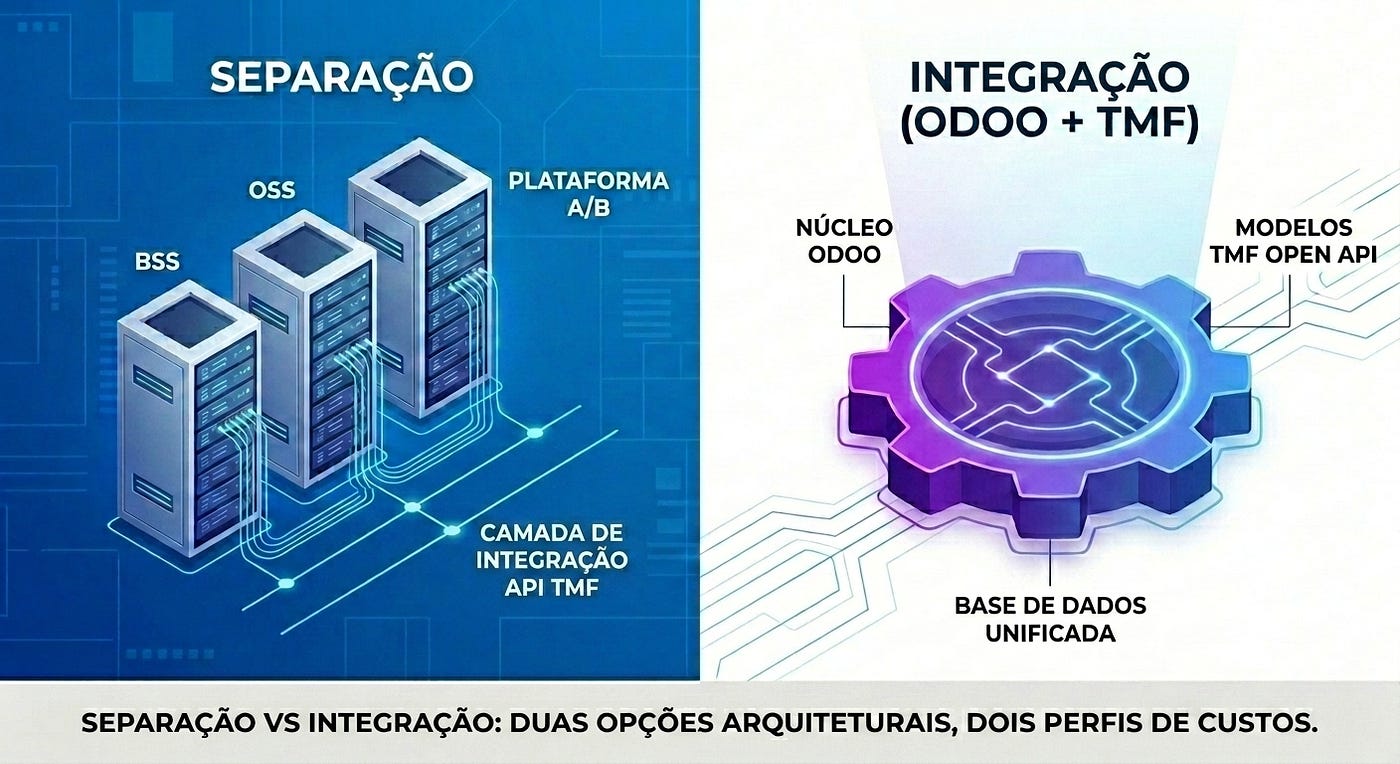
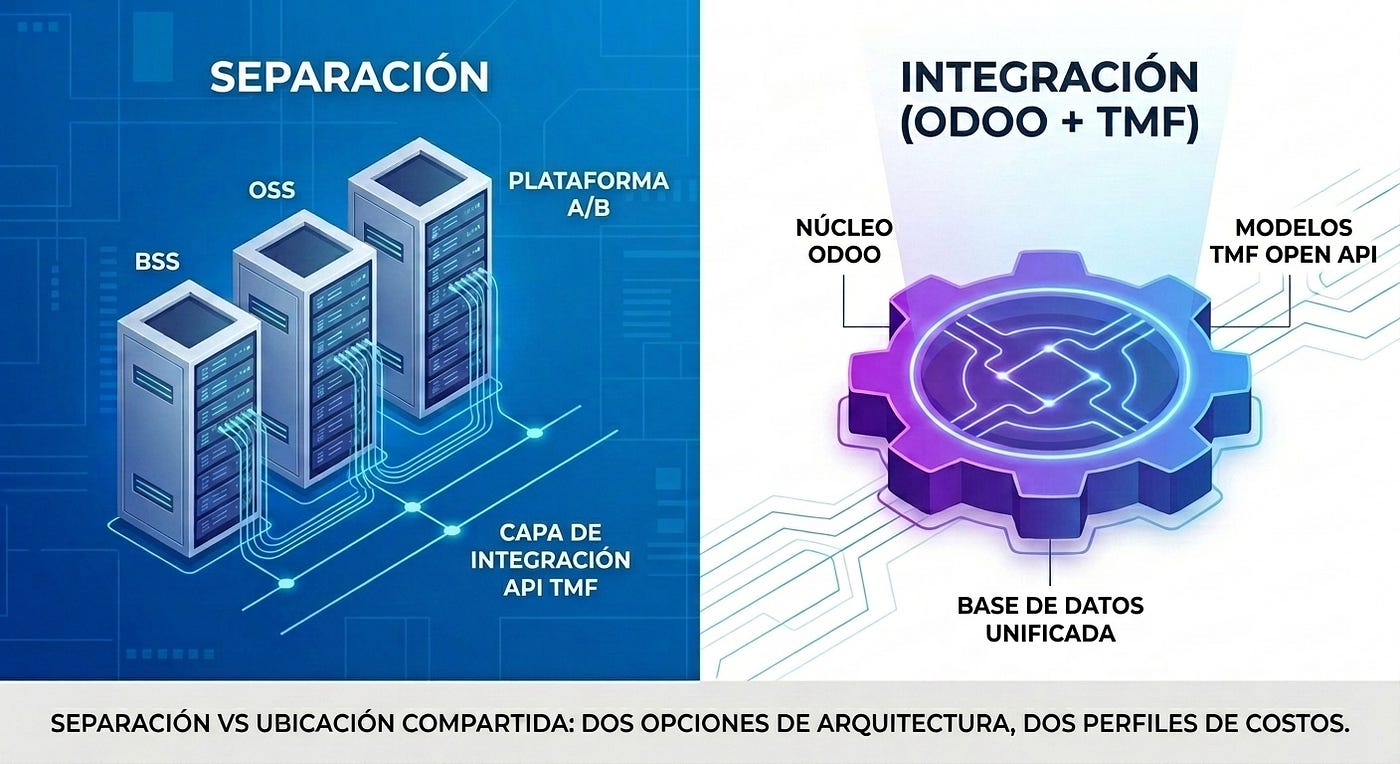
In most telecom environments, TM Forum Open APIs are exposed through an integration layer that sits in front of the real BSS and OSS. That pattern is well-established, often for sound reasons: teams own their systems independently, legacy platforms can’t be replaced quickly, and separating the integration contract from the operational core lets both evolve on their own cadence.
It’s a valid architecture. But it comes with a specific cost profile — mapping work, reconciliation, and a version-of-truth question between the API surface and the operating platform — and those costs are not always the right ones to pay.
OdooTMFOpenAPI explores a different point on the trade-off curve: implementing TM Forum Open APIs directly inside Odoo, so the TMF contract and the business state share the same models and the same transactional boundary. It is not a claim that facade-style integration is wrong. It is an experiment in what becomes easier — and what becomes harder — when the contract and the core are not separated in the first place.
Who this is for. This approach is particularly relevant for Tier 3 operators, MVNOs, and internal digital-native “speedboats” within Tier 1 telcos who need to move faster than their legacy stack allows. If your constraint is reconciliation overhead and time-to-launch, the native pattern is worth evaluating. If your constraint is federating across an entrenched OSS/BSS landscape owned by multiple teams, the facade pattern is likely still the right answer.
This is the first post in a five-part series on the platform, the architectural decisions behind it, the implementation journey, the use cases it supports, and the lessons learned.
The trade-off, stated plainly
Every TMF deployment makes a choice between two structural patterns:
- Facade pattern— a standards layer fronts one or more operational systems, translating between TMF resources and whatever the backing platform stores.
- Native pattern — the standards layer IS the operational model, so reads and writes go straight to the system of record.
Both are legitimate. The question is which cost profile a given organization prefers.
Facade tends to win when:
- Legacy core — the operational BSS/OSS can’t be rewritten.
- Multiple backing systems — one consistent API needs to front several platforms.
- Independent team ownership — the integration layer and the operational core are owned separately.
- Decoupled release cadences — the API evolves faster than the BSS, or vice versa.
- Engineering bench — there’s enough headcount to maintain the mappings and reconciliation jobs.
Native tends to win when:
- Malleable platform — the operating platform is extensible enough to host the TMF model directly.
- Single team ownership — the same team owns both the API and the operating platform.
- Reconciliation cost dominates — reducing mapping overhead and version-of-truth drift is the priority.
- Cross-domain flows — onboarding, activation, billing routinely cross domain boundaries.
- Greenfield or consolidating — the footprint is new, mid-sized, or collapsing onto one platform.
This project sits squarely on the second side — not because the first is mistaken, but because the trade-off looked favorable for the scenarios we wanted to support.
What the facade pattern actually costs
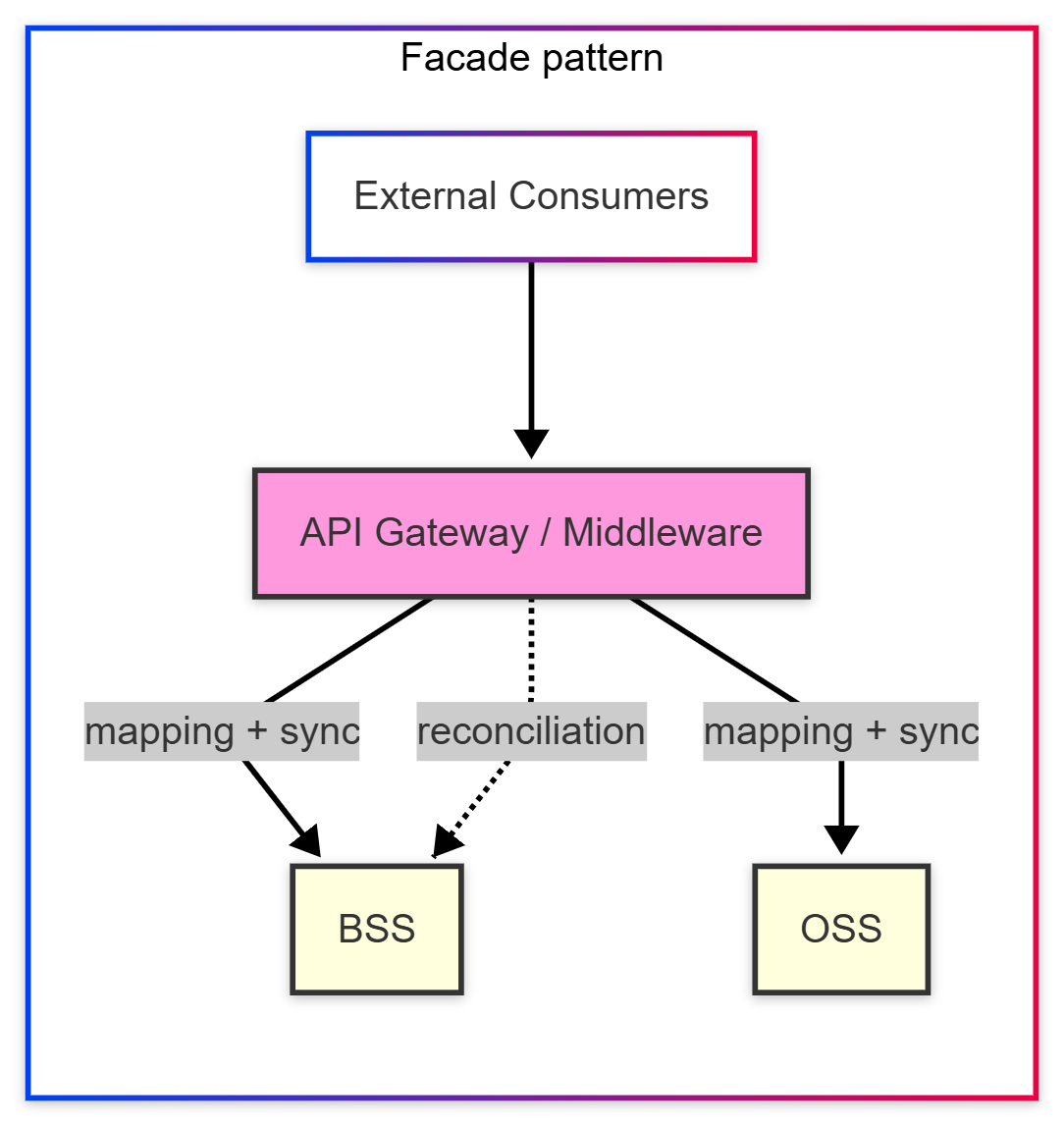
The facade is not inherently fragile — well-run facades are perfectly stable. The cost is concentrated in three places:
- Mapping maintenance. Every new TMF field or domain needs a mapping, and every internal model change may break one.
- Reconciliation. When the facade holds derived state or a cache, drift becomes a thing you monitor and correct.
- Flow representation. Operational journeys that cross domains (order → service → invoice) are easier to model when the data is co-located and harder when each step lives in a different system.
These costs are manageable. They become expensive when the API surface grows faster than the team absorbing them, or when the business needs to move a domain across the boundary.
What Odoo offers as a foundation
Odoo is not a telecom-native platform. Its appeal here is different: it provides a broad operational footprint on a unified transactional model, at a cost-to-stand-up and speed-to-market that legacy telecom stacks can rarely match.
For an MVNO or a greenfield digital brand, the “Telecom Legacy Tax” — licensing, integrator-led implementations, multi-year rollouts — is often too high for the business model to absorb. Odoo effectively ships as a BSS-in-a-box: CRM, quote-to-order, inventory, accounting, support, and projects already wired to one data model, with the source code available to extend.
- CRM for customers and accounts
- Sales for quote-to-order flows
- Inventory for physical and logical asset handling
- Accounting for billing and financial execution
- Helpdesk for support workflows
- Projects for operational delivery
The value isn’t any single module. It’s that these domains share one identity model and one database. A customer in CRM is the same row that participates in ordering, fulfillment, billing, and support — no integration copy, no synchronization job.
That’s the ingredient that makes a native TMF implementation tractable: there’s already a unified operating platform underneath, so the TMF layer doesn’t have to federate across systems. And because it starts from a running ERP rather than an empty canvas, an MVNO or digital speedboat can reach a usable BSS footprint in weeks rather than quarters.
This is also the specific property that gets harder as the operation grows. Odoo’s unified model is a strength at one scale and a constraint at another. The trade-off is real.
Why TM Forum Open APIs still matter either way
Independent of facade vs native, TMF Open APIs remain one of the most valuable interoperability assets in telecom architecture. They provide a stable contract across:
- TMF620 Product Catalog Management
- TMF622 Product Ordering Management
- TMF629 Customer Management
- TMF638 Service Inventory Management
- TMF639 Resource Inventory Management
- TMF641 Service Ordering Management
- and others across engagement, fulfillment, assurance, and billing
The benefits — reduced point-to-point integration, faster partner onboarding, better component replaceability, a stable contract for B2B and channels — apply regardless of whether the implementation is a facade or native.
The choice is only about where the TMF contract lives. Not whether it should exist.
The question this project explores
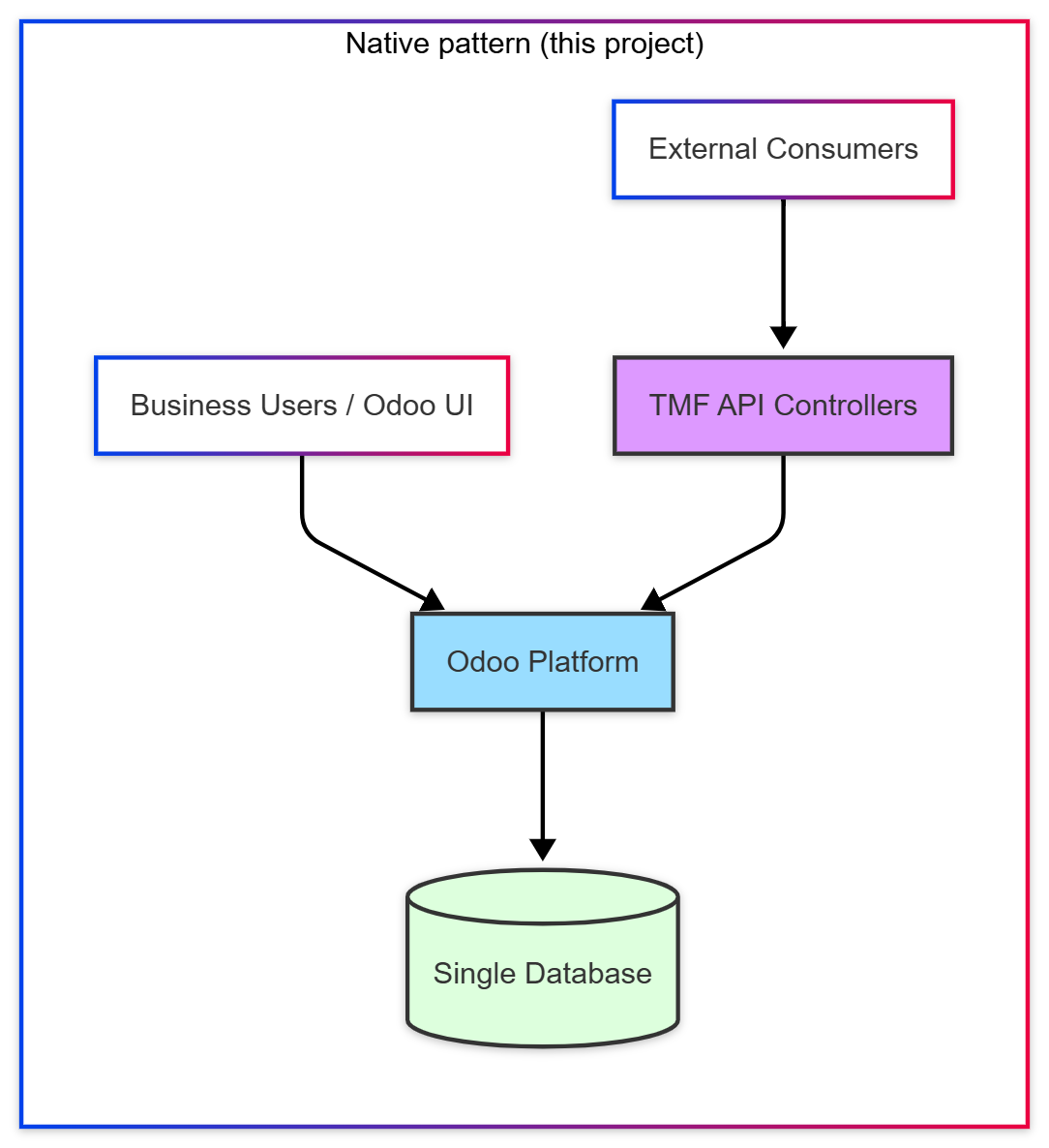
The question the project asks is narrow and specific:
If TMF Open APIs are implemented as first-class models inside Odoo rather than fronted by a separate integration layer — what becomes easier, what becomes harder, and where does the trade-off break down?
Early answers, to be elaborated in later posts:
- Easier — end-to-end flows, data consistency, adding a new TMF domain alongside an existing Odoo one, running operations and API from the same transactional context.
- Harder — isolating TMF evolution from Odoo upgrades, horizontal scaling of the API surface separately from the UI, federating data that genuinely lives outside Odoo.
- Breaks down when — the operational footprint exceeds what a single Odoo deployment can reasonably host, or when parts of the business live in systems that Odoo can’t absorb.
The interesting finding so far is that the break-even point is further out than we expected — but it does exist, and honesty about it matters.
What this series covers
- Post 2, Architecture — the modular addon design, the shared control-plane foundation, and the patterns that kept it scalable.
- Post 3, Implementation Journey — CTK conformance issues, recursion problems, response-shape mismatches, and the discipline required to work through them.
- Post 4, Use Cases — the operational scenarios this platform supports end-to-end.
- Post 5, Lessons and Roadmap — what worked, what did not, and when we would reach for a different pattern next time.
Code is here: [github.com/jgabielb/OdooTMFOpenAPI]
The next post starts at the architectural layer.
메타데이터
- post_id
- bb83ee65e6a6
- slug
- a-tmf-native-odoo-platform-when-co-location-is-the-right-trade-off-bb83ee65e6a6
- url
- https://medium.com/@joaogabrielb/a-tmf-native-odoo-platform-when-co-location-is-the-right-trade-off-bb83ee65e6a6
- canonical_url
- https://medium.com/@joaogabrielb/a-tmf-native-odoo-platform-when-co-location-is-the-right-trade-off-bb83ee65e6a6
- author_url
- https://medium.com/@joaogabrielb
- status
- ok
- fetched_at
- 2026-06-20 20:29:01