The illusion of learning: How do you know you are learning?
Imagine two students sitting through the same lecture, both pay attention, finish the lecture, and both leave saying, I learned a lot…
The illusion of learning: How do you know you are learning?
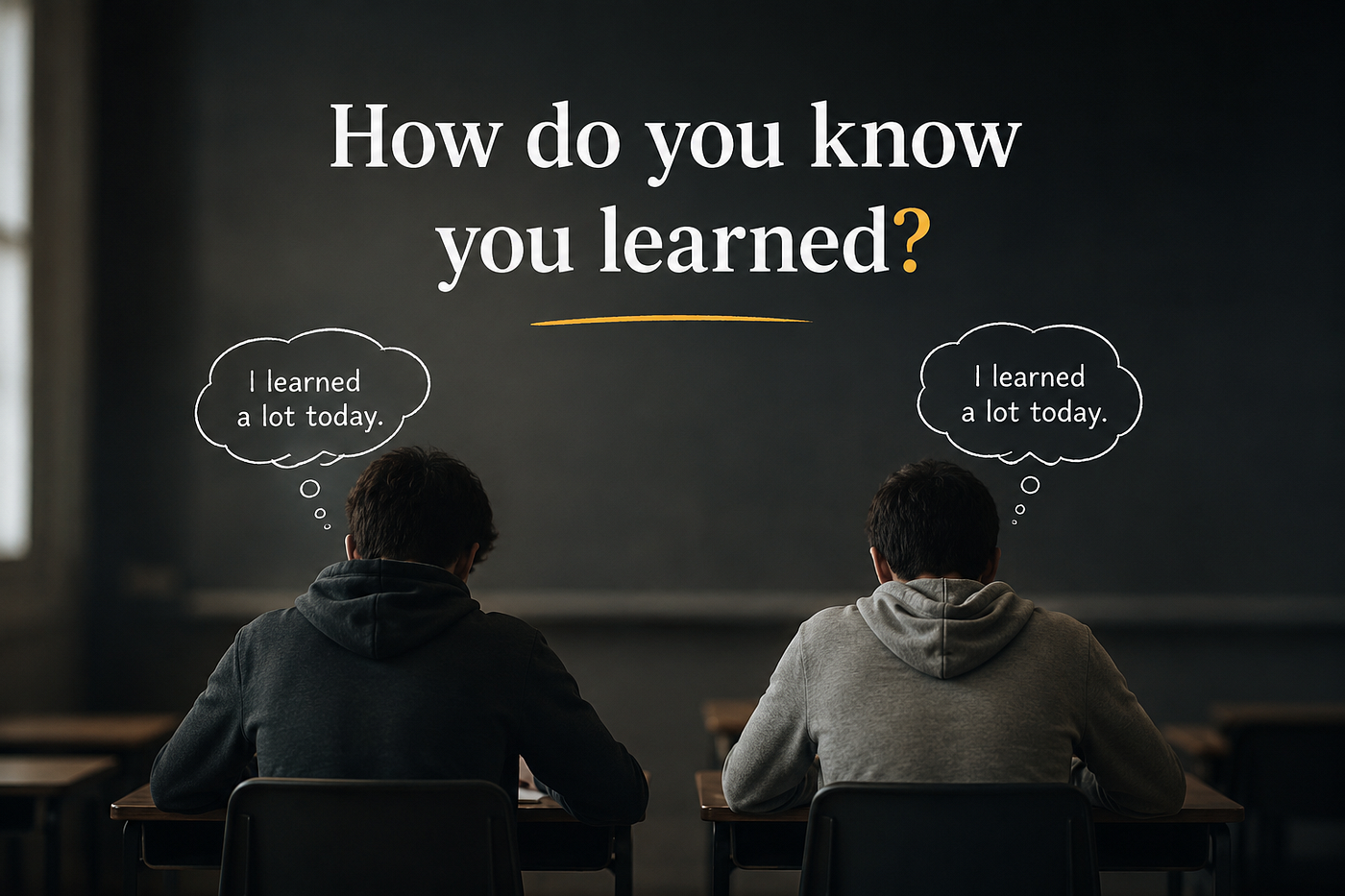
Imagine two students sitting through the same lecture, both pay attention, finish the lecture, and both leave saying, I learned a lot today. But one question that made me aware is, how do they know? And, this happened to a lot of people, including myself. After finishing a seminar, I always felt like I had learned something. But one day I asked, how do I know?
Before diving into it, it is crucial to understand what learning fundamentally is.
Learning can be defined as a process that results in a relatively lasting change in knowledge, understanding, or ability. And that said, when you are learning, you can’t actually say if you are learning or not. Interestingly, it also creates a sense of illusion that learning happened. For instance, take our above scenario, a person attended a seminar, finished the seminar, and thinks they learned from the seminar, but what evidence suggests they learned?
Similarly, when someone finishes a course or watches a full-length video, how does one know the learning really happens? In other words, what evidence suggests that learning has happened? You might be familiar with the seminar, course, or video, but how can one infer that learning has happened?
While researching, I came across the idea that learning is one of the latent variables that cannot be measured directly, which, in other words, can just be observed from the given evidence.
And this becomes my next question: if we can’t measure learning directly, what evidence points more towards learning occurring? And, one possible way to think about this is a framework that we can use to increase our confidence in the learning happening. These behaviors provide progressively stronger evidence that learning may have occurred.
I will call it EoL — Evidence of Learning. The EoL contains six different observable behaviors that will likely increase our confidence that learning has occurred. We will go from the least to the most weighted evidence.
- Observe ⇒ Observance might be the core idea of learning, but probably the weakest evidence supporting that learning has occurred. But every time someone wants to learn a specific topic, they have to go through this stage — observance.
- Imitate ⇒ Imitation can also be meant as mimicking. Interestingly, while talking to a person, I got to know about a fascinating gorilla, Koko, who learned from ASL(American Sign Language). First, the owner would do something, and the gorilla mimics. For instance, the owner performs how to say you are hungry with a sign, the gorilla mimics and learns. One important point to consider is that mimicking doesn’t guarantee learning. But mimicking is required to learn something for a task. Even if someone wants to learn a number for the first time, they have to observe and mimic the number in their mind, whether the meaning, the shape, the symbol, or simply loud.
- Perform Independently ⇒ Now, we enter the creation stage from abstract ideas — Perform Independently. The reason behind putting this at the third step is that without observing and imitating, one can’t perform independently. If you learn Newton's Law of Gravitation, you must be able to do it yourself with just the pattern formation in your mind. Another example can be cooking Biryani independently after observing, imitating, and watching the video on cooking.
- Transfer ⇒ This is probably the most critical evidence that shows strong evidence of learning occurred — able to transfer the skill you learn. For instance, you learn the Bayesian method to predict an outcome based on the evidence. Now, can you think with the Bayes framework in your life — acting on something only based on evidence? If a person can, there is strong evidence that the learning happened.
- Teach ⇒ After following the above steps, can you teach others about the concepts that you learned? This not only supports the learning happened evidence of learning but it can even deepen the understanding better. Teaching can also be considered as exploring ideas with students.
- Creating ⇒ This is one of my favourite steps, and one of the strongest demonstrations of understanding, which increases the probability of learning occurring drastically. Taking an example of how our cognition works, can you produce something new based on your learning? Additionally, this is not something that should be done to show others; that's just a byproduct. Instead, it should be used to sharpen your understanding and knowledge of the concept even further.
So, the next time you finish reading a book, don’t ask, “Did I finish?” Ask, “What evidence do I have that learning has occurred?”
Note: This framework is not intended to be a definitive theory of learning. Rather, it is one possible way to organize observable behaviors that may increase our confidence that learning has occurred.
메타데이터
- post_id
- bb8796b3ea35
- slug
- the-illusion-of-learning-how-do-you-know-you-are-learning-bb8796b3ea35
- url
- https://medium.com/@nirajtechx/the-illusion-of-learning-how-do-you-know-you-are-learning-bb8796b3ea35
- canonical_url
- https://medium.com/@nirajtechx/the-illusion-of-learning-how-do-you-know-you-are-learning-bb8796b3ea35
- author_url
- https://medium.com/@nirajtechx
- status
- ok
- fetched_at
- 2026-06-20 20:29:01