You Go By and You Go By and You Go By…: Before Sunset, Time, and Meaning in Film
“You go by and you go by and you go by and you go by, and I wake up with the fucking sweats”, Jesse tells Celine in the climactic scene of…
You Go By and You Go By and You Go By…: Before Sunset, Time, and Meaning in Film
https://vocal.media/humans/before-sunset-movie-review
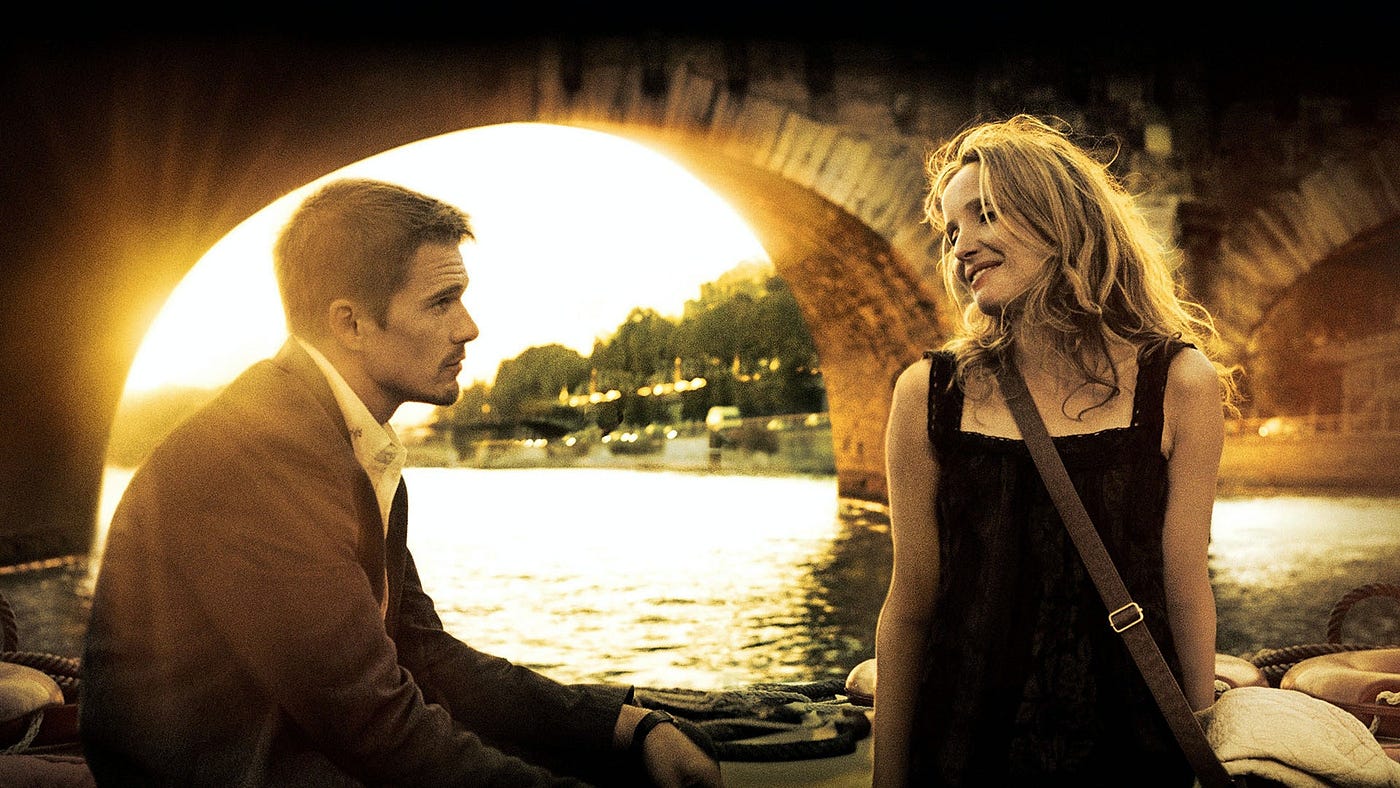
“You go by and you go by and you go by and you go by, and I wake up with the fucking sweats”, Jesse tells Celine in the climactic scene of Before Sunset. The two — him an American author on a book tour, her a French social activist — have spent the last hour walking around Paris with no destination in mind, each not-so-secretly nurturing a decade-long love for the other. Jesse is describing his recurring nightmares about losing her, seeing her race by on an endless train again and again and again.
This is my favourite film. There’s several more contending for that spot, but when it comes down to it I could throw up and scream and burst into tears each time I watch its final act. It’s undoubtedly the best of Richard Linklater’s Before Trilogy, bookended by the insufferably youthful Sunrise (their romantic first meeting as twenty-somethings) and the depressive Midnight (an extended argument years into their marriage). They’re both great in different ways, but the intensity of Sunset, the meaning-to-runtime ratio, the importance of every single line and character beat is so unmatched that it almost makes me hate the other two films by comparison.
And this line — ‘You go by’ — holds a special place in that meaning. The following too many words is an attempt to articulate how. First, we can start with the fact that Jesse is saying the line to and about Celine; he is positioned as subject, she as object. In many ways, this is Jesse’s film. We open on him giving the final interview of his book tour, the book in question being This Time, a reimagining of their first night together. At the talk, he outlines scenes from another story idea involving a woman he loves dancing to a pop song… the very shot the film will end on 80 minutes later. Not only does this scene give us the only moment in the trilogy so far when either Jesse or Celine speaks without the other clearly present, but it subtly places Jesse in control of the narrative and aligns him with the author.
[embed]
The first question of the interview we hear directed at Jesse is “Do you consider the book to be autobiographical?” His response — that in some sense every story is autobiographical — already works to make you aware of Linklater’s presence in and over the film. Really, Jesse has always been a Linklater composite: a Texan creative, whose first artistic idea in Sunrise is a plotless slice-of-life series (Boyhood, Before…, Slacker, Dazed and Confused). The parallel is reinforced by the story that inspired the Before films: Linklater meeting Amy Lehrhaupt in 1989. The Slate has done a brilliant job collating Linklater’s brief references to her, scattered across several years of interviews. The two met in Chicago, felt a connection, and walked around from midnight to 6 AM “[talking] about art, science, film, the gamut”. They exchanged numbers and tried to make long-distance work but ultimately lost contact. Linklater held the vague hope that she might show up at a Sunrise screening years later, but in 2010, he found out that she’d died in a motorcycle accident in 1994. The final film is dedicated to her memory.
Lehrhaupt haunts Sunset. Specifically, Celine. The script is credited to Linklater, Hawke, Delpy, and longtime Linklater collaborator Kim Krizan to reflect the collaborative nature of the story and characters, but it is still structured as Jesse’s film. He is the director’s self-insert; we see Celine from his eyes; he uncannily outlines the final shot in the first scene. While Delpy is a genius actor, crafting Celine into a ten-dimensional presence with the smallest performance choices, it’s hard to escape the fact that she is based on an absence. On Linklater’s memory of a dead woman. With direct access to his directorial counterpart, it’s no wonder Jesse’s perspective frames the film.
This weighting in the balance of perspective introduces a fascinating tension into the film. Celine is constantly wrestling with the text for narrative control. She expresses discomfort with her portrayal in Jesse’s book, a vocalisation that serves to assert her independence not only from Jesse’s perception of her but — by way of his proximity to Linklater — from the film itself. Her struggle for independence is also present in the first film, when she briefly refuses to sleep with Jesse for fear of being reduced into a male fantasy, and it drives their argument in Midnight. At one point in Sunset, she lies about not remembering their sleeping together in Sunrise, seemingly attempting to establish her own ability to rewrite the text. And she even directly undermines the possibility of Linklater to reconstruct Lehrhaupt through her in the line “You can never replace anyone because everyone is made of such beautiful specific details”.
Celine’s struggle reconfigures the meaning of the entire film and further problematises Linklater/Jesse’s position as author. As they take a tourist boat down the Seine, Jesse gives Celine two different explanations for why he wrote his novel:
I think my book was like building something so I wouldn’t forget the details. Like a reminder that once we really did meet, this was real, this happened… Alright, you wanna know why I really wrote that stupid book? So you might actually show up at a reading in Paris, and I’d walk over to you and ask ‘Where the fuck were you?’
In the first instance, the novel is a statue. A still marker preserving something past. In the second, it is active. Hyperstitional. It creates the moment that it is about. But in both, it is a means to an end, meaning that Celine — as the only one of the two without a present referent — is lost in his attempt to hold her, to call her (… you go by…). And his inability to get his story straight on why he wrote the novel indicates discomfort with his position as the author, as the writer of this narrative. Jesse’s tension, then, is the tension of the author’s (in)ability to access the Other. As a purely textual being (with no living referent), Celine’s tension is the struggle of the Other to fully be within a text. The tension of Jesse’s book — and arguably Sunrise, as its basis — flows from the text’s ability to preserve the past and to productively imagine the future. Taken together, Sunset exists at the intersection of a crisis in textual meaning and the ability of narrative to provide a stable ground on which we can know each other.
[embed]
The film came out at a time when romantic comedies were a cultural joke. The epitome of capitalism’s hollowing of art, pumping out plotless schlock sold on star power and formulaic comfort. This is, of course, not what I believe; there’s plenty of brilliant romcoms, and while denigrations of the genre have a point, they’re also general critiques of capitalism that don’t just apply to films associated with femininity. It’s another example of socialism of the fools, where capital’s worst excesses are confused with characteristics of the marginalised. Mark Fisher avoided this trap by constructing the term ‘capitalist realism’ to pin the blame back on capital, diagnosing the retreat into formula and repetition as a symptom of our inability to form new ideas, new modes of resistance — the cultural expression of Fukuyama’s ‘end of history’ thesis, or neoliberalism’s crushing of alternatives. In this context, we lose the possibility of representing a present from which capital has hopelessly alienated us. Not only do we get endless remakes, sequels, and franchises (Before…), but also endemic cynicism and ironic distance.
In their unrelenting earnestness, the Before films can’t help but be about this dynamic, dramatised in Jesse and Celine’s wavering wariness to give into their feeling for each other. You can see it clearest in a line that repeats in the first two films. In Sunrise, after a poet tells the couple that he’ll write them something based on whatever word they like, Jesse assumes that he simply plugs the word into a pre-written piece. In Sunset, after Celine plays him a song she wrote about their night together, he mocks his own cynicism by sarcastically supposing that she plugs any guy’s name into the same song. Through this motif, Sunset associates the embracing of love with the undoing of collective cynicism, of connection with closing capitalist realism’s ironic distance.
We should think of this not as an appeal to cheese, but as an urgent political task. Sunset was written and filmed months after America entered Iraq, a generation defining war-crime perpetrated with the goal of turning the Middle East into a neoliberal powerhouse. U.S. imperialism is directly present in the finished film — Celine: “An imperialist country can use that kind of thinking to justify their economic greed…”, Jesse: “Any particular imperialist country you’ve got in mind there, Frenchy?” Just the fact that he is an author, flying through “ten cities in twelve days”, while she is living and working in Paris as an activist mirrors America’s position as a culturally hegemonic world policeman riding into the end of history while the rest of the world exists to respond to it. Even the brief details mentioned about Jesse’s book — guns and violence, helicopter crashes, political intrigue — demonstrates a Hollywoodization of the original story that is laden with markers of America’s imperial crimes. Macropolitics speaks through them and is constantly between them. In acknowledging this, Sunset links American imperialism to the cultural spread of capitalist realism and registers a desire to overcome both as coded through love, through ecstatic connection with an Other. But more than this; through Jesse’s position as an author buried in his own text, it reveals the inherent melancholy of the white patriarchal subject as one that is haunted and possessed by its own privilege, trapped trying to overcome its alienation while entrenching it in the same movement.
[embed]
This is a dynamic touched on by Rob Stone and Luis Freijo in their 2021 essay ‘World Cinema Between the Rock of the Unknowable and the Hard Place of the As Yet Unknown’. The piece deftly navigates the question of whether it is possible for a film criticism based in the global centre to truly know films from the global periphery, whether any ‘Western’ system of knowledge production can account for the experiences of perspectives Other to it. In asking this question, they draw from Derrida’s concept of différance. Typically French, Derrida is hard to pin down, but the term refers to the idea that because the sign and its referent are differentiated across time (the time between you hearing a word and processing it, or experiencing a piece of art and interpreting it), the meaning of language depends on an initial deferral. This bedrock of unknowledge is différance, and it means that all signs bear within them the trace of ignorance, of alternative interpretation.
In basing his argument around language specifically, Derrida is subtly extending this point to all of Western metaphysics — itself built on and around the written word — and thereby undermining its privileging of presence, of simple definition, of the concrete and actual. Everything present depends on a deferred and differentiated absence. In the case of American hegemony, this is the cultures it has erased and the resistance that it cannot; in Jesse’s book, it is Celine and the memory of the night; in Before Sunset, it is Linklater’s memory of Lehrhaupt and Celine’s struggle for agency. And it is deeply important that this is a film, a medium based around absent presences — pictures of people who aren’t there, audio invisibly imposed. That Sunset takes place in real-time makes this all the clearer, watching like a smooth experience even though you know it is constructed, interrupted by cuts and camera changes. The line this article opened with quietly extends this theme to Celine’s nature as a filmic trace only able to be ‘present’ by the rapid succession of still images strung together, and, for that reason, inaccessible: ‘You go by and you go by and you go by…’.
We can link these themes of absence, inaccessibility, and film through Sunset’s focus on time. Really, the whole trilogy is about the passage of time, as their titles make clear. Jesse quoting the W.H Auden poem in Sunrise (‘The years shall run like rabbits’); the Nina Simone song that ends Sunset (Just in Time); the way he convinces her to get off the train and stops their Midnight argument by referencing a time machine. There’s an argument to be made that the key concern of the trilogy — and Linklater’s broader filmography — is about capturing the passage of time through film. I’m not making this argument. Linking Derrida by way of Stone & Freijo with film’s creation of meaning from absent presences, I’m arguing that Sunset’s concern with time is part of a broader concern with a text’s potential to create meaning in the context of a global crisis of meaning production. Of how we can wade through the unknowledge of différance in a time of timelessness, of cultural stuttering at the end of history.
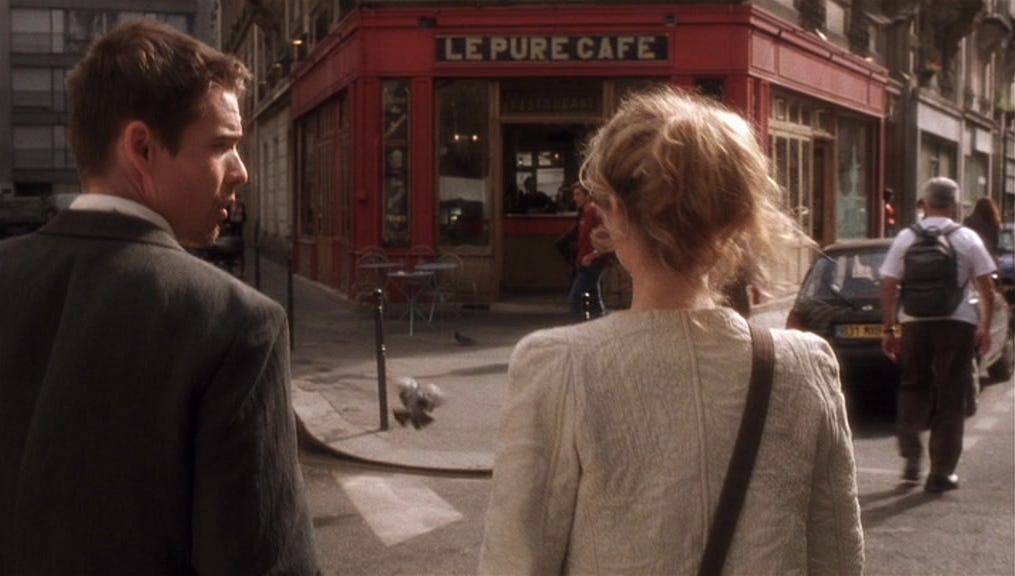
The uncanny return to Le Pure Cafe
As always, Deleuze can get us out of this jam. In his seminal works on cinema, he argues that pre- and post-war film can best be characterised by a shift from the ‘movement-image’ to the ‘time-image’. If Derrida is the hard place, Deleuze is the rock, but if I have to summarise these concepts (and 2000 words in I really do), I’d say that if the plots or time of pre-war films are driven by agentic characters acting, post-war films are marked by the breakdown in the coherent political subject. The traumas of war, genocide, and capitalist alienation complicate agency, responsibility, and morality so much that we can no longer clearly use the active hero-subject to make sense of this increasingly unthinkable world. As a result, time is no longer driven by action but emerges as a property in itself. For Deleuze, post-war cinema — particularly Italian neorealism and the films of European youth movements — are defined by characters in drift; by a fluid time of flashbacks and foreshadowing; by images that reveal the coexistence of past, present, and future. Or, as Jesse puts it when outlining his next book idea:
For a moment all his life is folding in and its obvious to him that time is a lie… That it’s all happening all the time, and inside every moment there’s another moment, all happening simultaneously.
Drift defines the Before films, and even though they do unfold in chronological time, it is a time constantly in tension. This is true in the text of the film, starting with flashes of key locations the characters will pass through during the runtime (their visit to Le Pure Cafe being particularly striking), creating the sense that their direction is predetermined. But it’s also true through Jesse’s book, their night together, the possibility of a relationship, and on a meta-level the existence of the other two films and of Linklater’s meeting with Lehrhaupt; the constructed presence of the film is overwhelmed by these ghostly virtual realities. Deleuze uses that term, ‘virtual’, not to connote a digitised virtual world, but memories, projections, art, everything that is separate from the concrete, here and now, actual world that you can touch with your hands. It is a field of abstract potentials and intensities, equally real to the measurable world, only on a different ontological plane. As a conceptual tool, it helps us conceive of the role that the intangible plays in the social and political realms, of the basis of the present on the absent. Sunset shares the same concern. We can read the entire film as a Deleuzian ‘crystal-image’ — an image in which the actual and virtual exist alongside each-other to the point of indistinction, summed up best by the image of a person in a mirror where you can’t tell the reflection from its referent. While there are no actual trippy mirror image shots in Sunset, the existence of Jesse’s ‘This Time’ within the film as a mise-en-abyme — a miniature mirror of the text within the text — extends the blurring of virtual and actual to the level of form.
[embed]
It’s here that we can find the hope in Sunset. Deleuze and Derrida are very different thinkers, the former focused on radical immanence and the latter on deconstructive absence, but in the time-image and différance, both make a similar point: that our disjointed end-of-history timelessness is not a dead end but a productive opening onto new meaning. This is the blood Stone & Freijo squeeze from Derrida in ‘Between the Rock…’, and we can find it latent within the importance of performance in Sunset. The more you look for it, the more you’ll see that Jesse and Celine’s relationship is built through performances: their fake phone call to friends in the first film; his recurring stories about time travel; her climactic Nina Simone performance and the waltz that precedes it; ‘This Time’. All these performances build the scaffolding of their relationship, linking love with the act of performance. Even on a meta-level, we know as we watch it that these are actors performing, and that the entire text is a performance of love from Linklater to Lehrhaupt. In Celine and Jesse allowing themselves to become channels for songs and stories, they position the virtual as a realm in which love under capitalist realism becomes possible. Intertextuality is no longer powerless repetition; it is the collapse between the actual/virtual distinction, and an opening onto freedom. Timelessness is no longer a dead end; it is the productive radicalisation of différance.
In this sense we can read this as an elaboration on Alain Badiou’s understanding of the radical potential of love: “Love and politics are the two great figures of social engagement. Politics is enthusiasm with a collective; with love, two people. So, love is the minimal form of communism”. But through Deleuze and Derrida, Sunset goes further by positioning the possibility of love and connection as a productive force that is dependent on text and intertextuality. This hopefulness holds out in the implication of the couple’s reuniting at the film’s end, an implication that is importantly withheld from full realisation so that the deferral of meaning — and the coherence of the film as a time-image — is maintained. The possibility of Celine’s being is held open, as is Jesse’s connection to an Other. In going by and going by and going by, both find virtual actualisation. And texts recover the ability to mean. Stories, as performances, become grounds for love.
There’s another interaction in the film that hints towards its mythic faith in the potential of art to speak across cultures, of texts to connect between Others. As the couple pass Notre Dame on the Seine, Jesse tells Celine a story about the Nazi’s failure to destroy the building in the war:
Jesse: … when the Germans were occupying Paris and had to retreat back, they wired the Notre Dame to blow, but they had to leave one guy in charge of hitting the switch. And the guy, the soldier, he couldn’t do it… When the allied troops came in they found all the explosives just lying there, and the switch unturned. And they found the same thing at Sacre-Coeur, the Eiffel Tower, couple other places, I think…
Celine: Is that true?
Jesse: I don’t know. I always liked the story, though.
메타데이터
- post_id
- bb93440e4ff8
- slug
- you-go-by-and-you-go-by-and-you-go-by-before-sunset-time-and-meaning-in-film-bb93440e4ff8
- url
- https://medium.com/@laikaconway/you-go-by-and-you-go-by-and-you-go-by-before-sunset-time-and-meaning-in-film-bb93440e4ff8
- canonical_url
- https://medium.com/@laikaconway/you-go-by-and-you-go-by-and-you-go-by-before-sunset-time-and-meaning-in-film-bb93440e4ff8
- author_url
- https://medium.com/@laikaconway
- status
- ok
- fetched_at
- 2026-08-04 06:35:05