Quantifying Swing Plane Matching- The geometry of pitch approach vs swing path
Ted Williams first wrote about matching swing plane to pitch approach in his 1971 book “The Science of Hitting”, and managers have long…
Quantifying Swing Plane Matching- The geometry of pitch approach vs swing path
Ted Williams first wrote about matching swing plane to pitch approach in his 1971 book “The Science of Hitting”, and managers have long mentioned it when explaining their pinch hit decisions. Take Dave Roberts, for example. After a 5–3 loss in Game 2 of the 2022 NLDS, the Dodgers skipper was asked why he pinch hit Austin Barnes for Cody Bellinger over Chris Taylor despite Taylor’s superior offensive profile.
“Hader’s tough on anyone but I felt that Austin’s short swing, flat path…Hader throws the 4-seam rise fastball, CT swings uphill, and Austin has had success against Hader”, Roberts replied.
It makes sense that matching swing plane to pitch approach would lead to better results for the hitter, but what is the actual run value of this mechanism? Barnes would go on to fly out to deep center field, and the Padres would win the game and eventually the series- was Roberts right in his assessment? How does the relationship between swing plane and pitch approach affect power, contact, and production?
In an attempt to test Robert’s intuition and explore the relationship, I trained a Generalized Additive Model on the target variable change in run expectancy per swing, after stripping out hitter/pitcher quality via empirical Bayesian shrinkage. The model utilizes nonlinear smooths on all features, allowing each variable’s effect to take whatever shape the data best supports. Tensor interactions are also included, capturing the relationship between geometry offsets and bat speed and how it changes with the level of effort the hitter swings with. The features, variables, tensors, and controls are listed below as follows:
- Target Variable: xRV residual (change in expected run value after stripping out hitter, pitcher quality)
- Geometry Features: vertical plane offset (how much steeper/flatter the swing is relative to pitch VAA) , horizontal plane offset (how far pull/opposite side the swing direction is relative to the pitch HAA)
- Bat Tracking Features: Bat speed, swing path tilt, intercept distance
- Pitch Context Controls: release speed, pitch type (as random effect), plate location
- Count and Matchup Controls: Count (0–0 through 3–2), Platoon
- Tensor Interactions: vertical offset x bat speed, horizontal offset x bat speed, vertical offset x intercept distance, horizontal offset x intercept distance
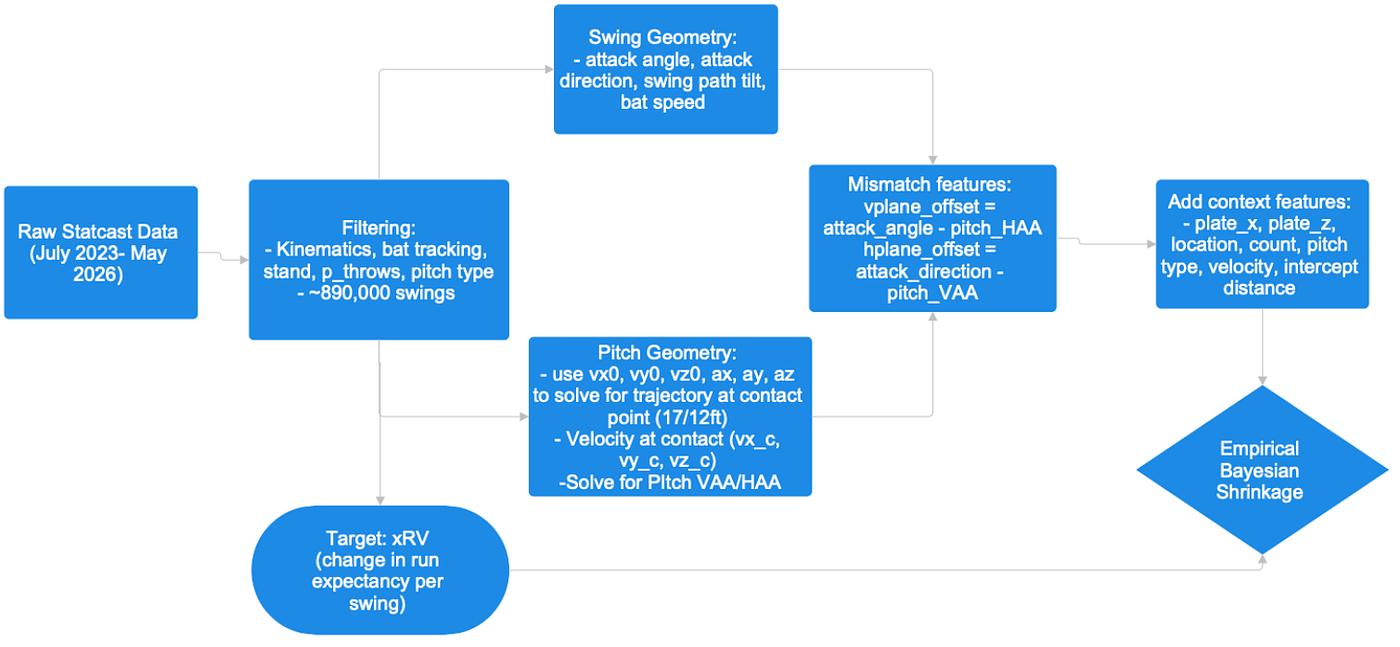
Below, a flow chart visualizes the process the data undergoes, from acquisition to modeling.
FINDINGS
After training the GAM model, with the aforementioned features, on the 890,000 swings we are able to conclude that geometric match does predict run value after controlling for confounds. The relationship is asymmetric, with one standard deviation worse of a match being worth -2.13 xRV/100 swings and one standard deviation better of a match being worth +0.65 xRV/100 swings. The penalty for mismatch is more than three times the reward for matching, meaning the majority of the value in swing plane geometry lies in avoiding bad matches, not perfecting good ones.
Additionally, matching swing planes maximize contact, but it does not necessarily maximize run value. Contact is maximized at a perfect match between pitch approach and swing path, but run value actually peaks at a moderate offset between planes. According to the model, the optimal swing plane match is generally about 10 degrees to the pull side and steeper than the pitch approach, but this is dependent on the hitter’s bat speed.

Below approximately 67 mph, flat is optimal and lift does not pay off without the bat speed to convert loft into damage. Above 67 mph, approximately 10 degrees steeper and to the pull side than the pitch plane is optimal.

The cost, by xRV, of matching vs optimizing swing plane is about -1.5 xRV/100 swings at average bat speed and +3 xRV/100 swings at high bat speed. For all hitters, a pull side offset of 10–15 degrees is beneficial.


Furthermore, better geometric match moves the hitter’s exit velocity distribution toward their personal ceiling, meaning matching the plane maximizes how often a hitter squares the ball up, while a moderate offset beyond match converts those squared balls into damage through launch angle. The two are complementary rather than competing. Extreme mismatches, naturally, lead to whiffs at all bat speeds.


VALIDATION
Validation of the model was performed on a held out 2025–2026 test set. A calibration check comparing predicted run values to actual run values returned a slope of 0.977, signaling the model’s predictions track well with actual outcomes. Moreover, a within hitter test showed when each hitter’s swings are split into near optimal and far from optimal geometry, 83% of hitters produce more run value when their swing geometry is closer to their personal optimal.


LIMITATIONS
The model is not without limitations, and the most prominent should be noted below:
- Modest Predictive Power: The model describes only 2.6% of swing level deviance in expected run value
- Swing Geometry Measurement: Swing geometry is measured from the swing itself rather than requiring contact, but on balls in play, “good geometry could partially reflect that the hitter was not fooled by the pitch rather than that they actively matched the plane.
- Empirical Bayesian Shrinkage: This method assumes pitcher/hitter quality is an additive quality that is separable by random effects. Because the model cannot capture nonlinear interactions, a small amount of matchup-level talent may leak through.
CASE STUDY
Thinking back to the Roberts quote from earlier, we can use the model to quantify the actual geometric match of Hader’s fastball and Barnes/Taylor’s swings. As seen below, Roberts’ intuition was correct, though the deciding factor was horizontal alignment rather than vertical. Barnes’ pull side attack direction aligned with Hader’s pitch plane where Taylor’s did not.

The horizontal alignment of his swing gave him an edge over Taylor against Hader’s sinker. More broadly, swing plane geometry predicts run value in a consistent and externally validated way, with most of the value lying in avoiding mismatches rather than perfecting them.
메타데이터
- post_id
- bb97501272db
- slug
- quantifying-swing-plane-matching-the-geometry-of-pitch-approach-vs-swing-path-bb97501272db
- url
- https://medium.com/@cade.cavin/quantifying-swing-plane-matching-the-geometry-of-pitch-approach-vs-swing-path-bb97501272db
- canonical_url
- https://medium.com/@cade.cavin/quantifying-swing-plane-matching-the-geometry-of-pitch-approach-vs-swing-path-bb97501272db
- author_url
- https://medium.com/@cade.cavin
- status
- ok
- fetched_at
- 2026-07-19 15:39:48