Building Production-Grade RAG: A Complete Architecture Guide
Moving beyond the “embed, retrieve, generate” demo every component you need to ship a reliable, observable, enterprise-ready RAG system.
Building Production-Grade RAG: A Complete Architecture Guide
Moving beyond the “embed, retrieve, generate” demo every component you need to ship a reliable, observable, enterprise-ready RAG system.
Most RAG tutorials stop at three steps: chunk your documents, embed them, and call an LLM with the retrieved context. That’s a great prototype. It is not a production system. A production RAG pipeline must handle malicious inputs, reroute unexpected queries, rerank noisy results, enforce output policies, and critically give you visibility into every failure. This article walks through every component of a battle-tested enterprise RAG architecture, explaining what each piece does, why it exists, and how it fits with the rest.
The full pipeline looks like this:
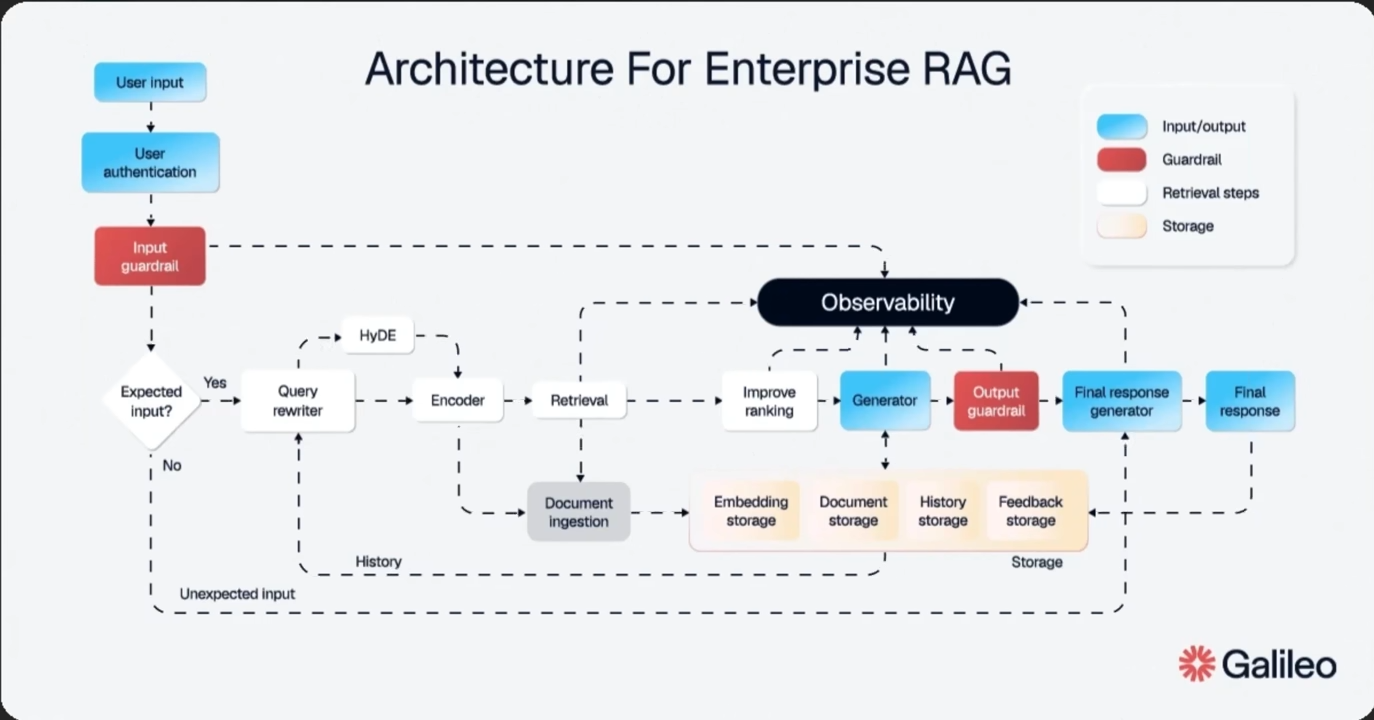
Let’s go through each component.
1. The Entry Points — User Input & Authentication
Every request into your RAG system enters through the same gate: the user sends a query, and before anything else happens, the system must know who is asking.
User Input
This is the entry point a free-form text string from a human (or an upstream system). It might be a question, a command, a conversational message, or even an adversarial injection attempt. At this stage, the system makes no assumptions about intent. The query is passed downstream as-is, with its full context preserved.
In an enterprise system, you also capture metadata here: timestamp, session ID, client type, and the user’s IP or device fingerprint. All of this flows into the observability layer and becomes critical when you need to debug a failure or investigate a policy violation.
User Authentication
Authentication is not just a security checkbox it is a prerequisite for personalization, access control, and auditability. Before the query touches any business logic, the system verifies who the user is. This step determines which document stores, tool integrations, and system prompts are available based on the user’s role and permissions.
In multi-tenant enterprise systems, a finance analyst should only retrieve financial documents, and a customer support agent should only see records relevant to their team. Authentication makes this enforcement possible downstream, especially at the retrieval phase where namespace scoping in vector stores gates document access.
If you skip authentication or defer it to a later step, you lose the ability to enforce row-level security on your knowledge base and in regulated industries, that’s not a tradeoff you can make.
2. The First Line of Defense — Input Guardrail
The input guardrail is your system’s bouncer. It sits between authentication and all downstream logic, and its job is to classify every incoming query before spending any compute on it. It answers two questions: Is this query safe? and Is this query relevant to what our system is designed to handle?
Notice in a well-designed architecture that the guardrail has a decision branch: Expected input → Query Rewriter and Unexpected input → rejected or looped back. This is the key insight. The guardrail does not simply reject bad queries — it separates them from the happy path.
Expected inputs are legitimate, on-topic, safe queries. Unexpected inputs include:
- Prompt injections and jailbreak attempts
- Off-topic queries outside the system’s defined scope
- Queries that risk exposing PII from the knowledge base
- Requests that violate content policy
Practically, this component uses a combination of fast classifiers (regex patterns, keyword blocklists), fine-tuned small models for intent detection, and sometimes a separate LLM call specifically trained for safety classification. The tradeoff is latency vs. robustness — production systems typically use a tiered approach: cheap heuristics first, deeper model classification only if needed.
Why reject at input, not output? Catching problematic queries early saves 80–95% of the per-query compute cost. Letting a prompt injection flow through retrieval and generation before catching it at output is expensive and occasionally dangerous — a sufficiently crafted injection might slip through output filtering too.
3. Query Intelligence — The Rewriter & HyDE
A raw user query is often a poor retrieval signal. People write queries the way they think, not the way documents are written. The query intelligence layer bridges this gap.
Query Rewriter
The query rewriter takes the verified, safe user query and transforms it into one or more improved retrieval queries. This is one of the highest-leverage components in the entire pipeline — small improvements in query quality compound across every downstream step.
Common rewriting strategies include:
- Query expansion — adding synonyms and related terms to broaden recall
- Query decomposition — breaking a complex multi-part question into several targeted sub-queries
- Contextual injection — incorporating conversation history so follow-up questions resolve pronouns correctly
- Domain normalization — mapping colloquial terms to domain-specific vocabulary present in your document store
The rewriter also incorporates History prior conversation turns used to contextualize the current query. Without this, a user asking “Can you explain that in simpler terms?” would trigger a retrieval with no context about what “that” refers to. This is one of the most common bugs in naive RAG deployments.
HyDE — Hypothetical Document Embedding
HyDE is an elegant technique that addresses a fundamental mismatch in semantic search: queries and documents exist in different linguistic registers. A query like “What causes transformer attention to fail on long documents?” sounds nothing like the abstract of a paper that answers it.
HyDE sidesteps this by asking the LLM to generate a hypothetical answer to the query even if that answer contains factual errors or hallucinations and then embedding that hypothetical answer rather than the original query. The hypothesis lives in “document space” rather than “question space,” dramatically improving retrieval recall on knowledge-intensive questions.
In practice, you can run both the original rewritten query and the HyDE hypothesis through retrieval and merge the results, or choose one strategy per query type based on query classification.
4. The Retrieval Core — Encoder, Ingestion & Retrieval
Encoder
The encoder converts text both queries and documents into dense vector representations that capture semantic meaning. The choice of encoder model is one of the most consequential architectural decisions in a RAG system. A mismatch between the embedding model used during document ingestion and the one used at query time will silently destroy retrieval quality.
Enterprise deployments must consider:
- Embedding dimensionality — higher dimensions are more expressive but increase storage cost and search latency
- Context window limits — chunks that exceed the encoder’s context window are silently truncated or errored
- Domain specificity — a general-purpose embedding model may perform poorly on legal, medical, or financial text
- Multilingual support — if your document store contains content in multiple languages, your encoder must handle them
Document Ingestion
Document ingestion is the offline pipeline that prepares your knowledge base for retrieval. It encompasses document parsing (PDF, DOCX, HTML, tables), chunking strategy, metadata extraction (source URL, creation date, author, access level), and finally encoding each chunk and storing it in Embedding Storage alongside the full text in Document Storage.
Chunking strategy deserves particular attention. Chunks that are too small lose context; chunks that are too large dilute the relevant signal and exceed the LLM’s context budget. Many production systems use a parent-child chunking strategy: small chunks are stored for high-precision retrieval, but the parent chunk (larger surrounding context) is what actually gets sent to the generator.
The ingestion pipeline must also handle document updates, deletions, and versioning. Enterprise knowledge bases are not static. A robust ingestion system tracks document lineage so that when source content changes, stale embeddings can be identified and refreshed.
Retrieval
The retrieval component searches Embedding Storage using approximate nearest neighbor (ANN) search to find document chunks whose embeddings are closest to the query embedding. In production, pure vector retrieval is rarely sufficient on its own — hybrid retrieval combining dense vector search with sparse keyword search (BM25) consistently outperforms either alone.
Access control is enforced here: the retrieval query is scoped to the namespaces and document collections the authenticated user is permitted to access. A user who isn’t authorized to see a document should never be able to retrieve its content, even indirectly through the LLM’s response.
Retrieval also pulls from History Storage to incorporate relevant past conversation turns as synthetic documents, allowing the system to reference prior exchanges when they’re relevant to the current query.
5. Ranking & Generation — The Intelligence Layer
Improve Ranking (Reranker)
Initial vector retrieval is optimized for speed and recall — it casts a wide net. The reranker’s job is precision. It takes the top-K retrieved chunks (often 20–50) and re-scores each one against the original query using a more powerful cross-encoder model that computes relevance jointly rather than independently.
Cross-encoders are significantly more accurate than bi-encoders for relevance scoring, but they’re also much slower (they compare each document-query pair directly rather than using precomputed embeddings). This is why retrieval and reranking are separated: use fast ANN search to get candidates, then use expensive cross-encoding to select the top 3–5 chunks that actually go to the generator.
Advanced rerankers also apply:
- Diversity constraints — avoiding redundant chunks that cover the same information
- Freshness weighting — preferring more recent documents for time-sensitive queries
- Source authority scoring — weighting chunks from authoritative sources higher than user-generated content
Generator
The generator is the large language model that takes the reranked context chunks, the original user query, the system prompt, and any conversation history, and synthesizes a coherent, grounded response. In a RAG system, the generator’s role is not to recall facts from its training data it’s to reason over and synthesize the provided context.
Prompt engineering at this stage is critical. The system prompt should explicitly instruct the model to:
- Answer only from the provided context
- Cite sources for factual claims
- Acknowledge when the context doesn’t contain sufficient information rather than hallucinating
- Maintain the persona and tone appropriate to the application
The generator also consumes Feedback Storage historical user feedback signals (ratings, corrections) that can be used to refine prompting strategies or fine-tune the model over time. This creates a learning loop that improves generation quality as the system is used.
6. The Second Safety Layer — Output Guardrail
Even with a perfectly safe input, generation can produce problematic outputs. Hallucinations, PII leakage from retrieved documents, confidential data surfaced from the knowledge base, toxic language, or responses that violate brand guidelines — these all require a dedicated output filter.
The output guardrail operates on the generated response before it reaches the user. It checks for:
- Factual grounding — is every claim supported by the retrieved context?
- PII detection — does the response contain names, emails, phone numbers, or other identifiers that shouldn’t be disclosed?
- Policy compliance — does the response adhere to content policies, legal constraints, and brand voice?
- Hallucination detection — are there factual claims in the response that contradict or go beyond the retrieved context?
When the output guardrail flags a response, it can either trigger a fallback response (“I don’t have enough information to answer that confidently”), route the request back to the generator with additional constraints, or escalate to a human reviewer depending on the severity and system design.
A dual-guardrail setup one at input, one at output is the industry standard for enterprise RAG. Skipping the output guardrail means trusting the LLM to self-police, which is not a reliable production strategy.
7. Delivery — Final Response Generator & Final Response
Final Response Generator
Once the output has cleared the guardrail, the final response generator handles post-processing: formatting the response for the target interface (markdown rendering, citation formatting, table generation), truncating or summarizing if the response is too long for the UI, and injecting contextual metadata like source links and confidence indicators.
This is also where streaming is typically initiated — rather than waiting for the full response before sending anything to the user, production systems stream tokens as they’re generated for a much better user experience. The final response generator manages the streaming protocol and handles any client-specific formatting requirements.
Final Response
The final response is what the user sees. At this point, the system also triggers several important side-effects:
- The exchange (query + response + citations) is written to History Storage for future context retrieval
- User feedback mechanisms (ratings, corrections) are activated and their signals stored in Feedback Storage
- The full trace of the request is emitted to the observability system for monitoring and debugging
These side-effects are what transform a one-shot Q&A system into a continuously improving, context-aware assistant.
8. The Storage Layer
Production RAG systems depend on four distinct storage systems, each serving a different purpose and with different performance characteristics.
Embedding Storage
A vector database (Pinecone, Weaviate, Qdrant, pgvector, etc.) that stores dense embeddings for each document chunk and supports fast approximate nearest neighbor search. Key operational concerns: index freshness, namespace isolation for multi-tenancy, metadata filtering to combine vector and attribute-based filtering in a single query, and scaling strategy as the document corpus grows.
Document Storage
The full text (and original binary) of every ingested document, stored in an object store (S3, GCS, Azure Blob) or a document database. When the reranker selects a chunk, the system fetches surrounding context from Document Storage to provide the generator with richer content than the small chunk alone. Document Storage also serves as the source of truth for re-ingestion when the embedding model changes.
History Storage
A session store (Redis, DynamoDB, or a purpose-built conversation database) that persists the conversation history for each user session. The Query Rewriter reads from this store to contextualize follow-up queries, and the Retrieval component may use past exchanges as additional retrieval signals. History Storage must support TTL (time-to-live) policies to expire old sessions and comply with data retention regulations.
Feedback Storage
Stores explicit feedback (ratings, corrections, escalations) and implicit signals (copy-to-clipboard, follow-up queries that indicate the previous answer was insufficient). This data feeds into RLHF fine-tuning pipelines, prompt engineering iteration cycles, and retrieval quality analysis. Feedback Storage is how your RAG system learns from real usage over timeit transforms a static deployment into a continuously improving system.
9. The Central Nervous System — Observability
Observability connects to virtually every component in the architecture. This is intentional and critical. In a traditional software system, you can often debug failures by inspecting code paths. In a RAG system, failures are stochastic and emergent a hallucinated answer can be caused by a bad chunk, a poor embedding, a reranker failure, or a generation drift that only appears in certain query patterns. Without comprehensive observability, you are flying blind.
What observability must capture in a production RAG system:
- Retrieval quality metrics — what chunks were retrieved, their similarity scores, and whether they were actually used by the generator
- Latency breakdowns — how long each component took, enabling you to identify bottlenecks (is it the reranker? the LLM? the vector search?)
- Guardrail trigger rates — how often inputs and outputs are being blocked, and why
- Hallucination rates — using automated faithfulness evaluation, comparing generated claims against retrieved context
- Answer quality scores — automated RAGAS-style metrics: faithfulness, answer relevance, context precision, and context recall, computed on a sample of queries
Platforms like LangSmith, Galileo, Arize Phoenix, or Weights & Biases Weave provide RAG-specific observability dashboards. Whichever tooling you use, trace every single request end-to-end with a unique trace ID that flows through every component. When something goes wrong and it will you need to reconstruct exactly what happened.
“You cannot improve what you cannot measure. In RAG systems, observability is not a nice-to-have — it is the only way to distinguish a retrieval failure from a generation failure from a data quality problem.”
Component Summary
Component Type Primary Responsibility User Input I/O Raw query entry point Authentication I/O Identity verification and access scoping Input Guardrail Guardrail Safety, relevance, and policy filtering Query Rewriter Retrieval Query expansion, decomposition, contextualization HyDE Retrieval Hypothetical document for improved semantic retrieval Encoder Retrieval Text-to-vector transformation Document Ingestion Retrieval Offline pipeline: parse, chunk, embed, store Retrieval Retrieval ANN search over embedding store Improve Ranking Retrieval Cross-encoder reranking for precision Generator Generation LLM synthesis from retrieved context Output Guardrail Guardrail Hallucination, PII, and policy filtering on output Final Response Generator Generation Formatting, streaming, citation injection Final Response I/O Delivery to user + side effects (history, feedback) Embedding Storage Storage Vector database for semantic search Document Storage Storage Raw and chunked source text History Storage Storage Conversation context across turns Feedback Storage Storage User signals for continuous improvement Observability Platform End-to-end tracing, metrics, and quality evaluation
Closing Thoughts
The gap between a RAG demo and a production RAG system is not a matter of scale — it is a matter of architecture. Each component in this diagram exists because someone ran a simpler system in production and discovered the failure mode it prevents. Authentication exists because not all documents should be accessible to all users. Input guardrails exist because adversarial users will probe your system on day one. HyDE exists because naive semantic search fails on knowledge-intensive queries. Feedback Storage exists because a static RAG system doesn’t improve.
You don’t need to implement every component on day one. But you do need to understand what each component does and what failure mode you’re accepting by not including it. Build iteratively, instrument everything, and let real usage data tell you which components to prioritize.
The architecture described in this article is not a theoretical ideal it reflects the components that teams have found necessary when operating RAG systems at enterprise scale. Start with the retrieval core and guardrails. Add HyDE and reranking when retrieval quality plateaus. Invest in observability from day one, because without it, you won’t know what’s failing or why.
메타데이터
- post_id
- bb9acf24b114
- slug
- building-production-grade-rag-a-complete-architecture-guide-bb9acf24b114
- url
- https://medium.com/@adeelmukhtar051/building-production-grade-rag-a-complete-architecture-guide-bb9acf24b114
- canonical_url
- https://medium.com/@adeelmukhtar051/building-production-grade-rag-a-complete-architecture-guide-bb9acf24b114
- author_url
- https://medium.com/@adeelmukhtar051
- status
- ok
- fetched_at
- 2026-06-09 15:37:30





