Building the Ontology Is Manual Work. And That Is Exactly the Point.
The most common objection to knowledge graphs. And why it misses the real question.
Building the Ontology Is Manual Work. And That Is Exactly the Point.
The most common objection to knowledge graphs. And why it misses the real question.
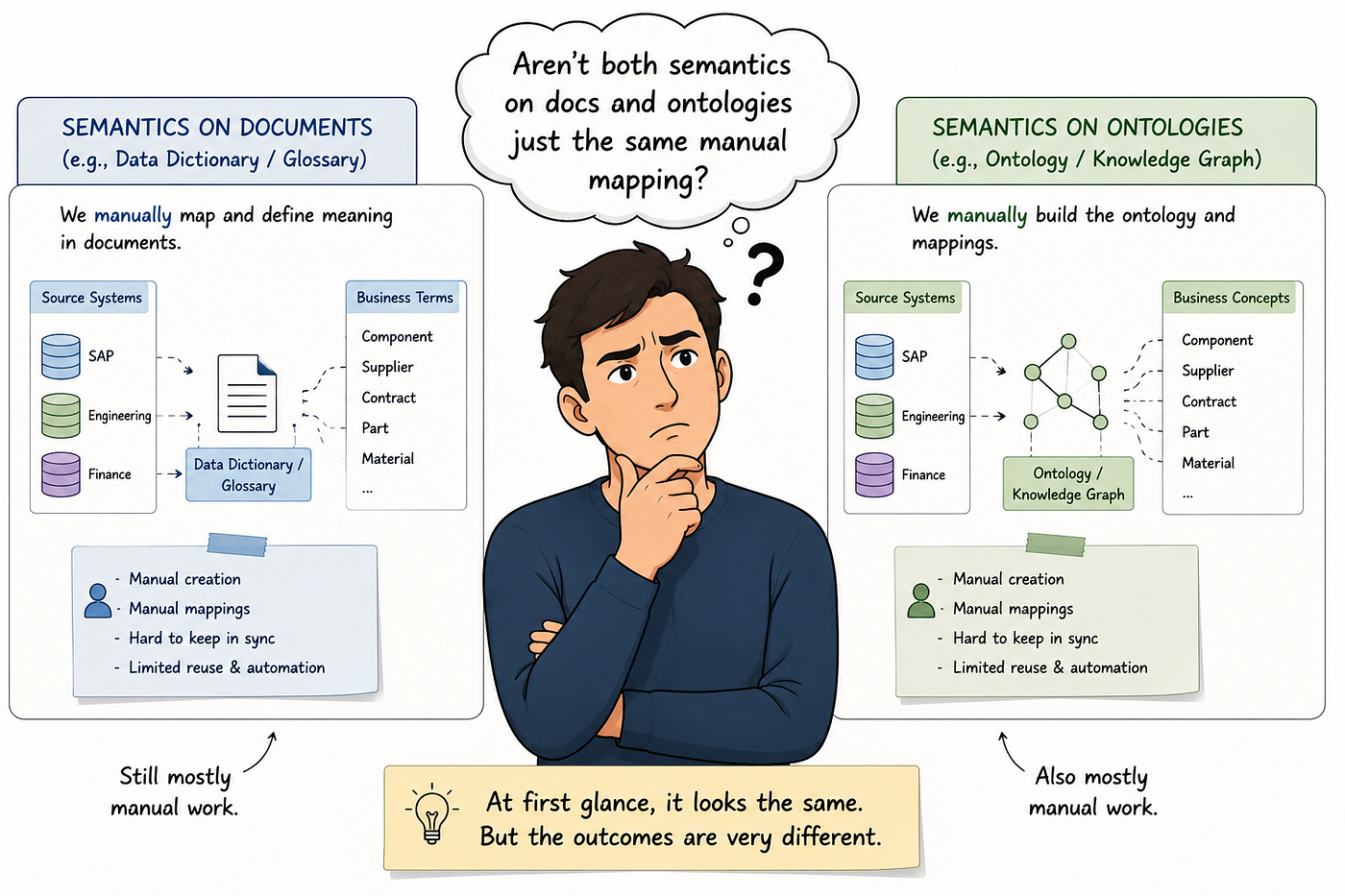
“But building the ontology is just manual mapping with extra steps.”
I get this pushback a lot. And honestly it’s fair.
Yes, someone has to sit down and define what a “component” is. What rules apply to it. How it relates to a supplier, a contract, a part. That is human work. There is no way around it initially.
And the first mapping telling the system that “part_id” in SAP equals “component_id” in engineering equals “material_code” in finance is also written by hand.
So what’s actually different?
The Nature of the Work Is Not the Same
Manual mapping is per pipeline, per team, per question.
Every analyst repeats it. Every new tool rebuilds it. Every system migration breaks it. The effort compounds because nothing is shared. The person who wrote the mapping last year has left. The mapping lives in a config file nobody can find. The new ERP changes the field name and three dashboards silently break.
“Ontology mapping is write once, inherit everywhere.”
Once “part_id” maps to “volt_component” , every pipeline, every AI application, every compliance report that touches that concept gets the mapping for free. The effort is front-loaded, not repeated. And unlike a config file, the ontology carries the reason not just the equivalence.

Think of it this way, manual mapping is giving everyone in the office their own set of keys cut for every door they need. The ontology is installing a key card system more work upfront, but every new door and every new person is cheaper than the last.
But the difference goes well beyond the mapping itself. Here is what you actually get, that a spreadsheet or config file with this mapping can never give you.
What the Ontology Does That Manual Mapping Cannot

Reasoning
A manual mapping says A = B. An ontology says A is a subclass of B therefore every rule defined for B automatically applies to A.
You define a compliance rule for “Tier 1 Supplier” once. It propagates to every entity in that class, across every system, without anyone rewriting a pipeline. Without the ontology, that rule lives in a SQL WHERE clause in one team’s pipeline. It is invisible to every other team. It breaks when the pipeline is refactored. With the ontology, the rule is part of the model. It runs everywhere the concept appears.
Validation at the door
SHACL constraints run at ingestion time. A component with no material classification, a supplier with no legal jurisdiction, an order referencing an entity that doesn’t exist in the canonical model all rejected before they enter the graph.
Manual mapping lets bad data through silently. It has no mechanism to check whether what arrived matches what was expected. The ontology stops bad data at the gate, before it corrupts downstream analytics, before it reaches an AI application, before it ends up in a regulatory report.
Multi-hop querying SQL cannot answer
“Find all products sharing a sub-component with a recalled product, where that sub-component came from a supplier currently under sanctions review.”
A lookup table has no answer to this. A SQL query requires someone who knows every schema involved, across multiple systems, to write a chain of joins that may not even be possible given how the data is structured. SPARQL over a knowledge graph returns it in one query because relationships are first-class citizens of the model, not foreign key joins buried across schemas you have to already know.
This class of question multi-hop, cross-domain, relationship-driven is exactly what regulators, supply chain teams, and risk managers ask. And it is exactly what manual mapping cannot support.
AI that actually knows your data
A language model cannot query your mapping spreadsheet. It cannot traverse a lookup table. It cannot use a config file to ground its answers in your organisation’s actual entities and relationships.
The ontology is queryable, traversable, and machine-readable. When an AI application queries the knowledge graph before generating a response, the answer is grounded in structured, organization-specific facts not the model’s best statistical guess. The difference between a trustworthy enterprise AI and a confidently wrong one is almost always whether the ontology exists underneath it.
Stability across system changes
When your ERP is replaced, “part_id” becomes “item_ref”. Every manual mapping that referenced “part_id” breaks. Finding and fixing all of them is weeks of work across teams who may not even know a mapping exists.
With the ontology, the new system maps to the same IRI the old one did volt:component/part-xyz. Nothing downstream changes. The knowledge about that entity its relationships, its history, its classifications survives the migration. The ontology outlives the tools built on top of it.
Auditable lineage
Every fact in the graph traces back to its source triple. Every AI answer traces back to the graph traversal that produced it. Every rule that fired is logged. When a regulator asks how a number was derived, or which systems contributed to a risk classification, the ontology already has the answer as a query, not a reconstruction.
A mapping file has none of that. It is a translation layer with no memory.
Shared language across domains without forcing anyone to change
Engineering calls it a “component ID”. Procurement calls it a “part number”. Finance calls it a “material code”. They are all talking about the same thing. Without the ontology, every cross-domain query requires someone in the middle who knows all three vocabularies.
With the ontology, volt:Component is the canonical concept. All three field names are registered as aliases. The domains remain independent nobody has to rename their fields or rebuild their systems but they are interoperable because the ontology is the agreement that was never written down before.
A Simpler Way to See It
Still wondering why you can’t just paste all your facts into a prompt and call it done? Here is the honest answer.
Giving facts to a language model is like briefing a consultant verbally before a meeting. They can answer questions in that meeting, based on what you told them, for as long as they remember it. The moment the meeting ends, the knowledge is gone. The next consultant starts from scratch. And if what you told them was incomplete, inconsistent, or out of date, their answers will be too delivered with the same confidence either way.
There is also a hard ceiling on how much you can tell them. Language models have a context window a limit on how much text they can hold at once.
Imagine Volta Motors tries to answer the question :
“which of our battery suppliers have contracts expiring in the next 90 days with an open quality flag?”
by pasting their supplier list, contract register, and quality log into a prompt. That is three systems, thousands of rows, and more text than any context window can hold. Something gets left out. And the model has no way to tell you what it missed it answers from whatever made it into the prompt, not from the complete picture. The ontology has no such ceiling. It is a database. The question becomes a SPARQL query, the graph returns exactly the three suppliers that match, and only those three facts reach the model. Nothing is left out. Nothing is approximated.
The ontology is the system of record they are briefed from. Structured, queryable, validated, live, and accessible to everyone in the organization not just the person who happened to be in the room.
The language model is still useful. It is the consultant you want in the meeting. But what it says is only as trustworthy as what it was given. The ontology is what makes what it was given trustworthy.
The Upfront Work Is Getting Lighter
Three things are shifting the economics of building the first ontology:
Tooling is improving. Visual interfaces in TopQuadrant, Metaphactory and Stardog Designer mean you are not writing RDF triples by hand. Mapping tools scan source schemas and suggest alignments based on field names and data patterns. A human reviews and confirms they don’t start from scratch.
LLMs are doing the first draft. Feed a source schema to a language model and ask it to generate candidate R2RML mappings or suggest where a field aligns in an existing ontology. The output needs review but it compresses the initial mapping work substantially. The ontology governs the AI; increasingly, the AI also helps build the ontology.
The ontology stabilises over time. The hardest work is the first two or three domains. Once your core concepts exist and are trusted, onboarding a new source system is mostly filling in aliases against concepts that already exist. The conceptual work is done. You are not rebuilding the model you are extending it.
The Real Question
The question was never ontology versus no manual work.
Manual work exists either way. Every team that joins data across systems is doing mapping in pipelines, in notebooks, in config files, in people’s heads. The question is what form that work takes and how far it travels.
Manual mapping compounds repeated by every team, invisible to machines, broken by every system migration, inaccessible to AI, untraceable by regulators.
Ontology mapping amortizes done once, shared everywhere, machine-readable, stable across tool changes, and still working when your systems have changed three times over.
The ontology doesn’t eliminate the work. It makes the work count beyond the person who did it.
메타데이터
- post_id
- bb9e150db9d1
- slug
- building-the-ontology-is-manual-work-and-that-is-exactly-the-point-bb9e150db9d1
- url
- https://medium.com/@tanuja3088/building-the-ontology-is-manual-work-and-that-is-exactly-the-point-bb9e150db9d1
- canonical_url
- https://medium.com/@tanuja3088/building-the-ontology-is-manual-work-and-that-is-exactly-the-point-bb9e150db9d1
- author_url
- https://medium.com/@tanuja3088
- status
- ok
- fetched_at
- 2026-08-17 04:23:16




