When Artificial Intelligence Decides Who Dies: The Rise of Algorithmic Warfare in Lebanon
For decades, wars were fought with soldiers, spies, and commanders making decisions under pressure. Today, another actor has entered the…
When Artificial Intelligence Decides Who Dies: The Rise of Algorithmic Warfare in Lebanon
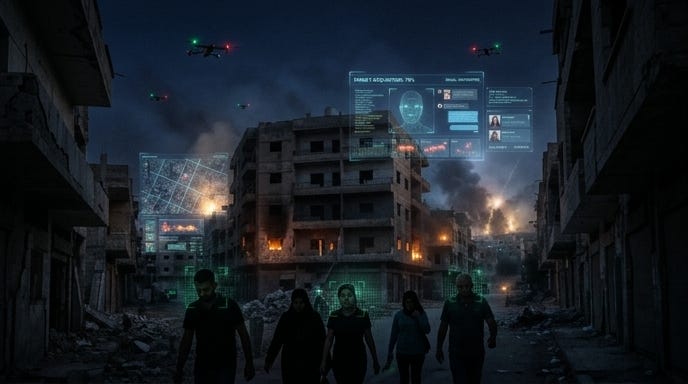
For decades, wars were fought with soldiers, spies, and commanders making decisions under pressure. Today, another actor has entered the battlefield: artificial intelligence.
According to a recent investigation by the Los Angeles Times, the Israeli military is now using AI-assisted targeting systems in Lebanon to identify, track, and eliminate suspected Hezbollah members. What once required weeks of intelligence work by hundreds of analysts can now reportedly be done in seconds.
This is not science fiction anymore.
It is the transformation of warfare into a world of algorithms, metadata, surveillance, and automated kill chains — where a phone signal, a facial match, or even a social media interaction can become enough to mark someone as a target.
And critics around the world are warning that humanity may be entering one of the most dangerous chapters in modern military history.
From Human Intelligence to Machine Targeting
The report describes a system that combines massive amounts of data:
- Phone metadata
- SIM card tracking
- Facial recognition
- Drone surveillance
- Wi-Fi signals
- Vehicle registrations
- Social media activity
- Government databases
These streams of information are reportedly processed through advanced AI platforms such as Palantir’s Maven system. (Los Angeles Times)
The objective is simple: rapidly identify patterns associated with militant activity.
But the implications are terrifying.
An Israeli military AI official quoted in the report explained that the system can now generate “target profiles” in seconds — a process that previously required entire teams working for weeks. (Los Angeles Times)
This represents a massive shift in military doctrine.
War is no longer only about firepower. It is now about data dominance.
When a Phone Becomes a Death Sentence
One of the most chilling elements of the investigation is the story of Ahmad Turmus, a 62-year-old Lebanese man reportedly targeted by Israel in southern Lebanon.
According to family members interviewed by the newspaper, he received a phone call from an Israeli officer asking:
“Ahmad, you want to die with those around you or alone?”
Moments later, he was killed in an airstrike. (Los Angeles Times)
The article suggests that years of digital tracking may have contributed to his targeting. Drone surveillance, phone tracking, facial recognition, and relationship mapping reportedly fed the AI systems responsible for building his “threat profile.”
Whether he was an active militant, an administrator, or merely associated with Hezbollah-linked structures remains debated.
And that uncertainty is exactly what alarms experts.
The Problem of “False Positives”
Artificial intelligence does not understand morality. It does not understand context. It does not understand nuance.
It recognizes patterns.
That is why experts are warning about the danger of “false positives” — situations where innocent civilians are misidentified as combatants simply because their digital behavior resembles someone else’s.
A professor at the Institute of Criminology in Slovenia, Vasji Badalic, warned that such systems rely heavily on behavioral correlations rather than direct evidence. (Los Angeles Times)
Someone may become suspicious because they:
- visit the same neighborhoods,
- communicate with certain people,
- use similar travel routes,
- or appear repeatedly in surveillance footage.
In traditional intelligence work, human investigators would examine context carefully.
But in algorithmic warfare, patterns can rapidly become accusations.
And accusations can rapidly become airstrikes.
“AI Does Not Think”
One anonymous AI specialist interviewed by the newspaper issued an especially important warning:
“It creates this illusion of certainty.” (Los Angeles Times)
That sentence may summarize the entire danger of military AI.
Artificial intelligence often appears objective because it processes enormous amounts of information quickly. But AI systems are only as reliable as the data they receive.
If the underlying information is flawed, biased, outdated, or incomplete, the machine can amplify errors at enormous speed.
Unlike humans, AI does not truly “understand” what it is seeing.
It predicts. It correlates. It matches patterns.
And in war, those mistakes can kill.
Gaza Was the Testing Ground
Human rights organizations and investigative journalists have already raised alarms over Israeli AI systems used in Gaza during the 2023–2025 war.
Systems reportedly known as “Lavender,” “Where’s Daddy?” and “Habsora” were accused by critics of accelerating target generation at unprecedented scales.
The controversy surrounding those systems centered on one fundamental concern: that the speed of killing had become more important than verification.
The Lebanon reports suggest that many of those technologies are now being deployed beyond Gaza.
Some analysts believe modern conflicts are becoming laboratories for AI-powered warfare.
Palantir and the Militarization of Artificial Intelligence
At the center of many discussions about military AI stands Palantir Technologies.
Originally funded in part through connections with U.S. intelligence structures, the company has spent years developing data-analysis platforms used by governments and military organizations. (Los Angeles Times)
Its Maven platform has increasingly become associated with modern AI targeting systems. Reuters recently reported that the Pentagon plans to formalize Maven as a core military system across U.S. operations. (Reuters)
Business Insider described demonstrations where AI systems could:
- identify vehicles,
- suggest strike options,
- and compress hours of military analysis into moments. (Business Insider)
Supporters argue this improves precision and reduces military casualties.
Critics argue it risks turning warfare into a semi-automated process where human judgment becomes secondary to algorithmic efficiency.
A Dangerous Psychological Shift
Perhaps the most disturbing aspect is not technological.
It is psychological.
The more warfare becomes digitized, the easier it becomes to emotionally distance decision-makers from the human consequences of violence.
When targets become dots on a screen, metadata clusters, or “behavioral signatures,” the line between analysis and execution begins to disappear.
Several online reactions to demonstrations of AI targeting systems compared them to video games — operators approving strikes with clicks on a screen. (Reddit)
This comparison may sound exaggerated.
But history repeatedly shows that technology can desensitize people to violence when human suffering becomes abstracted behind machines.
The Global Fear of Autonomous Warfare
The concerns surrounding Lebanon are part of a broader international debate.
The United Nations, human rights groups, and AI ethicists have repeatedly warned against the rise of autonomous and semi-autonomous weapons systems.
The fear is no longer simply about “killer robots.”
It is about systems that:
- recommend who should be targeted,
- compress decision-making time,
- overwhelm human oversight,
- and normalize algorithmic killing.
Once militaries begin trusting AI-generated threat profiles at scale, accountability becomes dangerously blurred.
Who is responsible for a mistake? The programmer? The intelligence officer? The commander? The company? The algorithm?
Modern warfare increasingly struggles to answer those questions.
The Future of War May Already Be Here
What is happening in Lebanon may represent something much larger than one regional conflict.
It may be a glimpse into the future of warfare itself.
A future where:
- surveillance never stops,
- every digital action creates suspicion,
- algorithms rank human beings by perceived threat,
- and machines influence life-and-death decisions faster than humans can fully comprehend.
Technology has always changed war.
But artificial intelligence changes something deeper: the relationship between human judgment and lethal force.
And once that line begins to disappear, the consequences may extend far beyond Lebanon.
The world may soon face a terrifying reality:
Not wars directed by humans using machines — but wars increasingly shaped by machines guiding humans.
메타데이터
- post_id
- bb9f77728bec
- slug
- when-artificial-intelligence-decides-who-dies-the-rise-of-algorithmic-warfare-in-lebanon-bb9f77728bec
- url
- https://medium.com/@karim2k/when-artificial-intelligence-decides-who-dies-the-rise-of-algorithmic-warfare-in-lebanon-bb9f77728bec
- canonical_url
- https://medium.com/@karim2k/when-artificial-intelligence-decides-who-dies-the-rise-of-algorithmic-warfare-in-lebanon-bb9f77728bec
- author_url
- https://medium.com/@karim2k
- status
- ok
- fetched_at
- 2026-07-10 19:15:58






