What Your Water Quality Sensor Is Actually Measuring
Confused about pH, TDS, and turbidity readings? Here’s what each water quality parameter means, what’s considered safe, and how real-time…
What Your Water Quality Sensor Is Actually Measuring
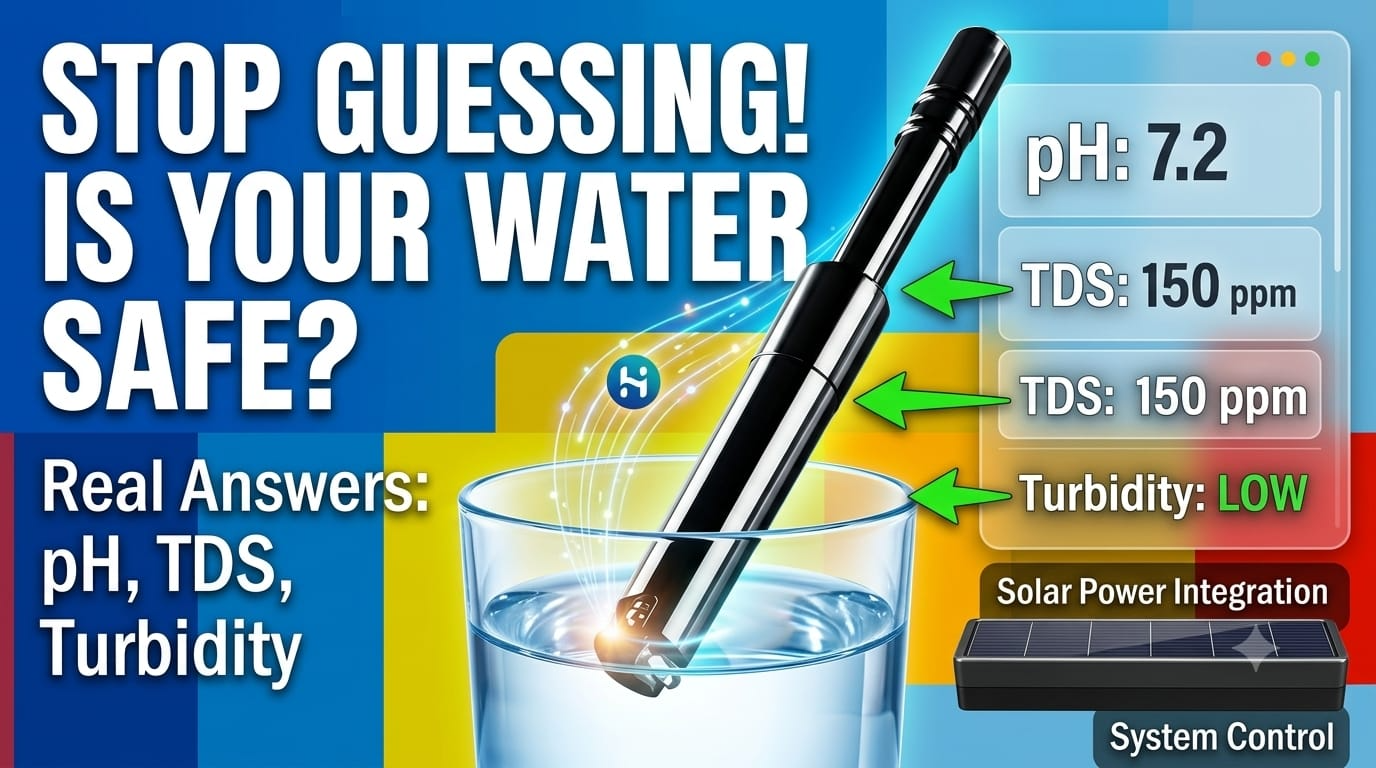
Confused about pH, TDS, and turbidity readings? Here’s what each water quality parameter means, what’s considered safe, and how real-time sensors like HydroQual track them.
A water quality dashboard full of numbers doesn’t mean much if you don’t know what those numbers represent. pH, TDS, and turbidity are the three parameters most commonly tracked in water quality monitoring, but they each measure something different — and understanding what “normal” looks like for each one is what actually makes the data useful.
pH: Is Your Water Too Acidic or Too Alkaline?
pH measures how acidic or alkaline water is, on a scale from 0 to 14, with 7 considered neutral. For most drinking and household water, a pH between roughly 6.5 and 8.5 is considered acceptable — outside that range, water can be corrosive to pipes and fixtures, or may indicate contamination from an external source.
Sudden pH swings are often one of the earliest signs of a problem, which is why **continuous pH monitoring** catches issues faster than periodic testing, where a swing between two scheduled samples would otherwise go unnoticed.

TDS: How Much Is Dissolved in Your Water?
Total Dissolved Solids (TDS) measures the combined concentration of minerals, salts, and other dissolved substances in water, expressed in parts per million (ppm). A rising TDS reading over time often points to mineral buildup, pipe corrosion, or contamination from the water source — and it’s a leading cause of the scaling and residue that shows up on fixtures and appliances.
Because TDS tends to change gradually rather than suddenly, historical tracking is especially useful for spotting a slow upward trend before it becomes a visible problem — you can find more on how this works in our **water treatment resources**.
Turbidity: How Clear Is Your Water?
Turbidity measures the cloudiness of water caused by suspended particles — sediment, organic matter, or microorganisms. High turbidity doesn’t just look unpleasant; it can also interfere with disinfection processes and may indicate that solids are entering the system from an external source, such as a compromised pipe or storage tank.
Unlike a visual check, an automated sensor on the **MyTank monitoring platform** tracks cloudiness continuously and consistently, removing the subjectivity of a “does this look clear enough” judgment call.

Temperature: The Overlooked Fourth Parameter
Temperature isn’t always top of mind, but it affects both water safety and system performance — warmer stored water can accelerate bacterial growth, while temperature swings can also affect the accuracy of other readings if not accounted for.
Putting the Parameters Together
No single parameter tells the whole story on its own. A tank could have normal pH but rising TDS, or clear turbidity but an unsafe pH — which is why real-time monitoring tracks all four together rather than relying on any one number in isolation.
ParameterWhat It MeasuresWhy It MatterspHAcidity or alkalinityCorrosion risk, contamination signalTDSDissolved minerals and saltsScaling, source water qualityTurbidityCloudiness from particlesSediment, disinfection interferenceTemperatureWater temperatureBacterial growth risk, system performance
How HydroQual Tracks All Four in Real Time
**HydroQual** is built to monitor pH, TDS, turbidity, and temperature continuously, sending an alert the moment any parameter moves outside a defined safe range — rather than waiting for the next scheduled test to catch it.
Quality Data Is Only Half the System
Knowing your water is safe doesn’t help if you also don’t know how much is available. Pairing quality data with a **tank level sensor and [automated pump control](https://mytank.cloud/smart-single-phase-pump-controller)** gives a complete view — level, safety, and automated response, all in one system.

Frequently Asked Questions
1. What’s considered a normal pH range for household water? A pH between roughly 6.5 and 8.5 is generally considered acceptable for household water, though the ideal range can vary based on local regulations and specific use case.
2. Is high TDS always a health concern? Not necessarily — some dissolved minerals are naturally occurring and not harmful. However, a rising TDS trend over time is worth investigating, since it can signal contamination or pipe corrosion.
3. Does high turbidity mean water is unsafe to drink? High turbidity itself isn’t always dangerous, but it can shield microorganisms from disinfection and often signals that something — sediment, organic matter — is entering the system that shouldn’t be.
4. Why does temperature matter for water quality? Warmer stored water can accelerate bacterial growth and is generally considered a risk factor for water safety, in addition to affecting the calibration of other sensor readings.
5. Can one sensor track pH, TDS, and turbidity together? Yes. This is designed to monitor all of these parameters simultaneously and report them on a single dashboard — see the full spec sheet on the **MyTank product page** rather than requiring separate devices.
6. How often should water quality be checked if I have a real-time sensor? A real-time sensor monitors continuously, so there’s no fixed “checking” interval needed — readings and alerts are generated automatically as conditions change.
Final Thoughts
pH, TDS, and turbidity each tell a different part of the water safety story, and real value comes from tracking all three continuously rather than relying on an occasional spot check. **MyTank** brings that continuous view together with tank level and pump automation on one platform.
**Talk to our team** to see how real-time water quality tracking fits your setup.
메타데이터
- post_id
- bba4d03f2948
- slug
- what-your-water-quality-sensor-is-actually-measuring-bba4d03f2948
- url
- https://medium.com/@mytank/what-your-water-quality-sensor-is-actually-measuring-bba4d03f2948
- canonical_url
- https://medium.com/@mytank/what-your-water-quality-sensor-is-actually-measuring-bba4d03f2948
- author_url
- https://medium.com/@mytank
- status
- ok
- fetched_at
- 2026-07-24 17:10:21