The Golden Rule of MIS: GIGO (Garbage In, Garbage Out)
Throughout my Management Information Systems (MIS) education, the clearest truth I have learned is this: the success of decision support…
The Golden Rule of MIS: GIGO (Garbage In, Garbage Out)
Throughout my Management Information Systems (MIS) education, the clearest truth I have learned is this: the success of decision support systems depends more on the purity of the data than the complexity of the algorithm used. Known in the literature as GIGO (Garbage In, Garbage Out), this concept is more than just a technical term; it is the “constitution” of a data analyst.
What is GIGO? A Technical Perspective
GIGO is the principle that illogical or erroneous data entered into a computing system will produce faulty output, regardless of how flawless the system itself may be. From a technical standpoint, this is a disruption of data integrity. If there is noise in the input layer, it is mathematically impossible to expect a meaningful signal in the output layer.
How and Where Does GIGO Occur?
This “garbage data” problem usually infiltrates the system at three main points:
- Data Collection Phase: A lack of sufficient constraints in user interfaces (UI). For example, allowing text in a numeric field or failing to standardize date formats (such as ISO 8601).
- Data Integration (ETL) Processes: Schema inconsistencies that occur when merging data from different sources. If one database uses USD while another uses EUR, and these are analyzed without conversion, GIGO is inevitable.
- Sampling Bias: When the dataset does not accurately reflect the population it is intended to represent. This technical error causes the model to produce biased results.
Technical Strategies to Avoid GIGO
As an aspiring analyst, following these technical steps is vital to minimize this issue:
- Exploratory Data Analysis (EDA): Before starting the analysis, always visualize the distribution, standard deviation, and outliers of the data. Box-plots or Histograms are the fastest ways to detect “garbage.”
- Data Validation Rules: Implement strict rules during the data entry phase. Using NOT NULL, CHECK, and UNIQUE constraints at the database level is your first line of defense.
- Imputation Techniques: Instead of simply deleting missing values, fill them meaningfully using methods like Mean/Median Imputation or K-Nearest Neighbors (KNN), depending on technical needs.
- Normalization & Standardization: Bring data from different scales (e.g., a 1–10 rating vs. a 10,000–50,000 salary) to the same scale so your model isn’t misled by magnitude differences.
Conclusion
GIGO is not just a computer science term; it is the greatest risk in Business Intelligence processes. As MIS students, we must be the ones who advocate for Data Quality throughout the entire lifecycle — from data generation to reporting — rather than just being those who “write code.”
Remember: Artificial Intelligence trained on wrong data only allows you to make mistakes faster.
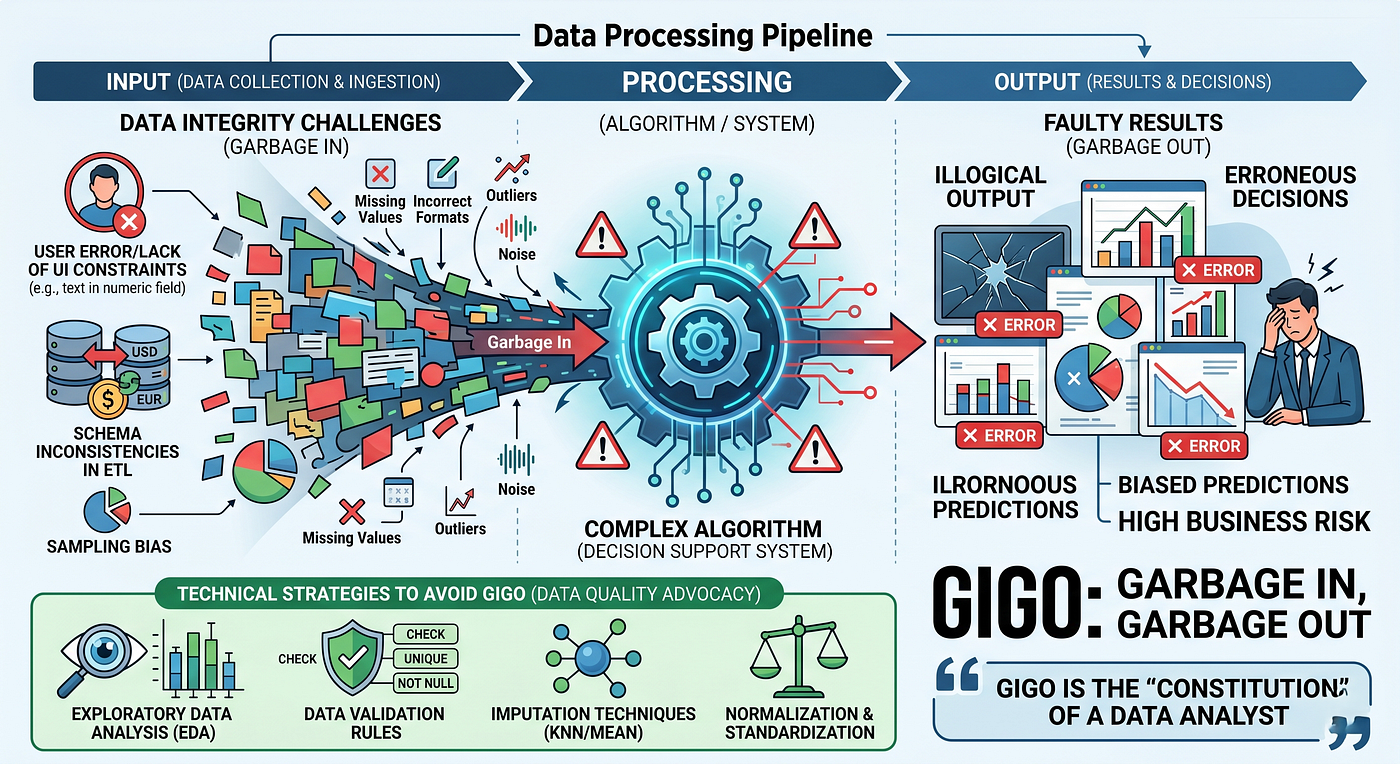
Data Quality Life Cycle: The direct correlation between corrupted input and faulty output, featuring key prevention and mitigation strategies.
메타데이터
- post_id
- bba8446e736b
- slug
- the-golden-rule-of-mis-gigo-garbage-in-garbage-out-bba8446e736b
- url
- https://medium.com/@uaysecetin/the-golden-rule-of-mis-gigo-garbage-in-garbage-out-bba8446e736b
- canonical_url
- https://medium.com/@uaysecetin/the-golden-rule-of-mis-gigo-garbage-in-garbage-out-bba8446e736b
- author_url
- https://medium.com/@uaysecetin
- status
- ok
- fetched_at
- 2026-06-14 11:28:49



