Statistics Concept — The Birthday Paradox: A Conditional Probability Perspective
Why shared birthdays emerge much earlier than intuition suggests — via conditional probability, interactions, and Monte Carlo simulation in…
Statistics Concept — The Birthday Paradox: A Conditional Probability Perspective
Why shared birthdays emerge much earlier than intuition suggests — via conditional probability, interactions, and Monte Carlo simulation in Python
Photo by Natalie Kinnear on Unsplash
Introduction
In probability, some results feel so counterintuitive that they almost seem wrong at first glance. The Birthday Paradox is one of the most famous examples.
The surprising result is this:
In a group of just 23 people, the chance that at least two people share the same birthday is already above 50%. [1]
At first glance, this feels implausible. With 365 possible birthdays, shouldn’t we need far more people?
The surprise comes from a subtle but powerful shift in perspective: the problem is not really about “matching your birthday” — rather, “comparing everyone in the group to everyone else”.
In this article, we reframe the problem using conditional probability and the chain rule, build it step by step through sequential construction, and verify the result with a Monte Carlo simulation using Python.
Problem Statement
Assume:
- There are 365 days in a year
- Birthdays are uniformly distributed
- Each person’s birthday is independent
The objective is to determine the probability that at least two people share the same birthday in a group of n people.
Key Idea: Solve using the Complement
The probability of a shared birthday is difficult to compute directly.
Instead, we use the complement: P(at least one match) = 1 - P(no match)
By doing so, the entire problem reduces to finding:
What is the probability that every new person avoids all previous birthdays?
Step 1: Constructing the Probability
Let Uₖ be the event that the k-th person has a unique birthday that does not match the previous people
P(no match) = P(U₁ ∩ U₂ ∩ … ∩ Uₙ)
Using the chain rule of probability:
P(U₁ ∩ U₂ ∩ … ∩ Uₙ) = P(U₁) P(U₂|U₁) P(U₃|U₁, U₂) … P(Uₙ|U₁, …, Uₙ₋₁)
This is the key structure behind the paradox.
Step 2: Compute Each Conditional Probability
The first person always has a unique birthday, i.e., no condition exists yet: P(U₁) = 365/365 = 1
Given that the first birthday is taken, the second person must avoid it: P(U₂|U₁) = 364/365
Now there are two occupied birthdays; the third person must avoid both: P(U₃|U₁, U₂) = 363/365
Continuing the logic, for the k-th person, there are k-1 birthdays already taken: P(Uₖ|U₁, …, Uₖ₋₁) = (365-(k-1))/365
Step 3: Build the Full Expression
By substituting into the chain rule:

Image 1. Generalized P(no match). Image by Author.
Step 4: Numerical Result for Probability of a Match at n=23
For n = 23: P(no match) ≈ 0.4927028 ∴ P(at least one match) = 1 - 0.4927028 ≈ 0.5072972
Why This Feels Counterintuitive
A common intuition is to think that each new person in a group still has 365 independent possible birthdays, so nothing fundamentally changes as the group grows. While birthdays are indeed generated independently, the event we care about — whether any two people in the group share a birthday — is not independent across people.
As the group grows, each new person must have a unique birthday that does not match anyone already in the group. So the probability becomes a chain of conditions, where every step depends on what has already been taken.
Another way to see this is to think in terms of interactions instead of individuals. The paradox is driven not by how many people there are, but by how many pairwise comparisons exist between them. In a group of n people, the number of possible pairs is:

Image 2. nC2 equation. Image by Author.
For n = 23, this already gives 253 possible pairs
So even though each pair has a small chance of matching, the number of opportunities for a collision grows quadratically — and that is what drives the probability up so quickly.
Python Simulation
We validate the result using a Monte Carlo simulation.
[embed]
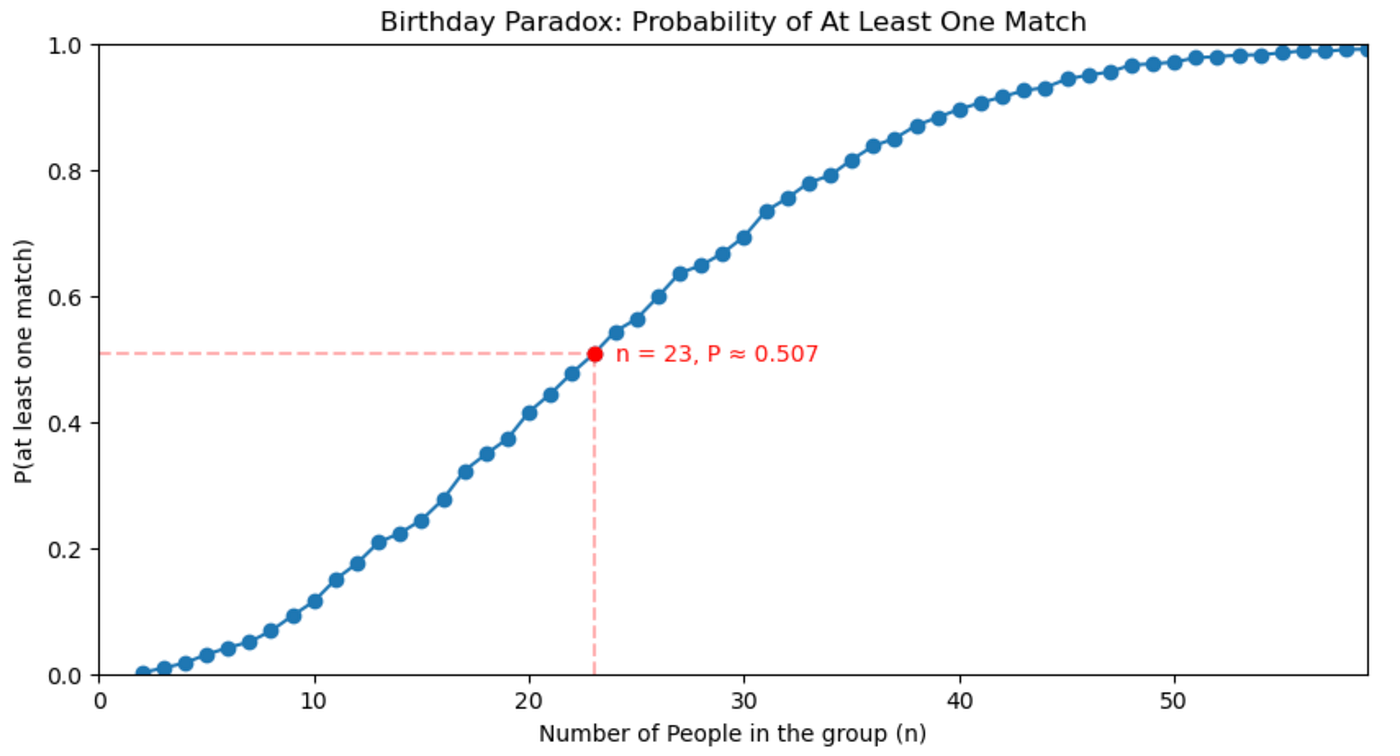
Image 3. The Birthday Paradox Simulation. Image by Author.
The simulation result closely matches the theoretical prediction, as shown in the chart. The probability increases rapidly as the number of people in the group increases.
Conclusion
The Birthday Paradox shows how easily intuition breaks down with combinatorial growth. It is really about how quickly interactions build up within a group. Once we rewrite the problem using the complement rule and a chain of conditional probabilities, it becomes a clean sequential construction. Each step is simple on its own, but together they explain why shared birthdays appear much earlier than intuition suggests.
What drives the result is not the number of people, but the number of pairwise comparisons between them. As these comparisons grow quadratically, collisions become likely far sooner than we expect.
Recommended Reading
References
메타데이터
- post_id
- bbb2f579de1c
- slug
- statistics-concept-the-birthday-paradox-a-conditional-probability-perspective-bbb2f579de1c
- url
- https://pub.towardsai.net/statistics-concept-the-birthday-paradox-a-conditional-probability-perspective-bbb2f579de1c
- canonical_url
- https://pub.towardsai.net/statistics-concept-the-birthday-paradox-a-conditional-probability-perspective-bbb2f579de1c
- author_url
- https://medium.com/@chaodeyu
- status
- ok
- fetched_at
- 2026-06-17 17:19:58