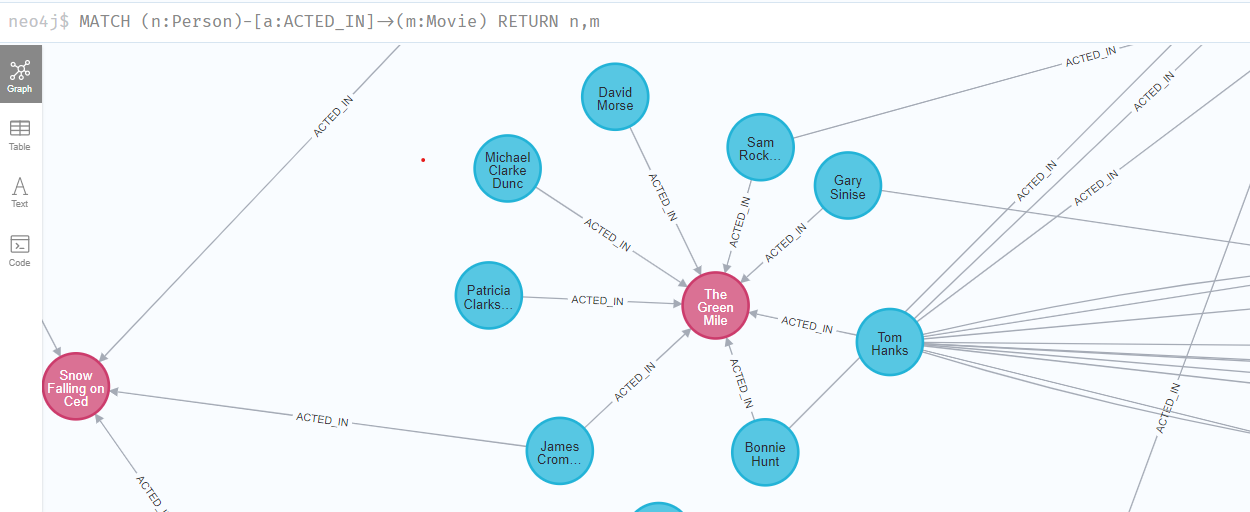
Six Healthcare Teams, No Coordination, Same Architecture: What Knowledge Graphs Just Proved
Six independent teams, three continents, one architecture. What the most regulated industry on earth just told the rest of us about…
Six Healthcare Teams, No Coordination, Same Architecture: What Knowledge Graphs Just Proved
Six independent teams, three continents, one architecture. What the most regulated industry on earth just told the rest of us about building AI that works
Grab a coffee, because this is a long one — but I promise you, it’s worth the ride.
Six teams, no coordination, same answer
Over the past two months, I found six independent healthcare teams — Abu Dhabi, Toronto, multiple sites in China, European oncology networks, and US hospital systems — all building the same thing. A knowledge graph (Neo4j in most cases), an LLM grounded in it, and structured medical reasoning on top. None of these teams cites the others. None shares funding sources. They published on different platforms, in different languages, solving different clinical problems. And they converged on the same architecture.
Six teams landing on the same answer independently means the problem forced the architecture.
The broader numbers back this up. An IntuitionLabs analysis found that 89% of AI pilots in pharma fail to scale past proof-of-concept, and the consistent reason is weak data foundations, not weak models. The teams that survive have a structured knowledge layer underneath. When the most regulated, most cautious, most liability-exposed industry on earth quietly agrees on a technical pattern, the rest of us should probably pay attention.
These are early-stage results, not production deployments at a national scale. But the direction is consistent enough — and from enough independent sources — to be worth examining closely.
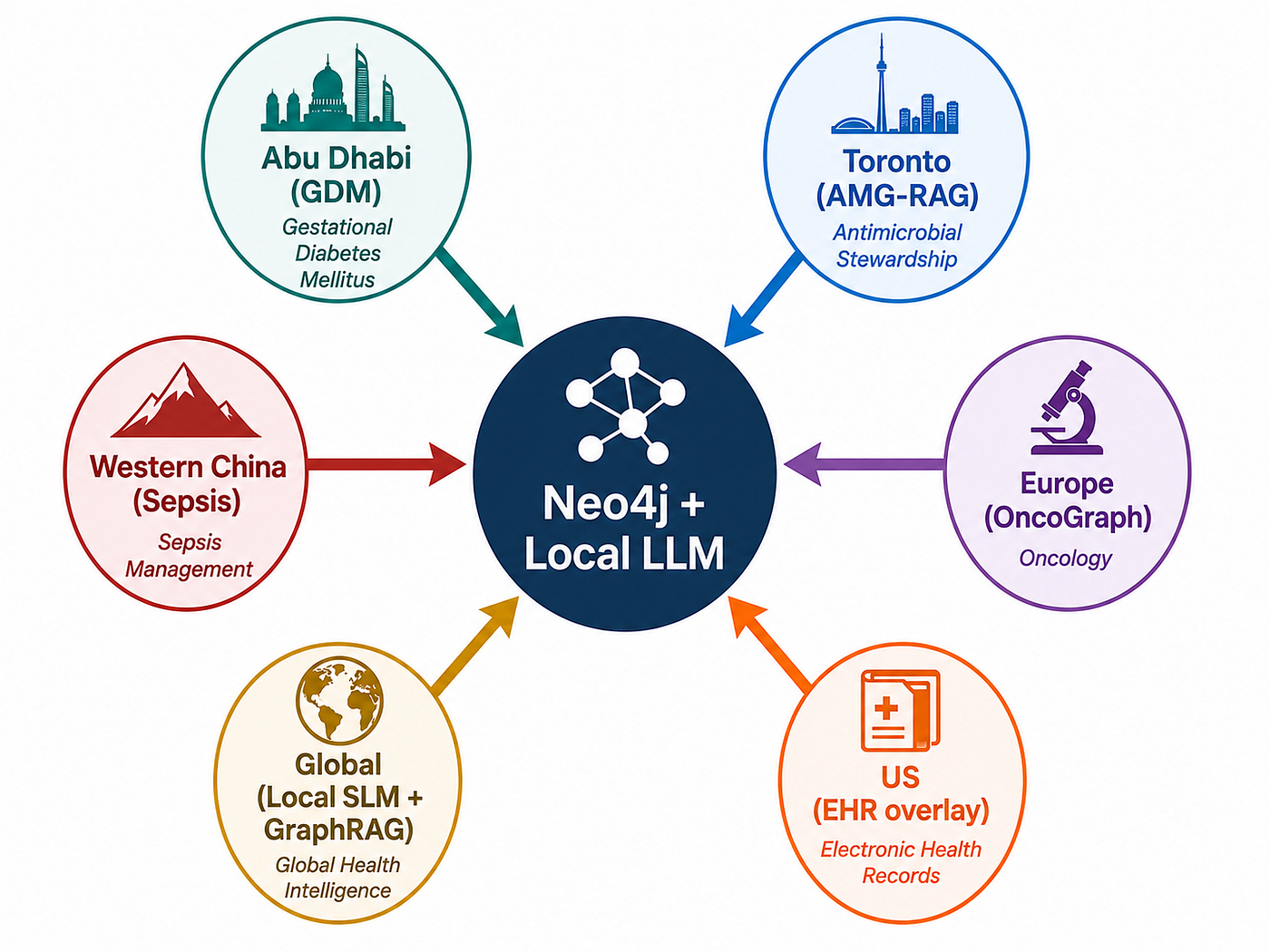
generated with chatgpt
The evidence, with context
The two strongest results first, in detail. Then the rest of the six, side by side — because the signal is in the convergence, not any single project.
GDM — Gestational Diabetes Management. Evangelista et al. at Zayed University in Abu Dhabi built a Neo4j knowledge graph from 1,212 research papers, layered a local LLM on top, and grounded its outputs entirely in graph-structured medical knowledge. The system was designed for off-grid clinics with no internet — a local SLM running on modest hardware. On a small 20-prompt test set, it hit a BLEU score of 0.99 against reference answers — too small to generalize from, but ChatGPT scored 0.62, Claude 0.65, and Gemini 0.61 on the same prompts. Published in JMIR Diabetes, January 2026. (Source)
The architecture matters more than the benchmark: a knowledge graph constraining an LLM’s outputs to relationships extracted from peer-reviewed literature. Better structure drove that score — the model itself was smaller and simpler than the baselines.
OncoGraph / Massive Bio. 3,804 cancer patients across a study published in ESMO Real World Data and Digital Oncology. Clinical trial matching dropped from 120 minutes per patient to 30. The study reported zero algorithmic hallucinations in the matching process — because matching was graph traversal against explicit eligibility criteria, not generation. That’s a strong result at the clinical study scale. Whether it holds at the national health-system scale is a different question, and one nobody has answered yet.
The other four, briefly:
AMG-RAG (University of Toronto) tackled medical question answering and hit 74.1% F1 on MEDQA, a benchmark built from US medical licensing exams. (arXiv)
Three hospitals in Western China built a Neo4j sepsis knowledge graph paired with GPT-4 for early sepsis diagnosis — reasoning across fragmented clinical data that previously lived in incompatible systems. (JMIR)
Agentic GraphRAG for hepatology delivered liver disease decision support with a 0.94 faithfulness score, achieved through a self-correcting, graph-grounded agent loop. (Frontiers in Medicine)
US hospital networks are layering Neo4j over existing EHR systems for AI triage, querying multi-decade patient history across providers in milliseconds. This work shows up in industry deployments rather than peer-reviewed publications.
The EHR work is the least documented of the six — vendor and hospital case material rather than peer review — but it’s also the most pragmatic. The EHR stays. The graph connects what the EHR never could.
And the pattern extends beyond these six. Novartis has been mapping phenotypic, genomic, and compound data in Neo4j for years, shaving time off drug target discovery by making connections explicit that used to live in separate databases, separate teams, and separate buildings. An open-source trend on GitHub is building causal knowledge graphs for adverse drug reactions — predict-before-it-happens reasoning about dangerous drug combinations, structured as a directed graph rather than statistical correlation. And the local-SLM-plus-GraphRAG pattern from the GDM paper repeats across global health forums: resource-constrained clinics getting decision support without cloud dependencies, without sending patient data to an API endpoint, without vendor lock-in.
Healthcare is the canary, not the exception
It would be easy to file all of this under “healthcare is special.” Strict regulations, patient safety, and unique constraints. Interesting but not relevant to my industry.
That’s wrong. These aren’t healthcare-specific problems. They’re the extreme version of problems every data-heavy organization faces.
Zero hallucination tolerance. Healthcare can’t afford a fabricated drug interaction. Legal is already paying for this — courts have seen a growing number of cases involving AI-hallucinated citations since 2023, and judges are now requiring disclosure of AI use in filings. Finance faces the same exposure with compliance guidance. Insurance with claim reasoning. Healthcare just has the lowest tolerance for error. Other regulated industries are close behind.
Regulatory audit trails. The FDA’s “show your reasoning” requirement feels like a medical thing. It’s not. The EU AI Act classifies dozens of non-healthcare applications as high-risk — employment screening, credit scoring, and critical infrastructure. All of them will need the same traceability that healthcare is building now. If your AI can’t walk back from answer to evidence, you have a compliance problem that gets worse every quarter.
Then there’s data sovereignty. Healthcare can’t send patient records to a cloud API. Defense can’t either. Banking has its own constraints. Government agencies, any org with sensitive IP, any company operating under GDPR — the “just call the OpenAI API” architecture has a ceiling, and a lot of organizations are hitting it.
And multi-stakeholder complexity — a single clinical decision involves the patient, the doctor, the insurer, the regulator, and sometimes a pharmaceutical company. Each with different data, different incentives, different access rights. Supply chains look exactly like this. So does manufacturing. So does energy grid management. The knowledge graph doesn’t just store data — it models who needs what, and why, as traversable relationships.
That 89% AI pilot failure rate? It’s not a healthcare stat. It’s a “throwing raw data at LLMs without structure” stat. Healthcare just measures it more carefully than the rest of us.
The business case is taking shape
If you’re trying to justify a knowledge graph investment to a CFO, healthcare is starting to provide the numbers — even if they’re early.
OncoGraph’s trial matching: 120 minutes to 30 minutes, at 3,804-patient scale. That’s a clinical study, not a full deployment, but the operational math is clear. Multiply the time savings by the clinician's hourly cost, multiply by annual patient volume, and you have an ROI model any finance team can evaluate. The same math applies to any workflow where a human currently spends time manually connecting information across systems — claims processing, contract review, supplier risk analysis.
The compliance argument may be even stronger. Pharma data leaders are increasingly vocal that regulators will reject black-box AI findings — the pressure from both European and US regulatory bodies is toward explainability and data lineage. If you’re building AI for any high-risk application and your system can’t trace its reasoning, you have two options: build traceability in now, or retrofit it later at significantly higher cost. The pattern across published post-mortems is consistent: retrofitting is always more expensive than building it in.
The local-first advantage deserves its own line in the business case. The GDM system runs without cloud infrastructure. No per-token API costs. No data leaving the premises. No vendor is deciding to change pricing, deprecate a model, or alter terms of service. For organizations processing sensitive data at scale, the total cost of ownership math shifts dramatically when you own the full stack.
The market direction supports this. Gartner identifies GraphRAG as a top data and analytics trend for 2026, and knowledge graphs have reached the Slope of Enlightenment on their 2025 Hype Cycle for Generative AI — past the hype peak, into the phase where real deployments start compounding. That signal extends well beyond healthcare — it’s about infrastructure.
What a knowledge graph actually replaces
The knowledge graph doesn’t replace your database or your data lake. It replaces the brittle, undocumented reasoning chain between your data and your AI’s answers.
Take a supply chain example. A procurement manager asks: “Which of our Tier 2 suppliers in Southeast Asia have single-source dependencies for components used in products shipping to EU customers subject to CBAM carbon reporting?”
With vector RAG, the system retrieves text chunks that mention Southeast Asia, suppliers, and carbon reporting. Maybe it finds relevant paragraphs. Maybe it stitches together an answer that sounds right. There is no way to verify whether the connections it made are real or hallucinated. The supplier it names might not actually supply that component. The carbon reporting requirement might apply to a different product line.
With a knowledge graph, that question becomes a traversal:
MATCH (product:Product)-[:SHIPS_TO]->(region:Region {regulation: 'CBAM'})
MATCH (product)-[:CONTAINS]->(component:Component)
      -[:SUPPLIED_BY]->(t2:Supplier {tier: 2, region: 'Southeast Asia'})
WHERE count { (component)-[:SUPPLIED_BY]->(:Supplier) } = 1
RETURN t2.name, component.name, product.name
Every hop is an explicit, auditable relationship. The answer traces back through a path you can inspect, challenge, and explain to an auditor.
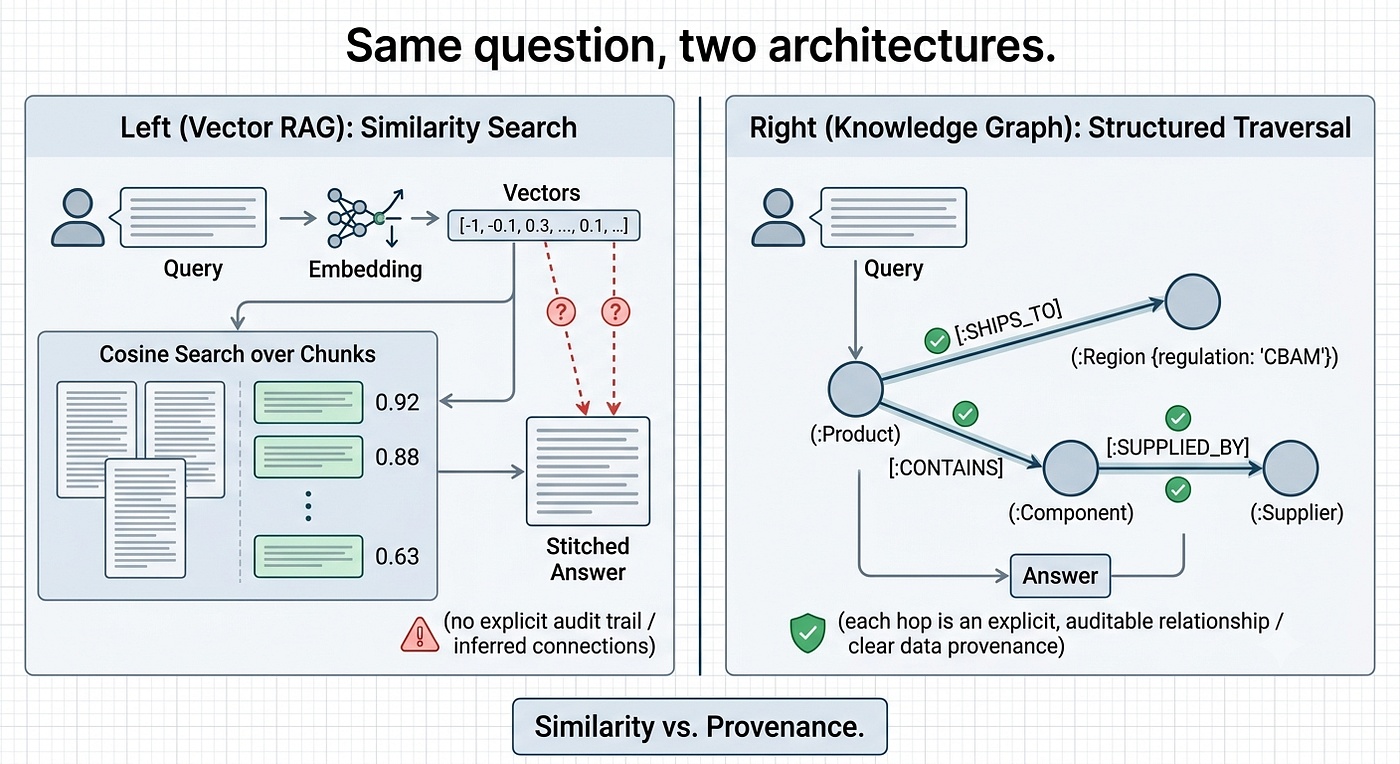
generated with gemini
Provenance is the difference. A vector store gives you cosine similarity — “these chunks were close to your question in embedding space.” A knowledge graph gives you a chain: this answer came from this fact, which was extracted from this document, which was last updated on this date, which contradicts this other source from 2023. A regulator asking “how did your system reach this answer?” needs a traceable chain from answer to fact to source document — not a similarity score.
And nothing gets thrown away. Your existing databases stay. Your data warehouse stays. Your BI tools stay. The graph layers over them, connecting what they could never connect on their own. The healthcare teams didn’t rip out Epic or Cerner. They built a graph on top that made the data in those systems actually queryable across boundaries.
What needs to happen next
The direction is clear. The gap between these proof-of-concept results and reliable production systems is where the real work lives.
The extraction-to-graph pipeline as a whole remains the hardest unsolved problem. It’s not just raw extraction accuracy — entity disambiguation, schema drift, and error propagation across pipeline stages are at least as challenging. In 2023, the Text2KGBench benchmark showed F1 as low as 0.25–0.38 for fact extraction using open-source 13B models. Current approaches with larger LLMs push this toward 0.65–0.88 — a big improvement, but still not good enough for clinical safety. And the gap between ontology conformance (does the output look right?) and factual correctness (is it actually right?) persists. Closing it is the next milestone for every team working on automated KG construction — including mine.
Scale is the second challenge. OncoGraph’s 3,804 patients is impressive for a clinical study. A national health system processes millions. The GDM team’s 1,212 papers are a focused corpus. A pharmaceutical company’s internal literature runs into hundreds of thousands. Nobody has demonstrated the GraphRAG pattern specifically at enterprise scale across years of continuous operation — the pattern is too new. The underlying graph infrastructure is proven — Novartis, AstraZeneca, and others have been running production knowledge graphs on Neo4j for years. But the full LLM-extraction-to-graph-to-retrieval pipeline at that scale? Still uncharted.
The talent gap compounds both problems. Neo4j is used by 1.9% of developers according to Stack Overflow’s 2024 survey, and dedicated knowledge graph roles remain rare across major job boards. Few teams have graph database expertise and deep domain knowledge in the same room. The healthcare teams that got results had clinicians working alongside engineers. Replicating that cross-functional model in insurance, legal, or supply chain means finding — or building — teams that bridge the gap. That’s a harder hiring problem than most organizations admit.
And not every problem needs a graph. If your data relationships are simple, your queries are single-hop, and your compliance risk is low, a well-tuned vector RAG pipeline is cheaper and faster to ship. Most enterprise queries are simple semantic lookups that vector search handles fine. The graph earns its complexity when the relationships between your entities are what matter — not just the entities themselves. The industry is converging on hybrid architectures: vector search for broad semantic retrieval, graph traversal for relationship verification and multi-hop reasoning, with a routing layer that sends each query to the right engine. Not either/or. Both for different parts of the problem.
What I think this actually means
Six teams, three continents, no coordination, and the same architecture.
This is what convergence looks like before anyone names it a standard. No vendor pushed it. No keynote set the agenda. Practitioners solving hard problems under real constraints landed on the same answer because the problem left them no choice.
The opportunity this reveals isn’t about any single technology. The bottleneck is constructing domain-specific knowledge graphs. The LLM matters more than people assume — extraction quality varies sharply between models, and even minor version updates can shift output quality noticeably. Model choice is a real architecture decision, not a plug-and-play commodity. The database matters too — Neo4j’s ecosystem (APOC, GDS, Cypher tooling) creates genuine advantages that don’t transfer easily to other graph databases. But what’s scarcest and most valuable is the structured domain knowledge itself: the ontology, the entities, the relationships, the validation. That’s where the competitive moat lives — and across the published healthcare work, it’s consistently where the time goes.
My projection: within the next months, the standard due diligence question for any high-stakes AI deployment becomes “how does your AI ground its reasoning in verifiable facts?” Knowledge graphs are the strongest answer available today — not the only one, but the one with the most evidence behind it. Regulators are already mandating the capabilities KGs provide — explainability, traceability, and audit trails. The EU AI Act’s Article 86 gives people affected by high-risk AI a right to “clear and meaningful explanations” of individual decisions — effective August 2026. Investors and procurement teams will follow the regulatory signal.
The window is open, but it won’t stay open. You can stand up a graph in weeks with modern LLM tooling — Neo4j’s LLM Graph Builder and similar tools have compressed what used to take months of manual work. But what you can’t compress is the domain modeling depth, the edge-case coverage, and the organizational muscle memory that separate a demo from a production system your regulators will trust. The teams that started early will have graphs refined by years of domain feedback — ontology maturity, entity resolution quality, governance processes. That compounding effect is real, and it doesn’t shortcut. Although I’m sure someone’s pitching “zero to production KG in a quarter” to a board right now.
If you’re evaluating where to invest your next engineering cycle, I’d look at this healthcare convergence and ask a simple question: is your industry more or less regulated than the one that just decided knowledge graphs aren’t optional?
I genuinely don’t know what the answer looks like for every sector. But I know the question is worth asking — before someone asks it for you.
Resources
Primary research:
- GDM knowledge graph (Evangelista et al., JMIR Diabetes 2026): https://diabetes.jmir.org/2026/1/e76454
- Self-correcting agentic GraphRAG for hepatology (Frontiers in Medicine): https://www.frontiersin.org/journals/medicine/articles/10.3389/fmed.2025.1716327/full
- AMG-RAG medical QA (University of Toronto): https://arxiv.org/html/2502.13010v2
Oncology and clinical trials:
- OncoGraph / Massive Bio (ESMO Real World Data and Digital Oncology): https://massivebio.com/massive-bio-publishes-landmark-prospective-study-demonstrating-ai-driven-clinical-trial-matching-at-scale-in-3804-cancer-patients/
- Sepsis knowledge graph across 3 hospitals in Western China: https://www.jmir.org/2025/1/e65537
Pharma and drug discovery:
- Novartis knowledge graph for drug target discovery: https://neo4j.com/developer/industry-use-cases/life-sciences/
- Causal KGs for adverse drug reactions (GitHub open-source trend): https://github.com/KHP-Informatics/ADR-graph
Enterprise healthcare:
- EHR decoupling with Neo4j overlay for AI triage: https://neo4j.com/developer/industry-use-cases/life-sciences/medical-care/patient-journey/
- Local SLM + GraphRAG for resource-constrained clinics: https://diabetes.jmir.org/2026/1/e76454
Regulatory and compliance:
- FDA CDS guidance update (January 2026): https://www.arnoldporter.com/en/perspectives/advisories/2026/01/fda-cuts-red-tape-on-clinical-decision-support-software
- EU AI Act high-risk obligations (August 2026): https://artificialintelligenceact.eu/
Market context:
- IntuitionLabs pharma AI pilot failure rate analysis (89%): https://intuitionlabs.ai/articles/pharma-ai-pilots-failure-scaling-guide
- Gartner Top Trends in Data & Analytics 2026: GraphRAG: https://www.gartner.com/en/documents/7444326
- Gartner Hype Cycle for Generative AI 2025: Knowledge Graphs in Slope of Enlightenment: https://www.gartner.com/en/documents/6719134
- Stack Overflow Developer Survey 2024: Neo4j at 1.9% developer adoption: https://survey.stackoverflow.co/2024/technology
- Text2KGBench (ISWC 2023): https://arxiv.org/abs/2308.02357
메타데이터
- post_id
- bbb7421d3d0b
- slug
- six-healthcare-teams-no-coordination-same-architecture-what-knowledge-graphs-just-proved-bbb7421d3d0b
- url
- https://medium.com/@akkonrad/six-healthcare-teams-no-coordination-same-architecture-what-knowledge-graphs-just-proved-bbb7421d3d0b
- canonical_url
- https://medium.com/@akkonrad/six-healthcare-teams-no-coordination-same-architecture-what-knowledge-graphs-just-proved-bbb7421d3d0b
- author_url
- https://medium.com/@akkonrad
- status
- ok
- fetched_at
- 2026-06-17 08:20:12