The Wheel and the Serpent. The Cyclic System of Giordano Bruno’s Mnemonic Agents
by Federico Berti
**The Wheel and the Serpent. **The Cyclic System of Giordano Bruno’s Mnemonic Agents
by Federico Berti
To think is to make connections: the human mind organizes its knowledge through metaphors, placing each new piece of information under the dominion of an already familiar image so as to root it in deep memory. This happens continuously, involuntarily, without our awareness. Not all metaphors are equal, however. Some, over the centuries, have accumulated around themselves such dense layers of interpretive, philosophical, artistic, religious, and ritual traditions that they become attractors of meaning with an exceptionally broad semantic field. It is on this principle that Giordano Bruno builds his mnemonic system.
The system that Bruno presents in the Ars memoriae of 1582 — published together with De umbris idearum and effectively an integral part of the same project — is founded on a mechanism of concentric rotating rings. The outermost wheel holds thirty symbolic figures, called agents: they are the protagonists of Bruno’s art of memory, the densest archetypal metaphors. The inner rings hold other elements (attributes, actions, emblems, connections) that can be combined with those agents by rotating the wheels. The result is an open system, capable of generating a very large number of associations from a finite repertoire of elements. Each element is designed to serve as a metaphor for a content to be memorized: by placing that content under the dominion of that metaphor, connections are created with everything previously placed under that same dominion.
Each agent is linked to a letter of an alphabet composed of twenty-three Latin letters plus seven taken from Greek and Hebrew, for a total of thirty, and one hundred and fifty (a multiple of thirty) syllabic groups filed under that sign — adding one of the five vowels to the letter, so that each syllable can correspond to an image. The number thirty is not a consequence of phonetic conversion; if anything, the opposite is true: the interlinguistic alphabet was adapted to the structure of the ring, which represents the measure of degrees in each zodiacal sign of the Babylonian astrological system — each degree corresponding to a day in the astronomical calendar. Thirty is the measure of the lunar month as the elementary unit of time. This correspondence recurs in Bruno, who, during his years of training in the convent of San Domenico Maggiore in Naples, had before his eyes the Carafa Chapel of Santa Severina: an architectural space organized according to a structure reminiscent of Giulio Camillo’s Theatre, whose arches bore thirty carved astrological symbols.
The choice of thirty figures on the outer wheel responds to the idea of drawing from the arts, philosophy, and religion a canon of recurring symbols, as the classical tradition teaches: Mnemosyne is the mother of the Muses. Bruno incorporates a selection of archetypal figures taken from Ovid’s Metamorphoses, following their narrative order: Lycaon first, Deucalion second, Apollo third, and so on. Although the classical text features many more characters, Bruno chooses a canon of thirty to organize them on the outer ring of his system. This is the point that secondary literature has generally treated as obvious, but which should not be obvious: the order of the sequence is Ovidian, but the selection is not. Bruno does not randomly pick the first thirty characters he encounters in the text; rather, he arranges those that together allow him to describe a complete cycle, a periodic key. The progression he proposes — from the primordial bestiality of Lycaon to the final dissolution of Glaucus into the ocean, passing through creation, passions, challenges to the gods, works of ingenuity, fall, and mourning — is not Ovid’s linear progression culminating in imperial apotheosis, but a progression that Bruno closes back upon itself, turning a linear sequence into a ring.
Ovid writes a carmen perpetuum, an unbroken song from cosmic chaos to Augustan Rome. Bruno takes that same material and folds it into a wheel: he compares the cycle to the mythical serpent biting its own tail, a symbol of the universe itself, placed around the wheels as a structural principle. The cycle of emblems closes with the return of Glaucus to the ocean, to reconnect with the first: Lycaon, the creature of shadow and dual nature, who seems to have just emerged from that primordial sea. The firmament is thus the metaphor Bruno himself uses to describe this system. Just as Metrodorus of Scepsis built his memory palace from the thirty-six decans of Hellenistic astrology, Bruno builds his from the lunar month.
Why a cyclic system rather than a linear one? The answer lies rooted in the principle that Bruno calls vicissitudo universalis — the fundamental law by which everything changes continuously, every state evolves into its opposite through progressive degrees, every end is a beginning. This principle, which Bruno inherits from Nicholas of Cusa and the Hermetic tradition, is not compatible with a list or a linear hierarchy. It requires a structure in which no element is first or last in an absolute sense, in which movement is always possible in both directions — as in the solar cycle of the decans and in all symbolic keys developed over the centuries. The wheel does not merely produce sequential relations between adjacent elements; it produces geometric relations among all elements. In astrology — the system from which Bruno borrows the measure of thirty — planets form aspects with each other based on angular distance: conjunction at zero degrees, opposition at 180°, trine at 120°, square at 90°, sextile at 60°. Each of these aspects has a meaning, a quality of relation that determines how the forces of the two planets interact.
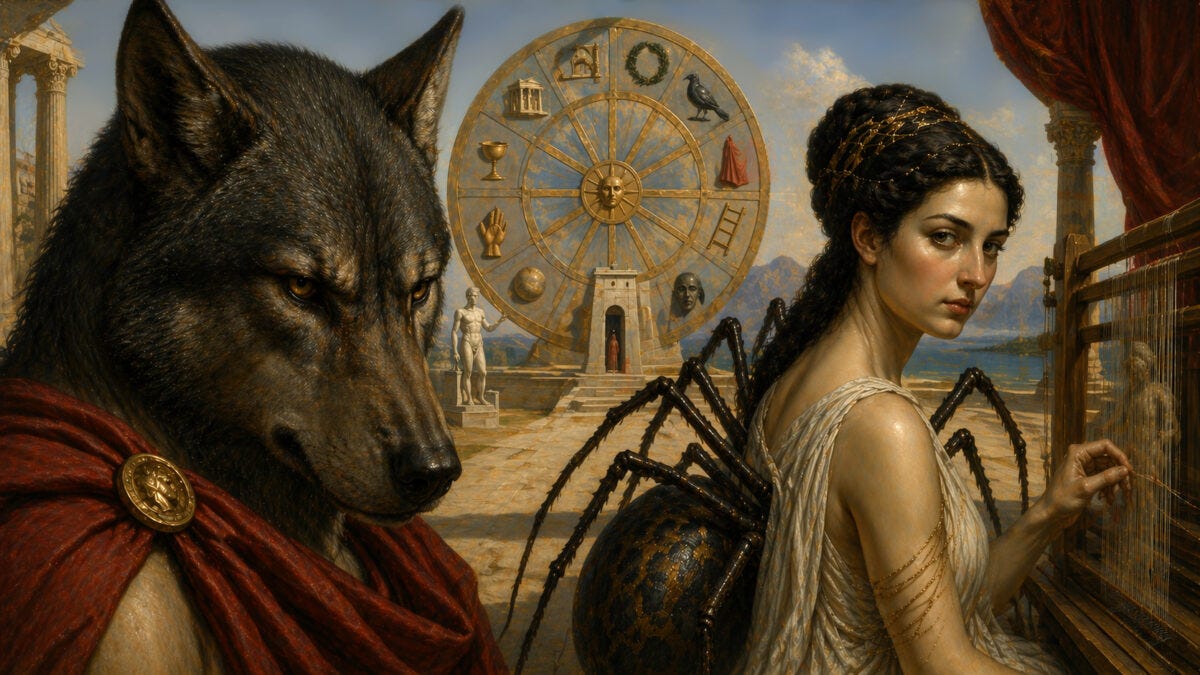
Bruno does not explicitly transfer this system of aspects to the agents on his wheel, but the very structure of the wheel makes it possible. If Lycaon occupies the first position and Arachne the sixteenth, the opposition constitutes, in effect, a geometric relation inscribed in the form — a relation contemplated in the intentio operis, but whose declinations the subject may attribute according to the hermeneutic tradition that inspires them. The two agents are found on opposite sides of a secant line cutting the circle, charged with the tension between complementary forces, polarities that define each other — the point where two opposing principles face one another. But it is then up to subjective imagination to weave the web of contextual relations.
Lycaon is the first agent. In the classical myth, he is a king of Arcadia who serves human flesh to Jupiter to test his divinity and is transformed into a werewolf. Bruno makes him something more complex: not merely a cannibalistic criminal, but the creature that lives on the boundary between humanity and animality, between consciousness and instinct, between the world of light and the world of shadow — a symbol of coexisting human and bestial natures. His eyes shining in the dark — a detail Ovid inserts into the description of the metamorphosis — make him a guide in the darkness, a figure who knows the wild territory of the unconscious and can lead others through it without being devoured. He is the starting point of the cycle, the ambivalence common to each sign that is never entirely positive or negative.
Arachne is the sixteenth agent. Bruno places her at the point exactly opposite on the wheel — or more precisely, as the principle of the second half of the cycle, the descending one that leads back to the starting point. She is a Lydian weaver who, according to the story, challenged Athena in her own art, producing a tapestry indistinguishable from that of the goddess and was for this reason turned into a spider, because the perfection of her work was interpreted as an insult to the goddess. Bruno makes her the symbol of the moment when human art becomes confused with the divine, stained by the most unforgivable sin: pride.
The opposition between Lycaon and Arachne is thus an opposition between two ways in which the boundary between human and divine can be violated: by default, sliding toward animality, or by excess, pushing toward absolute perfection. Both produce metamorphosis and show that crossing that boundary is the very condition of thought striving for elevation — the heroic fury of the thirst for knowledge, or, as Foucault would say, the will to know. Seen on the wheel, the two agents mirror each other. Lycaon is the point where the mind touches the depths of its own unconscious and finds a light there; Arachne is the point where the mind touches the limit of its own creative capacity and finds shadow there. The wheel places them in a geometric relation of opposition, and this relation is the engine of the system: one cannot understand the one without the other — or rather, one understands both better also by virtue of the connections we find between them.
It is proper to note here that we cannot claim to know what Bruno thought when he chose these thirty figures and arranged them in this order. The present considerations should be understood within the domain of what Umberto Eco called a use of the text, not an interpretation. The operation we have undertaken arises from a meditation on the structures put into play by the work and exploits them to produce meanings that the work does not explicitly formulate, but that its internal architecture makes possible — indeed, desirable. This type of operation is not only legitimate but indispensable when working with a combinatorial system. Bruno intended precisely a tool that would generate new connections from given elements. Thus, using the wheel to read the geometric relations among the agents is not to force the text, but to use it exactly in the manner for which it was designed.
The difference from the hermetic drift — that labyrinth of self-referential associations with no anchor in the real, which Bruno himself distrusted — lies in never postulating a causal link between the symbolic substratum and its subjective declination. What we seem to grasp is not reality, but its projection internal to ourselves: a perspective that exists only in our imagination. Not the idea, but its shadow — hence a phantasm in the sense of a vision produced by fantasy, over which we ourselves must maintain control.
The opposition between Lycaon and Arachne is thus experiential. They are found in the first and sixteenth positions in a sequence of thirty. The implications of this position emerge (subjectively) from reading the myths and their placement in the overall cycle. The system allows us to go further, asking which agents are in trine with Lycaon, which in sextile with Arachne, which occupy the square relative to Glaucus, and so on — relating the symbols placed at the vertices of polygons inscribed within the wheel itself. Each of these questions opens a field of analysis that the present article deliberately leaves open, but to which we will return.
When Bruno builds this system, he recovers the tradition of the mnemonic palace “written” in the sky, of which Quintilian testifies when speaking of Metrodorus’s system, founded on the decans of Hellenistic astrology. Just as the astronomical sky updates every night, producing ever-new relations among the celestial bodies, so Bruno’s wheel updates every time it is rotated, producing ever-new combinations between the agents and the elements of the inner rings — a system open in form and closed in structure, like the zodiac: a finite circle capable of describing the infinite variety of time.
A system that has no absolute beginning or end, in which every point is at once conclusion and opening, in which Glaucus returning to the sea is already Lycaon emerging from the shadow. The cyclicality of thought itself — which does not accumulate knowledge linearly but reorganizes it continuously, always finding new relations between what it knows and what it learns, using as its instruments the densest metaphors that culture has sedimented over the centuries. Naturally, we can incorporate other rings into the system to adapt it to the historical and cultural context, without changing its functioning. The structure is always that of concentric rings free to rotate in either direction. Just as Bruno integrated the cycle of zodiacal signs, we can add all the periodic keys relative to our own system of thought and in use in our time — for example, the Tarot arcana, the I Ching hexagrams, the periodic table of elements, the system of pictograms, and so on. The wheels are interchangeable.
Nevertheless, knowing Bruno’s system is also important for the work he does on the symbolic canon of his time, which had such great influence on the arts and sciences in subsequent cultural development. Just observe the symbolic system of the Smorfia Unificata — the one used for dream interpretation in the Italian lottery game — to realize that a large part of the images reshuffled in the numerical key are also found in the catalogue of inventions ordered by Giordano Bruno under the dominion of each emblem. This may mean that between the two systems there runs, at the very least, a line of cultural continuity — not necessarily a derivation, but decidedly an affinity. In the following lessons, we will examine the individual emblems in Bruno’s canon in order to reconstruct his outermost wheel.
메타데이터
- post_id
- bbbcf0d77452
- slug
- the-wheel-and-the-serpent-the-cyclic-system-of-giordano-brunos-mnemonic-agents-bbbcf0d77452
- url
- https://medium.com/the-art-of-memory-review/the-wheel-and-the-serpent-the-cyclic-system-of-giordano-brunos-mnemonic-agents-bbbcf0d77452
- canonical_url
- https://medium.com/the-art-of-memory-review/the-wheel-and-the-serpent-the-cyclic-system-of-giordano-brunos-mnemonic-agents-bbbcf0d77452
- author_url
- https://medium.com/@bertitacabanda
- status
- ok
- fetched_at
- 2026-07-24 15:22:40