How to Get More From One Book Than Most People Get From Ten
The 4 levels of reading, explained simply
How to Get More From One Book Than Most People Get From Ten
The 4 levels of reading, explained simply
Source: Image Generated by GPT 5.5
I read over 70 books a year, and it took me an embarrassingly long time to admit that I’d been reading most of them wrong.
I don’t mean in the sense of moving my eyes across the page in the wrong direction; I mean that I’d finish a book, feel that warm glow of completion, add it to my done pile, and then discover a month later that I remember almost nothing. While I read every word in the book, I hadn’t really read the book. There’s a difference, and Mortimer Adler spent an entire book explaining it.
That book is How to Read a Book, first published in 1940, and while the title sounds almost insulting, like a manual for people who haven’t figured out the alphabet, it’s actually one of the most useful books I’ve read on how to think, and its central idea is that reading is a skill with levels, and most of us stall on the lowest ones without knowing there’s anything above.
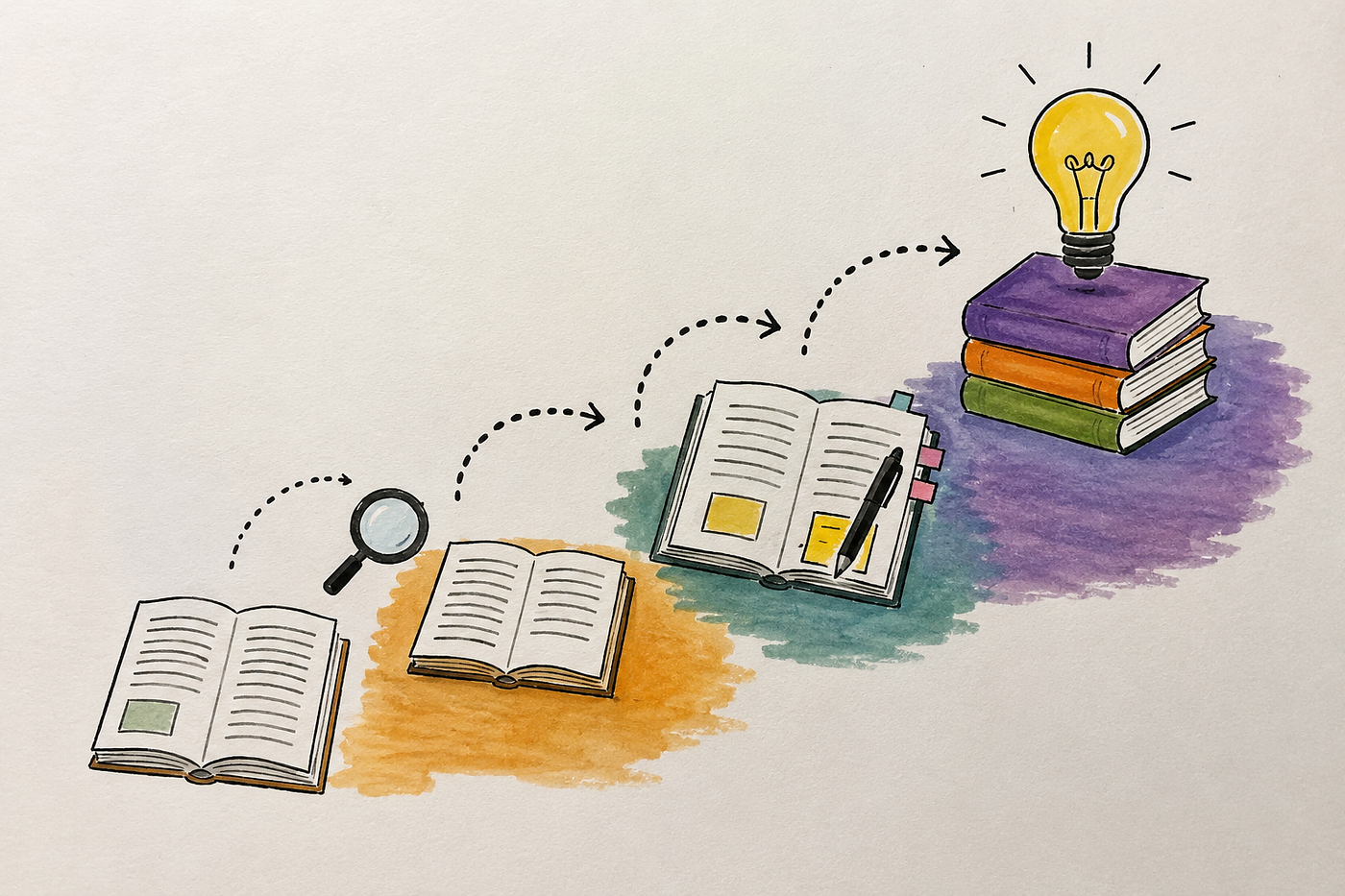
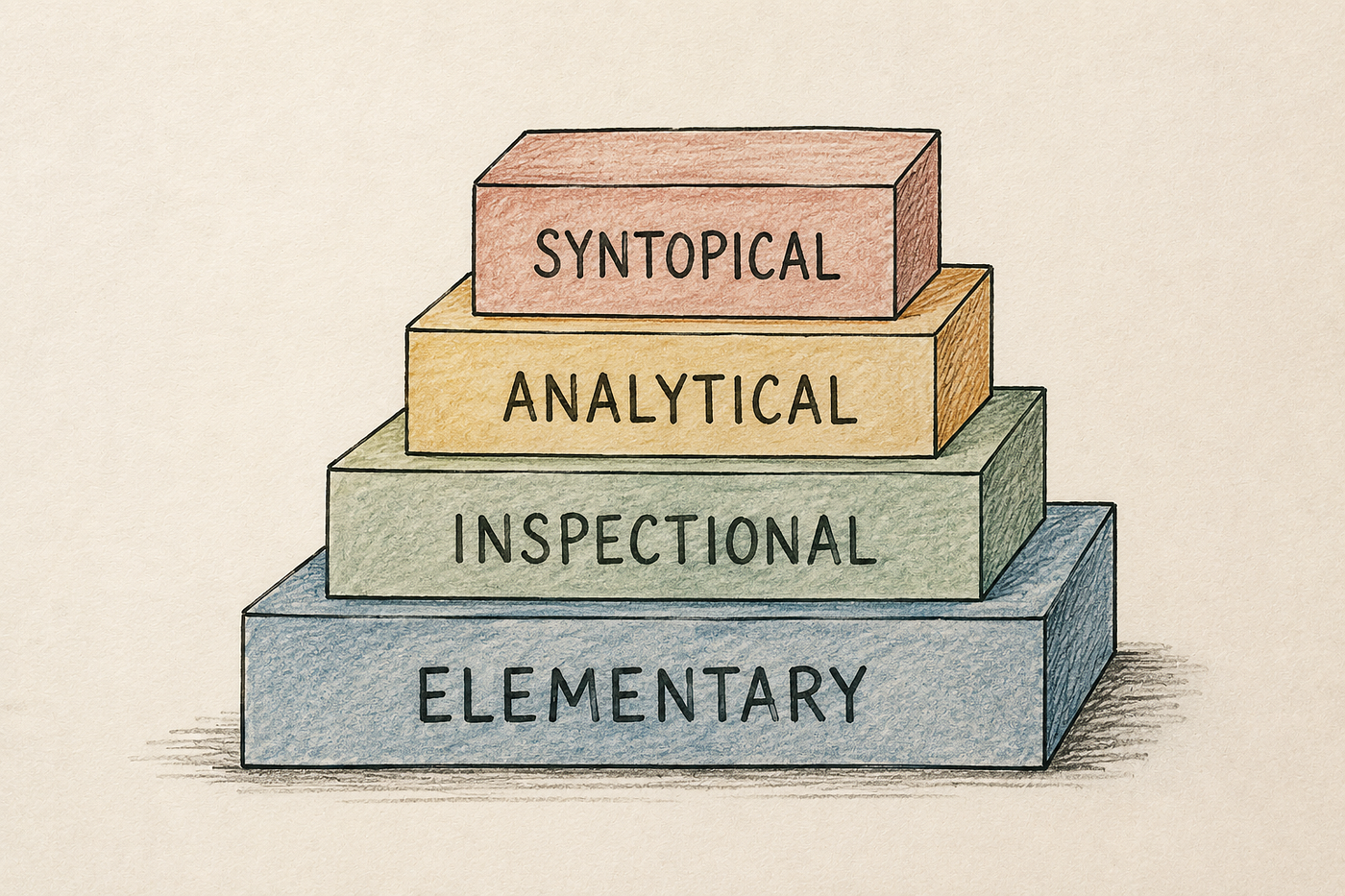
Adler lays out four levels in the book, and each one contains the ones below it. Here’s each level in plain language and how to actually use it.
If you like reading this kind of thing alongside other people, we work through one book a month in The Useful Readers Club inside my free Discord. It’s a few hundred readers, no cost, and it’s the most reliable way I know to finish the books you keep meaning to finish.
Level 1: Elementary Reading
This is the kind of reading you learned in school, and it’s exactly what it sounds like. At this level, you can look at a sentence and understand what it says; the words become meaning, and you’re not fighting the language itself.
Adler doesn’t spend long here, and neither will I, because if you’re reading this, you cleared this level years ago. The only reason it’s on the list is that the higher levels assume it. You can’t wrestle with an author’s argument if you’re still decoding the vocabulary.
Source: Image Generated by GPT 5.5
The one place elementary reading sneaks back in for adults is when you pick up something outside your world, like a dense philosophy book, a technical paper, or a book in a second language. Then you’ll realize that you’re back to reading one careful sentence at a time, but it just means you’ve stepped onto unfamiliar ground.
Level 2: Inspectional Reading
This is the level almost nobody was taught, and it’s the one that changed how I handle my reading pile.
Inspectional reading is basically just systematic skimming. Before you commit to reading a book properly, you spend 15 minutes getting the lay of the land. You read the title and subtitle carefully, study the table of contents like a map, read the preface, skim the index, look at the chapters that seem to carry the weight, and dip into a few paragraphs here and there. By the end, you know what the book is about, how it’s structured, and whether it deserves your deeper attention.
I do this with every nonfiction book before I decide to actually read it (or buy it, if I am at a bookstore, which is also a main reason I still prefer to buy my books at one), and it’s saved me from dozens of books that had one good chapter wrapped in three hundred pages of padding. It’s also the honest answer to the guilt people carry about not finishing books. You don’t owe a book a full read, but you owe it an honest inspection, after which you’re free to walk away.
The second half of this level is what the author calls superficial reading, which is his advice for a hard book: read it all the way through once without stopping to fight the difficult parts. Don’t look anything up or reread the paragraph that confused you. Just get to the end, and you’ll understand more on a second pass than you ever would by grinding to a halt on page 12.
Level 3: Analytical Reading
Here’s where the title of this post pays off: analytical reading is how you get more from one book than most people get from ten.
This is reading a book thoroughly, on the assumption that you want to understand it completely rather than just get through it. The author describes it as chewing and digesting a book instead of swallowing it whole. It takes effort, it’s slower, and it’s reserved for the books that actually earn it, which is a small fraction of what you read.
The heart of it is that you stop being a passive receiver and start interrogating the book. The author says every good reader asks four questions of whatever they’re reading, and I keep these four taped to the wall above my desk:
- What is the book about as a whole?
- What is being said in detail, and how?
- Is the book true, in whole or in part?
- If the book is true, what does it mean for you, and what are you going to do about it?
Analytical reading also means marking up the book by underlining, arguing in the margins, and writing a few-word summary of each chapter. I used to keep my books pristine, but now the ones I care about look attacked, full of ink and folded corners, and those are the books I actually remember.
But keep in mind that this level is slow work, and you can’t do it with a hundred books a year. You only do it with the handful that deserve it, which raises an obvious problem: how do you find that handful in the first place?
That’s the exact gap I built The 150+ Book Database to fill. It’s a Notion database of 150+ books I’ve read and vouched for, sorted into nine categories, such as money, psychology, creativity, and philosophy. Every entry has my rating out of five, a difficulty level so you don’t open an advanced book at the wrong moment, tone tags like Practical or Research-Heavy, and a “Read This If” tag that matches a book to whatever you’re facing right now.
This database is the filter I use to decide which books earn the slow, analytical read and which ones get a quick inspection and a place back on the shelf. You can grab it here:
Level 4: Syntopical Reading
This is the level that separates people who read to be entertained from people who read to actually understand something.
Syntopical reading, sometimes called comparative reading, is when you read many books on a single subject and put them in conversation with each other. At this level, instead of trying to understand one author, you’re building your own understanding of a topic by seeing where a dozen writers agree or disagree, and where they all miss something.
The strange and wonderful part is that the analysis you end up with often isn’t in any single book you read. You constructed it yourself, from the overlaps and the gaps, and this is exactly how real expertise gets built, and it’s why reading five books on one subject teaches you more than reading fifty books on fifty subjects.
Yes, I know that it is demanding work. You have to find the relevant books, identify the passages that matter across them, translate the different authors into a shared language, and remain neutral enough to judge the whole conversation fairly. It’s a lot, but it’s also the closest thing to a superpower that reading offers, and once you’ve done it on a topic you care about, you’ll never go back to reading one book and calling it settled.
If you want to try syntopical reading, the database above is a decent on-ramp, since filtering by a single category hands you a ready-made stack of books on the same subject to read against each other.
Here’s what I want you to take from the book more than any single level. The value you get from a book has almost nothing to do with how fast you read or how many you finish. It has everything to do with how actively you read the ones that matter.
Which brings up the uncomfortable last step, the one the author’s fourth question points at and most readers never take. Understanding a book and being changed by it are different things, and only one of them has any impact on your life. I finished around 70 books last year, and only a handful of them altered how I actually spend a day.
That gap is why I made Read to Transform. It’s a 30-day field journal that takes one nonfiction book and turns it into one specific behavior change. You read the book with prompts that pull it apart, extract the single most actionable idea, write it as a signed 30-day pact, and then run it as a real experiment with one reflection question a day.
It’s 37 pages and every field is fillable on your iPad or printable, with a worked example on every page so you never face a blank one. It’s the analytical reading habit turned into something you do rather than something you admire. You can check it out here:
Pick one book that deserves the full treatment. Read it slowly, mark it up, argue with it, and ask what you’re going to do about it. Once you do that, you’ll feel the difference immediately, and you’ll never be satisfied with swallowing books whole again.
메타데이터
- post_id
- bbbcf785442f
- slug
- how-to-get-more-from-one-book-than-most-people-get-from-ten-bbbcf785442f
- url
- https://medium.com/the-useful-life/how-to-get-more-from-one-book-than-most-people-get-from-ten-bbbcf785442f
- canonical_url
- https://medium.com/the-useful-life/how-to-get-more-from-one-book-than-most-people-get-from-ten-bbbcf785442f
- author_url
- https://medium.com/@raja96
- status
- ok
- fetched_at
- 2026-07-16 08:03:49