Strategic Guide to PC Game Development in 2026: Concept to Launch
The interactive entertainment landscape in 2026 has evolved into a highly sophisticated, multi-billion dollar ecosystem characterized by…
Strategic Guide to PC Game Development in 2026: Concept to Launch
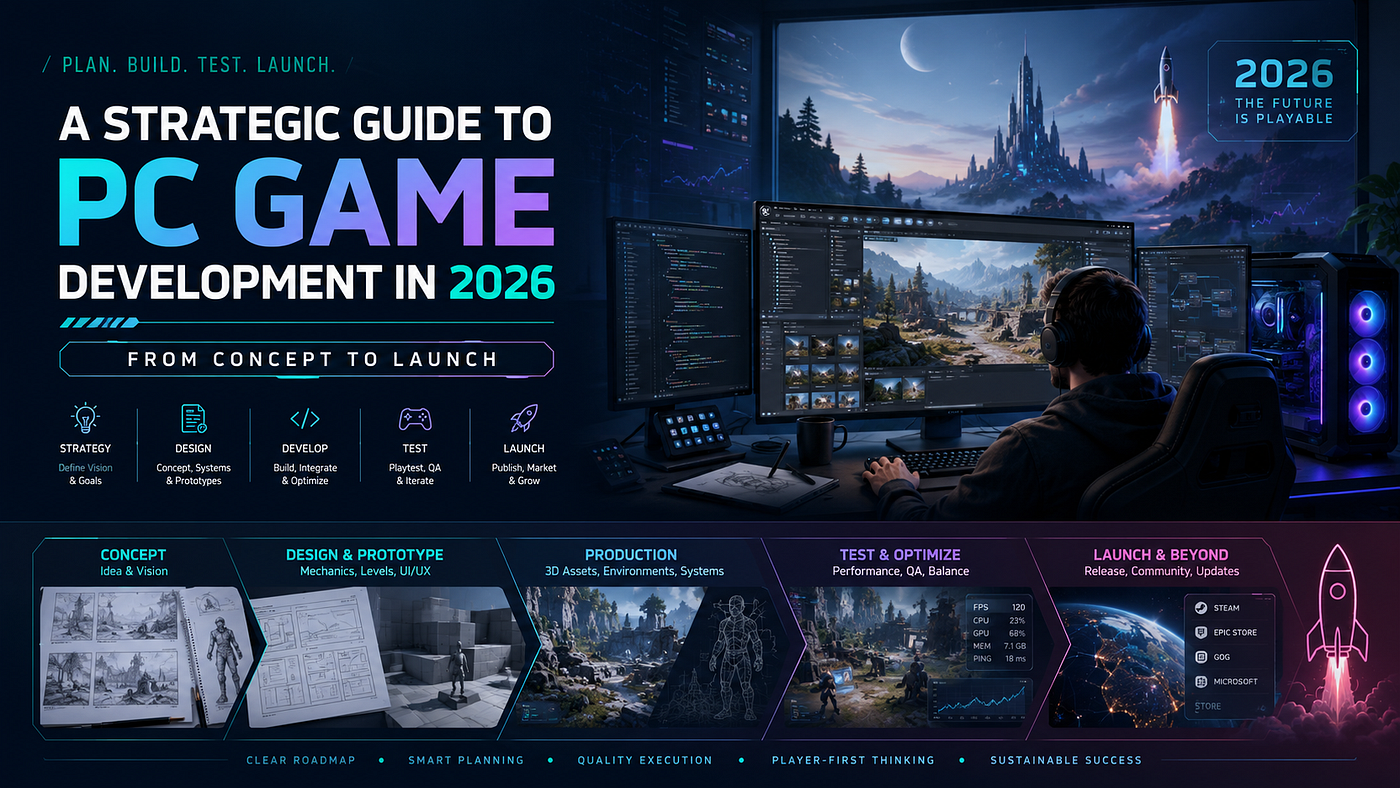
The interactive entertainment landscape in 2026 has evolved into a highly sophisticated, multi-billion dollar ecosystem characterized by technological leaps and shifting consumer behaviors. PC gaming, long considered the bedrock of high-fidelity experiences and community innovation, continues to thrive, with market analysts projecting the global PC gaming market to exceed $46 billion by the end of 2026, driven by a compound annual growth rate (CAGR) of 1.6% since 2023. For developers, whether they are solo indies or AAA giants, navigating this landscape requires a strategic, holistic approach that transcends mere coding. Success in this environment often necessitates internal expertise or collaboration with specialized **Game Development Services** to handle the mounting technical and creative demands. This guide offers a comprehensive blueprint for taking a PC game from conceptualization to a successful launch in 2026.
Pre-Production: The Foundation of Strategic Alignment
Pre-production in 2026 is no longer just about making a fun prototype. It is about meticulous market validation and architectural planning. The cost of development has risen alongside the demand for higher fidelity, making failure early on unsustainable.
1. Conceptualization and the “Hook”
Every successful game begins with a core concept, but in an overcrowded market, the concept must possess a distinct “hook” — the unique selling proposition that immediately captures attention. In 2026, genre-blending is the norm. Pure RPGs or standard shooters are rarely enough. Developers must find the whitespace between established genres or introduce a disruptive mechanic.
Market research is critical at this stage. Tools like SteamDB and specialized market intelligence platforms can analyze player trends, genre saturation, and revenue metrics. If the target audience is shrinking or the genre is dominated by powerful live-service incumbents, the concept must pivot.
2. Market Research and Audience Segmentation
Understanding who will play the game is vital. In 2026, the PC audience is highly segmented:
- The Power Gamer: Equipped with RTX 50-series (or equivalent) GPUs, demanding 4K/120FPS with full ray tracing.
- The Hybrid Player: Primarily gaming on handheld devices like the Steam Deck 2 or ASUS ROG Ally X, which now command a significant market share (estimated at 15% of the total PC user base).
- The Global Mid-Range: Gamers in emerging markets who may be using hardware a few generations old.
Developers must decide which segment to prioritize, or strategically plan for scalability to address multiple groups. Data shows that 68% of new PC games in 2025 offered distinct UI and optimization profiles for handheld devices.
3. Engine and Technology Stack
In 2026, the choice is primarily between Unreal Engine 5 (or its impending successor) and Unity. Custom engines are rare, reserved for studios with massive infrastructure.
Unreal Engine 5’s Lumen (global illumination) and Nanite (virtualized geometry) have become the default standards for AAA and high-end AA productions. By 2026, Nanite is fully integrated into foliage and translucent materials, allowing for unprecedented environmental detail. However, Unity continues to dominate the indie and AA space, particularly for titles targeting scalability across lower-end specs and handhelds.
Production Phase: Agile Execution in the Age of AI
The production phase is where the strategic plan is executed. In 2026, the workflow is fundamentally different from five years prior, primarily due to the ubiquitous integration of AI in development pipelines.
1. Agile Methodology 2.0
Standard Agile methodologies have been refined to handle the immense asset data loads of Nanite-capable pipelines. In 2026, “Scrum of Scrums” and scaled Agile frameworks are necessary to synchronize large art pipelines with programming sprints. Effective use of Version Control (Git with LFS or Helix Core) and CI/CD (Continuous Integration/Continuous Deployment) is not optional; it’s a prerequisite for managing the terabytes of data generated during high-end asset creation.
2. AI-Assisted Development pipelines
This is the largest technological differentiator of 2026. AI is not just a tool; it is a force multiplier across all departments.
- Asset Generation: Generative AI is used for rapid ideation and, increasingly, for generating finalized low-to-mid priority assets. In 2026, standard workflows include using AI to generate high-fidelity PBR (Physically Based Rendering) textures from simple prompts or sketch inputs. Data suggests AI assistance has reduced the average time for environmental asset creation by 35% since 2024.
- Coding Assistance: Large Language Models (LLMs) are integrated into IDEs (Integrated Development Environments), serving as advanced copilots that handle boilerplate code, write unit tests, and even assist in debugging complex multithreaded operations. This has shifted the developer’s role from “writer of code” to “editor and architect.”
- Automated QA: Traditional internal QA is supplemented by AI agents. These “bot-players” can tirelessly playtest for days, identifying collision bugs, optimization bottlenecks, and game balance issues in multiplayer titles, freeing human QA to focus on high-level feel and complex scenarios. Studios that implement AI QA report a 40% reduction in ship-stopping bugs found in the final beta phase.
3. Optimization and Handheld Considerations
A strategic failure point in PC development is poor optimization at launch. In 2026, optimization cannot be an afterthought. High-profile, poorly optimized launches in the early 2020s taught the industry severe lessons, and now the Steam refund system is heavily utilized for technically subpar games.
Developers must adhere to standard profiling metrics from the outset. Crucially, “Steam Deck Compatibility” (which by 2026 includes the second-generation hardware) is almost mandatory for maximizing market reach. This requires planning for a flexible UI (large enough for 7-inch screens), Controller/KB+M input parity, and extensive graphics scalability. Data from Steam indicates that games labeled “Verified” for Deck have a 22% higher average revenue than titles that are merely “Playable.”
Community and Marketing: Starting on Day One
Marketing a PC game is a marathon, not a sprint, and it begins long before the code is finalized. In 2026, the market is highly competitive, and algorithmic visibility is increasingly difficult to secure organically.
1. Community Building as Core Marketing
The relationship with the audience must be participatory. Platforms like Discord (now integrated even more deeply with Steam) remain the hub of community interaction. Successful titles in 2026 are those that involve their community in open alpha/beta phases, iterate openly on feedback, and foster a toxic-free, welcoming environment. The distinction between community and audience is vital: an audience receives a product; a community participates in an ecosystem.
Data shows that 85% of successful indie PC games in 2025 engaged in structured community development at least 18 months prior to release.
2. The Storefront Strategy: More Than Just Steam
While Steam remains the dominant platform with over 75% market share, a strategic launch requires a multi-platform approach on PC.
- Steam: The primary engine of organic discovery through its Wishlist algorithm. Wishlists are the single most important pre-launch metric. In 2026, a AA title typically requires a minimum of 80,000 to 120,000 wishlists to secure a placement on the “Popular Upcoming” section on launch day.
- Epic Games Store: Known for better revenue splits (88/12) and, by 2026, a robust cross-play infrastructure (Epic Online Services) that is increasingly attractive to multiplayer developers.
- GOG.com: A niche but loyal audience favoring DRM-free (Digital Rights Management) titles.
The storefront strategy should be unified, ensuring input parity and cloud save synchronization across all platforms.
3. Influencer and Content Creator Management
In 2026, standard social media ad spend is less effective than targeted creator partnerships. However, the influencer landscape is extremely saturated. Successful developers utilize data-driven tools to identify niche creators whose audience metrics align perfectly with the game’s mechanics, rather than simply chasing raw follower count.
Creator-led marketing programs, Battle Pass collaborations, and integrated streaming tools (e.g., allowing viewers to interact directly with the game) are standard in 2026. Micro-influencers (10k-50k followers) with high engagement rates often provide a 3x higher ROI (Return on Investment) than massive macro-influencers in the crowded PC space.
Launch Phase: Open Beta to Day One patches
The launch is not a single point in time; it is a critical multi-month operation.
1. The Strategy of Early Access (EA)
For indie and AA developers, Early Access (EA) on Steam is the preferred strategic launch vehicle. EA has matured into a powerful live-service monetization model for premium titles. It allows developers to generate revenue while validating mechanics and refining balance with a dedicated player base.
The data on EA is compelling: successful titles that spend 12–18 months in Early Access before a 1.0 release have, on average, a 30% higher Lifetime Value (LTV) than titles that attempt a standard full launch. However, a strategic EA launch requires having a robust, content-rich build (at least 60% complete) and a published roadmap detailing content drops. An EA launch with minimal content will be penalized with “Mixed” reviews and immediate abandonment.
2. Launch Day Management
Launch day is an operation in crisis management and data tracking.
- Server Readiness: For multiplayer titles, server stability is paramount. Data shows that 52% of negative launch reviews are related to network instability. Using cloud infrastructure (like AWS GameLift or Azure PlayFab) to scale horizontally is mandatory.
- Day One Patches: They are an accepted reality. A dedicated, internally managed “hotfix team” must be ready to work around the clock for the first week, patching critical compatibility and stability issues that were missed in QA (due to the infinite variety of PC hardware combinations).
3. Monitoring Metrics and Data Analysis
Post-launch success is dictated by data analysis. Developers must monitor key performance indicators (KPIs) immediately:
- Steam Review Score: The initial reviews define the game’s algorithmic fate. A score below “Mostly Positive” (70%) will severely inhibit organic visibility.
- Retention Metrics: D1, D7, and D30 retention are critical for identifying engagement issues. D1 retention below 40% for single-player narrative titles or below 60% for live-service multiplayer games indicates fundamental issues that must be addressed via rapid content patches or mechanical rebalancing.
- Conversion and LTV: How many wishlists are converting to sales, and what is the LTV of a player? This determines the budget for post-launch marketing.
Conclusion: The New Era of Strategic Development
PC game development in 2026 is a complex synthesis of technology, art, market intelligence, and community management. Developers must not only leverage advanced toolsets like AI pipelines and Next-Gen engines but also navigate a highly segmented, global hardware market and build participatory relationships with an audience that demands both innovation and optimization. The barriers to entry are lower due to powerful tools, but the barriers to market success are higher due to intense saturation and the mounting costs of high-fidelity asset pipelines.
Whether you are a solo indie developer or a larger studio looking to expand onto the PC platform, having a seasoned **PC Game Development Company** as your strategic partner can turn these technical, creative, and logistical challenges into massive market opportunities. Success in 2026 is a marathon of strategic alignment, continuous optimization, and open iteration. By adhering to this strategic blueprint — meticulous market validation in pre-production, AI-accelerated production, day-one community building, and a multi-platform, optimized launch strategy — you can turn a disruptive conceptual hook into a critically and commercially successful PC gaming experience.
메타데이터
- post_id
- bbbdfe9ec5b2
- slug
- strategic-guide-to-pc-game-development-in-2026-concept-to-launch-bbbdfe9ec5b2
- url
- https://medium.com/@redappletechnologies/strategic-guide-to-pc-game-development-in-2026-concept-to-launch-bbbdfe9ec5b2
- canonical_url
- https://medium.com/@redappletechnologies/strategic-guide-to-pc-game-development-in-2026-concept-to-launch-bbbdfe9ec5b2
- author_url
- https://medium.com/@redappletechnologies
- status
- ok
- fetched_at
- 2026-06-21 23:24:37