The Company That Made Farmers Afraid of Their Own Neighbors
How Monsanto turned rural America into a surveillance state — one seed at a time
The Company That Made Farmers Afraid of Their Own Neighbors
How Monsanto turned rural America into a surveillance state — one seed at a time
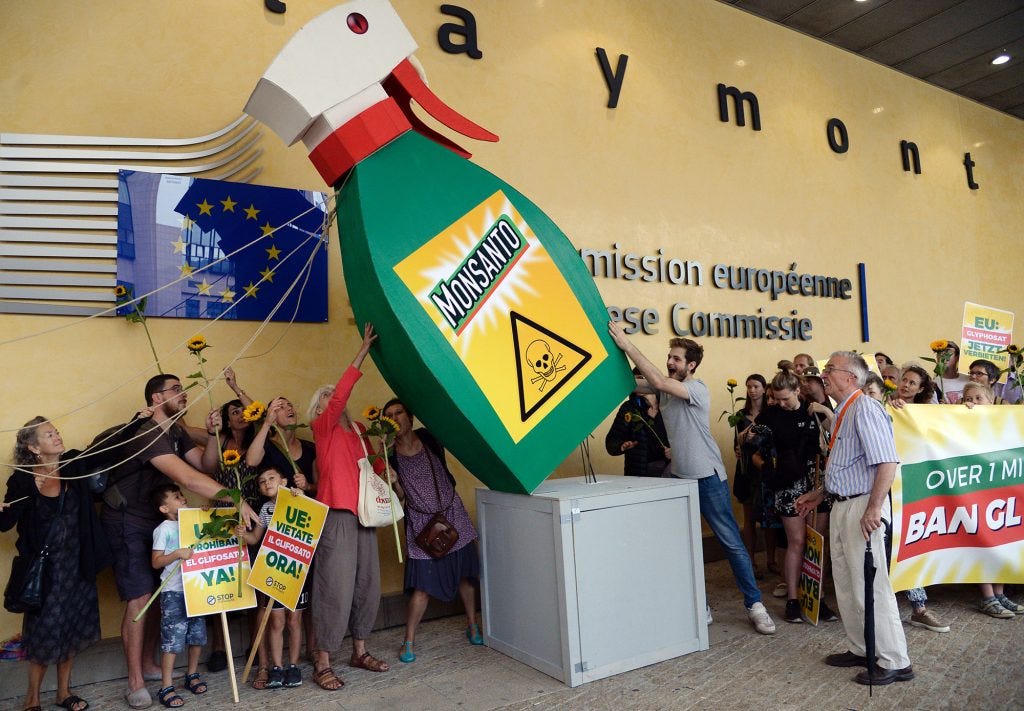
Source
On an October evening in 2016, a farmer named Mike Wallace pulled up to a country road bordering his field in Arkansas. He had a grievance. His soybeans were dying, and he suspected the cause was herbicide drifting over from a neighboring farm.
He never made it home.
Wallace was shot and killed during that roadside confrontation — not over money, not over land, but over a weed killer. A chemical. A product made by a single corporation that had, quietly and methodically, inserted itself into nearly every acre of American farmland.
That corporation was Monsanto.
A Seed Worth Owning
To understand how a herbicide dispute could end in murder, you have to understand just how thoroughly Monsanto had reshaped the economics of farming by the early 2000s.
It started with a genuinely revolutionary product. In 1974, Monsanto brought glyphosate to market under the brand name Roundup — a broad-spectrum herbicide that killed virtually every weed it touched. Farmers loved it. It was effective, easy to use, and allowed for a practice called no-till farming: spray the field, let everything die, then plant directly into the residue. No plowing, no backbreaking weed-pulling. Just spray and go.
But glyphosate had one inconvenient flaw: it killed crops too.
Monsanto’s solution was audacious. Instead of reformulating the herbicide, they would redesign the plants. Through genetic engineering, their scientists introduced a bacterial gene into soybeans, corn, canola, and cotton — a gene that made those crops immune to Roundup. They called the lineup Roundup Ready.
The result was a closed-loop system that only Monsanto could sell. You bought their herbicide-resistant seeds. You sprayed their herbicide. Everything died except your crop. It was elegant, profitable, and — crucially — patented.
By 2001, more than 70% of all soybeans grown in the United States came from Monsanto seeds. Roundup was generating over $2.5 billion a year. No agricultural product in history had ever sold like this.
Sign Here — or Else
To access Roundup Ready seeds, farmers had to sign a Technology Use Agreement. And the terms were unlike anything rural America had seen before.
Farmers agreed not to save seeds from their harvest for replanting the following year — a practice as old as agriculture itself. They agreed not to share or sell their seeds to anyone. And they agreed to allow Monsanto and its representatives access to their land at any time, to examine crops, take samples, and collect evidence.
One clause was particularly striking: by simply opening a bag of seeds, you were legally bound to the contract.
For generations, farming had been built on a culture of neighborly exchange — sharing tools, trading seeds, helping each other through hard seasons. Monsanto’s agreement didn’t just restrict those practices. It turned them into crimes.
1–800-ROUNDUP
Monsanto didn’t rely on farmers to self-report violations. They built an enforcement apparatus.
The company deployed private investigators and former law enforcement officers across the country. Planes and helicopters surveyed farmland from the air, scanning fields for signs of unauthorized planting. Monsanto’s legal team sent threatening letters demanding that farmers turn over all business records within seven days.
And they established a hotline — 1–800-ROUNDUP — where farmers could call to report on their neighbors.
The number still works. When pressed, a recorded message offers to connect callers who have information about “seed compliance issues.”
The effect on farming communities was profound. One farmer from Indiana, Dave Runyon, described two men showing up at his door claiming to conduct a magazine survey. They asked what crops he planted, what herbicides he used, what seeds he bought. When Runyon tried to close the door, one of the men said quietly: “I think he’s guilty.”
Months later, Runyon received a letter from Monsanto threatening to sue him for patent infringement — despite the fact that he had never signed a contract with the company. The allegation: that someone had tipped off Monsanto that Runyon was replanting their seeds illegally.
He was not alone. By 2013, Monsanto had sued over 400 farmers, collecting more than $20 million in settlements. Many of those sued went bankrupt. Many others — even those who had done nothing wrong — settled out of court simply because they couldn’t afford the legal risk.
“You never know who might report on you,” Runyon later said. “You could actually willfully plant unauthorized seed in somebody’s land if you want to destroy them.”
The Drift Problem
The fear didn’t only flow from Monsanto to farmers. It flowed between neighbors.
Roundup is a non-selective herbicide, meaning it kills virtually every plant it touches. If you’re a farmer using Roundup-resistant seeds and your spray drifts across a property line onto a neighbor’s conventional crops — crops that haven’t been genetically modified to resist it — you’ve potentially just destroyed his livelihood.
This dynamic created enormous pressure. If your neighbor was using Monsanto’s system and you weren’t, you were vulnerable. And so farmers who were skeptical of Monsanto’s products, or who simply preferred conventional farming, often found themselves cornered: adopt the system, or risk losing everything when the wind shifted.
One Monsanto salesman, as recalled by an Ohio seed grower, was blunt about the stakes. Farmers could either sign on, he said, or they’d all be out of business within two years.
The result was a kind of agricultural monoculture enforced not by law but by economic logic and social pressure. Monsanto didn’t need to force every farmer to use its products. It only needed enough farmers to adopt the system that holdouts became isolated and exposed.
Mon-Satan
Farmers started calling them Mon-satan.
The mistrust was everywhere — in community meetings, on radio stations (which Monsanto reportedly pressured to publicly name farmers accused of saving seeds), and along the fence lines between properties.
Mike Wallace’s death was the most tragic expression of this tension. Wallace farmed soybeans in Arkansas. His neighbor used Monsanto’s Dicamba system — another herbicide packaged within the Roundup Ready framework. Wallace believed Dicamba had drifted from the neighboring farm onto his field, killing his crop and costing him around $100,000 in damages. The neighbor denied it. The dispute escalated. And on an October evening, it ended on a country road with gunfire.
What killed Mike Wallace was not simply a disagreement between two men. It was the accumulated pressure of a system designed to make herbicide use feel like a matter of loyalty — where choosing the wrong seed could make you a suspect, and where neighbors had been incentivized, for years, to watch each other.
The Monopoly in the Mirror
By the time the lawsuits over glyphosate’s potential cancer risks began piling up — eventually exceeding 100,000 cases and costing Bayer, which acquired Monsanto in 2018, over $10 billion in settlements — the story of what Monsanto had done to farmers was almost overshadowed.
But the control Monsanto exercised over the seed supply may be its most lasting legacy. At its peak, the company held patents covering more than 80% of seeds planted in the United States. Through legal threats, surveillance, and economic pressure, it had transformed independent farmers into licensees — people who worked the land but didn’t fully own what grew in it.
The seeds. The herbicide. The contract. The hotline.
It was a monopoly built not with tanks but with paperwork, and it reshaped the American countryside in ways that will take generations to fully understand.
Sources
- Carey Gillam, The Monsanto Papers: Deadly Secrets, Corporate Corruption, and One Man’s Search for Justice (Island Press, 2021)
- Bart Elmore, Seed Money: Monsanto’s Past and Our Food Future (W. W. Norton & Company, 2021)
- Dewayne Johnson v. Monsanto Company, Superior Court of California, County of San Francisco, Case No. CGC-16–550128 (verdict: August 10, 2018)
- Monsanto internal depositions and documents released as part of multi-district litigation, In re: Roundup Products Liability Litigation, U.S. District Court, Northern District of California, MDL №2741
- The “Monsanto Papers” — a collection of internal emails, memos, and safety studies made public in 2017 as part of discovery proceedings
- IARC Monographs Volume 112: Evaluation of Five Organophosphate Insecticides and Herbicides (2015) — the paper classifying glyphosate as “probably carcinogenic to humans” (Group 2A)
- U.S. EPA Glyphosate Issue Paper: Evaluation of Carcinogenic Potential (2016)
- Williams, G.M., Kroes, R., & Munro, I.C., Safety Evaluation and Risk Assessment of the Herbicide Roundup and Its Active Ingredient, Glyphosate, for Humans, Regulatory Toxicology and Pharmacology, 31(2), 117–165 (2000)
- Carey Gillam, “Monsanto Weed Killer Roundup Faces New Doubts on Safety in Unsealed Documents,” The Guardian, March 2017
- Danny Hakim, “Monsanto’s Weed Killer, Dicamba, Divides Farm Country,” The New York Times, September 2017 — covers the herbicide drift disputes central to the Mike Wallace case
- Leah Douglas, “How Monsanto Maintains Its Stranglehold on American Agriculture,” The Nation, July 2018
- Center for Food Safety & Save Our Seeds, Seed Giants vs. U.S. Farmers (2013 Report) — documents Monsanto’s patent enforcement actions against U.S. farmers
- Andy Davis, “Arkansas Farmer’s Death Puts Spotlight on Dicamba Controversy,” Arkansas Democrat-Gazette, October 2016
메타데이터
- post_id
- bbbf0bf41b11
- slug
- the-company-that-made-farmers-afraid-of-their-own-neighbors-bbbf0bf41b11
- url
- https://medium.com/@bilginsoyb/the-company-that-made-farmers-afraid-of-their-own-neighbors-bbbf0bf41b11
- canonical_url
- https://medium.com/@bilginsoyb/the-company-that-made-farmers-afraid-of-their-own-neighbors-bbbf0bf41b11
- author_url
- https://medium.com/@bilginsoyb
- status
- ok
- fetched_at
- 2026-06-09 14:34:10