Syria’s Civil Society Must Not Become the Soft Face of a New Order
11 April 2026
Syria’s Civil Society Must Not Become the Soft Face of a New Order
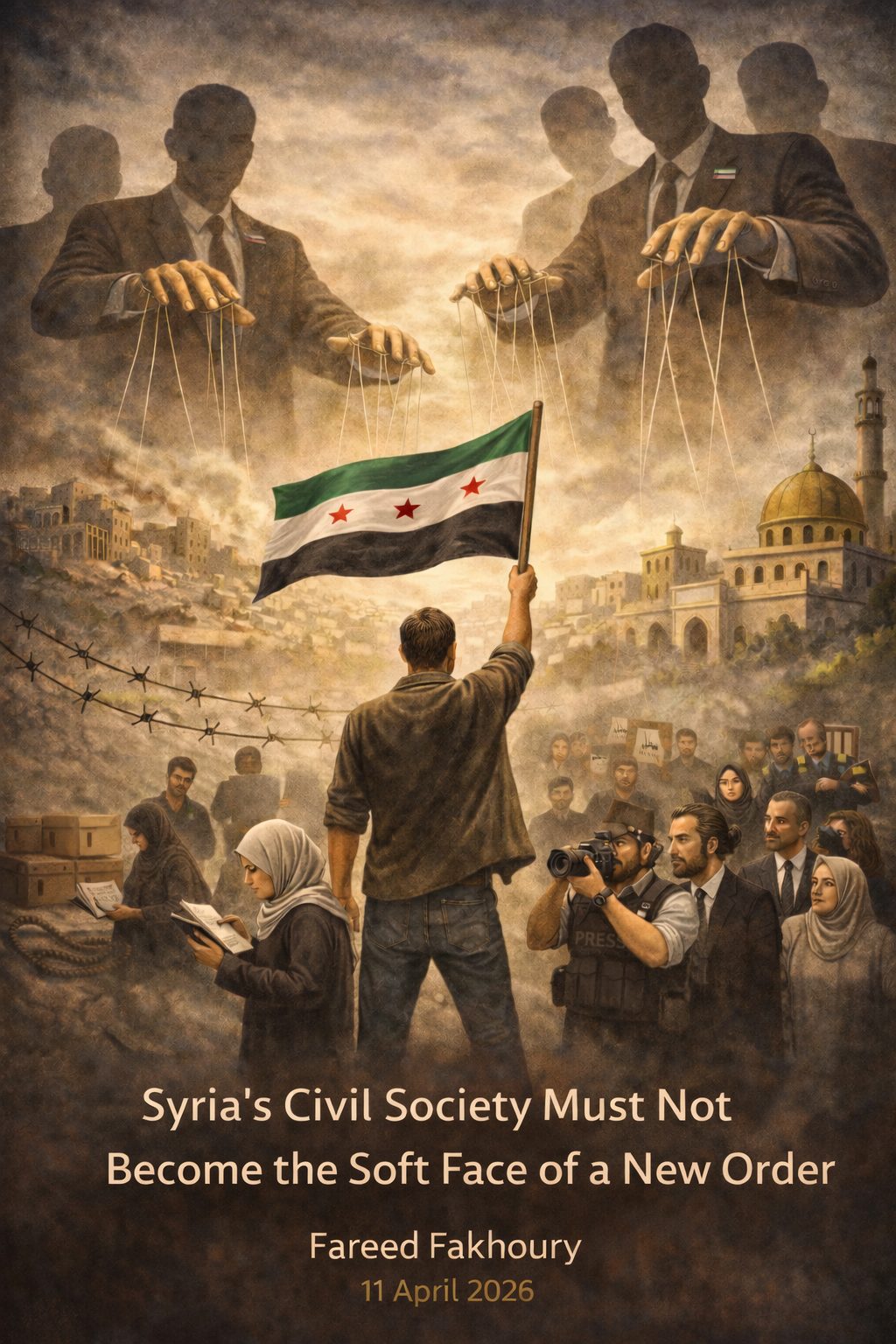
11 April 2026
In early March, Ahmad al-Sharaa received two sets of guests at the Presidential Palace. On 3 March, he met civil society activists and media professionals and urged them not to get lost in “minor details” at the expense of “higher goals”.[1] On 7 March, he met representatives of civil society organisations (CSOs) and spoke in a polished language about stronger partnership and coordination between state institutions and humanitarian actors.[2] None of this looks alarming, as of course any country emerging from catastrophe needs channels between public authorities and civic actors, and any serious recovery requires all stakeholders. However, politics often reveals itself less in what power says than in the role it imagines for others.
What unsettled me was not the meetings themselves, but how familiar they felt. I recognised many of the faces in those rooms; colleagues and friends I had worked with in Gaziantep, people who spent years keeping communities alive through conflict and displacement. That is precisely why the moment calls for suspicion rather than applause. The problem, as I see it, is not that the new authorities want to work with civil society. It is what they appear to want from it, which, I’m afraid, is the very thing Assadism always feared and HTS learned to manage in Idlib; social reach without political independence. In NW Syria, HTS didn’t simply crush every civic actor in sight but learned something more pragmatic, which is to fold authority into bodies tied to the Syrian Salvation Government (SSG) and leave room for humanitarian and socially useful work so long as politics itself remained contained. That experience and near history require us to seriously ask: what kind of partnership is being offered today?
Why? Because Syria is now post-Assad, but not safely post-authoritarian. I agree that civic space has widened in ways that would’ve been unthinkable before. Yet that opening remains fragile, uneven, and deeply conditional. As recent analysis has put it, Syria now lives in a hybrid civic space that looks wider, but structurally unstable, shaped by discretion, bureaucracy, and old legal habits that are still intact. Humanitarian activity proceeds as it’s seen as useful and non-threatening, while political engagement faces quiet obstruction. Even the broader transition has carried this double character as participation is invoked constantly, yet major consultative exercises have been left opaque enough to make Syrians wonder whether they were meant to shape policy or merely decorate it.[3]
By civil society I don’t mean NGOs alone, still less donor-funded service providers alone; I mean the broader sphere of associations, initiatives, unions, professional bodies, victims’ networks, women-led organisations (WLOs) and other forms of collective action between the household and state. In a healthy political order, this third sector doesn’t replace government; it helps society organise itself, articulate interests, defend rights, rebuild trust, and hold power to account. That’s why authoritarian rulers fear it, aid systems narrow it, and de facto authorities, like those ruling Syria today, try to manage it.
Before Assadism
Syrian civil society didn’t begin with humanitarian NGOs, because Syrian society had traditions of self-organisation long before Assadism narrowed public life into something politically harmless. The right to form associations was recognised in earlier constitutional frameworks, including the 1930 and 1950 constitutions, and the first dedicated law for Syrian associations, Law №47 of 1953, was markedly more liberal than what came after it.[4] The change started in 1958 when the state acquired a tighter legal grip over it through Law №93, which was shaped in the context of the union with Egypt and later preserved within a much harsher authoritarian order.[5] Syrian associational life predates both the Assad family and the humanitarian sector, and what is at stake today, then, isn’t merely the regulation of NGOs but our capacity to organise socially, speak collectively, and build public life beyond the state’s preferred script.
Assadist Domestication of Civil Society
Assadism hollowed out civil society and forced it to live below politics. The decisive shift began under Ba’athist emergency rule in 1963, then Hafez al-Assad turned that closure into a governing system, treating unions and civic bodies as potential rivals to be penetrated, intimidated, or neutralised. Emergency rule became a practical substitute for law, allowing the regime to ban organisations, halt their activities, subject associations to strict security oversight, and dissolve them by decree. To suppress independent initiative further, the regime cultivated state-aligned alternatives that mimicked civic life while serving political control. This wasn’t simply repression; it was replacement. The identity of civil society was steadily eroded and recast within a regime-managed structure designed to pre-empt opposition and deny society independent forms of organisation. Even the charitable sector shrank under that logic; the number of associations fell to 513 from more than 596 between 1946 and 1963.4
Bashar al-Assad changed the tone, not the structure. The brief opening of the Damascus Spring and the language of reform didn’t restore civic autonomy. They produced only a carefully managed associational sphere. In late 2000, the Civil Society Revival Committees appeared, and by 2001, some activists were openly demanding the lifting of emergency rule, broader freedoms, and laws governing parties and associations. The regime quickly contained those demands. The Ministry of Social Affairs imposed tight administrative controls on civic activity, while security and media crackdowns moved in parallel. Figures such as former Information Minister Adnan Omran dismissed civil society itself as a form of “neo-colonialism”, even as the regime encouraged government-organised NGOs that blurred the line between civic work and state control. The clearest example was the Syrian Trust for Development, launched by Asma al-Assad in 2001 as a façade for regime-managed civil society.[6] According to the Ministry of Social Affairs and Labour, the number of registered organisations rose to 1,486 during this period. But this was not a democratic opening,4 as most of these organisations remained confined to service delivery under state supervision, not allowed to become independent actors capable of generating public legitimacy outside the regime’s grip.
After 2011, the same logic persisted in regime-held areas. Between 2011 and 2021, more than 40 organisations affiliated with Assad’s networks were formed out of 83 associations operating in regime-controlled Aleppo alone.6 Civic work was accepted only when it served domination. That deeper habit still haunts Syria now.
The Revolution as Civic Rupture
Let’s remember, the Syrian Revolution was organised into existence by civic actors who returned society to politics after decades of enforced silence. 2011 reopened the possibility that Syrians can act collectively as citizens. Local coordination committees, medical volunteers, media activists, relief groups, and documentation teams all became part of that return.6 As the CIHRS report notes, after 2011, civil society entered a historic phase, assuming critical roles in humanitarian action and in documenting violations despite bombardment, siege, and scarce resources. These actors didn’t merely occupy a vacuum left by a weakening regime; they created a new political and moral grammar built around mobilisation, solidarity, exposure of abuse, and the insistence that society could speak in its own name again.[7]
This resurgence quickly took organisational form. According to the Harmoon study, hundreds of local CSOs were established in opposition-controlled areas during the revolutionary period, many concentrated in Aleppo and Idlib, where relative stability allowed them to function. Later, international support mechanisms expanded around that civic field through the cross-border aid framework that widened after UN Security Council Resolution 2165 in 2014 and through the Brussels process from 2017 onward. The civic impulse came first. While some organisations remained cautious and narrowly humanitarian, others adopted a clearer national political identity and gained broader social acceptance, most notably the Syrian Civil Defence, as they were seen not simply as service providers but as part of a wider public struggle.4 These civic networks didn’t only resist; in many places, they tried to govern, seeking to create a civilian alternative to both regime rule and pure armed control.
Local Councils and Revolutionary Legitimacy from Below
One of the revolution’s most important achievements was that it turned mobilisation into a form of local legitimacy and self-rule. By mid-2012, as regime institutions retreated, civilian revolutionary organisation stepped into the vacuum through revolutionary councils and then local councils, many of which grew out of the same local coordination committees that had organised demonstrations in the uprising’s early months.4 Their purpose wasn’t symbolic; no, they actually did their best to secure food, sewage, fuel, healthcare, education, transport, and emergency relief to people in need. A 2016 study based on 50 interviews found that respondents generally saw these councils first and foremost as service institutions meant to alleviate civilian suffering under war.6 At their best, however, they were more than service providers; they were experiments in governing from below. How? As civilian structures, they tried to derive authority from communities rather than from the regime or armed factions. By late 2017, there were around 400 local councils overseen by 12 provincial councils, with the largest concentrations in Aleppo (140) and Idlib (144).4 That scale alone tells us something important; besides resisting, the revolution also tried, however unevenly, to build public life in its place.
This civic impulse also produced local initiatives such as al-Bayt al-Idlibi (Idlib House), which became part of the effort in late 2016 to form a civilian administrative council for the city after the failures of Jaish al-Fatah’s management. The significance of that experience wasn’t only organisational but political, as it reflected an attempt by local civil actors to pull urban administration away from direct military control and place it, at least partially, in civilian hands. However, the experiment also exposed its limits, as even where a civilian façade was permitted, the armed actor retained the power to supervise, obstruct, or reclaim the files that mattered most. In that sense, Idlib case revealed both the ambition and the fragility of revolutionary local legitimacy and civilian self-rule.[8] What looked like autonomous civilian governance in such settings rarely escaped the gravitational pull of the actor that held the monopoly of force. As my 2021 research on HTS argued, wartime governance bodies may appear independent, but their relationship with the de facto authority is usually far more intricate and often shaped by a shifting mix of cooperation, coercion, and selective accommodation.[9]
Yet this was also where the next distortion began. As the West’s enthusiasm for local councils as a grassroots alternative to Assad waned, aid increasingly shifted into NGO channels. Donors often failed to take local councils adequately into account in decision-making, leaving them with limited room for influence. Parallel to that, the number of INGOs and Syrian NGOs expanded rapidly across opposition-held areas. The result was naturally a structural imbalance as representative local bodies were weakened while parallel aid architectures grew around them, drawing away resources, staff, and practical authority. HTS exploited that fragility, and as its SSG expanded, opposition-affiliated local councils were dissolved or pushed into transition, while funding shocks hit the civic and service sectors around them. It didn’t convert that fragility into hegemony by force alone; HTS combined military dominance with interest-based ties to local elites as well as the imposition of order and security to turn armed control into a more durable system of governance.9 For example, in January 2019, donor suspensions after HTS advances affected work in 50 health facilities,[10] and unfortunately, once local legitimacy was separated from material support, it became far easier for HTS to capture civilian structures and absorb them into a wider architecture of managed rule.
From Survival to NGOisation
After 2011, humanitarian NGOs became indispensable to Syrian survival. In conditions of bombardment, siege, mass displacement, institutional collapse, and international paralysis, Syrian NGOs emerged genuinely out of collapse and formed an essential component of the response. They managed to reach communities and preserve some continuity in social life when the state had either withdrawn or turned predatory.
But what the aid system saved in humanitarian terms, it also narrowed in political terms. In spite of the courageous work under impossible conditions, the humanitarian architecture increasingly came to stand in for civil society itself. Funding channels, compliance systems, remote management, English-speaking mediation, and donor demands for neutrality reformatted local initiative as what was fundable by donors gained ground over what was socially rooted and politically meaningful. Activists became implementers, and local legitimacy gave way to project logic. Yes, aid kept communities alive, but it also turned much of Syrian civil society into contractors. I think this critical point is one of the keys to understanding the present, because after December 2024, it returned in a new form under a new authority eager to inherit the social reach, technical capacity, and local access that NGOs had built over a decade.
Opening, Filtering, and Participation Without Power
After December 2024, Syria’s civic field became busier, louder, and more visible. In the first six months of 2025, more than 650 NGOs registered with the Ministry of Social Affairs and Labour in Damascus, and one account put the number operating across the country at over 2,400. This signals motion, appetite, and a society trying to breathe again. But movement is not the same as freedom. Syria’s civic space has widened in practice while remaining constrained in structure, with restrictive laws, discretionary oversight, and political red lines still shaping what is possible, where, and for whom.[11]
The legal core of that problem has not changed enough. Law №93 of 1958 remains in force, and on 29 December 2024, the transitional authorities required all organisations to register or re-register with the Ministry of Social Affairs and Labour in order to operate. If approved, they receive only a six-month provisional licence, after which their work is subject to an “evaluation” whose criteria remain unclear. In theory, this is a regulation. In practice, it leaves civil society in a condition of permanent precarity, legal enough to function, but never secure enough to act with confidence. The same unevenness appears on the ground. In some places, activities proceed informally; in others, requests are stalled, permissions delayed, and events quietly blocked.[12]
The problem, however, extends beyond paperwork to the political meaning of participation itself. The National Dialogue was presented as a cornerstone of the transition, yet officials promised a detailed report on its debates and recommendations and never published it. More than a year later, Syrians still have no comprehensive public record of what was said, what priorities emerged, or whether any of it shaped policy. That silence is not a procedural detail. It suggests that participation is welcome as performance, not necessarily as influence. Nor should the current language of “moderation” and “opening” be taken at face value. Some of the most sympathetic readings of HTS’s transformation have relied on leadership-curated access, self-justifying narratives, and analytical frames that underweight repression, intimidation, and the voices of those safest to speak openly from outside Syria. More than that, what is sometimes described as a socially accepted “silent majority” can also be understood as the product of prior authoritarian filtering, in which some civic currents were tolerated while others were marginalised, intimidated, or eliminated.[13]
Set against arbitrary restrictions, sudden administrative reversals, and the broader pattern of selective inclusion, the danger becomes clearer. Syria’s transition is still being governed too often by discretion rather than rules, and civil society is being allowed back into the room, but not yet on terms that guarantee its voice will carry political consequence.[14]
Civil Society Should Rebuild Syria, Not Serve Those In Power
A healthy civil society doesn’t exist to help rulers govern society but to help society limit, correct, and humanise power. In Syria, that distinction marks the line between recovery and domination. Civil society should help rebuild the country, but it must not become the social department of a new ruling bloc that wants the language of participation without the burden of accountability.
Civil society must therefore refuse any role that reduces it to a technical arm of managed recovery. It should keep its distance from power even when coordination is necessary. Cooperation may be unavoidable, but subordination is not. Civil society must remain free to criticise, mobilise, litigate, expose, and, when necessary, embarrass those who now rule by fait accompli when they overstep.
Thereby, a healthy relationship with authority is legal, not discretionary; coordinated, not subordinated; consulted, not choreographed; critical, not decorative. Civil society should not need political favour to register, raise funds, speak publicly, monitor authorities, or organise communities. Nor should it wait for goodwill from above or build its strategy on charitable assumptions about the ruler’s intentions. In Syria, that isn’t prudence but political naïveté, as Karam Shaar tweeted on 29 March.[15] Concentrated power keeps what it can unless society pushes back; this is the harder truth that serious civil society should start from.
And for my Syrian colleagues, let me remind you that CSOs’ real work goes far beyond aid delivery and carries far more weight than symbolic participation. It should represent society in all its breadth, especially those communities most easily marginalised or spoken for. It should monitor the current authorities with the same rigour it brought to documenting Assad’s crimes. It should defend WLOs, victims’ groups, detainees’ families, minorities, and others whom rulers prefer to tokenise rather than genuinely include. And it should push reconstruction towards justice while insisting that the transition be governed by clear, predictable rules, not by the personal preferences or moral impulses of new officials, as recent controversy over the alcohol ban in Damascus has shown.[16]
Syria, at this critical moment, doesn’t need a civil society that makes power look more presentable, but needs one strong enough to hold power to account.
[1] https://www.syriaweekly.com/p/syria-weekly-march-3-10-2026
[2] https://sana.sy/en/presidency/2301109/
[3] https://en.majalla.com/node/330127/politics/one-year-syrias-national-dialogue-promises-fall-flat
[4] Syrian Organisations and Associations: Building a National Strategy from the Legacy of Tyranny — مركز حرمون للدراسات المعاصرة
[5] No Room to Breathe: State Repression of Human Rights Activism in Syria: IV. Syria’s Legal Framework
[6] https://isj.org.uk/the-ngoisation-of-the-syrian-revolution/
[7] https://ifex.org/wp-content/uploads/2025/11/syrias-transition-through-the-eyes-of-civil-society-cihrs.pdf
[8] مركز عمران للدراسات الاستراتيجية — Displaying items by tag: البيت الإدلبي
[9] Keser, A., & Fakhoury, F. (2025). Hay’at Tahrir Al-Sham (HTS) from an Insurgent Group to a Local Authority: Emergence, Development and Social Support Base. Studies in Conflict & Terrorism, 48(1), 46–66. https://doi.org/10.1080/1057610X.2022.2082833
[10] Local councils, civil society brace for HTS takeover after cuts to healthcare funding in rebel-held northwest — Syria Direct
[12] Syria’s Transition Hangs in the Balance: CIHRS Report on Civil Society’s Struggle for a Voice — Cairo Institute for Human Rights Studies (CIHRS)
[13] https://www.syriaintransition.com/ar/home/archive/issue-31/transformed-by-the-people-or-performed-for-the-people
[14] Syria’s civic space opens…but not for everyone | Al Majalla
[15] https://x.com/Karam__Shaar/status/2038133560477892778?s=20
[16] ما الذي تكشفه قرارات حظر الكحول عن المرحلة الانتقالية في سوريا؟
메타데이터
- post_id
- bbc88733c1f8
- slug
- syrias-civil-society-must-not-become-the-soft-face-of-a-new-order-bbc88733c1f8
- url
- https://medium.com/@f.fakhoury83/syrias-civil-society-must-not-become-the-soft-face-of-a-new-order-bbc88733c1f8
- canonical_url
- https://medium.com/@f.fakhoury83/syrias-civil-society-must-not-become-the-soft-face-of-a-new-order-bbc88733c1f8
- author_url
- https://medium.com/@f.fakhoury83
- status
- ok
- fetched_at
- 2026-06-10 08:17:25


