Dialoguing the Stitch: How to Work with Inner Structural Loops
You can’t overwrite a loop until you learn to listen to it.
Dialoguing the Stitch: How to Work with Inner Structural Loops
You can’t overwrite a loop until you learn to listen to it.

1. Some Structures Don’t Respond to Disruption
ZERA Experiments are powerful — micro-interruptions that help us see the invisible loops that shape reality. But sometimes, something resists. You poke the stitch, and the structure pushes back harder. The loop doesn’t just continue — it tightens.
Why?
Because some loops don’t run automatically. They run relationally — as inner roles, internal scripts, and meaning-based systems. They are not just reactions. They are structures with a story.
These loops don’t need to be disrupted. They need to be dialogued.
2. What Is a Structural Loop?
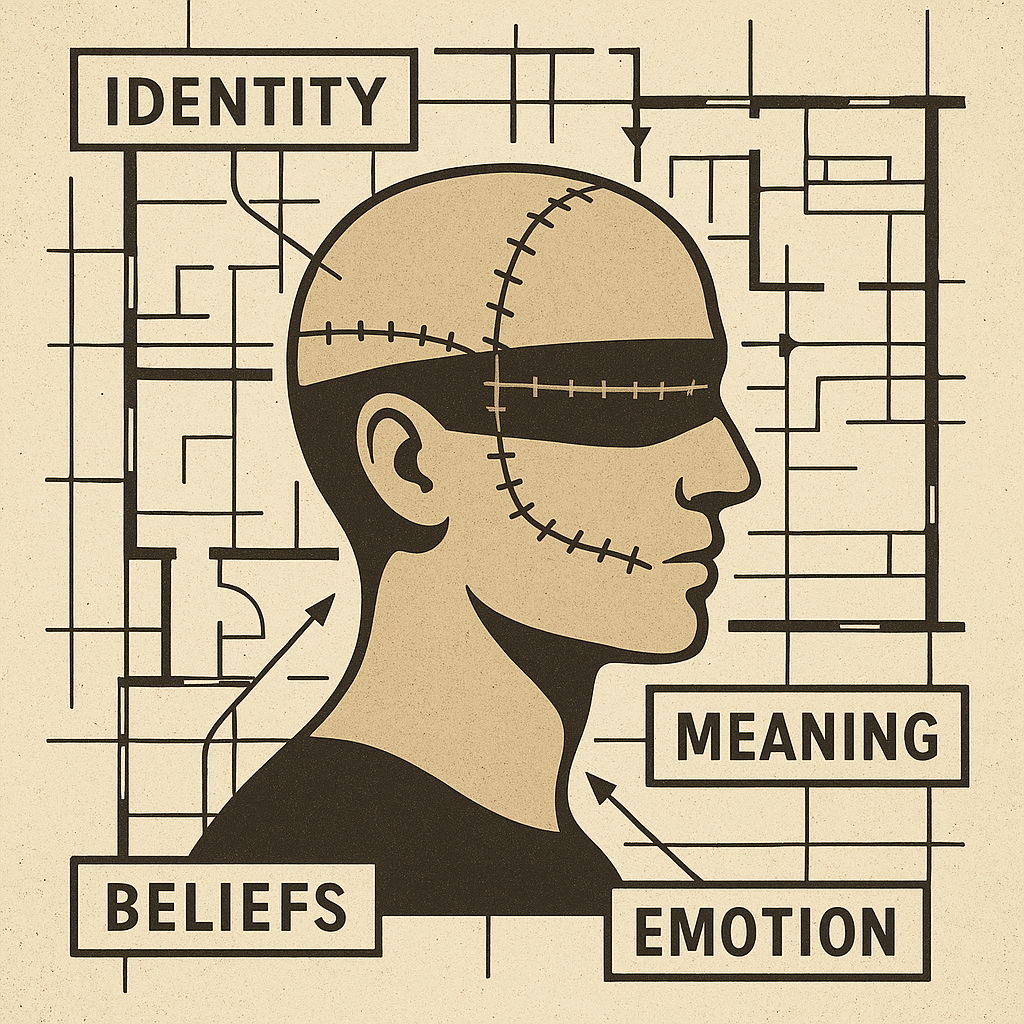
A structural loop is more than a habit or thought. It’s a self-reinforcing patch of reality.
It includes:
a version of you
a storyline about others
an emotional weather system
and an invisible contract about what “must” happen next
These loops are not random. They exist to stitch identity to safety. You don’t just repeat a behavior — you repeat a reality that keeps your ZION coherent.
3. Why You Can’t Break It by Force
These loops aren’t held together by logic. They’re held together by meaning.
And meaning is sticky. It protects the structure by creating emotional consequences:
- Guilt when you try to leave a role
- Fear when you pause a pattern
- Emptiness when you stop believing the old story
That’s why rational strategies — “Just change your mindset,” “Challenge your beliefs,” “Build new habits” — often fail.
The loop doesn’t want to be corrected. It wants to be heard.
Which is why we turn to the practice of Stitch Dialogue.
4. What Is a Stitch Dialogue?
A Stitch Dialogue is a deliberate conversation with the structure — not from within it, but with it.
It’s not:
- Inner monologue
- Emotional journaling
- Self-coaching or mindset reframing
It’s a relational interview with the internal loop. You stop playing the role, and instead ask the role to speak.
You don’t analyze the voice. You ask it questions. You don’t try to control the response. You listen.
You become the host — not the actor.
5. How to Begin a Stitch Dialogue
🔹 Step 1 — Catch the Loop Mid-Run
Identify a pattern that keeps repeating — especially one with emotional intensity or identity reinforcement.
Examples:
- “I always end up being the responsible one.”
- “No one listens to me.”
- “If I slow down, I’ll fall apart.”
Use REVA to spot it when it’s live, not post-mortem.
🔹 Step 2 — Pause & Externalize
Step out of the version that’s running. Give the loop a name (“The Protector,” “The Performer,” “The Doubter”).
Write or speak to it. Literally.
“Hey, you showed up again. What are you here for?”
🔹 Step 3 — Ask Structural Questions
Questions that bypass content and go to the role’s purpose.
- “What are you protecting?”
- “What would break if you stopped running?”
- “What do you believe about me?”
- “What do you believe about the world?”
- “What do you fear I would do without you?”
🔹 Step 4 — Listen Without Correction
Don’t argue. Don’t improve. Don’t comfort.
Just hear it. Write its voice like a character. Let it finish.
You’re not extracting insight. You’re offering space.
🔹 Step 5 — Close Gently, Note the Thread
Thank the loop. Seriously. Even if it hurts.
Then ask:
- What changed in your internal sensation?
- What did the loop expect you to do?
- What did you choose to do instead?
Document the structure, not the story. You are mapping ZION, one dialogue at a time.
6. What You Might Hear Back
If you do this honestly, you may hear:
- “If I don’t panic, you won’t survive.”
- “If I let go, no one will love you.”
- “I’m the only reason you still belong.”
- “I’ve held your shame so you didn’t have to.”
- “I don’t trust you to be without me.”
These aren’t truths. They’re structure-language — stitched into your versioning system.
And they’re not your enemy. They’re your inheritance.
Your job isn’t to erase them. It’s to recognize them — and eventually rewrite the contract they operate under.
7. Up Next: Rescripting the Thread
Now that you’ve heard the loop, what do you say back?
Next, we explore how to replace structural self-talk — not with affirmations, but with deliberate response-language that meets the need without obeying the pattern.
Next: Rescripting the Thread: Designing New Language for Conscious Structure
✦ If this helped you see the story behind your reactions, follow the ZERA column. ✦ Up next: Rescripting the Thread: Designing New Language for Conscious Structure
메타데이터
- post_id
- bbd31b297d81
- slug
- dialoguing-the-stitch-how-to-work-with-inner-structural-loops-bbd31b297d81
- url
- https://medium.com/@zerap/dialoguing-the-stitch-how-to-work-with-inner-structural-loops-bbd31b297d81
- canonical_url
- https://medium.com/@zerap/dialoguing-the-stitch-how-to-work-with-inner-structural-loops-bbd31b297d81
- author_url
- https://medium.com/@zerap
- status
- ok
- fetched_at
- 2026-06-10 09:45:17