HR Grades Itself as Underperforming in the Future of Work
By Mike Brennan, Chief Services Officer at LeapGen
HR Grades Itself as Underperforming in the Future of Work
By Mike Brennan, Chief Services Officer at LeapGen
As my LeapGen colleague, Jason Averbook, recently stated, ‘in order to be digital workforce transformation leaders, HR and HRIS professionals need to upskill quickly.’ Based on the ‘report card’ depicted above, a lot of HR and HRIS professionals would agree. The grades based on polling results from one of our recent LeapChats where we focus on a variety of topics for HR and IT professionals interested in shaping the future of work.
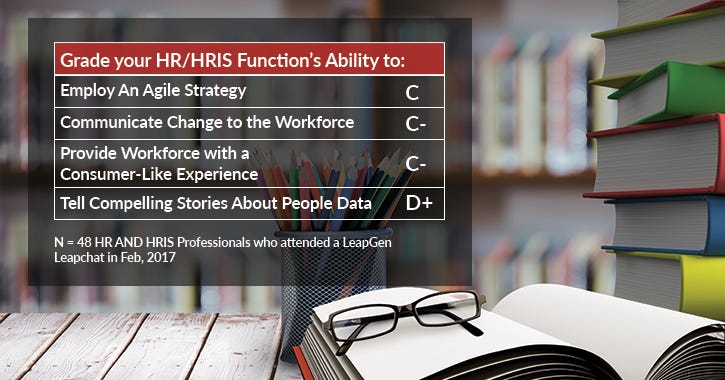
Throughout the session, we asked participants to grade their organization’s HR and HRIS functions on four skill sets (i.e., abilities) we believe are critical to serving the workforce whose mindsets are being influenced by the expectation economy in which we all find ourselves. These increasingly important skill sets are both depicted in the report card and above and listed here:
- Agile strategy
- Change communications
- Consumer experience for the workforce
- Data analysis, including storytelling
Despite Good Intentions…
A quick disclaimer. The ‘sample population’ nice enough to yield this data was not random. The theme of our LeapChat that day was, ‘Kill the HRIS Function! What’s Next!’ So most, if not all, attendees have a predisposition for disrupting business as usual in HR. While I concede this bent may compel them to be tough graders of their own organizations, I wholeheartedly believe the results are significantly relevant (if not statistically significant). The grades are consistent with what I hear from clients and peers in the HCM world.
Make no mistake, LeapChat participants — like many HR practitioners — have an interest in shaping the future of work. They have ambition; they aspire to something better. And if I know our community, these aspirations include:
- Providing tools and services make employees more productive at work and fulfilled in their careers
- Helping managers be more effective coaches and developers of talent
- Making their HR function a more strategic partner to the business
And I’m confident in saying that every single one of our participants on that day is translating their good intentions and aspirations like these into efforts to deliver value to the workforces, and in turn, their organizations.
…The Typical HR Department Doesn’t Have What it Takes to Deliver
Given the participants’ report card resembles that of America’s infrastructure, their HR and HRIS functions are being held back because they lack the skills, knowledge and abilities to be true drivers of the digital enterprise. Let’s take each skill set one-by-one.
1. Ability to Develop and Employ and Agile Strategy. Average Grade: C
‘Like the process of innovation itself, an innovation strategy involves continual experimentation, learning, and adaptation.’ ~Professor Gary P. Pisano, Harvard Business School
Aligning with the needs of the business and the workforce starts with strategy. An agile strategy enables HR to be proactive and responsive delivering capabilities when needed. Strategy informs investments in HR — e.g., initiatives, capabilities, projects, technology, etc. It also provides clarity and targets for accountability for key stakeholder groups to drive success. A thoughtful and well-communicated strategy can also serve as a touchstone behind which people can rally. An HR function that cannot develop or employ a strategy leaves a lot to chance, including its own seat at the proverbial table.
2. Ability to Communicate Change to the Workforce. Average Grade: C-
‘It does not matter what you know about anything if you cannot communicate to your people. In that event, you are not even a failure. You’re just not there.’ ~ Saul Alinsky, Community Organizer and Writer
Change management has always reminded me of *Goldilocks and The Three Bears.* It can be too cold (i.e., an after-thought) or too hot (over-engineered) in the context of new policy, process, procedure or system roll-out. To get it ‘just right,’ it starts with tightly integrating impact assessments with smart design practices. From there, the right messages, media and feedback loops can be developed for the target workforce segments inside an organization. Sounds a lot like marketing, right? I do not think I’ve met an HR professional who doesn’t think their function could use more marketing skills.
3. Ability to Provide the Workforce with a Consumer-Like Experience. Average Grade: C-
‘I’ve learned that people will forget what you said, people will forget what you did, but people will never forget how you made them feel.’ ~ Maya Angelou, Poet, Memoirist and Civil Rights Activist
According to TechTarget, ‘Consumer experience (CX), also called customer experience, is the perception a patron has after engaging with a company, brand, product or service.’ HR needs to apply this mindset to the workforce — employees, contractors, interns, applicants, etc. in order to support, convey and amplify their organizational cultures. What’s more, they need to engage their ‘customers’ to buy into the company mission and in ways that make them more productive. In order to provide a consumer-like worker experience, HR can’t simply throw technology at the problem, although software is part of the solution. The bigger picture includes the nature of jobs, compensation & benefits and relationships with colleagues benefits. And the experiences need to become increasingly digital, which means they need to be more personalized, responsive and driven by sound data.
4. Ability to Tell Compelling Stories about People Data. Average Grade: D+
‘It is an ancient need to be told stories. But the story needs a great storyteller.’ ~ Alan Rickman, Actor and Director
Some of the best storytellers I know are HR professionals. I suspect the tough grade on this one is more related to challenges with data than it is the ability to communicate. Some common data challenges include processes not being designed to efficiently collect data, a lack of standard definitions for workforce classifications and/or metrics, and information being managed in disparate systems. These challenges typically represent the effects of a lack of workforce data governance and/or a lack of business analysts in HR to partner with the rest of the business to identify and quantify challenges or offer compelling insights to drive smart decision-making.
Get Ahead of the Curve
If HR is to support the future of work, it must invest in its future workers. This is not just about the next generation either. Current HR and HRIS professionals should invest much of their lifelong learning to developing these capabilities. I recommend checking out LeapAcademy as a way to do just that.
As Jason also pointed out in a recent post, ‘LeapAcademy is the first educational experience focused solely on educating and arming HR, IT and workforce transformation professionals of today and tomorrow with the knowledge and tools they need to be successful.’
Mike Brennan is the Chief Services Officer and President of LeapGen. A HR and talent management consulting services firm that works with organizations globally to challenge established thinking and shape their future of work.
메타데이터
- post_id
- bbebdbc83f25
- slug
- hr-grades-itself-as-underperforming-in-the-future-of-work-bbebdbc83f25
- url
- https://medium.com/@kristinlynnpenney/hr-grades-itself-as-underperforming-in-the-future-of-work-bbebdbc83f25
- canonical_url
- https://medium.com/@kristinlynnpenney/hr-grades-itself-as-underperforming-in-the-future-of-work-bbebdbc83f25
- author_url
- https://medium.com/@kristinlynnpenney
- status
- ok
- fetched_at
- 2026-07-11 03:21:30