The Secret Weapon of Vector Database Scaling: How Binary Quantization Cuts RAM Usage by 92% and…
When a retrieval-augmented generation system works well in a local proof of concept, the natural next step is production deployment. Then…
The Secret Weapon of Vector Database Scaling: How Binary Quantization Cuts RAM Usage by 92% and Triples Search Speed
When a retrieval-augmented generation system works well in a local proof of concept, the natural next step is production deployment. Then the vectors start accumulating. One million documents become ten million. Ten million become a hundred million. At some point, a cloud infrastructure bill arrives that looks nothing like the numbers from the prototype phase, and the engineering team realizes that vector search at scale is far more expensive than anyone anticipated.
The instinct at that point is usually to look at the database choice, or to reduce the number of chunks being indexed, or to investigate sharding strategies. These approaches address symptoms. The actual root cause is often something more fundamental: the format in which embeddings are stored.
This article describes a production-verified approach that reduced RAM consumption in a vector database deployment by 92%, accelerated search queries by a factor of three, and cost less than one percent of recall accuracy. The technique is binary quantization combined with two-stage retrieval, and it is available today in the leading open-source vector database platforms.
Understanding the Billion-Vector Trap
To understand why this problem arises, it helps to understand how modern vector databases deliver their speed guarantees.
Most production-grade vector databases, including Qdrant, Milvus, Weaviate, and Chroma, rely on an index structure called HNSW, which stands for Hierarchical Navigable Small World. HNSW is a graph-based approximate nearest neighbor algorithm that delivers remarkably fast search results by organizing vectors into layered proximity graphs and navigating those graphs during query time.
The critical constraint of HNSW is that the index must reside entirely in RAM to function correctly. This is not a configuration choice or a limitation that can be tuned away. The graph traversal that makes HNSW fast depends on random-access memory latency. If any portion of the index is on disk, the traversal latency spikes by orders of magnitude and the performance guarantees collapse.
This means that every vector in the database occupies RAM proportional to its dimensionality. The standard embedding format is Float32, which allocates four bytes per dimension. A popular embedding model like text-embedding-3-large from OpenAI produces vectors with 3072 dimensions. Each vector in Float32 therefore consumes 12,288 bytes, or approximately twelve kilobytes. At one million vectors, that is roughly twelve gigabytes of RAM dedicated to embeddings alone, before accounting for the HNSW graph structure itself, which typically adds another thirty to forty percent on top.
At one billion vectors, the numbers become genuinely alarming. And because RAM is the most expensive per-unit resource in cloud compute, the costs scale linearly with every new batch of documents indexed.
Sharding across multiple nodes is the conventional mitigation, but it compounds costs rather than solving them. Each shard needs sufficient RAM for its portion of the index, and the total hardware spend grows in step with the data volume.
The Root Cause: Float32 as the Default
The float32 format exists as the default because it provides high precision. Each floating point value can represent a wide range with fine granularity, which is appropriate for training neural networks and for many downstream numerical computations.
For the specific purpose of approximate nearest neighbor search, however, that precision is often excessive. The goal of vector search is to identify which stored vectors are most similar to a query vector, not to compute exact distances with scientific precision. An approximate answer that identifies the genuinely relevant documents ninety-nine percent of the time is more than sufficient for a retrieval system feeding a language model.
This observation is the foundation of quantization techniques for vector databases. If the precision can be reduced without meaningfully degrading retrieval quality, then storage and memory requirements can be reduced proportionally.
Binary Quantization: The Mechanism
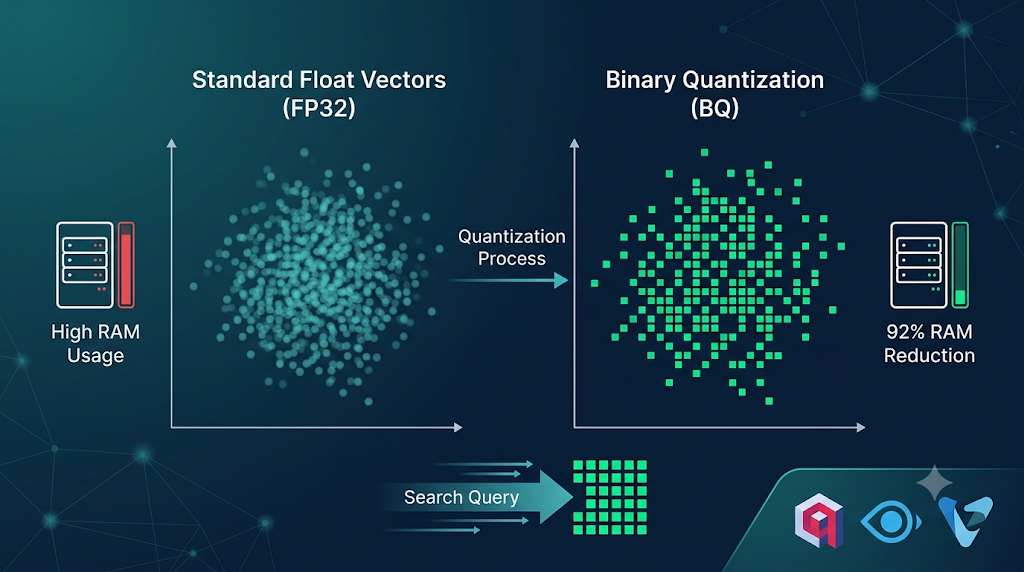
Binary quantization is the most aggressive form of vector compression available in production vector databases. It reduces each dimension of a vector from a 32-bit floating point value to a single bit.
The conversion rule is simple: if the original floating point value for a given dimension is greater than zero, the binary representation is one. If it is less than or equal to zero, the binary representation is zero. A vector that previously required 32 bits per dimension now requires exactly one bit per dimension. The compression ratio is 32 to one, which explains the ninety-two percent reduction in RAM consumption observed in production deployments.
The implications for storage are immediate and dramatic. A collection of one billion Float32 vectors with 1536 dimensions would require approximately 5.7 terabytes of RAM in the HNSW index. The same collection after binary quantization requires roughly 180 gigabytes. The difference represents the gap between a deployment that requires dozens of high-memory cloud instances and one that can run on a handful.
The speed improvement comes from a change in the similarity computation. Float32 similarity search uses cosine similarity or dot product calculations, which involve floating point multiplication and addition across all dimensions. These operations are computationally expensive when performed across millions of candidates.
Binary vectors, by contrast, can be compared using XOR and popcount operations, which are executed directly at the hardware level in a single CPU instruction cycle. The Hamming distance between two binary vectors, which approximates their similarity, can be computed in nanoseconds rather than microseconds. This hardware-level efficiency produces the threefold acceleration in search queries that has been observed in production systems.
Two-Stage Retrieval: Preserving Accuracy
The obvious concern with quantization is accuracy loss. Compressing 32 bits of information per dimension into a single bit must lose information, and that information loss could translate into retrieval errors where relevant documents are missed.
This concern is valid, and the two-stage retrieval architecture addresses it directly.
In the first stage, the binary quantized index handles the broad search. Given a query vector, the system uses XOR and popcount operations to rapidly identify the one hundred most similar candidates in the binary index. This is the fast, approximate stage that benefits from all the memory and speed advantages of binary quantization.
In the second stage, those one hundred candidates are rescored using their original Float32 representations. The full-precision vectors for just those one hundred documents are retrieved from disk and used to compute exact similarity scores. The top five or ten results from this rescoring are returned to the language model.
The key insight is that storing the original Float32 vectors on disk, rather than in RAM, is inexpensive and fast enough for a small fixed number of candidates. Disk latency is a serious problem when it affects HNSW graph traversal across millions of nodes, but it is entirely acceptable when reading one hundred records for a final scoring pass.
The accuracy impact of this two-stage approach in production has been measured at approximately 0.7 percent reduction in recall score. For a retrieval system feeding a large language model, this is negligible. The language model’s own variability in response generation dwarfs this difference. In exchange for this minimal accuracy cost, the system achieves the full memory and speed benefits of binary quantization.
Implementation in Practice
Major open-source vector databases have built-in support for binary quantization. The following examples use Qdrant, which has first-class support for the technique.
Creating a collection with binary quantization enabled requires specifying the quantization configuration at collection creation time:
from qdrant_client import QdrantClient
from qdrant_client.models import (
    VectorParams,
    Distance,
    BinaryQuantization,
    BinaryQuantizationConfig,
)
client = QdrantClient(url="http://localhost:6333")
client.create_collection(
    collection_name="documents",
    vectors_config=VectorParams(
        size=1536,
        distance=Distance.COSINE,
    ),
    quantization_config=BinaryQuantization(
        binary=BinaryQuantizationConfig(
            always_ram=True,
        ),
    ),
)
The always_ram=True setting ensures the binary index remains in memory for fast first-stage retrieval, while the original Float32 vectors are stored on disk for the rescoring stage.
At query time, the two-stage rescoring is configured through the search parameters:
from qdrant_client.models import SearchRequest, QuantizationSearchParams
results = client.search(
    collection_name="documents",
    query_vector=query_embedding,
    limit=5,
    search_params=QuantizationSearchParams(
        ignore=False,
        rescore=True,
        oversampling=20.0,
    ),
)
The rescore=True flag activates the second stage using original Float32 vectors. The oversampling parameter controls how many candidates the binary stage retrieves before rescoring. A value of 20.0 with a final limit of 5 means the binary stage retrieves one hundred candidates, which are then rescored to produce the final five results.
For systems already in production with existing Float32 collections, binary quantization can be applied retroactively:
client.update_collection(
    collection_name="documents",
    quantization_config=BinaryQuantization(
        binary=BinaryQuantizationConfig(
            always_ram=True,
        ),
    ),
)
Qdrant will reprocess the existing vectors in the background without requiring downtime or re-indexing from the source data.
When Binary Quantization Is the Right Choice
Binary quantization is not universally appropriate for every vector search workload. Understanding when it applies well and when it does not is important for making an informed architectural decision.
The technique works best when the embedding model produces vectors that are approximately unit-normalized, meaning that the values cluster around zero with relatively symmetric positive and negative distributions. Most modern text embedding models from OpenAI, Cohere, and the Hugging Face ecosystem satisfy this property, which is why binary quantization performs well in RAG systems built on these models.
The technique also works best when the downstream use case tolerates a small recall trade-off. For applications where missing one percent of relevant documents has low consequences, such as most enterprise search and question-answering systems, the trade-off is favorable. For high-stakes retrieval applications where exhaustive recall is legally or operationally required, a less aggressive quantization method such as scalar quantization (8-bit rather than 1-bit) may be more appropriate.
The biggest wins come at scale. At ten thousand vectors, the memory savings are modest in absolute terms and may not justify the implementation effort. At ten million vectors and beyond, the savings become meaningful. At one billion vectors, binary quantization can mean the difference between a viable production deployment and an economically unsustainable one.
The Broader Lesson: Understanding Your Hardware
The ninety-two percent RAM reduction described here was achieved not by adopting a new database platform, not by redesigning the chunking strategy, and not by changing the embedding model. It was achieved by understanding a single property of how vector data is stored and exploiting the capabilities of the hardware that runs it.
Modern CPUs execute XOR and popcount instructions with remarkable efficiency because those operations map directly to logic circuits in the silicon. This is a hardware capability that has existed for decades and is available on every server and personal computer. Binary quantization works by aligning the computational requirements of vector search with what hardware is actually good at, rather than demanding that hardware perform expensive floating point arithmetic at scale.
This is a broader principle that applies across systems engineering: before adding more hardware or switching to a more expensive solution, it is worth asking whether the existing hardware is being used according to its actual capabilities. Infrastructure costs in production AI systems often reflect mismatches between data representations and hardware strengths, and those mismatches can frequently be corrected with targeted algorithmic changes rather than capacity additions.
Quantization in vector databases is one of the clearest examples of this principle in the current AI infrastructure landscape. The technique is mature, well-supported in major platforms, and delivers results that are both measurable and dramatic.
Conclusion
Building a RAG system that works well in a prototype is one challenge. Building one that scales to billions of vectors without requiring an enterprise infrastructure budget is another. Binary quantization with two-stage retrieval is a production-proven bridge between those two realities.
The trade-off is clearly defined: a 0.7 percent reduction in recall in exchange for a 92 percent reduction in RAM usage, a threefold improvement in search speed, and a fundamentally different infrastructure economics curve. For the overwhelming majority of enterprise RAG deployments, that trade-off is not a compromise. It is an optimization.
The technique requires no change to the embedding model, no reduction in document coverage, and no architectural restructuring beyond a configuration change in the vector database. It is available today in Qdrant, Milvus, and other leading platforms with straightforward setup.
For any team building at scale on vector search infrastructure, binary quantization belongs in the standard toolkit. It is one of the clearest examples of a small technical decision that has an outsized effect on production viability and long-term cost sustainability.
메타데이터
- post_id
- bbec53637e85
- slug
- the-secret-weapon-of-vector-database-scaling-how-binary-quantization-cuts-ram-usage-by-92-and-bbec53637e85
- url
- https://medium.com/ai-mindset/the-secret-weapon-of-vector-database-scaling-how-binary-quantization-cuts-ram-usage-by-92-and-bbec53637e85
- canonical_url
- https://medium.com/ai-mindset/the-secret-weapon-of-vector-database-scaling-how-binary-quantization-cuts-ram-usage-by-92-and-bbec53637e85
- author_url
- https://medium.com/@eng.fadishaar
- status
- ok
- fetched_at
- 2026-06-17 08:20:12