Retailers Will Own Consumer Truth, Not MR Firms
Why Walmart, Tesco, and Amazon are quietly building the insights monopoly — and what agencies should do before the door closes
Retailers Will Own Consumer Truth, Not MR Firms
Why Walmart, Tesco, and Amazon are quietly building the insights monopoly — and what agencies should do before the door closes
For most of the past half-century, the contract was simple. Brands paid Nielsen for what got scanned, Kantar for what got said, and Ipsos for what got rated. The retailers handed over their data, took a cut, and stayed in their lane. That contract is breaking. The largest retailers are no longer suppliers of consumer data — they are increasingly its only credible interpreters. The future of consumer truth runs through Bentonville, Hertfordshire, and Seattle, not through Stamford or London.
Look at what Walmart Connect is doing. It crossed $4 billion in annual ad revenue, and the pitch to CPG brands has shifted: stop buying a syndicated panel that estimates what your shopper did across 60,000 households, and start buying access to what 145 million of them actually did at the shelf this week. Amazon Ads sells the same logic, sharpened with browse, search, and review behavior the retailers’ data brokers never see. Tesco’s Clubcard, sitting inside Dunnhumby, watches roughly 80% of UK grocery baskets and now sells the kind of category insight Kantar used to gatekeep. None of these companies call themselves market research firms. They are.
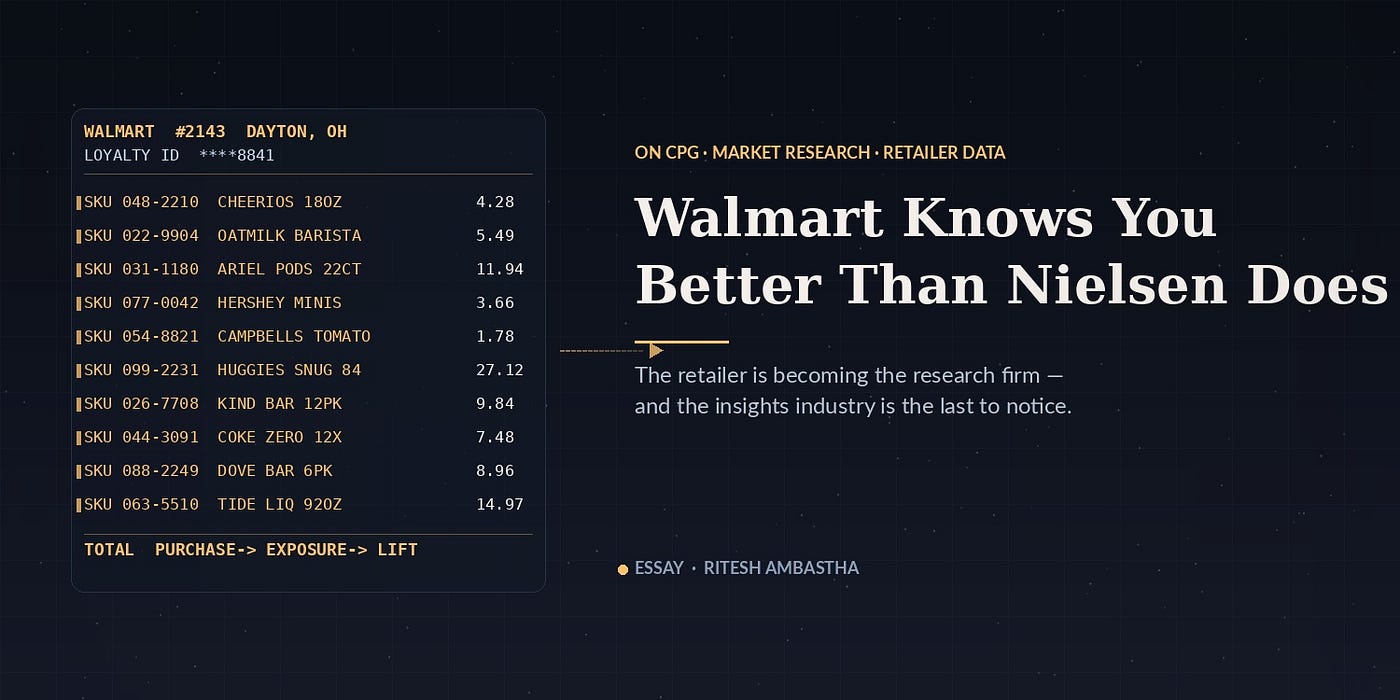
The reason this works is mundane and devastating. Retailers have the only dataset that links the question every brand actually asks — did they buy it, did they come back, did they switch — to identity, geography, household composition, and increasingly to ad exposure. A traditional MR firm models that with claimed purchase intent, panel projection, and a confidence interval. The retailer just looks it up. When Mondelez wants to know how a new Cadbury SKU is performing in the Midlands, Tesco can tell them by Tuesday. The agency answer arrives in six weeks with a confidence band that everyone politely ignores.
Synthetic data does not rescue the agencies — it accelerates the inversion. A simulated panel built on stale syndicated data is just a faster version of the wrong answer. A simulated panel trained on retailer loyalty signals is genuinely useful. Guess who has those signals.
So what does an agency do? Three honest moves.
First, stop selling the deliverable and start selling the question. Retailers will undercut anyone who ships a 200-slide deck, but they cannot yet frame a strategic problem the way a senior Ipsos or Kantar lead can. Frame the question, then buy the data from whoever has it cheapest. Second, build the layer the retailer will not build — the cross-retailer, cross-category, attitudinal context. Walmart will never tell you what your shopper bought at Kroger. That gap is real estate. Third, get inside the retailer’s data clean rooms before the clean rooms get inside your clients. LiveRamp, Habu, and InfoSum are not nice-to-haves; they are the next survey instrument.
The MR firms that survive this decade will not look like Nielsen. They will look like McKinsey with a clean-room subscription and a synthetic modeler in the back. The ones that don’t survive will spend another two years insisting that “panel quality” is the moat, while the retailer’s algorithm quietly finishes building a model of every shopper they ever claimed to represent.
The receipt always wins.
메타데이터
- post_id
- bbf5b37c5f00
- slug
- retailers-will-own-consumer-truth-not-mr-firms-bbf5b37c5f00
- url
- https://medium.com/@riteshambastha/retailers-will-own-consumer-truth-not-mr-firms-bbf5b37c5f00
- canonical_url
- https://medium.com/@riteshambastha/retailers-will-own-consumer-truth-not-mr-firms-bbf5b37c5f00
- author_url
- https://medium.com/@riteshambastha
- status
- ok
- fetched_at
- 2026-06-27 18:20:27