The Surprising Reason Kids Forget What They Just Learned
“But You Studied This Yesterday!”
The Surprising Reason Kids Forget What They Just Learned
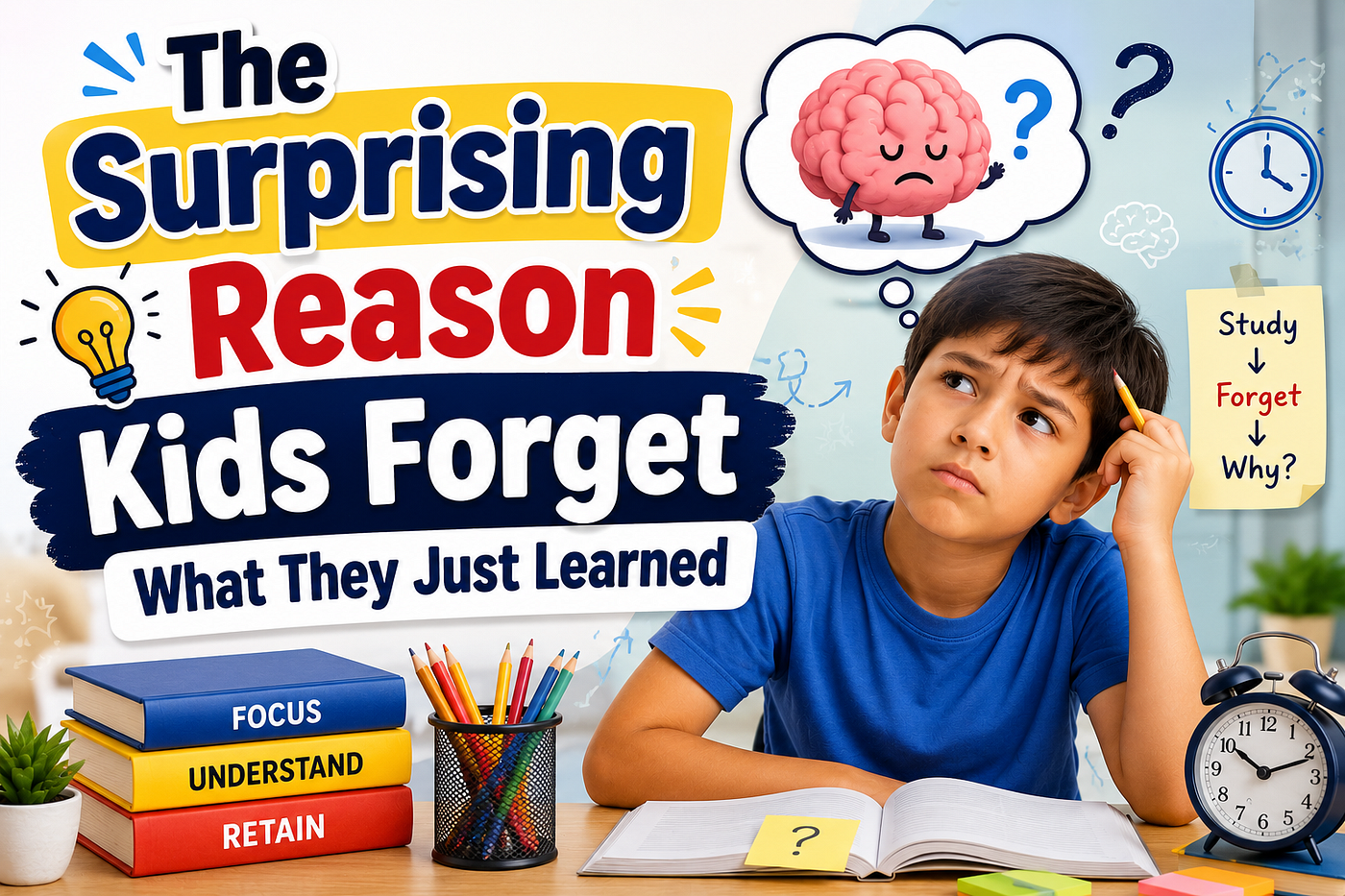
“But You Studied This Yesterday!”
It’s a scene that plays out in homes around the world.
A child spends an hour studying a chapter, completes the homework, and even seems to understand the topic perfectly. Then, the next day, you ask a simple question and suddenly, they can’t remember what they learned.
As a parent, this can be frustrating and confusing.
You may wonder:
- Are they not paying attention?
- Are they spending too much time on screens?
- Do they need more study time?
- Are they simply not interested?
Surprisingly, the answer is often none of these.
The real reason children forget what they just learned has less to do with intelligence and more to do with how the brain stores information.
Understanding this can completely change the way your child learns and remembers.
Let’s uncover the surprising science behind forgetting and what parents can do about it.
The Brain Is Designed to Forget
Yes, you read that correctly.
The human brain is actually designed to forget information.
Imagine if your brain remembered every single detail of every day:
- Every conversatio
- Every advertisement
- Every license plate
- Every random fact
Your brain would quickly become overloaded.
To protect itself, the brain constantly filters information and decides what is worth keeping and what can be discarded.
Unfortunately, school lessons often end up in the “discard” category.
Why?
Because the brain doesn’t yet recognize them as important.
This is where many children struggle.
They study information once, but their brains don’t receive enough signals to store it for the long term.
The Forgetting Curve: Why Memory Fades So Fast
In the late 1800s, psychologist Hermann Ebbinghaus discovered what is now known as the “Forgetting Curve.”
His research revealed that people forget a significant amount of newly learned information within the first 24 hours if they don’t review it.
Think about your child learning a science concept today.
Without reinforcement:
- Some information is forgotten within hours.
- More is forgotten within days.
- Most may disappear within weeks.
This is completely normal.
The issue isn’t that children can’t learn.
The issue is that they aren’t revisiting the information in ways that strengthen memory.
The Biggest Mistake Children Make While Studying
Many students believe learning means reading a chapter repeatedly.
They read the same page again and again and feel familiar with the content.
But familiarity is not memory.
Reading creates recognition.
Memory requires retrieval.
In simple terms:
Seeing an answer is easy.
Remembering it without looking is much harder.
That’s why students often feel confident while studying but struggle during exams.
The brain strengthens memories when it actively retrieves information — not when it passively rereads it.
Why Active Learning Changes Everything
One of the best ways to improve retention is active learning.
Active learning forces children to engage with information instead of simply consuming it.
Examples include:
Asking Questions
Instead of reading a chapter silently, ask:
- Why does this happen?
- How does this work?
- What would happen if this changed?
Teaching Someone Else
When children explain concepts to parents, siblings, or friends, they strengthen memory pathways.
Solving Problems
Practice questions encourage retrieval and application.
Creating Summaries
Writing concepts in their own words helps children process information more deeply.
Many successful **One on One Online Tuition** programs focus heavily on active learning because it produces better long-term retention than passive study methods.
Attention Is the First Step to Memory
Children cannot remember information they never fully processed.
In today’s world, distractions are everywhere.
- Smartphones
- Notifications
- Social media
- Television
- Video games
Even brief interruptions can significantly reduce memory formation.
Studies show that multitasking creates fragmented attention.
When attention is fragmented, learning becomes fragmented too.
Parents can improve retention by creating focused learning environments where children can concentrate without constant interruptions.
This is one reason structured **Online Classes by Junior Robo** often produce better results than self-study alone. Lessons are designed to keep students actively engaged and focused throughout the session.
Sleep: The Hidden Learning Superpower
Most parents think learning happens during study time.
Actually, some of the most important learning happens while children sleep.
During sleep, the brain processes and organizes information gathered throughout the day.
It decides:
- What to keep
- What to strengthen
- What to discard
Without enough sleep, memory consolidation becomes weaker.
This means a child may study hard but still struggle to retain information.
School-aged children generally need:
- 9–12 hours of sleep depending on age
Consistent sleep schedules can significantly improve academic performance and memory retention.
Why Repetition Matters More Than Intelligence
Many parents assume children who remember easily are simply smarter.
In reality, memory often depends more on repetition than intelligence.
The brain strengthens neural connections each time information is reviewed.
Think of memory like a walking trail.
The first time you walk through a forest, the path is difficult to see.
The more often you walk the same route, the clearer the path becomes.
Learning works the same way.
Each review strengthens the memory pathway.
This is why spaced repetition is so effective.
Instead of studying a topic once, children should revisit it multiple times over days and weeks.
The Power of Personalized Learning
Every child learns differently.
Some children learn visually.
Others learn through discussion.
Some learn best through hands-on activities.
When teaching methods don’t match learning styles, retention suffers.
Personalized learning helps solve this problem.
Through **One on One Online Tuition**, tutors can identify:
- Strengths
- Weaknesses
- Learning preferences
- Knowledge gaps
Lessons can then be adapted to suit the individual student.
This targeted approach helps children understand concepts more deeply and remember them longer.
Why Students Need More Than Just Memorization
Many educational systems have traditionally emphasized memorization.
However, understanding creates stronger memories than rote learning.
Consider a math formula.
A child who memorizes the formula may forget it quickly.
A child who understands why the formula works can often recreate it even if they temporarily forget it.
This is why high-quality CBSE tuition programs increasingly focus on conceptual understanding rather than simple memorization.
When students truly understand a topic, retention naturally improves.
How Online Learning Can Improve Memory
Online education has evolved dramatically over the past few years.
The best online learning platforms don’t simply deliver lectures.
They create interactive learning experiences.
Quality Online Classes by Junior Robo include:
- Live interaction
- Personalized feedback
- Practice exercise
- Revision sessions
- Continuous assessment
These elements help reinforce learning and improve memory retention.
Instead of passively listening, students actively participate in the learning process.
That engagement helps information move from short-term memory into long-term memory.
Why IGCSE Students Need Strong Retention Skills
The IGCSE curriculum emphasizes application, critical thinking, and problem-solving.
Students aren’t just expected to remember facts.
They must apply knowledge in unfamiliar situations.
This requires strong memory foundations.
That’s why IGCSE tuition by Junior Robo focuses on:
- Conceptual clarity
- Regular revision
- Practice-based learning
- Analytical thinking
By strengthening understanding and retention together, students become more confident and better prepared for exams.
Practical Strategies Parents Can Start Today
Here are some simple techniques you can implement immediately:
Ask Your Child to Teach You
Even five minutes of explanation can strengthen memory.
Use Flashcards
Excellent for formulas, vocabulary, and key facts.
Review Lessons Within 24 Hours
Quick reviews dramatically improve retention.
Encourage Mind Maps
Visual learning helps many children remember more effectively.
Limit Study Distractions
Create focused, device-free study periods.
Prioritize Sleep
Memory formation depends heavily on quality rest.
Celebrate Understanding, Not Just Marks
Encourage curiosity and deep learning rather than short-term cramming.
The Real Secret to Better Memory
The surprising reason kids forget what they just learned isn’t laziness, lack of intelligence, or poor motivation.
It’s simply how the brain works.
The brain needs:
- Attention
- Repetition
- Retrieval
- Understanding
- Sleep
- Practice
When these elements are present, memory becomes stronger and learning becomes more effective.
Whether your child is enrolled in **CBSE Online Tuition, attending [IGCSE Online Tuition](https://jrrobo.com/igcse-online-tuition.html) by Junior Robo, participating in [Online Classes](https://jrrobo.com/online-tuition-for-grade-1-to-12.html) by Junior Robo, or benefiting from personalized [One on One Tuition](https://jrrobo.com/one-on-one-online-tuition.html)**, the goal should never be just learning information for a test.
The real goal is helping children build knowledge that lasts.
Because when children learn how to remember, they don’t just become better students; they become lifelong learners.
메타데이터
- post_id
- bbfa371dd71d
- slug
- the-surprising-reason-kids-forget-what-they-just-learned-bbfa371dd71d
- url
- https://medium.com/@care_2746/the-surprising-reason-kids-forget-what-they-just-learned-bbfa371dd71d
- canonical_url
- https://medium.com/@care_2746/the-surprising-reason-kids-forget-what-they-just-learned-bbfa371dd71d
- author_url
- https://medium.com/@care_2746
- status
- ok
- fetched_at
- 2026-06-21 07:44:09