Anthropic’s Claude Corps Could Change How Nonprofits Use AI
One number sits at the center of Anthropic’s latest announcement: 1,000 fellows. Not engineers hired into the company, not researchers…
Anthropic’s Claude Corps Could Change How Nonprofits Use AI
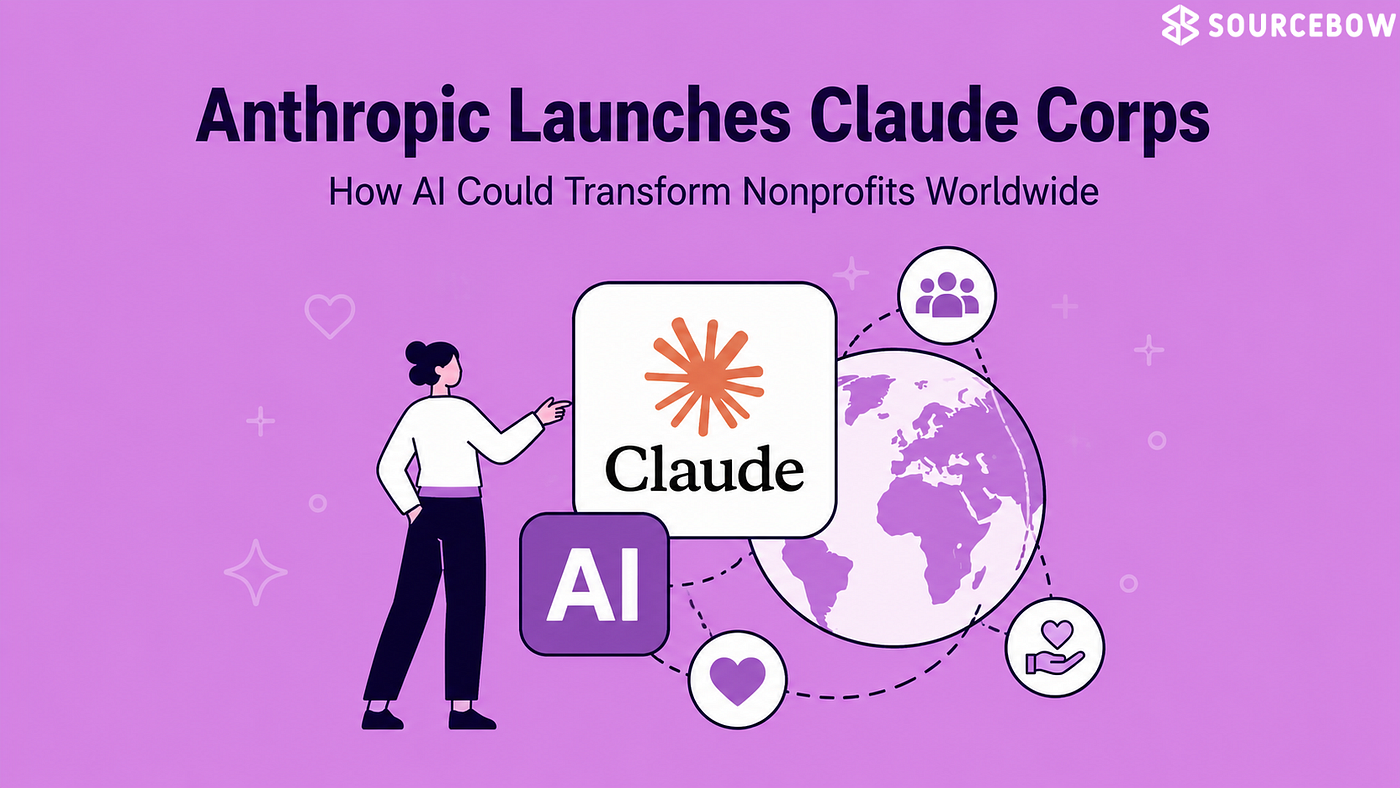
One number sits at the center of Anthropic’s latest announcement: 1,000 fellows. Not engineers hired into the company, not researchers publishing papers, but people trained to work inside nonprofits and civic organizations for a year.
That detail changes the story. Software companies usually distribute products. Anthropic is proposing to distribute people.
The Bigger Bet Behind Claude Corps
A fellowship program sounds harmless enough until the scale comes into focus. Anthropic plans to place 1,000 AI-trained fellows across roughly 400 organizations, backed by funding, Claude credits, and structured support. The stated goal is straightforward: help nonprofits and mission-driven groups use AI for real work rather than occasional experiments.
Yet the mechanics matter more than the mission statement.
Most enterprise software succeeds or fails during implementation, not purchase. Organizations rarely struggle because they lack access to tools. They struggle because nobody has time to learn them, configure them, or convince skeptical teams to change routines. Anthropic appears to understand that bottleneck better than many AI rivals.
Instead of waiting for adoption, the company is stepping into the adoption process itself. That makes Claude Corps less interesting as a charitable initiative than as a model for how an AI company might extend its influence into institutions that shape public trust.
“For a more detailed description, you can check here”
Quick Highlights
•Anthropic plans to place 1,000 fellows inside approximately 400 organizations •Host groups receive both human support and access to Claude resources •The program focuses on day-to-day operational work rather than AI research. •CodePath is involved, giving the initiative a workforce-development angle •Success depends as much on organizational behavior as model performance.
The Real Product Might Be Adoption, Not Claude
Anyone who has worked inside a nonprofit knows the pattern.
There is always another grant application to prepare, another donor report due next week, another meeting that generated pages of notes nobody has time to organize. Staff shortages become permanent operating conditions. Administrative work expands until it fills every available hour.
Generative AI fits neatly into that environment. Drafting communications, summarizing documents, sorting information, creating first-pass reports — these are tasks that often consume disproportionate amounts of attention. A capable assistant can reduce that burden.
The interesting move is not providing access to Claude. Many organizations can already access AI tools.
Anthropic is addressing the gap between availability and actual use. A trained fellow functions as translator, trainer, troubleshooter, and internal advocate all at once. That person helps teams move from curiosity to habit. Once that happens, software becomes part of normal operations rather than another unused subscription.
For nonprofits, the arrangement may genuinely create value. For Anthropic, every successful deployment becomes a case study. The overlap between those interests is obvious, though the long-term consequences remain harder to measure.
A Company That Keeps Explaining Its Motives
Anthropic occupies a somewhat unusual position in the AI industry.
While competitors often emphasize speed, capability, and market share, Anthropic regularly returns to discussions of safety, governance, and social responsibility. Its public messaging spends an unusual amount of time explaining not just what the company builds but why it deserves trust.
That tendency shows up throughout the Claude Corps initiative.
The fellowship is being presented as practical assistance, but it also reinforces a broader narrative: AI companies can pursue growth while maintaining a public-interest mission. Whether observers accept that framing is another matter.
Corporate history offers plenty of examples of firms wrapping commercial objectives in civic language. Skepticism did not emerge from nowhere. Public trust tends to decline whenever companies ask audiences to accept promises before evidence exists.
The AI sector faces additional scrutiny because the stakes are larger than software adoption. Questions about labor displacement, concentration of power, algorithmic bias, and institutional dependence continue to shadow every major product launch. Under those conditions, declarations of responsibility inevitably carry strategic value.
None of that proves bad faith.
It does mean that every initiative aimed at public benefit also functions as a test of credibility, particularly when the sponsoring company stands to gain from widespread acceptance.
The Most Important Audience Isn’t Who It Seems
Much of the discussion around artificial intelligence still revolves around technical elites.
Researchers debate model capabilities. Engineers compare benchmarks. Venture capital firms discuss infrastructure spending. Product teams analyze feature releases. Those conversations matter, but they often occur far from the organizations expected to absorb the practical effects of new technology.
Claude Corps points somewhere else.
By partnering with groups that operate closer to community services, workforce development, and civic functions, Anthropic is focusing on people who are rarely treated as the center of AI strategy. The fellowship model recognizes a simple reality: adoption usually depends on human relationships rather than technical specifications.
A nonprofit director deciding whether to trust an AI-generated summary is not evaluating benchmark scores. Staff members care whether a tool saves time without creating new risks. Confidence develops through repeated use, not marketing claims.
That is where the program becomes politically interesting.
The organizations chosen today could become some of the earliest institutional examples of successful AI integration outside traditional technology circles. Early familiarity often shapes later expectations. Systems embedded into reporting workflows, communications processes, scheduling practices, and administrative operations have a tendency to feel permanent after enough repetition.
Dependency rarely arrives all at once.
It grows through convenience, accumulated habits, and the quiet disappearance of alternatives.
How AI Becomes Ordinary
Most people will never interact directly with Claude Corps, but many will encounter organizations touched by it.
A local workforce center may produce resources faster. A nonprofit could respond to inquiries more quickly. Community organizations handling limited budgets might spend fewer hours on paperwork and more hours on services. Those are tangible outcomes rather than abstract promises.
The practical shift, however, extends beyond efficiency.
When AI tools become part of the operating routine of trusted institutions, public perception changes. Technology that once felt experimental starts to feel ordinary. A donor reading a report, a volunteer receiving an email update, or a job seeker getting information from a support organization may never know AI played a role in producing those materials.
Normalization often arrives quietly, through routine interactions rather than dramatic announcements.
Final Thoughts
The most revealing part of Claude Corps is not the software. It is the decision to place people between the software and the organizations expected to use it.
That choice acknowledges something the technology industry often prefers to ignore: adoption is a social process before it becomes a technical one. Habits, trust, and institutional culture usually determine outcomes long before model quality does.
A year from now, the strongest measure of success may have little to do with Claude itself. The more interesting question is whether hundreds of organizations begin treating AI as infrastructure rather than a tool — a distinction that tends to become visible only after it has already settled into the background.
메타데이터
- post_id
- bbfcc2b0abd6
- slug
- anthropics-claude-corps-could-change-how-nonprofits-use-ai-bbfcc2b0abd6
- url
- https://medium.com/@sourcebowresource/anthropics-claude-corps-could-change-how-nonprofits-use-ai-bbfcc2b0abd6
- canonical_url
- https://medium.com/@sourcebowresource/anthropics-claude-corps-could-change-how-nonprofits-use-ai-bbfcc2b0abd6
- author_url
- https://medium.com/@sourcebowresource
- status
- ok
- fetched_at
- 2026-06-13 16:00:06