Stop Paying to Move Redundant Data: Why Shift-Left Architecture Changes Everything in Modern Data…
Most data teams aren’t dealing with a storage problem as much as a data processing problem: they spend time, compute, and money for pushing…
Stop Paying to Move Redundant Data: Why Shift-Left Architecture Changes Everything in Modern Data Stack
Most data teams aren’t dealing with a storage problem as much as a data processing problem: they spend time, compute, and money for pushing low‑ROI , duplicate, or invalid records through layers that don’t actually need to process them. In a traditional medallion architecture i.e Bronze, Silver, and Gold layers, redundant data is collected, cleaned, and refined across the architecture. But if we don’t address these issues sooner, growing data ingestion need will turn what should be simple pipelines into expensive, brittle data factories.
The Scale:
One would argue that storage costs are cheap so we can treat ingestion layer Bronze-certified, raw, “as-is” copy of the source system data. The MDS(Modern Data Stack) in any ELT model involves various cloud tools like AWS, Fivetran and Snowflake / BigQuery and the costs are based on usage-based pricing plan. The data volumes can be predictable in servicing and operations domain in Fintech Companies based on a few indicators I’ll mention later.
The Bronze layer is a defacto “data black box” serving as an ingestion gateway to capture everything that happens in our Data Analytics world. The entry gate-way for any data source, the scale is ever increasing .That is why shift‑left architecture is no longer an option, rather a necessity in today’s ever growing data demand (90% of world’s data generated in last 2 years). By making smarter ingestion‑layer decisions early especially around deduplication and filtering via natural keys, Transaction identifiers , and business‑relevant attributes, teams can dramatically reduce unnecessary processing, improve performance, and build platforms that scale more efficiently.
The Real Cost of Waiting
Many platforms accept raw data first and clean it later. That feels flexible, but it becomes expensive later. Every query used to filter that set of records that enter the pipeline can trigger storage, transformation, orchestration, and governance downstream. The 1×10×100 rule applies here: fixing an issue at ingestion might cost 1 unit of effort, in transformation 10 units, and in consumption up to 100 units. As a principal Data Engineer of Servicing and Operations where the data received is directly proportional toadvisor-client target market , I can say that our data volumes for client‑ and advisor‑centric datasets are predictable and driven by:
- advisor expansion
- mergers and acquisitions
- increased digital engagement for service enhancement
- Call center logs
the impact is predictable:
- Higher cloud spend. Snowflake charges per Query execution runtimes
- Slower pipeline execution than ideal in orchestration workload.
- More noise for downstream teams.
- More effort spent firefighting issues that could have been caught much earlier.
- Bug fixes and enhancements costs also add to the wait. Engineering effort to optimize ingestion pipelines , and enforce schema validation checks.
The Elephant in the Room
Although, SaaS CRM partners deliver semantically named, report‑ready datasets, but our ingestion‑to‑refine conversion is still constrained by outdated, narrative‑style business requirements designed for batch (daily/weekly) refresh, not 30‑minute Refresh style in the modern data stack. Also, Failures to consistently tie them into our own logical data model is amplifying the data operational costs that we need to rethink our volume handling across Colossal Bronze, Silver and Gold Layer in our MDS.
Even though external data feeds have improved in timeliness and , structure, and schema enforcement, the real problem is semantic loss. The technical dimensional models require explicit decisions about grain especially around dimensional datsets, conformed keys, SCD behavior, and metric logic. When those details are missing, teams keep rebuilding the same transformation logic across multiple layers, amplifying compute costs across Silver and Gold and eroding trust in the data when pipelines fail from timely data SLAs of 30 min or less for Servicing and Operations domain needs .
Looking at the hidden modeling decisions underneath them:
- Exactly what business process and grain are we modeling?
- What defines a metric, and where does it live, fact or dimension?
- How do slowly changing attributes evolve over time?
- Which dimensions must be conformed across subject areas?
Shift‑Left in Practice:
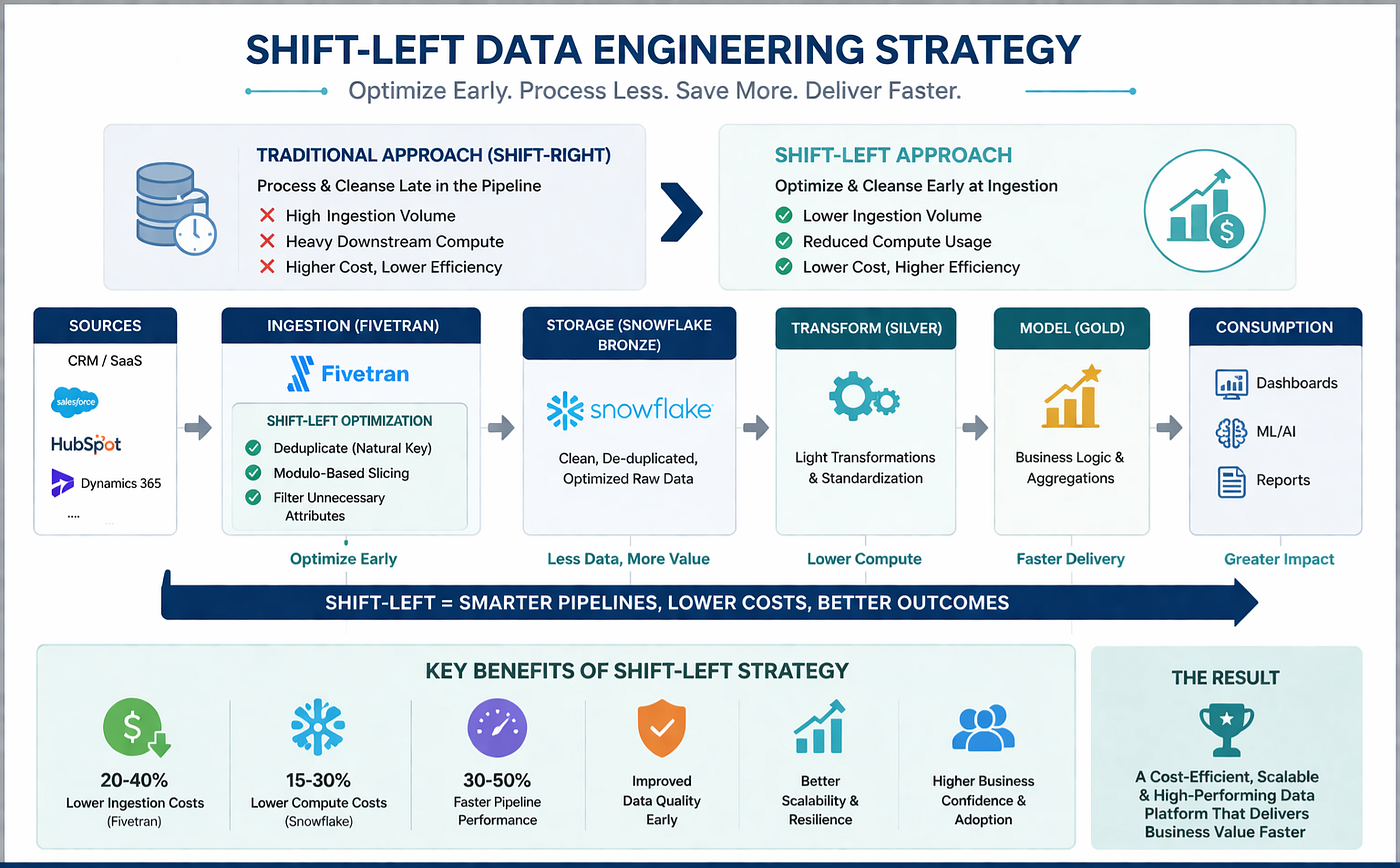
Shift-left: Fortify Bronze
Shift‑left architecture moves validation, filtering, and deduplication closer to ingestion which is exponentially growing worldwide.
The starting point for shift-left is to approach data reliability to ensure that data entering your environment is of the highest quality and can be trusted. Shifting left is essential, but it’s not something that can simply be turned on.Data Reliability is essential to enable enterprises to make the right decisions based on the right information.
Data Observability plays a key role in shaping data reliability, and only with the right platform can you ensure you’re getting only good, healthy data into your system. By understanding the pattern of data stored in Refined which has a time-audit trail of datasets, We can make decisions on Data Reliability. Instead of waiting for downstream jobs to sort out quality, the ingestion layer becomes the first line of defense. At its core, that means:
- Deduplicating records before they’re stored in Bronze.
- Filtering out invalid to quarantine data at the point of entry.
- Validating schema, keys, and business‑relevant attributes before data moves downstream.
When this happens early, every downstream layer becomes lighter, faster, and easier to operate. The Bronze layer evolves from a passive landing zone into a centralized, contract‑enforced foundation for schema, freshness, and downstream expectations.
The AI‑Accelerated Feedback Loop
Tools proposed: Fivetran , DBT and Agentish AI on Snowflake.
Where this becomes truly powerful is when you add an AI‑accelerated feedback loop between Bronze and the Refine layer. Teams can maintain an audit log that tracks rows received, processed, rejected in refine layer through dbt fact/dimension models jobs over time vs Fivetran‑ingested Colossal Bronze raw tables audit over time turning historical processing behavior into proactive design signals. core of the problem statement: Duplicate % ↑ → Reprocess rate ↑ → Cost ↑
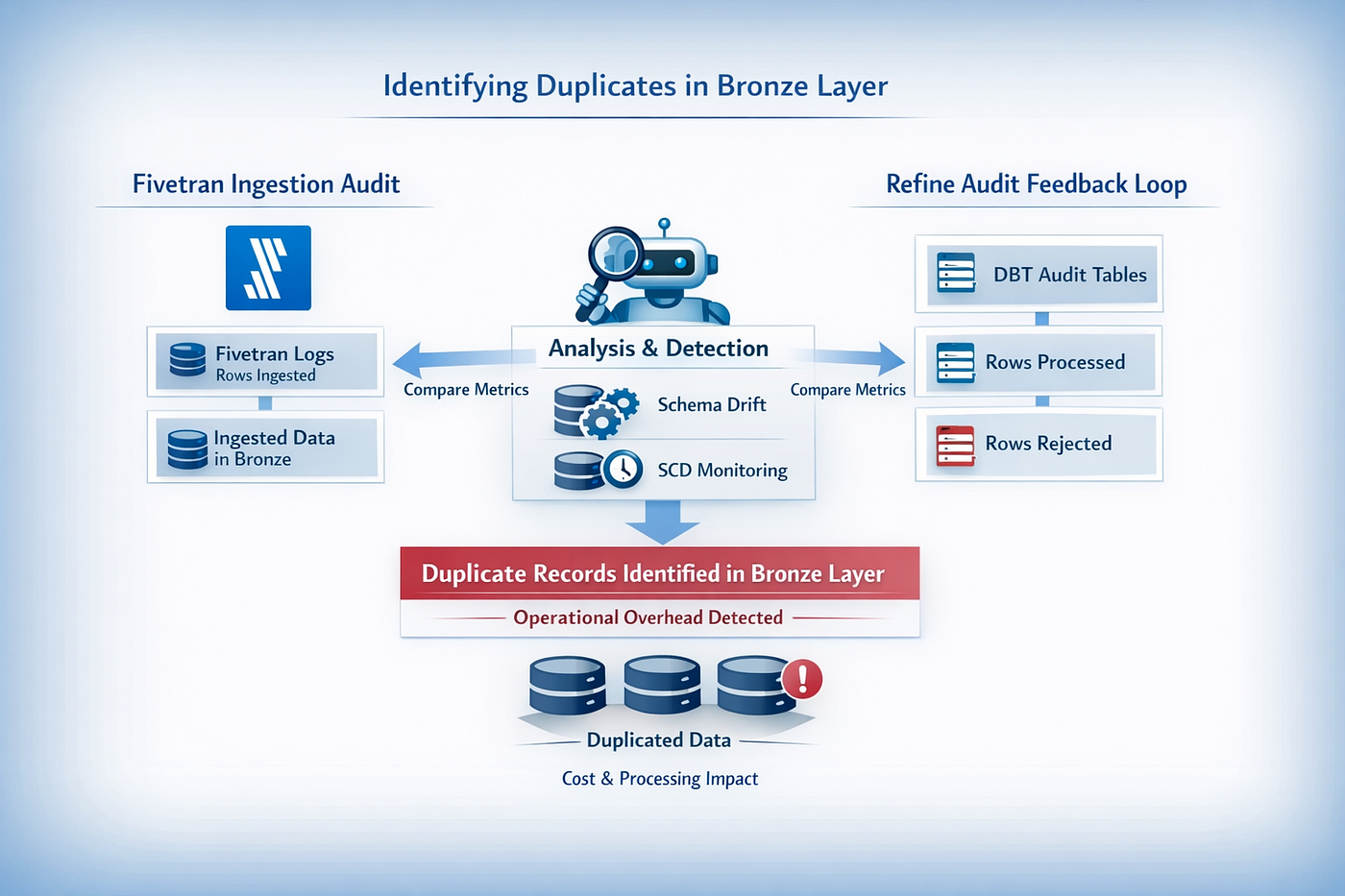
Self learning for optimization scope
By feeding that audit log into an AI model trained on:
- natural keys and business identifiers :
- transactional patterns and update frequencies
- deduplication criteria
- relevant ingestion attributes
- schema drift and rejection behavior
The platform learns which tables are good candidates for earlier optimization by comparing the audit outputs at Fivetran (Bronze) and DBT/Refine to asses which tables/ potential dimensions can be contracted at ingestion vs those legitimately that belong in Refine layer for complex transformations. So, In an existing enterprise, you have to reengineer workflows from the ground up to deliver the right information to agents at the right moment.The result is not automation without human oversight, but co-piloted decision‑making to take insights: the AI populates potential candidates , and engineers apply judgment, reinforce contracts, and tighten ingestion‑layer rules over time. We need to reengineer the workflows to match content to context off the deep rooted enterprise data.
The platform shifts from reacting to data issues to preventing them by turning audit signals into proactive design rules. Duplication and reprocessing create a clear cost chain: more noise → more compute → higher operational overhead. Closing the loop between ingestion and refinement cuts redundant dbt runs and Snowflake consumption, improving pipeline efficiency, reducing latency, and delivering measurable business impact.
Slowly, the platform becomes self‑improving. It starts catching schema evolution sooner(Bronze-Ready), recommending where deduplication can move left, and flagging tables likely to generate noise or compute spikes. This is how we can accelerate shift‑left in a quick yet careful human oversight manner. With Centralized logging and operational cost-scale monitor, We can see Data expenses from a holistic manner from data acquisition to operation/insights- ready time-to-delivery.
ROI, Performance, and Scale
The financial impact is straightforward: less data in means less compute, less storage, and less overhead on orchestration framework that stacks Snowflake-DBT on Airflow. But the bigger payoff is strategic. A cleaner ingestion layer reduces technical debt, makes pipelines more predictable, and frees teams from constant cleanup work. That means more time can go toward:
- New data products that drive business value.
- Better analytics and insights, not janitor‑level transformations.
- Automation, optimization, and proactive governance.
- Business‑facing innovation instead of firefighting.
- Reduce Total Cost Of Ownership by strategizing cloud vendor usage.
Performance improves because pipelines are no longer forced to carry unnecessary weight. Deduplication and filtering at ingestion shorten end‑to‑end latency, improve freshness, and make the platform more responsive to business needs. In environments where fresh, reliable data powers service, underwriting, and customer experience, this is not just an engineering win rather a competitive advantage.
The 1×10×100 Rule
The earlier we address issues at the business level, the better. Waiting means you end up paying far more over time. In data, this is the 1×10×100 rule in action.
- Fixing a quality issue at ingestion might cost 1 unit.
- Letting it slip into transformation could cost 10 units.
- Allowing it to reach consumption can easily cost 100 units in operational overhead, rework, and lost trust.
If you apply shift‑left thinking early in existing systems , you prevent schema drift, duplication, and poor‑quality data from compounding. Data ROI for tech teams then means sustaining operational cost, meeting business demand, and creating data of interest, not data with interest (tech debt).
The Bigger Lesson
The most important architectural decisions are often made before data ever reaches transformation or analytics. If the ingestion layer is designed to shift‑left early and is AI‑aware, the entire platform becomes more efficient, more scalable, and better aligned with business value.
Shift‑left architecture turns ingestion from a passive entry point into an active control point for cost, performance, and scale. And when AI helps the platform learn from its own audit history, shift‑left is no longer just a pattern; it becomes a self‑evolving data strategy.
메타데이터
- post_id
- bc2a5b163bb2
- slug
- stop-paying-to-move-bad-data-why-shift-left-architecture-changes-everything-in-modern-data-stack-bc2a5b163bb2
- url
- https://medium.com/@smsgoonersarfraz/stop-paying-to-move-bad-data-why-shift-left-architecture-changes-everything-in-modern-data-stack-bc2a5b163bb2
- canonical_url
- https://medium.com/@smsgoonersarfraz/stop-paying-to-move-bad-data-why-shift-left-architecture-changes-everything-in-modern-data-stack-bc2a5b163bb2
- author_url
- https://medium.com/@smsgoonersarfraz
- status
- ok
- fetched_at
- 2026-07-20 09:16:42




