How I Passed the eWPT in 1.5 Months: Study Strategy + Exam Tips
Hey everyone!
How I Passed the eWPT in 1.5 Months: Study Strategy + Exam Tips
Hey everyone!
Thanks for stopping by. In this blog, I’ll be sharing my experience with the eWPT certification exam, how I prepared for it, what the exam was like, and whether I think it’s worth taking especially for anyone looking to break into web application security or VAPT.
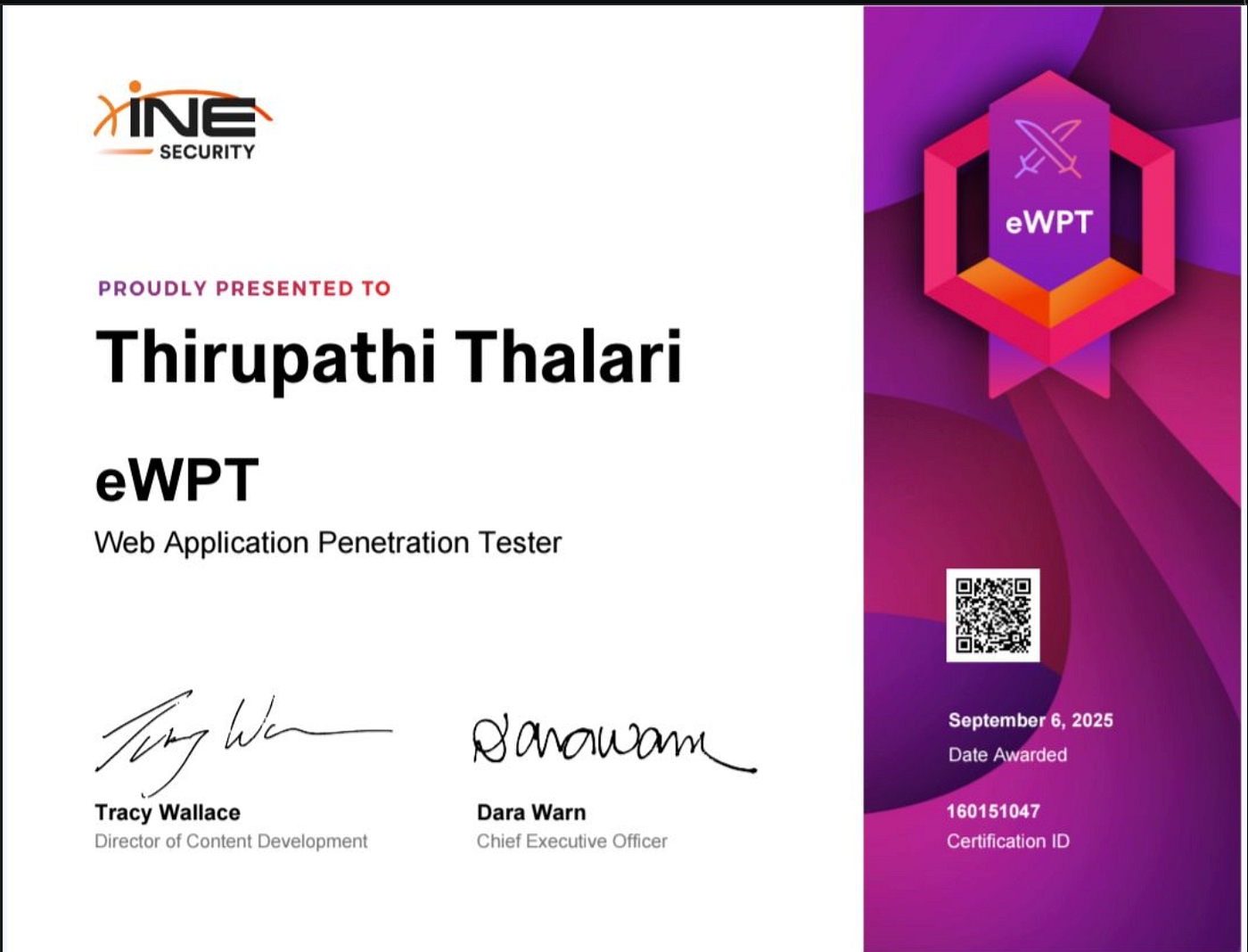
I recently passed the eLearnSecurity Web Application Penetration Tester (eWPT) certification by INE, and I wanted to share my experience to help others who might be considering this path.
I started the course around July 21st and sat for the exam on September 6th, giving me about 1.5 months to go from scratch to certified. This blog walks through how I approached the course, prepared for the exam, and what I learned along the way.
Why I Chose the eWPT
I’ve always been interested in cybersecurity and wanted to focus on web application security. The eWPT seemed like a great choice because it: Offers a hands-on, lab-based learning experience ,Covers real-world vulnerabilities aligned with the OWASP Top 10 ,Doesn’t require years of experience to get started,Has a practical exam instead of just multiple choice questions
Course Overview
The Web Application Penetration Testing (WAPT) course from INE, which prepares you for the eLearnSecurity Web Application Penetration Tester (eWPT) certification, is delivered through an extensive video series presented by Alexis Ahmed. The course features around 106 hours of hands-on video content, and is structured to take you from the fundamentals of web security to more advanced testing techniques-making it ideal for beginners and intermediate learners alike.
Alongside the videos, the course offers around 50 labs that allow you to apply techniques covered in each module. These labs gradually increase in complexity and are designed to simulate real-world scenarios, helping reinforce key concepts like XSS, SQLi, authentication bypasses, file. inclusion vulnerabilities, and much more. Many of these labs are exploratory and challenge you to think critically, not just follow instructions. Toward the end of the course, you’ll also face final lab challenges, which are closer to black-box environments and help simulate the kind of mindset and workflow you’ll need for the actual exam.
Beyond the core vulnerabilities, the course touches on more advanced topics like basic filter evasion, web service (API) testing, and access control flaws. It also introduces widely used tools like SQLMap, XSSer, Nikto, and others-ensuring that you’re not only learning manual testing techniques but also how to automate parts of your workflow where appropriate.
By the end of the course, you’ll have a strong grasp of the OWASP Top 10, know how to set up and manage your own testing environment, and most importantly, understand the mindset of a web application attacker.
My Study Plan & Preparation
I started the course around July 21st and completed all the material and labs in about 1.5 months, finishing just before my exam on September 6th. However, everyone’s learning pace is different, so don’t rush yourself. Some may take more time, and that’s perfectly okay what matters most is thoroughly understanding the content and feeling confident before scheduling the exam.
During my preparation, I dedicated around 5 to 6 hours on weekdays, plus additional time on weekends, to watching videos, completing labs, and reviewing concepts. I also took detailed notes throughout the course, which proved to be very helpful during the exam. The course’s 50+ labs were essential for building my practical skills, and I made sure to complete every single one without skipping. Taking notes especially on Burp Suite workflows and common payloads helped me immensely when it came time to tackle the exam environment.
To reinforce what I learned, I often paused videos to practice techniques immediately, revisited the OWASP Top 10 vulnerabilities regularly, and supplemented my study with external platforms like PortSwigger Web Security Academy and TryHackMe. These additional resources offered a wider variety of environments and helped me get comfortable with different scenarios.
The exam itself was more difficult than the labs, requiring not only technical skill but also strong problem-solving and critical thinking abilities. Taking your time to prepare well, focusing on mastery rather than speed, and developing a solid methodology are crucial to passing the exam successfully.
Exam Experience
First off, the eWPT exam is not a Capture The Flag (CTF) style test. Instead, you’re provided access to several web applications within a controlled environment. Your task is to perform thorough penetration testing against these applications to answer around 50 questions, which are a mix of multiple-choice and short-answer formats. To pass, you need to correctly answer at least 70% (35 questions). You have 10 hours total to conduct your testing and submit your answers.
Some questions require you to find specific “flags” pieces of information or proof-of-exploitation hidden in the applications. These flags often provide answers or lead you to additional areas for further testing. This means your ability to methodically enumerate, exploit vulnerabilities, and analyse results is crucial for success.
My opinion
In my opinion, the eWPT exam is definitely worth taking, especially for anyone who’s planning to get into Web Application Security, Vulnerability Assessment and Penetration Testing (VAPT), or wants a strong foundation in Web Application Penetration Testing. The exam is hands-on, challenging, and forces you to really understand how web vulnerabilities work in real environments. I personally found it to be very difficult, especially compared to the training labs so it’s important to go in with the right expectations.
I took the exam a bit fast after completing the INE course in about 1.5 months, but that might not be the right approach for everyone. This exam requires serious practice and time, especially if you’re new to web app pentesting. I strongly recommend taking your time, reviewing each topic properly, and practicing on intentionally vulnerable applications like DVWA, bWAPP, Juice Shop, and platforms like PortSwigger Web Security Academy. These helped me a lot in improving my hands-on skills and learning how to deal with real-world scenarios.
Also, following content creators and ethical hackers on YouTube really helped me stay motivated and learn different approaches. One of is NahamSec , who shares amazing bug bounty and web app security content. There are also many more creators and writeups out there make use of them to get multiple perspectives and techniques.
Overall, the eWPT exam is not easy but that’s what makes it valuable. It pushes you to move beyond the basics and think like a real attacker. If you’re willing to put in the effort, practice regularly, and use all the great resources out there, then it’s absolutely a certification worth pursuing.
Thanks for reading my blog! I hope my experience with the eWPT exam helps you in your own certification journey.
If you have any questions, want to share your experience, or just want to connect, feel free to reach out!
LinkedIn: thalari-thirupathi
메타데이터
- post_id
- bc3ef417f28d
- slug
- how-i-passed-the-ewpt-in-1-5-months-study-strategy-exam-tips-bc3ef417f28d
- url
- https://medium.com/@thirupathi5605/how-i-passed-the-ewpt-in-1-5-months-study-strategy-exam-tips-bc3ef417f28d
- canonical_url
- https://medium.com/@thirupathi5605/how-i-passed-the-ewpt-in-1-5-months-study-strategy-exam-tips-bc3ef417f28d
- author_url
- https://medium.com/@thirupathi5605
- status
- ok
- fetched_at
- 2026-06-25 16:53:31