From DNA to Millions: Understanding PCR
Polymerase Chain Reaction, abbreviated as PCR, is a standardised methodology for molecular biology, which permits the generation of a great…
From DNA to Millions: Understanding PCR
Polymerase Chain Reaction, abbreviated as PCR, is a standardised methodology for molecular biology, which permits the generation of a great number of copies of a target region of the DNA molecule from a limited amount of the original sample in a short amount of time. Thermostable Taq polymerase is one of the enzymes that are involved in the process. The term “chain reaction” corresponds to the exponential amplification of the target region of DNA during the PCR process.
PCR has a large number of applications, including the diagnosis of medical diseases, forensic science, and genetic research. It is frequently implemented in areas such as disease diagnosis, personal identification, and paternity testing.
Principle :
The process of PCR relies on the principles that govern DNA replication. The double-stranded DNA molecule will be denatured (i.e., the two strands of DNA will be separated) and then replicated numerous times by subjecting the target DNA of interest to sequential changes of temperature. The short single-stranded DNA sequences (i.e. primers) that have been designed to hybridise specifically and precisely to the target sequences will be used to initiate DNA synthesis, which results in amplifying the specific target DNA.
PCR is carried out in the following three steps:
Denaturation-
Denaturation is accomplished by applying heat (e.g., heating the PCR reaction mixture to approximately 94–96°C) to separate the DNA strands.
Annealing-
During the annealing step, the temperature is lowered to allow the target-specific primers to hybridise to their complementary DNA sequences (approximately 50–65°C).
Extension-
The addition of nucleotides to the hybridised PCR primers to form new double-stranded DNA (resulting in the amplification of the target DNA) is accomplished by Taq polymerase, an enzyme obtained from the thermophilic bacterium Thermus aquaticus, at its optimum temperature of approximately 72°C.
A series of repeating cycles is performed for the amplification process — with each cycle the amount of DNA doubles, resulting in exponential amplification (e.g. 2, 4, 8, 16…) and after repeated cycles, millions of copies of the DNA are produced.
PCR has the following requirements to function:
A template DNA
Two primers that begin the DNA synthesis
Taq) DNA polymerase enzyme that synthesizes the new DNA strands from template DNA.
A mixture of dNTP (deoxynucleotide triphosphate) — the building blocks of the new DNA.
A buffer solution for the maintenance of optimal conditions.
Applications of PCR:
Disease detection (e.g. pathogens or genetic abnormalities)
Forensic science (e.g. DNA profiling for criminal or paternity testing)
Genetic research
Conclusion:
Hence, PCR is a vital technique used in modern biological research, enabling the rapid amplification of DNA. The efficiency of this technique, along with a wide variety of applications, has resulted in PCR being an indispensable tool within the area of molecular biology, and beyond.
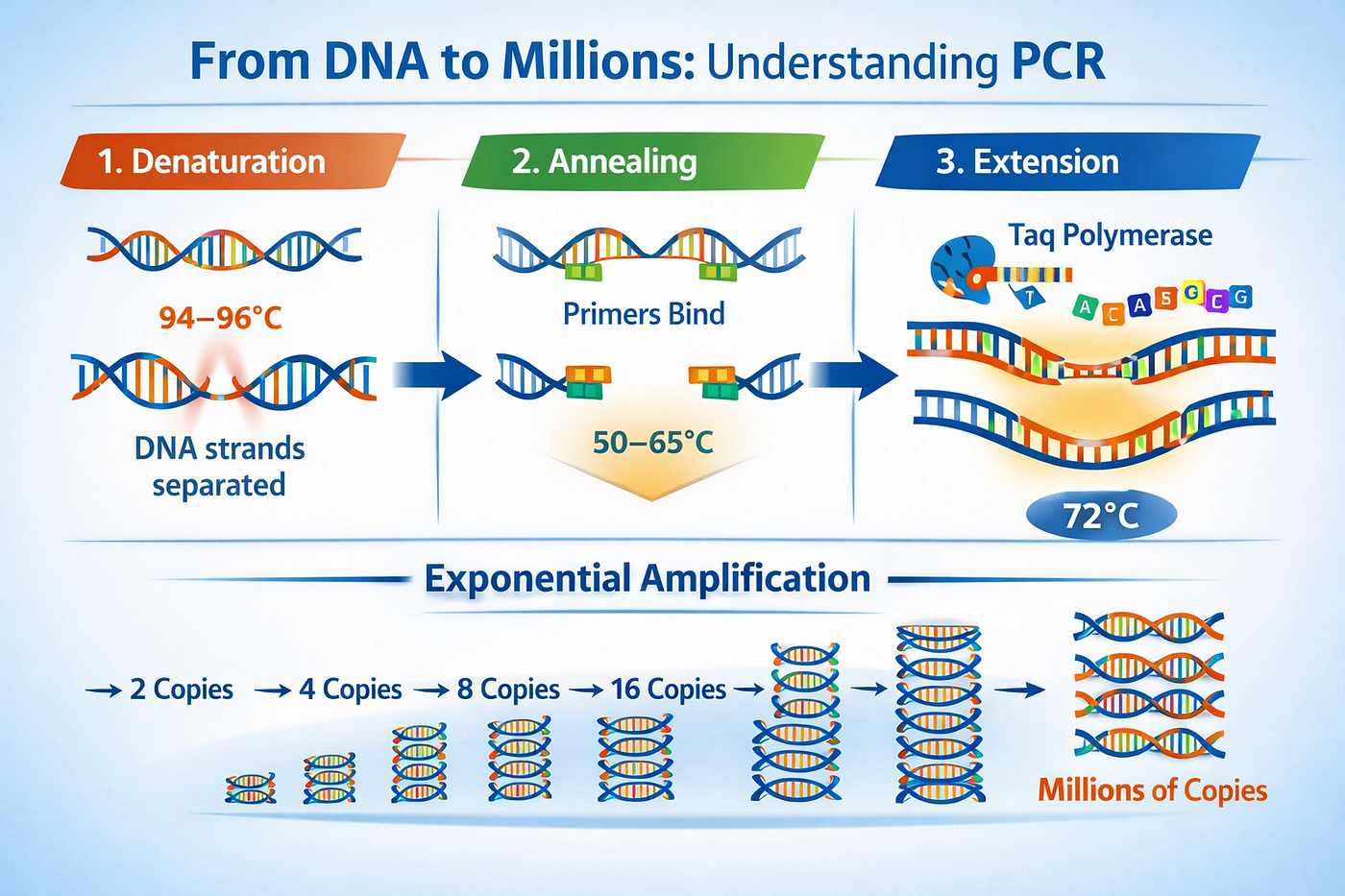
Schematic representation of PCR showing denaturation, annealing, extension, and exponential DNA amplification
메타데이터
- post_id
- bc447b9d4bef
- slug
- from-dna-to-millions-understanding-pcr-bc447b9d4bef
- url
- https://medium.com/@harshinichintalawork/from-dna-to-millions-understanding-pcr-bc447b9d4bef
- canonical_url
- https://medium.com/@harshinichintalawork/from-dna-to-millions-understanding-pcr-bc447b9d4bef
- author_url
- https://medium.com/@harshinichintalawork
- status
- ok
- fetched_at
- 2026-06-09 15:37:30