Utopia Is Not Built on Efficiency and Profit.
This article explores human and social conditions relevant to prevention and community resilience — topics also discussed in recent public…
Utopia Is Not Built on Efficiency and Profit. It Is Built on Maintaining Dignity, Agency, and Breathable Personal Space.

This photo represents a utopian, secluded residence designed for maximum privacy. Surrounded by breathtaking nature and ‘breathable’ open spaces, the home remains entirely shielded from noise. While not designed for urban efficiency, it provides the essential human ‘break’ — offering the choice to disconnect for peace or reconnect with the world on one’s own terms.
This article explores human and social conditions relevant to prevention and community resilience — topics also discussed in recent public health strategies. Shared for general informational purposes only.
The “Behavioral Sink” Revisited: Urban Density, Social Stress, and the Erosion of Human Agency
In the late 1960s and early 1970s, ethologist John B. Calhoun conducted the well-known Universe 25 experiments, in which mice placed in a resource-abundant but spatially constrained environment developed what he termed a behavioral sink: social breakdown, maternal neglect, aggression, social withdrawal, and eventual population collapse to 0.
While some may think direct biological comparisons between mice and humans are inappropriate, the work of John B. Calhoun, conducted with support from the National Institutes of Health and the National Institute of Mental Health, remains a valuable conceptual resource for sociology, environmental psychology, and urban studies. His experiments explored how extreme density, chronic social friction, and loss of personal space affected social behavior in confined populations.
In the Universe 25 studies, overcrowded mice — despite abundant resources — developed abnormal social behaviors, including extreme aggression, chronic stress from intrusion, excessive pursuit of females, territorial conflict, maternal neglect and social withdrawal, ultimately leading to a collapse of group structure. Often described as a “behavioral sink,” this phenomenon is used as a model for how high-density environments can contribute to crime, stress, and social breakdown.
Metaphorically applied to human urban environments under prolonged stress, these patterns can be examined through observable outcomes such as elevated violence, robbery, social isolation, reduced mutual respect, and the erosion of stable family and community relationships.
This framing does not suggest that humans replicate animal behavior biologically. Rather, it highlights how environmental design and chronic social stress can degrade the social conditions necessary for healthy human functioning.
Whether expressed as violent crime in some parts of Memphis, Oakland, and New York City, or as social withdrawal and demographic decline in South Korea, the pattern suggests the same principle:
Urban efficiency without humane spatial design produces long-term social degradation.
Memphis is often discussed in criminology for high violent-crime rates, but its urban form is not a classic high-density pattern like South Korea or New York City. In fact, Memphis is relatively low-density and sprawling compared with those cities.
What makes Memphis relevant to this framework is not density alone, but environmental stress factors that urban researchers link to social outcomes:
- Concentrated poverty and disinvestment in specific neighborhoods
- Fragmented urban layout and limited access to services in some areas
- Weak neighborhood cohesion in high-turnover zones
- Vacant properties and reduced informal social oversight (“eyes on the street”)
- Longstanding segregation patterns affecting community trust and opportunity
These conditions can produce chronic social stress, which aligns with environments that erode trust, stability, and social cohesion.
So Memphis is not as an example of “overcrowding,” but as an example of how urban environments that lack social cohesion, spatial dignity, and supportive infrastructure can produce outcomes similar to those seen in Calhoun’s stress model — through a different pathway than density.
Cities do not fail only because of economics or politics. They can fail because their design quietly exceeds the limits of human social tolerance.
Calhoun’s behavioral sink should not be read as a literal biological prophecy, but as a warning about what can occur when living systems are pushed beyond their capacity for healthy social interaction.
If cities are designed without regard for human psychological limits, the consequences may include social fragmentation, declining family formation, rising isolation, and vulnerability to predatory structures. Urban success, therefore, should not be measured only by density and economic output, but by whether residents retain the capacity to trust, connect, and build meaningful lives within the spaces they inhabit.
Calhoun also observed maternal withdrawal and neglect among the mice as social conditions deteriorated. In human societies experiencing chronic environmental and social pressure, this can parallel declining birth rates, family strain, and broader social withdrawal.
Some mice, referred to as the “beautiful ones,” withdrew almost entirely from social interaction. In urban human contexts, similar patterns may appear as isolation, social withdrawal, and persistent loneliness among residents.
As the experiment progressed, the mice lost normal mating and social structures. In human terms, this can be compared to reduced interest in dating, marriage, and long-term family formation in highly stressful living environments.
Finally, Calhoun noted a collapse of functional social hierarchy among the mice. Metaphorically, in strained urban environments, this may manifest as individuals seeking status through domination, intimidation, or group affiliation rather than through constructive social roles.
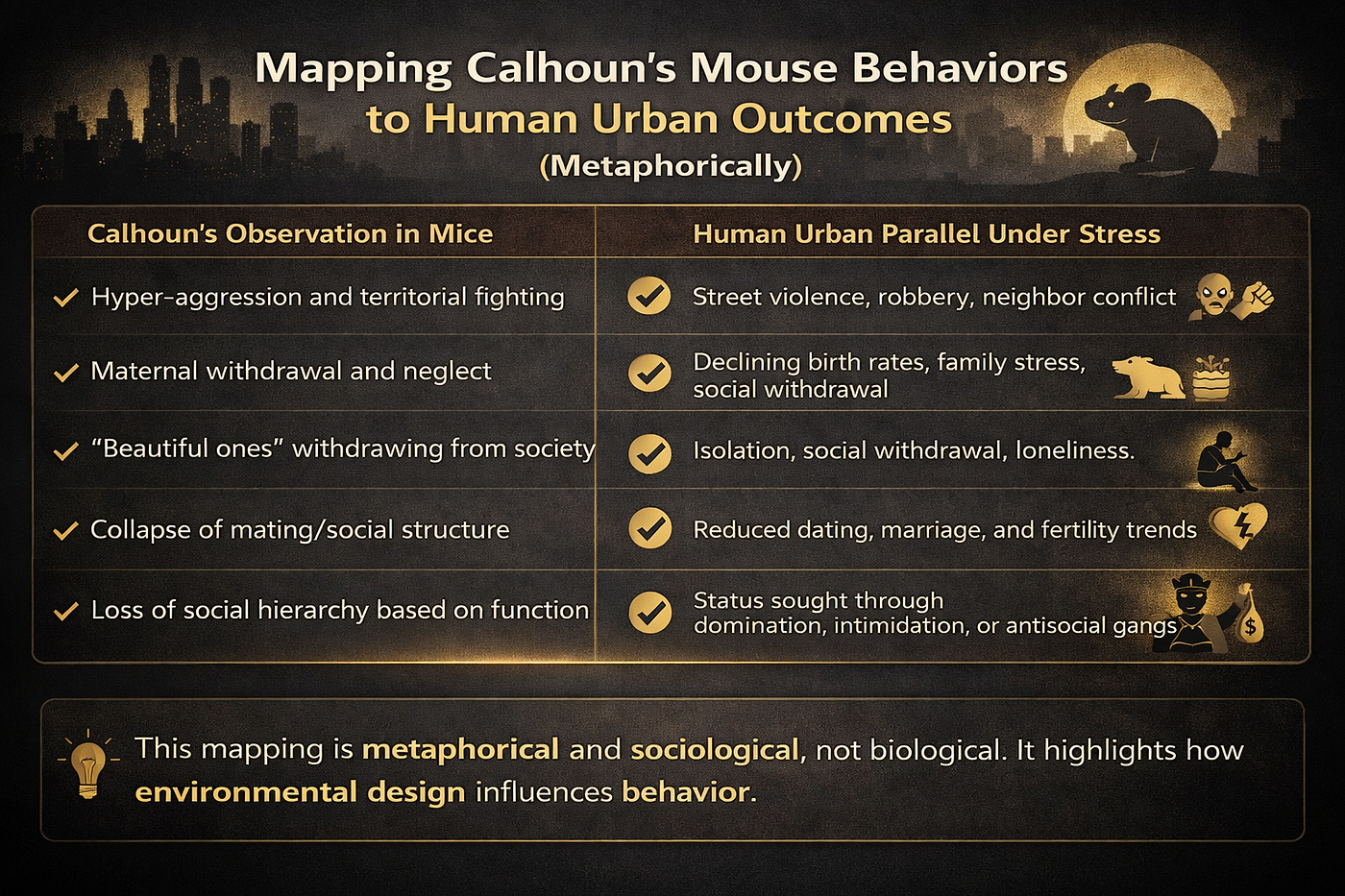
Some hyper-dense urban environments raise parallel questions for urban planners and policymakers. Cities like New York City and San Francisco are often celebrated as models of efficiency and economic productivity.
Yet, when housing design prioritizes unit maximization and profitability over internal quality of life, residents may experience chronic stressors: persistent noise, lack of privacy, social friction with neighbors, and reduced opportunities for restorative space.
Density Without Refuge: Chronic Stress as a Social Variable
Environmental psychology has long shown that lack of personal space, noise exposure, and perceived loss of control elevate stress and reduce prosocial behavior. In such conditions, antisocial patterns — harassment, territorial conflict, social withdrawal, and distrust — can become more common, not because of individual pathology but because of environmental pressure.
In Calhoun’s mice experiments, some individuals became hyper-aggressive, while others withdrew completely — the so-called “beautiful ones.” In human societies, similar patterns may emerge as:
- Withdrawing from in-person relationships and daily social contact.
- Reduced interest in forming long-term relationships or starting families
- Increased conflict, cynicism, or distrust toward institutions and fellow humans
- Greater susceptibility to manipulative or coercive groups — such as cults, gangs, pyramid schemes, or romance scams — that offer a false sense of belonging or status
These behaviors are not rooted in genetics but are adaptive responses to prolonged environmental stress.
Urban Environments Under Chronic Social Pressure
Several modern cities frequently cited in criminology and urban studies for high rates of violent crime and social disorder. These cities differ economically and culturally, yet share environmental characteristics found in Calhoun’s model:
- High residential density in specific zones
- Persistent noise and lack of privacy
- Weak neighbor trust and territorial conflict
- Public spaces where informal social norms break down
- Elevated rates of robbery, assault, and harassment in concentrated areas
These are not signs of moral failure. They are indicators of social environments under prolonged stress.
Different environments, same underlying variable: humans placed under constant spatial and social pressure begin to disengage from healthy social reproduction and trust networks.
Crime as a Symptom of Environmental Design Failure
In cities like Memphis, parts of Oakland, Chicago, Detroit, Baltimore, St. Louis, New Orleans, Philadelphia, and sections of New York, high crime is often analyzed through the lenses of economics, policing, or social policy. However, from an environmental-behavior perspective, it may also indicate the consequences of urban design that compress humans into high-friction, low-purpose environments, where social bonds weaken, stress accumulates, and behavioral collapse becomes more likely.
Areas where urban design has exceeded the human capacity for healthy social regulation.
When density removes privacy and weakens informal trust, people rely less on social norms and more on defensive or aggressive behaviors.
Crime, in this framing, becomes a signal of social systems under environmental strain. Social Fragmentation and the Search for Substitute Belonging.
When everyday urban life erodes informal trust networks, people may seek belonging through alternative structures. In many dense cities worldwide, this can manifest as susceptibility to high-control groups, scams, or predatory social structures that promise status, recognition, or connection to socially isolated individuals.
Transit hubs, dense residential blocks, and highly transient areas often become focal points where lone individuals are more easily targeted.
This reflects a broader issue: when urban design weakens organic social cohesion, artificial structures rush to fill the void.
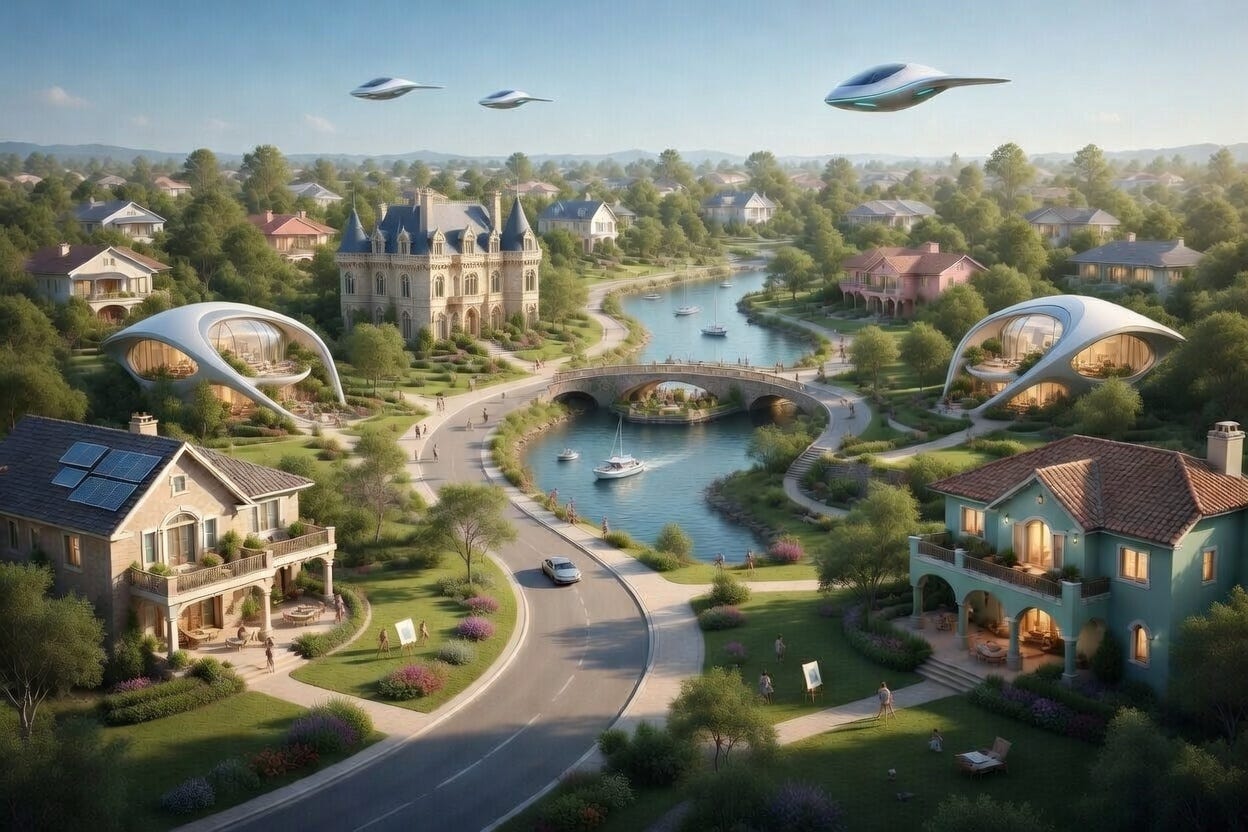
This photo represents a mixed-use block that integrates a community center, café, and children’s playground into a single, spacious environment. Constructed with advanced soundproofing materials and embedded with noise-free autonomous drones, vehicles, and boats, the design ensures seamless accessibility. This advanced ‘circulatory system’ — including a central waterway — keeps the town connected and lively without the friction of traditional urban noise.
Urban design + social infrastructure + economic pathways can reliably lower the conditions that allow crime to grow.
Research across cities shows that places with lower crime tend to combine: visibility, dignity, stability, and connection.
Here’s what that looks like in practice.
1) Eyes on the Street — Natural Surveillance
Jane Jacobs argued that safety comes from ordinary people informally watching public space.
Design for:
- Windows and active fronts facing streets
- Mixed uses (homes, shops, cafés) on the same block
- Good lighting and sightlines
- Walkable streets with steady foot traffic
When streets are populated and visible, opportunistic crime drops.
2) Defensible Space Without Isolation
From Oscar Newman:
Design for:
- Clear boundaries between public, semi-public, and private space
- Small shared courtyards rather than anonymous mega-corridors
- Limited shared entrances (people recognize neighbors)
- Human-scale buildings (avoid long anonymous hallways)
People protect spaces they feel ownership over.
3) Reduce Chronic Environmental Stress
Chronic stress (noise, crowding, lack of privacy) increases conflict.
Design for:
- Acoustic privacy in housing
- Adequate personal space per resident
- Green and restorative spaces within 5 minutes’ walk
- Noise buffers, trees, and airflow
Calmer environments reduce aggression triggers.
4) Opportunities for Purpose and Daily Activity
Idle, disconnected environments correlate with crime.
Design for:
- Local workshops, maker spaces, sports courts
- Public libraries, learning centers
- Easy access to jobs via transit
- Youth activity spaces visible to the community
Purpose and routine reduce antisocial pathways.
5) Community Nodes (Organic Social Contact)
Not forced density — voluntary connection.
Design for:
- Small plazas, benches, shared gardens
- Community kitchens or markets
- Spaces where neighbors casually meet
Trust forms through repeated low-stakes contact.
6) Maintenance and Order (Broken Windows Principle)
From James Q. Wilson and George L. Kelling:
Design for:
- Rapid repair of vandalism
- Clean, well-kept public areas
- Functional lighting, signage, and walkways
Visible neglect signals that no one is in control.
7) Housing Stability
Frequent turnover weakens social bonds.
Design for:
- Long-term leases and ownership pathways
- Family-sized units, not only micro-units
- Policies that prevent constant displacement
Stable neighbors = informal guardianship.
8) Transit and Accessibility
Disconnected areas see higher crime.
Design for:
- Reliable public transit
- Walkability to essentials
- No “dead zones” cut off from the city
Connectivity reduces isolation.
9) Dignity, Agency, and Personal Space
Low-crime environments consistently give residents:
- Personal space
- Privacy
- Autonomy
- A sense that they belong and matter
This reduces both aggression and social withdrawal.
Low crime cities are not the most policed. They are the most watchful, connected, stable, and dignified by design.
Irreversibility and Long-Term Social Effects
One of the most striking observations in John B. Calhoun’s Universe 25 was that mice removed from the “sink” environment often did not resume normal social behavior. The colony’s population initially peaked at approximately 2,200 mice before declining steadily to zero, ultimately going extinct within about five years of the experiment’s start. This illustrates the severe long-term effects of sustained social and environmental stress within the enclosure.
For humans, this suggests a cautionary principle: prolonged exposure to stressful, socially degrading environments may have lasting psychological and behavioral consequences, even after relocation to a better environment or immigration to another country.
This perspective aligns with concerns in countries experiencing:
- Extremely low birth rates
- Rising loneliness and social isolation
- Increased mental health strain in dense metropolitan regions
For example, South Korea has been widely discussed in demographic research for its ultra-low fertility rate and high urban living pressures, prompting questions about how dense housing, city design, a pressuring culture, and population density may contribute to social strain.

A visual metaphor for the delusional hierarchy born from stripped human agency. These figures represent the operators of cults, scams, and organized crime, individuals who commit crimes to ascend an imaginary hierarchy within a collapsing system.
The Case of National Demographic Crime and Stress
South Korea presents a different but related pattern often discussed in urban and demographic research:
- High living-environment density and limited personal space due to urban design and dense apartment living, which can contribute to hyper-vigilance.
- Chronic neighbor friction (e.g., noise, odors, smoking, and lack of boundaries) that has escalated into prolonged conflict or crime (such as tresspassing, aggression, stalking, gender-based violence, and murder) is often reported.
- Stagnation and decline of many densely designed rural areas
- Ongoing High Rates of Gender-Based Crime and Gender Conflicts
- Gender-based crime accounts for the largest proportion of abuse at 53.9%, followed by emotional and physical abuse.
- An ultra-low fertility rate
- Elevated loneliness and social isolation reported in urban surveys
- Mental health strain can increase when individuals rely heavily not only on external validation tied to achievement and social status, but also on emotional dependence on others, often leading to greater substance use, such as alcohol.
- The number of people seeking professional help has surged by nearly 40% over the last five years. Approximately 2.83 million people received treatment for mental disorders (excluding dementia) in the past year.
- High levels of narcotics misuse are sometimes described as a form of sensory shut-off and chemical escape. Estimates for total narcotics misuse, including hidden or unreported cases, range from 2.26 million to 3 million in a population of 51 million.
- There is a significantly visible presence of high-control groups (often labeled as cults) compared to many other countries. Reports have cited estimates ranging from approximately 660,000 to 2–3 million followers across roughly 500 such groups, although exact cross-national comparisons are difficult due to differences in definitions and data collection methods.
- There are also notably high rates of fraud and scam crimes, particularly phone scams (phishing), investment scams, and romance scams that target vulnerable individuals. Roughly 44% of Korean adults encountered a scam in the past 12 months, with 26% (over one in four) becoming actual victims. On average, an individual may encounter up to 56 scam attempts per year, which can contribute to social degradation and mistrust across society.
- By 2023, police investigations and government task forces had identified thousands of victims and trillions of won in unrecoverable deposits, with some individual “Villa King” scam cases involving hundreds of properties held through leverage or proxy ownership. In many cases, buildings were acquired or constructed specifically to enable this scam model.
- Multi-unit housing allowed anonymous ownership, rapid tenant turnover, and believable price narratives that masked debt structures designed to be repaid not by landlords, but by successive tenants. Yet the very normality of the process concealed a pre-engineered financial trap in which the tenant’s deposit functioned as unsecured venture capital.
- Victims were left not only without housing but still responsible for the loans they had taken to assemble their Jeonse deposits. Korean media and advocacy groups documented cases of severe psychological distress and suicides linked to these losses, underscoring that the damage was not merely financial but existential.
- Multi-unit housing made this tactic scalable, repeatable, and harder to detect. In the Jeonse cases across South Korea, the core trick (deposit set near or above true value + layered debt) can happen in a single house. But it becomes a systemic extraction model only in multi-unit buildings. On the scalability and anonymity that multi-unit housing provides. What might be an isolated risk in a single home becomes a repeatable extraction model when dozens of identical units allow deposits to be harvested, circulated, and concealed behind believable price narratives.
The following are common Jeonse scam tactics that exploit multi-unit housing structures.
Tactic 1 — Price inflation before the contract
Using compliant brokers/appraisers, scammers:
- Set an artificially high “market price” for the unit
- Justified a very high Jeonse deposit based on that price
- Created the illusion that the deposit is “safe” because it’s below value
But the true resale/auction value was much lower.
So from day one: Deposit is more than what the house could ever be sold for in a downturn.
Tactic 2 — Using each tenant to buy the next property
This is why some “Villa Kings” held hundreds of units.
Process:
- Tenant A gives ₩300M Jeonse
- That money is used as down payment for next building
- Tenant B funds the next
- No real capital involved
The system only works while prices rise and new tenants keep coming.
It’s structurally Ponzi-like but legally disguised as leasing.
Tactic 3 — Layering mortgages above and below the deposit
Because of how registry priority works, scammers:
- Took mortgages that tenants didn’t fully understand
- Timed loans and contracts to weaken tenant recovery order
- Ensured that in auction, banks get paid first
So even if tenant had legal priority, there was nothing left to recover.
Tactic 4 — Targeting multi-unit buildings
In apartments/villas:
- Same price narrative for all units
- Fast tenant turnover
- Easy to repeat the structure dozens of times
- Hard for tenants to assess true value individually
Scale is what made this devastating.
The outcome is social withdrawal, stress, and demographic collapse. This more closely resembles Calhoun’s “withdrawn mice,” with some observers noting that certain crime patterns may also reflect aspects of the behavioral degradation he described.
Calhoun did not argue that humans would replicate these behaviors biologically. However, the experiment offers a powerful model for examining how overcrowding combined with loss of personal space and social structure can produce predictable social stress outcomes.
Although this case focuses on demographic patterns in South Korea, its crime trends closely resemble those found in highly dense cities in the United States. However, the underlying motivations differ.
In the U.S., crime is more often associated with gang activity or financially driven offenses — such as robbery — or with social dislocation, including loss of purpose linked to homelessness and economic instability.
In contrast, crime in South Korea is more frequently rooted in dense neighborhood conflict and psychosocial pressures, including the pursuit of hierarchical status. In some cases, offenses are driven by psychological instability or delusional motivations related to social hierarchy, which appear to be more prevalent than crimes stemming purely from economic instability — at least as portrayed in the media.
While financial crimes in the media may seem non-violent, the persistent reality of normalized daily physical violence in East Asian societies often stems from a systemic prioritization of “social flow” over individual dignity. As discussed in the critique of a world built solely on efficiency and profit, these cultures frequently treat human beings as mere components of a machine rather than autonomous individuals. In this dystopian environment of normalized, everyday acts of aggression — such as shoulder-bumping, kicking, shoving, pulling, staring, and groping in public transportation and shared public spaces — individuals may attempt to assert dominance over random people, enacting an imagined competition and hierarchy through routine interactions. Such behaviors persist in part because legal enforcement is often insufficient, while society prioritizes keeping systems functioning smoothly at all costs.
Because the system typically ignores psychological and physical force that does not result in “visible disfigurement,” and social pressure discourages victims from making a “scene,” a vacuum is created. In this space, primitive aggression can thrive without consequence, making daily violence more prevalent than in Western societies. Unlike many Western countries, where the threat of immediate retaliation, the unpredictability of showing aggression toward random people, and the strict enforcement of battery laws create a protective “bubble” around the individual, the East Asian environment forces the individual to “numb” constant violations of their personal space. When efficiency becomes the highest virtue, the soul is sacrificed; people stop seeing each other as humans and start seeing each other as obstacles or objects upon which to assert dominance.
Consequently, the result is a society that may appear orderly on the surface but is actually more saturated with daily, inescapable violence than its Western counterparts.
Some individuals may exhibit behaviors that seem confusing or difficult to understand, but these actions can reflect similar underlying motivations to those observed in South Korean crime, such as the pursuit of hierarchical status or social dominance.
Additionally, many financially motivated crimes in South Korea are less physically violent than those often portrayed in U.S. media and instead manifest in more psychologically exploitative forms, such as scams or coercive group dynamics.
When people are stripped of real agency (the ability to actually change their lives), they pivot to imaginary hierarchy and competition. Because U.S. culture is more varied and does not revolve around a single, rigid, unified “script” like those found in some East Asian cultures, when the “American Dream” feels impossible, many people do not try to climb a fake ladder; they simply stop playing the game, resulting in social dislocation or total withdrawal.
The key lesson for urban designers and policymakers is that a city optimized purely for efficiency, throughput, and profitability may unintentionally degrade the human conditions necessary for a stable society.
A sustainable urban environment must include:
- Design for dignity, not unit maximization (limit over-compression of residents)
- Low-friction housing and urban design that guarantees residents the right to a healthy and quiet environment, providing sufficient personal space — not only within their homes but also across the city — featuring legally mandated noise control, proper ventilation, smoke and odor management, and layouts that prevent direct intrusion, as implemented in many developed countries
- Cultural norms that respect privacy and boundaries alongside community life
- Access to sunlight, air flow, and greenery within residential blocks
- Mixed-use neighborhoods where daily needs are walkable without overcrowding
- Clear territorial boundaries between private, semi-private, and public space (reduces neighbor conflict)
- Visible community stewardship (“eyes on the street”) to strengthen informal trust
- Distributed gathering spaces (small courtyards, benches, local plazas) rather than one crowded center
- Opportunities for organic social connection free from forced density and pressuring culture
- Opportunities for purposeful activity (workspaces, maker spaces, learning centers)
- Stable jobs and financial security, giving people direction and meaning in life
- Social services embedded locally (mental health, mediation, community support)
To address mental health strain and a high dependence on external validation tied to achievement and status, the solutions need to operate at three levels: environment, community, and individual resilience.
These same measures also reduce vulnerability to scams and high-control groups, because both prey on isolation, status anxiety, and the need for belonging.
1) Individual Psychological Resilience
- Encouraging purpose through creative work, learning, and meaningful contribution, rather than through status comparisons or hierarchical competition.
- Teaching critical thinking and emotional awareness from an early age
- Normalizing counseling and peer support
- Promoting internal validation (self-worth from competence and values) instead of external validation (rank, salary, prestige)
People who feel purposeful and socially supported are far less susceptible to addiction, scams, high-control groups, or being exploited in relationships, as they are less likely to seek shortcuts to happiness or peace.
2) Environmental / Urban Design
- Quiet, private living spaces that reduce constant stress and hyper-vigilance
- Small, distributed community spaces that allow low-pressure social contact
- Access to nature, sunlight, and walkable neighborhoods
- Local access to counseling and community mediation centers
These reduce baseline stress that makes people psychologically vulnerable.
3) Community and Social Structure
- Public education programs to help individuals recognize and avoid manipulative relationships, scams, and recruitment tactics used by high-control groups.
- Social gatherings and community programs that are not tied to achievement, status, hierarchy, or external validation, and where participants are free from judgment — such as hobby clubs, volunteering, sports, or arts groups
- Many victims noted they felt socially unable to question a landlord’s financial stability, and legally they were not given the information needed to assess it. Registry documents revealed liens but not repayment capacity, effectively asking ordinary renters to perform bank-level due diligence without bank-level data. The system permitted financially fragile or proxy owners to control dozens of units through leverage while transferring nearly all risk onto tenants.
- Preventing such predation requires shifting responsibility upstream: limiting highly leveraged multi-unit ownership, mandating standardized landlord risk disclosure at contract, criminalizing proxy ownership, and teaching basic real estate literacy from an early age so that tenants are not navigating legal complexity alone.
This reduces the need to seek belonging or validation from unhealthy sources.
Key Principle
Drug cartels, abusers, scam operations, and cult recruiters do not primarily target the poor. They target the isolated, stressed, status-anxious, and socially disconnected.
Reducing environmental stress, strengthening community ties, and building internal psychological resilience directly weakens the conditions these groups exploit.
Human Agency as Resistance
In the Universe 25, resources such as food and shelter were abundant, yet social behaviors still deteriorated. Rather than a lack of material needs, the breakdown appeared alongside crowding, social friction, and the disruption of normal roles and interactions within the enclosure.
Metaphorically, this suggests that social degradation in human environments is not caused only by shortages of food or housing, but can also emerge when people experience a loss of purpose, autonomy, and meaningful social roles.
Even within stressful environments, individuals who maintain a sense of purpose through meaningful work, creative output, or technical contribution often demonstrate greater psychological resilience. Purpose, autonomy, and objective achievement can act as stabilizing forces against environmental stress.
This is not merely personal success; it is preservation of agency in environments that otherwise erode it.
Implication for Urban Designers and Policymakers
The lesson from Calhoun’s work is not about mice. It is about limits.
A city or Country optimized only for:
- Unit count
- Economic throughput
- Transit efficiency
- Profit per square meter
may unintentionally create conditions that erode:
- Trust
- Family formation
- Social cohesion
- Psychological well-being
Over time, this manifests either as violence (aggressive response) or withdrawal (demographic collapse).
The behavioral sink is a warning about what happens when living beings are placed in environments that ignore their spatial and social needs.
Resolving these specific issues requires a multi-layered frequency management strategy. Enosichthon has mapped these dependencies in our latest Technical Memorandum.
To request the full Technical Memorandum or to schedule a Strategic Scoping Briefing for your department, please contact:
© 2026 Liin Kim. All rights reserved.
No part of this publication may be reproduced, distributed, or transmitted in any form or by any means without the prior written permission of the author, with the sole exception of brief quotations. All quotations must be accompanied by full and clear credit to Liin Kim and a link back to the original content.
Selected Resources & Theoretical Foundations
1. Biological & Behavioral Foundations
- Calhoun, J. B. (1962). “Population Density and Social Pathology.” Scientific American.
- The foundational study on the “Behavioral Sink,” detailing the collapse of social structures in high-density environments.
- Marsden, H. M. (1972). “Crowding and Animal Behavior.”
- Further analysis on how spatial friction leads to “Inhuman” mutations in social interaction and reproductive failure.
2. Urban Design & Environmental Psychology
- Simmel, G. (1903). “The Metropolis and Mental Life.”
- A classic sociological text on how urban density forces individuals to develop a “blasé outlook” (the “Numbing” effect) to survive sensory overload.
- Newman, O. (1972). “Defensible Space: Crime Prevention Through Urban Design.”
- An analysis of how high-rise, “stacked” architecture destroys human agency and creates “Dead Zones” prone to antisocial behavior.
3. Geopolitics & Modern Socio-Technical Systems
- OECD (2025). “The Economic Impact of Social Isolation and Loneliness.”
- Data linking the “Loneliness Pandemic” to the rise of predatory shadow economies and cult-like engagement in developed nations.
- South Korea Fair Trade Commission (KFTC) & FSS Reports.
- Official data on the proliferation of multi-level marketing (MLM) and “Information Scams” in stagnant rural-dense corridors.
4. Epigenetics & Stress Integration
- Meaney, M. J. (2001). “Maternal Care, Gene Expression, and the Transmission of Individual Differences in Stress Reactivity.”
- Scientific backing for the “Integrated Stress” gene, showing how environmental friction is encoded and passed to the next generation.
메타데이터
- post_id
- bc4bb20b79ec
- slug
- utopia-is-not-built-on-efficiency-and-profit-bc4bb20b79ec
- url
- https://medium.com/@liinkim/utopia-is-not-built-on-efficiency-and-profit-bc4bb20b79ec
- canonical_url
- https://medium.com/@liinkim/utopia-is-not-built-on-efficiency-and-profit-bc4bb20b79ec
- author_url
- https://medium.com/@liinkim
- status
- ok
- fetched_at
- 2026-06-14 13:58:26