Why Most Brow Regret Has Nothing to Do With the Tattoo
After years behind the chair in South Yarra, I have learned that disappointment almost always starts before the first stroke.
Why Most Brow Regret Has Nothing to Do With the Tattoo
Why Most Brow Regret Has Nothing to Do With the Tattoo
After years behind the chair in South Yarra, I have learned that disappointment almost always starts before the first stroke.
A woman sat down in my studio last winter and told me she hated her brows. She had them done somewhere else, eighteen months earlier, and she had spent every morning since trying to cover them with concealer.
She wanted to talk about pigment. About whether the colour was wrong, whether the technique was outdated, whether the practitioner had used the wrong needle.
None of that was the problem. Her brows were technically well executed. Clean strokes, even saturation, no blurring. The issue was that the arch sat about 4 millimetres too far out on both sides, which pulled her whole expression into something faintly surprised. Every time she looked in the mirror, her face was making an expression she had not chosen.
That is what brow regret usually is. Not bad work. A shape decision that nobody slowed down for.
The conversation that happens too late
Most people arrive at a cosmetic tattooing appointment having researched the wrong things. They know the difference between nano brows, ombre brows and feathering. They have watched videos about needle depth. They have read about aftercare.
What they have almost never done is think about shape. They assume shape is something the practitioner handles, the way you assume a hairdresser will handle the parting.
But shape is the only part of this that you have to live with on your face every day for the next year or two. Technique determines how the work looks. Shape determines how you look.
I now spend more time on mapping than on the actual session. Not because it is harder, but because it is the only step that cannot be quietly corrected later.

Shape is a decision, not a default
Shape is a decision, not a default
There is a version of the brow that has dominated Melbourne for about a decade. High arch, sharp tail, strong front. It photographs beautifully. It also does not suit a large number of the faces it ends up on.
When I map a brow, I am working with the brow bone, the eye socket, the distance between the eyes, the shape of the forehead, and where the natural hair actually grows. Then I am working with something less measurable: what this person’s face does when it is relaxed, and what it does when it is animated.
A brow that flatters someone in a still photograph can read as tense the moment they start talking.
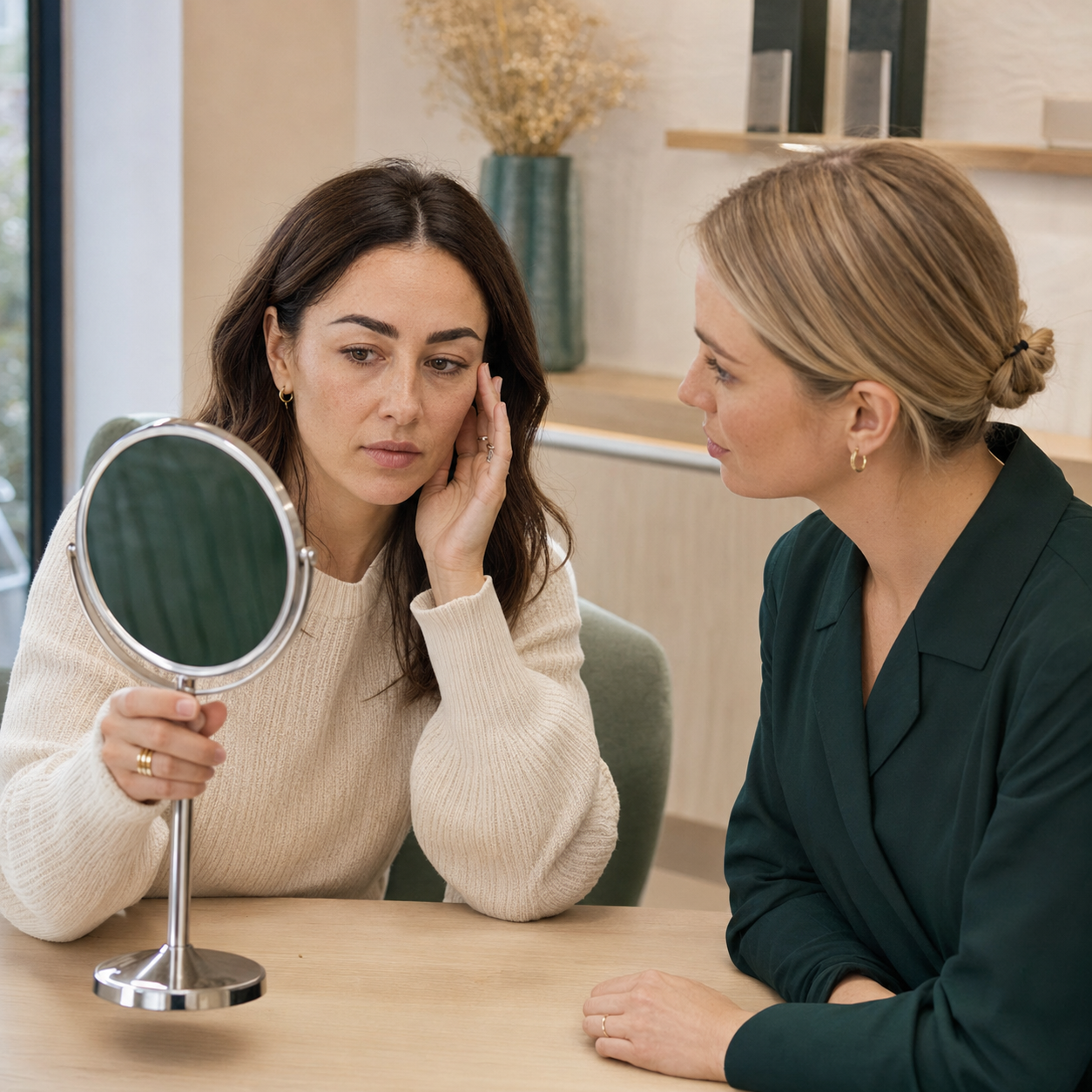
This is why I ask clients to sit up, look at the mapping in a mirror held at arm’s length, then talk to me for a minute while I watch. Almost every meaningful adjustment I make comes from that minute, not from the measurements.
If your practitioner maps you lying flat and shows you the result on a phone screen from above, you have not seen your brows. You have seen a diagram.

Your face is not symmetrical
Your face is not symmetrical, and chasing symmetry makes it worse
Nobody has matching brows. One eyebrow usually sits higher, one arch is usually softer, and one side of the forehead usually carries more movement than the other.
The instinct is to correct all of it. Force both brows onto the same line, same height, same arch point.
The result almost always looks stranger than the asymmetry did, because the rest of the face has not been corrected to match. You end up with two identical brows sitting on an unidentical face, and the eye reads that as wrong without being able to explain why.
What I do instead is bring the two sides into agreement rather than into identity. Same visual weight, same intention, same finishing point. The measurements might differ by 2 or 3 millimetres. Nobody notices the difference. Everybody notices when it is forced.
If a client tells me she wants them perfectly even, I explain this before we start. Some people still want it. That is their call. But they make it knowingly, which is the entire point.
Undertone does more work than the colour you pick
Clients choose from a swatch. Practitioners should be choosing from what the skin will do to that swatch over the next twelve months.
Pigment does not sit on the skin like paint. It settles into tissue that has its own undertone, its own thickness, and its own way of pushing colour around as it softens. A shade that looks correct on the day can drift warmer or cooler depending on what it was mixed into.
This is why the swatch conversation matters far less than the undertone conversation. I would rather spend five minutes looking at the inside of a client’s wrist and the base tone of her natural hair than twenty minutes comparing browns.
The skin you have decides how the work settles
Oily skin does not hold crisp hair strokes the way drier skin does. The strokes soften, spread very slightly, and after a year they can read more like a soft shadow than individual hairs.
That is not a flaw. It is predictable, and it should change the plan.
If a client with genuinely oily skin asks for the finest possible hair strokes, and nobody tells her what that will look like at month ten, she is going to feel let down by a service that did exactly what it was always going to do. In that case a softer ombre or a combination approach usually gives a far more satisfying long-lasting result.
The honest version of this conversation costs a practitioner about three minutes and occasionally costs them the booking. It is still the right conversation.
What to actually do with all of this
If you are booking cosmetic tattooing, the questions worth asking have almost nothing to do with equipment.
Ask how long the mapping takes. Ask whether you will see it sitting upright, in a mirror, before anything begins. Ask what your skin type means for the result at month twelve, not month one. Ask what happens if you look at the mapping and do not like it.
A practitioner who welcomes those questions is a practitioner who has had the uncomfortable conversation before, and would rather have it with you now than in eighteen months.
The woman from last winter came back. We softened the tail, brought the arch in, and let the shape sit closer to where her face already wanted it. It took two sessions and a lot of patience.
She told me the strange part was that nobody could tell what had changed. They just said she looked rested.
That is what a brow is meant to do. Not announce itself. Just let the face get on with it.

PhiBeauty Cosmetic & Laser Clinic
Sarah is a cosmetic tattooing practitioner at PhiBeauty, a beauty studio on Chapel Street in South Yarra, Melbourne. She works across nano brows, ombre brows, feathering, powder brows, microshading and eyeliner tattoo. Bookings and consultations: phibeauty.com.au or 0452 235 811.
메타데이터
- post_id
- bc4ea0ac55a8
- slug
- why-most-brow-regret-has-nothing-to-do-with-the-tattoo-bc4ea0ac55a8
- url
- https://medium.com/@phibeauty/why-most-brow-regret-has-nothing-to-do-with-the-tattoo-bc4ea0ac55a8
- canonical_url
- https://medium.com/@phibeauty/why-most-brow-regret-has-nothing-to-do-with-the-tattoo-bc4ea0ac55a8
- author_url
- https://medium.com/@phibeauty
- status
- ok
- fetched_at
- 2026-08-09 12:08:31