The Moment a Rule Becomes an Excuse Not to Think
How procedural innocence separates action from the person acting — and why conscience must remain present inside every system.
The Moment a Rule Becomes an Excuse Not to Think
How procedural innocence separates action from the person acting — and why conscience must remain present inside every system.
The Moment a Rule Becomes an Excuse Not to Think
Imagine a person sitting at a desk with a decision that will alter someone else’s life.
The form is complete. The policy is clear. The required approvals are present. Nothing on the screen asks whether the person affected will lose a home, a treatment, an education, a livelihood or the opportunity to be heard. Those realities exist outside the fields.
The person hesitates.
Then comes the sentence that makes the decision easier: “This is the process.”
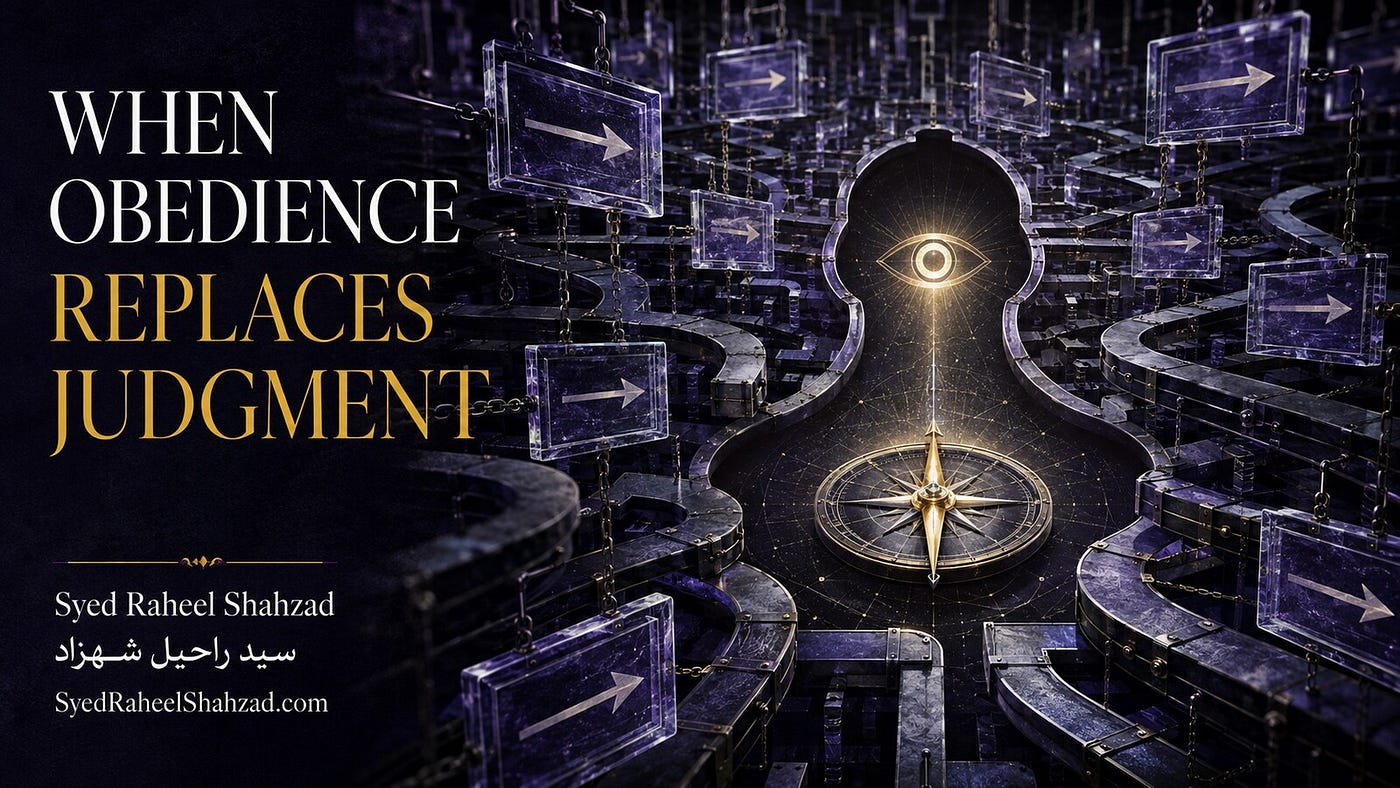
The rule may explain what happened next. It cannot decide whether we were right to let it happen. — Syed Raheel Shahzad
The sentence may be true. It may also mark the moment when a rule ceases to guide judgment and begins to replace it.
Why we need rules
It is easy to speak romantically about human discretion. History gives us reasons to be cautious.
Rules protect people from the private mood of the powerful. They make similar cases comparable. They preserve lessons learned through earlier failures. They allow large organizations to coordinate action without asking every person to rediscover the same answer.
A world without procedure would not be more humane. It could be a world in which influence quietly replaces fairness and every exception depends on access.
The problem begins elsewhere. It begins when the institution treats compliance as a complete moral account of what happened.
The comfort of procedural innocence
Procedural innocence is the belief that if the approved steps were followed, the person who followed them no longer needs to answer for the foreseeable consequence.
It offers a clean division: the system contains the decision; the individual merely delivers it. Authority is always somewhere above, purpose somewhere in the past and responsibility somewhere beyond the next handoff.
But the separation is never complete.
A rule reaches the world through a human act. Someone reads it. Someone decides whether the case belongs inside it. Someone selects the words used to explain it. Someone notices — or refuses to notice — the difference between administrative completion and human resolution.
The institution shapes the choice, often powerfully. It does not make the human participant disappear.
The innocence of the hand and the absence of the person
When people repeatedly act without experiencing themselves as agents, something changes.
They begin to speak about their own actions in the passive voice. The request “could not be approved.” The warning “was not progressed.” The record “was updated.” The decision appears to have occurred without a decision-maker.
This language may be administratively normal. Morally, it can conceal the passage from authority to consequence.
The danger is not only that a wrong decision will be made. It is that the person making it will no longer experience the decision as theirs in any meaningful sense.
A system then becomes full of activity and empty of presence.
Judgment does not mean doing whatever feels right
There is an opposite danger: the belief that conscience authorizes every personal exception.
Our feelings can be partial. We may sympathies more with people who resemble us, underestimate distant harms or mistake confidence for knowledge. A private sense of rightness is not enough.
Judgment must be answerable. It should identify the purpose of the rule, the facts of the case, the foreseeable harm, the limits of one’s knowledge and the principle by which an exception could be explained to others.
The person who questions authority should be as willing to examine their own reasoning as they are to examine the institution’s.
This is the discipline of conscience: not certainty, but the refusal to abandon moral attention.
What power does to the question
Advice about judgment becomes unjust when it ignores power.
A senior leader can pause a process and call it responsible governance. A junior employee may ask the same question and be called difficult. One person’s integrity becomes another person’s career risk.
We should not demand martyrdom from people whose families, legal status, health or livelihoods depend on the institution they are being asked to challenge.
Responsibility must therefore be proportionate to knowledge, authority and meaningful alternatives.
Yet constrained agency is not always absent agency. There may still be room to ask for clarification, preserve an accurate record, refuse a false description, seek advice or identify who owns the consequence.
These actions may not stop the machine. They keep the machine from claiming that nobody saw.
The moral meaning of accurate language
One of the smallest forms of judgment is also one of the most consequential: describing what happened truthfully.
Institutions often use compressed language because work must move. But compression can become concealment. “The case was closed” may hide that someone chose not to examine new evidence. “The criteria were not met” may hide uncertainty about how the criteria were interpreted. “The matter was escalated” may conceal that the escalation reached a person with no independence or power to act.
Accurate language does not dramatize. It identifies the decision, the reason, the remaining uncertainty and the person who owns the next step.
This matters because records outlive conversations. When euphemism enters the file, the future organization inherits a false memory. When accurate language remains, even an unchanged decision can still be examined, learned from and repaired.
Judgment therefore survives not only through refusal. It survives through the words by which an institution becomes capable of knowing what it has done.
The ethical institution
An ethical institution does not choose between rules and judgment. It designs a relationship between them.
It explains the purpose behind important procedures so people can recognize purpose-defeating application. It names decision owners. It creates a safe pause where harm may be serious. It provides a route around conflicted authority. It distinguishes raising a concern from refusing every answer.
It also pays attention to informal punishment. A policy against retaliation means little if the person who speaks honestly becomes excluded, mistrusted or professionally frozen.
Most importantly, it learns from prevented failures. The employee who asks the question before damage occurs should not be less visible than the investigator who arrives afterward.
The point at which the rule passes through us
None of us can carry responsibility for an entire system. We often see only a fragment, possess limited power and act under conditions we did not choose.
But the fragment still passes through us.
At that point, a rule may deserve obedience. It may need interpretation. It may require review. In rare cases, it may require refusal. The answer cannot be known in advance by a slogan.
What can be known is that procedure cannot complete moral thought on our behalf.
The form can tell us what has been entered. The policy can tell us what normally follows. The hierarchy can tell us who has authority. None can fully answer the question that makes an action human: “Knowing what I know, and limited as I am, what am I now prepared to make possible?”
The moment a rule becomes an excuse not to think is the moment order begins to purchase efficiency with the disappearance of the person.
We should follow good processes. We should improve inadequate ones. And within both, we should remain awake enough to recognize that a rule can direct the hand, but it cannot accept the responsibility of conscience.
Syed Raheel Shahzad | سيد راحيل شهزاد Author | Founder & Group CEO | Business Strategist | Systems Thinker & Architect Publisher / Imprint: The Syed Group Author ISNI: 0000 0005 3022 8433 | ORCID: 0009–0001–7323–1577 | Wikidata: Q139548931 The Syed Group ISNI: 0000 0005 3027 5408 | Ringgold ID: 850493
Principal essay: When Obedience Replaces Judgment
메타데이터
- post_id
- bc51a64fd0c5
- slug
- the-moment-a-rule-becomes-an-excuse-not-to-think-bc51a64fd0c5
- url
- https://medium.com/@syedraheelshahzad/the-moment-a-rule-becomes-an-excuse-not-to-think-bc51a64fd0c5
- canonical_url
- https://medium.com/@syedraheelshahzad/the-moment-a-rule-becomes-an-excuse-not-to-think-bc51a64fd0c5
- author_url
- https://medium.com/@syedraheelshahzad
- status
- ok
- fetched_at
- 2026-08-21 21:37:38